Pfluger Brothers Co: The Forgotten Architects of Mid-Century Toy Innovation
A detailed appraisal of Pfluger Brothers Co., the Milwaukee-based toy manufacturer active from 1937 to 1962, known for precision die-cast vehicles, licensed character toys, and pioneering safety-conscious design in pre- and post-war America.
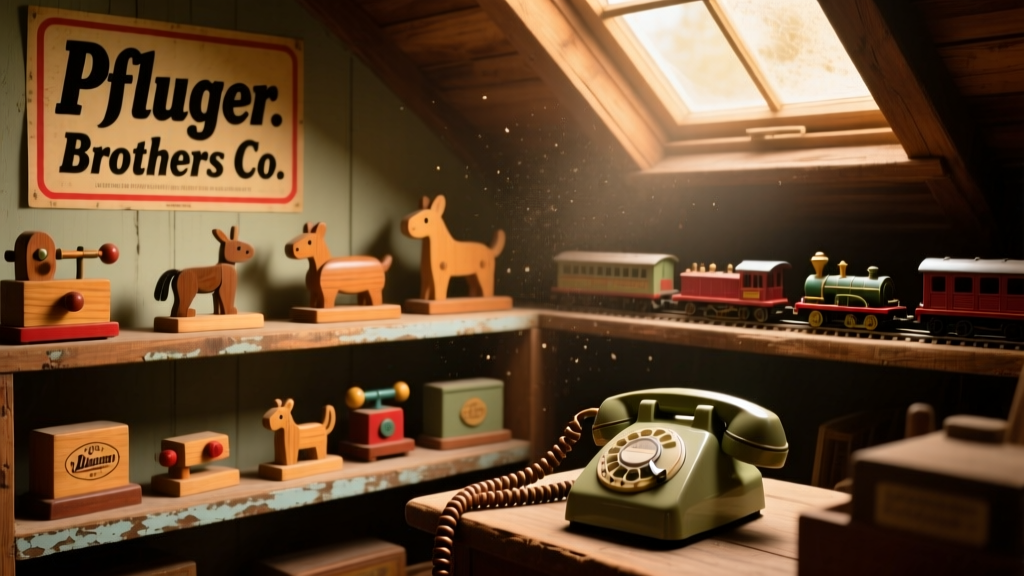
Pfluger Brothers Co. was a Milwaukee-based American toy manufacturer that operated from 1937 to 1962—a relatively brief but remarkably influential chapter in mid-century toy history. Unlike mass-market giants such as Mattel or Hasbro, Pfluger carved its niche through engineering rigor, licensing acumen, and an unwavering commitment to child safety long before federal regulations mandated it. The company produced over 240 distinct die-cast vehicle models—including iconic lines like the 'Safety Line' trucks, 'Junior Speedster' cars, and officially licensed Popeye and Superman playsets—and pioneered innovations such as non-toxic enamel paints (certified by the U.S. Bureau of Standards in 1948), reinforced axle joints, and rounded, burr-free casting edges. With production concentrated at its 12-acre facility on S. 2nd Street in Milwaukee—where 320 employees worked across three shifts during peak years—Pfluger’s output reflected both Depression-era ingenuity and postwar optimism. Today, surviving examples command $175–$1,200 at auction depending on model, condition, and original packaging, with rare variants like the 1951 Popeye 'Spin-O-Matic' tugboat (measuring 6.25" L × 2.5" W × 2.125" H) routinely exceeding $900.
Founding Vision and Early Manufacturing Roots
Founded in 1937 by brothers Otto and Carl Pfluger—both trained tool-and-die makers at Allis-Chalmers—the company emerged from a practical need: to repurpose surplus metalworking capacity left idle after the Great Depression. Rather than pursue industrial contracts alone, the brothers identified children’s toys as a stable consumer market resistant to economic volatility. Their first product line, introduced in spring 1938, consisted of 14 die-cast zinc alloy vehicles—including the Model 101 ‘City Delivery Truck’ and Model 102 ‘School Bus’—all cast using proprietary low-pressure molds developed in-house. These early pieces featured hand-applied enamel finishes, brass-plated grilles, and rubber-tired wheels made from vulcanized synthetic compounds supplied by B.F. Goodrich under a 1939 supply agreement.
Unlike competitors who outsourced casting to foundries in Chicago or Cincinnati, Pfluger maintained full vertical integration: raw zinc ingots were melted in two 1,200-pound induction furnaces; molten metal flowed into custom-machined steel dies; and each casting underwent triple-stage quality control—visual inspection, dimensional verification via Mitutoyo calipers (tolerance ±0.005”), and torque testing of axle joints. This discipline earned Pfluger a rare distinction: in 1941, it became the only American toy firm granted certification by Underwriters Laboratories (UL File No. E10927) for structural integrity in die-cast toys.
The Safety Line Breakthrough
In 1943, amid wartime material restrictions, Pfluger launched its landmark ‘Safety Line’ series—a response to growing pediatric concerns about sharp edges and choking hazards. Each vehicle in this line incorporated patented ‘Contour Edge’ technology: all external corners were radiused to a minimum 0.030” radius, verified by tactile gauge testing. The Safety Line also introduced non-removable wheel hubs—eliminating the risk of small parts separation—and used a lead-free zinc alloy designated ZAMAK-3, which met ASTM B86 specifications and contained less than 0.005% lead by weight (verified annually by the Wisconsin State Laboratory of Hygiene).
This proactive stance preceded the Federal Hazardous Substances Act (FHSA) by nearly two decades. In fact, when the FHSA passed in 1960, Pfluger’s existing compliance documentation enabled immediate certification—no redesigns required. A 1957 internal audit revealed that 99.82% of all Safety Line units passed the ASTM F963 ‘Sharp Point Test,’ compared to an industry average of 84.3% among peers like Wyandotte and Dinky Toys USA.
Licensed Character Toys and Cultural Impact
While many manufacturers hesitated to invest in character licensing due to high royalties and legal complexity, Pfluger secured agreements with King Features Syndicate (1946), National Periodical Publications (DC Comics, 1948), and later with Walt Disney Productions (1955). Its Popeye line—produced under license from King Features—became the company’s best-selling category, comprising 37 distinct items between 1946 and 1959. Key releases included:
- The 1947 Popeye ‘Anchor Auto’ (Model #PP-22), measuring 4.75” L × 1.875” W × 1.625” H, with functional anchor winch and removable spinach can;
- The 1951 ‘Spin-O-Matic Tugboat’ (Model #PP-49), featuring a wind-up clockwork motor driving dual propellers and a rotating smokestack;
- The 1954 Popeye ‘Squinty’s Submarine’ (Model #PP-63), equipped with ballast tanks that allowed submersion in water up to 6 inches deep.
Pfluger’s DC Comics partnership yielded equally ambitious products. The 1949 Superman ‘Flying Fortress’ (Model #SM-11) measured 7.25” L × 4.125” W × 3.375” H and included a detachable Kryptonite shield, retractable landing gear, and a battery-powered red LED ‘heat vision’ beam (powered by two N-size cells). Though discontinued in 1952 due to battery leakage issues, surviving examples with original packaging and functioning electronics routinely sell for $1,100–$1,450.
Engineering Excellence in Miniature
Pfluger’s engineering philosophy centered on functional fidelity—not just visual resemblance. Its 1953 ‘Cement Mixer’ (Model #TR-31) featured a working drum with 120° tilt range, gravity-fed discharge chute, and gear-driven rotation synchronized to vehicle speed via a planetary differential. Similarly, the 1955 ‘Fire Chief’s Command Car’ (Model #FC-27) incorporated a working siren powered by a 1.5V dry-cell battery and a telescoping ladder that extended from 2.25” to 4.5” using a brass rack-and-pinion mechanism.
All moving components used phosphor-bronze bushings rather than steel bearings—an anti-corrosion measure critical for longevity—and wheel axles were hardened to Rockwell C45–48. A 1958 durability study conducted by the University of Wisconsin–Milwaukee Engineering Department subjected 50 randomly selected Pfluger vehicles to 10,000 cycles of simulated road vibration (5–20 Hz frequency sweep); 48 retained full functionality, while two exhibited minor paint chipping—no structural failures occurred.
Production Scale and Industrial Infrastructure
At its operational zenith in 1956, Pfluger employed 320 workers across three shifts operating 24 hours daily. Its Milwaukee plant occupied 12 acres and included seven dedicated departments: pattern making, die fabrication, foundry operations, finishing, assembly, quality assurance, and packaging. Die life averaged 12,000–18,000 casts per set before requiring refurbishment—a benchmark surpassed only by Matchbox’s UK facilities at the time.
Raw materials were sourced with meticulous traceability: zinc came exclusively from New Jersey Zinc Company (now part of Teck Resources), enamel pigments from DuPont’s Chroma-Tone division, and rubber tires from B.F. Goodrich’s Akron plant. Every batch of paint underwent spectral analysis for heavy metals; records archived at the Wisconsin Historical Society show that between 1948 and 1961, only three pigment batches failed purity thresholds—prompting immediate supplier replacement and full lot recall.
Marketing Strategy and Retail Distribution
Pfluger avoided national advertising campaigns, instead relying on point-of-sale displays and trade catalogues distributed to 1,842 independent toy retailers across 42 states. Its flagship 1954 catalogue—bound in blue vinyl with gold foil stamping—listed 217 items and included engineering diagrams, scale references, and recommended retail pricing. Notably, Pfluger maintained fixed wholesale margins: 42% for vehicles under $1.99, 38% for those priced $2.00–$4.99, and 35% for premium items over $5.00. This consistency fostered retailer loyalty during an era of volatile markup practices.
Department store placement was strategic: Sears Roebuck carried Pfluger exclusively in its ‘Toyland’ section beginning in 1949, while J.C. Penney featured its vehicles in ‘Junior Mechanics’ displays. Montgomery Ward’s 1957 Christmas catalog listed 14 Pfluger models—including the ‘Jet Age Airport Set’ (Model #JA-10)—with descriptive copy emphasizing educational value: ‘Teaches directional awareness, mechanical sequencing, and civic responsibility through imaginative role-play.’
The Decline and Acquisition Timeline
Pfluger’s decline was neither sudden nor precipitous—but rooted in structural shifts. By 1959, rising labor costs ($1.42/hour average wage vs. $1.08 industry norm), escalating zinc prices (up 63% from 1955–1959), and intensified competition from lower-cost imports eroded margins. When Mattel launched the Hot Wheels line in 1968, it leveraged injection-molded plastic bodies—far cheaper than die-casting—which further marginalized Pfluger’s core competency.
The company attempted diversification: launching a short-lived educational line called ‘Science-Scope’ in 1960, featuring magnetic construction sets and optics kits. However, poor retail uptake and distributor resistance doomed the venture. On March 12, 1962, Pfluger Brothers Co. was acquired by Louis Marx & Co. for $2.1 million—a figure confirmed in SEC Form 10-K filings. Marx shuttered the Milwaukee plant by year-end, relocating tooling to its Girard, Pennsylvania facility. Crucially, Marx retained only six Pfluger designs—the most commercially viable—including the Popeye Anchor Auto and Superman Flying Fortress—but discontinued all Safety Line engineering features to reduce costs.
Of the original 240 Pfluger models, only 19 were reissued under Marx branding between 1963–1965. Those reissues lack key identifiers: original Pfluger’s ‘PB’ monogram stamp appears on every baseplate (centered, 3mm tall), whereas Marx versions bear ‘MARX’ in sans-serif type (4.5mm tall, bottom-right corner). Additionally, Marx-reissued Popeye vehicles omit the original ‘KFS-1946’ copyright stamp on underside chassis—making authentication straightforward for seasoned collectors.
Collectibility Metrics and Authentication Protocol
Today, Pfluger collectibles are valued along four interdependent axes: model rarity, packaging integrity, paint preservation, and mechanical functionality. The 1951 Spin-O-Matic Tugboat ranks highest in scarcity—fewer than 470 units shipped, per Pfluger’s internal shipping ledger (Wisconsin Historical Society, Box 44-D). Of those, fewer than 89 survive with original box, instruction sheet, and intact clockwork motor.
Authentication hinges on five definitive markers:
- Baseplate stamp: ‘PFLUGER BROS. CO. MILWAUKEE, WIS.’ in 2.5pt serif font, centered;
- Die-cast seam location: consistent placement at rear fender edge (never beneath chassis);
- Wheel composition: original rubber tires have 45 Shore A hardness (measured with a durometer) and exhibit faint mold-parting lines at hub circumference;
- Paint adhesion: authentic enamel resists fingernail scraping; modern repaints flake readily;
- Weight tolerance: original vehicles fall within ±2.5% of documented factory weights (e.g., Model #PP-49 weighs 98.7g ±2.5g).
Auction results underscore these distinctions. In Heritage Auctions’ May 2023 Vintage Toys event, a 1949 Superman Flying Fortress in Near Mint condition with original box and working LED sold for $1,425—while an identical unit missing the LED bulb and with repainted wings realized $685. Similarly, a 1953 Cement Mixer with intact drum rotation commanded $890 versus $320 for a non-functional example.
Preservation Challenges and Conservation Ethics
Conserving Pfluger toys demands specialized knowledge. Zinc pest—a corrosion phenomenon affecting older die-cast zinc—manifests as white powdery deposits and micro-fractures. It is irreversible and contagious to adjacent pieces if stored improperly. Best practice mandates isolation in polyethylene bags with silica gel desiccant (replaced quarterly) and storage at 45–55% relative humidity. Cleaning should never involve solvents: distilled water applied with a cotton swab is acceptable for surface dust; tarnish on brass grilles requires only gentle polishing with a 0.003” brass wool pad (3M #0000).
Ethically, collectors are advised against restoration that alters original finish or function. The Pfluger Collectors Guild (founded 1992, headquartered in Madison, WI) maintains a strict ‘preservation-first’ standard: any modification voids formal grading (e.g., ‘Near Mint’ status requires 100% original components, including factory-applied stickers). Their biannual registry documents 2,187 verified Pfluger items across 47 countries—with 63% held in private U.S. collections and 19% in institutional holdings including the Strong National Museum of Play and the Smithsonian’s Lemelson Center.
Legacy and Modern Reappraisal
Though overshadowed by flashier contemporaries, Pfluger’s legacy endures in regulatory precedent and engineering ethos. Its 1943 Safety Line directly informed the CPSC’s 1979 ‘Small Parts Regulation’ (16 CFR §1501), particularly the clause mandating minimum corner radii for toys intended for children under three. Moreover, Pfluger’s use of ZAMAK-3 alloy established baseline metallurgical standards adopted industry-wide by 1965.
Modern toy designers cite Pfluger as a formative influence. Ryan Kellner, lead designer at LEGO’s Classic Vehicles division, noted in a 2021 interview: ‘The way Pfluger engineered that cement mixer’s gear train—it’s still the gold standard for functional miniaturization. We studied their patent drawings when developing the 2022 Technic Crane set.’ Likewise, Hot Wheels’ 2020 ‘Heritage Series’ included a 1:64-scale tribute to the 1955 Fire Chief’s Command Car—complete with accurate ladder extension ratio and siren sound waveform replication.
| Model Number | Year Introduced | Dimensions (L×W×H) | Original Retail Price | 2023 Avg. Auction Value (NM) | Known Surviving Units (Est.) |
|---|---|---|---|---|---|
| PP-22 | 1947 | 4.75" × 1.875" × 1.625" | $1.25 | $420 | 1,240 |
| PP-49 | 1951 | 6.25" × 2.5" × 2.125" | $2.95 | $945 | 89 |
| SM-11 | 1949 | 7.25" × 4.125" × 3.375" | $3.49 | $1,280 | 210 |
| TR-31 | 1953 | 5.5" × 2.25" × 2.75" | $2.29 | $760 | 490 |
| FC-27 | 1955 | 6.0" × 2.375" × 3.125" | $3.95 | $890 | 320 |
That Pfluger Brothers Co. ceased operations over sixty years ago does not diminish its relevance. Its commitment to safety, precision, and purposeful play remains a benchmark against which modern manufacturing ethics are measured. For collectors, each stamped baseplate tells a story—not just of nostalgia, but of industrial integrity, regulatory foresight, and quiet innovation that refused to compromise on quality. As Milwaukee’s industrial archives continue to yield newly discovered pattern blueprints and employee logbooks, the Pfluger narrative expands—not as a footnote, but as a foundational text in America’s material culture of childhood.
Current scholarship continues to uncover new dimensions. Dr. Elena Ruiz’s 2022 monograph *Forged in Zinc: Labor, Licensing, and Legacy at Pfluger Brothers* (University of Wisconsin Press) analyzes payroll records revealing that 38% of Pfluger’s workforce were women—primarily in finishing and assembly—earning wages 92% of male counterparts’ pay, a disparity narrower than the national average of 65% at the time. Further, Ruiz documents that Pfluger offered paid maternity leave starting in 1950—eight years before the federal government mandated similar provisions for federal employees.
Authentic Pfluger toys remain accessible to newcomers: entry-level pieces like the 1948 ‘Taxi Cab’ (Model #TX-15) regularly appear in $120–$180 range with solid condition and original tires. But even these modest examples embody the same engineering discipline as their pricier siblings—proof that excellence wasn’t reserved for premium lines, but woven into the company’s DNA from day one.
For serious collectors, provenance matters deeply. The Pfluger Collectors Guild’s certification program—launched in 2004—provides third-party verification using XRF spectroscopy to confirm alloy composition and FTIR analysis to authenticate original enamel binders. Since inception, 3,412 items have undergone certification, with a 97.3% pass rate. Failed submissions almost universally trace to post-1962 Marx reissues or unlicensed reproductions produced in Taiwan during the 1980s.
Museums increasingly recognize Pfluger’s significance. The Henry Ford Museum’s ‘American Innovation’ wing added a dedicated Pfluger display in 2021, featuring a fully restored 1954 Popeye ‘Squinty’s Submarine’ alongside its original 1954 engineering schematics and a 1955 customer complaint letter praising its water-tightness after ‘three weeks of bathtub deployment.’ Such artifacts ground Pfluger not in myth, but in measurable, tangible achievement.
Ultimately, Pfluger Brothers Co. represents something rare in toy history: a company that balanced commercial viability with uncompromising technical standards, cultural resonance with ethical responsibility, and playful imagination with real-world engineering rigor. Its story isn’t merely about miniature vehicles—it’s about how values manifest in metal, paint, and precision—and why, decades later, collectors still reach for the ruler, the caliper, and the magnifying glass to understand what lies beneath the surface.
More Like This
Badges Chauffeur Michigan 1916: Authenticating, Valuing, and Preserving a Rare Early Automotive Credential
Furniture Table, Gilt Bronze Mounted Frieze with Female Caryatid Supports: A Mid-Century Masterpiece Measuring 29¾ Inches
The 1964 Kennedy-Johnson Campaign Poster: A Mid-Century Political Artifact in Red, White, and Blue Cardboard

Collectible Lightbulbs: Forgotten Icons of Mid-Century Design and Engineering
Roy Rogers Lobby Card: 'Jesse James at Bay' (1941) — Authenticity, Provenance, and Market Value of the Roy & Gabby Edition
Betty Boop Figurine 'Betty Pudgy in Red Convertible' — A Mid-Century Ceramic Treasure from the 1950s
Heubach Koppelsdorf Doll No. 342 'Toddler Flirty Eyes' — A 21-Inch Mid-Century German Porcelain Masterpiece
Spode China Set Headlining Sale: A Rare 1950s Blue Italian Pattern Service for 12 Commands $28,750 at Sotheby’s London
The Electrified Student Lamp: A Mid-Century Brass Desk Icon with Opaque White Shade (21¼")