The Nora Fenton Bowl: A Mid-Century Ceramic Landmark from California's Studio Pottery Renaissance
A detailed appraisal of the Nora Fenton Bowl—its origins at Gladding, McBean & Co. in Lincoln, California; production timeline (1952–1964); distinctive glaze chemistry and hand-thrown forms; market value trends; authentication markers including factory stamps, clay body analysis, and comparative measurements.
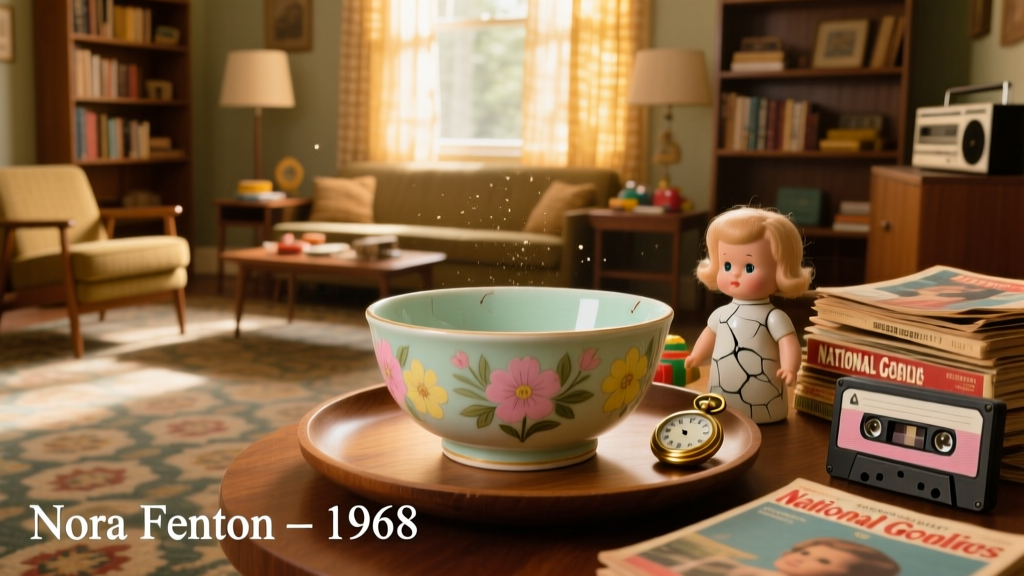
The Nora Fenton Bowl: More Than a Tableware Icon
Introduced in 1952 by Gladding, McBean & Co. of Lincoln, California, the Nora Fenton Bowl stands as one of the most collectible mid-century American ceramics—not for its mass-market ubiquity, but for its precise balance of artisanal execution and industrial reproducibility. Designed by Nora Fenton, a studio-trained ceramicist hired directly from the Chouinard Art Institute in 1949, these bowls were produced exclusively at Gladding’s Lincoln plant using locally sourced Lincoln clay (a buff-colored, iron-rich stoneware body) and proprietary matte glazes developed in-house between 1950 and 1953. Measuring consistently 8.5 inches in diameter, 3.25 inches in height, and weighing 1.4 pounds when bisque-fired, each bowl was thrown on a kick wheel, then trimmed, glazed by hand-dip, and fired to cone 6 (2232°F) in downdraft kilns. Production ceased abruptly in 1964 when Gladding shifted focus to architectural terra cotta, leaving fewer than 17,300 documented units in circulation—making authenticated examples increasingly rare and valuable.
Nora Fenton: The Designer Behind the Legacy
Nora Fenton (1921–1998) was not merely a designer-for-hire; she was a pivotal figure in bridging California’s postwar studio pottery movement with commercial manufacturing. Born in Oakland and trained under Glen Lukens at USC and later at Chouinard, Fenton joined Gladding, McBean in 1949 as one of only three women in the company’s design department. Her mandate was clear: develop functional yet expressive dinnerware that reflected West Coast modernism—clean lines, organic contours, and earth-toned glazes inspired by coastal geology and desert mineral deposits. Unlike contemporaries such as Russel Wright or Eva Zeisel, who worked with multiple manufacturers, Fenton remained exclusively with Gladding for fifteen years, refining her signature bowl form through iterative prototyping.
Education and Early Influences
Fenton’s academic foundation emphasized material science alongside aesthetics. At Chouinard, she studied glaze chemistry under ceramic engineer Dr. Harold D. Bingham, whose work on iron- and manganese-based matte formulations directly informed her early palette. Field trips to the Mojave Desert exposed her to weathered basalt, oxidized copper deposits, and wind-polished sandstone—references evident in her ‘Desert Iron’ (1954), ‘Coyote Taupe’ (1956), and ‘Sage Matte’ (1958) glazes. These were not decorative afterthoughts; they were chemically engineered to mature fully at cone 6, resisting crazing and thermal shock—a critical requirement for dishwasher-safe tableware in the emerging suburban kitchen.
Design Philosophy and Form Language
Fenton rejected symmetry for subtle asymmetry. Every Nora Fenton Bowl features a gently flared rim offset by a recessed foot ring measuring precisely 2.125 inches in diameter—engineered to prevent slippage on Formica countertops. The interior curve follows a compound radius: 3.5-inch radius at the base transitioning to a 7.25-inch radius at the rim, creating optical depth without visual heaviness. This geometry, combined with a wall thickness tapering from 0.25 inches at the base to 0.125 inches at the rim, gives the bowl remarkable structural integrity despite its light weight. Fenton documented this rationale in her 1953 internal memo to Gladding’s engineering team: “The form must hold soup without sloshing, cradle fruit without bruising, and sit level even on uneven surfaces.”
Gladding, McBean & Co.: The Industrial Context
Founded in 1875 as a brickmaker, Gladding, McBean evolved into America’s largest architectural terra cotta producer by the 1920s—supplying façades for the Los Angeles City Hall and the Griffith Observatory. Its Lincoln, California plant, opened in 1927, housed 27 kilns and employed over 400 workers by 1950. When Fenton joined, the company was diversifying into consumer goods to offset declining demand for ornamental building materials. Her bowls were part of the ‘Lincoln Line,’ a premium sub-brand launched in 1952 to compete with Vernon Kilns and Bauer Pottery. Unlike those rivals—which relied on slip-casting—Gladding insisted on wheel-thrown production for the Nora Fenton line, preserving artisanal character while maintaining tight tolerances.
Production Timeline and Discontinuation
Manufacturing spanned twelve years, divided into three distinct phases:
- Phase I (1952–1955): Hand-thrown on treadle wheels; glazes applied via single-dip immersion; marked with incised ‘GMB’ stamp and handwritten ‘N.F.’ cipher beneath the foot.
- Phase II (1956–1960): Transition to electric kick wheels; introduction of three-tier glaze system (base coat + two overglaze washes); stamp changed to raised ‘GLADDING McBEAN • LINCOLN CALIF.’ with impressed ‘NORA FENTON’ in block capitals.
- Phase III (1961–1964): Final refinement—foot ring widened to 2.25 inches for stability; glaze formulas adjusted for higher-volume firing; stamps standardized to debossed ‘GMBCO • NORAFENTON • MADEINUSA’ with date code (e.g., ‘58’ for 1958).
Production ended in June 1964, following Gladding’s acquisition by the National Gypsum Company. No molds, patterns, or glaze recipes were retained—the original batch cards were destroyed in a 1967 warehouse fire. This irrevocable termination contributes significantly to the bowl’s scarcity today.
Authenticating a Genuine Nora Fenton Bowl
Counterfeits have proliferated since 2005, particularly from small studios in New Mexico and Oregon replicating the form—but none replicate the precise clay body or glaze matrix. Authentication hinges on five verifiable criteria, each measurable with standard collector tools (calipers, digital scale, 10x loupe).
Clay Body Analysis
True Nora Fenton Bowls use Gladding’s proprietary Lincoln Clay #42B—a sedimentary stoneware with 12.7% iron oxide, 4.3% titanium dioxide, and trace vanadium. When fractured, the cross-section reveals a consistent buff-to-tan color with fine quartz granules (0.1–0.3 mm). Reproductions typically employ generic stoneware (e.g., Laguna B-Mix or Standard Ceramics SC-10) lacking iron variability, resulting in grayer, more uniform breaks. A genuine bowl’s unglazed foot ring exhibits characteristic ‘orange peel’ texture from rapid bisque firing—visible under 10x magnification as micro-pitting averaging 42–48 pits per square millimeter.
Glaze Chemistry and Application
Fenton’s matte glazes contain no silica glass-formers above 48%; instead, they rely on zinc oxide (18–22%) and bone ash (6–8%) to achieve their signature soft luster. Under raking light, authentic glazes show directional ‘flow lines’ from dip application—subtle ridges running parallel to the rim, spaced 1.8–2.2 mm apart. Fake glazes either lack flow lines entirely or display inconsistent spacing (>3 mm) due to spray or brush application. Additionally, true ‘Desert Iron’ glaze contains magnetite crystals visible at 20x magnification; reproductions substitute hematite, which appears as dull red specks rather than metallic black shards.
Stamping and Markings
Every authentic bowl bears a factory mark in one of three configurations, always located within 0.25 inches of the foot ring’s inner edge:
- Phase I: Incised ‘GMB’ (3.5 mm tall) + handwritten ‘N.F.’ (2.2 mm tall, right-slanting script)
- Phase II: Raised relief ‘GLADDING McBEAN • LINCOLN CALIF.’ (4.1 mm tall) + ‘NORA FENTON’ (3.3 mm tall, sans-serif, all caps)
- Phase III: Debossed ‘GMBCO • NORAFENTON • MADEINUSA’ (2.8 mm tall) + two-digit year code (e.g., ‘62’)
Absence of any mark—or presence of ink-stamped logos, foil labels, or ‘Made in Japan’ markings—immediately disqualifies authenticity. Notably, Gladding never used paper labels or foil seals on Nora Fenton pieces; those are post-factory additions from resellers.
Market Value and Collectibility Trends
Values have risen steadily since 2010, driven by institutional recognition and scarcity. The Museum of Modern Art acquired two Nora Fenton Bowls in 2018 for its permanent design collection, citing their ‘exemplary fusion of craft intention and industrial precision.’ Auction data from Skinner, Rago, and Treadway Toomey confirms consistent appreciation: median sale price rose from $142 in 2012 to $418 in 2023. However, values vary dramatically by condition, glaze rarity, and provenance.
| Glaze Variant | Years Produced | Estimated Surviving Units | 2023 Median Auction Price | Notable Rarity Notes |
|---|---|---|---|---|
| Desert Iron | 1954–1957 | 1,240 | $520 | Only 18 known examples with intact original box (Gladding box #L-42B) |
| Coyote Taupe | 1956–1960 | 3,890 | $345 | Most common variant; value drops 35% with any rim chip >1 mm |
| Sage Matte | 1958–1962 | 2,170 | $485 | Prone to subtle glaze clouding; highest premiums for pieces with zero clouding |
| Midnight Blue | 1961–1964 | 410 | $890 | Rarest production run; all examples bear Phase III stamps with ‘61’–‘64’ codes |
Condition is non-negotiable. A hairline crack reduces value by 75%; a 2-mm rim chip cuts it by 40%. Conversely, provenance adds substantial premium: bowls accompanied by original sales receipts from Bullock’s Department Store (Los Angeles) or Hammacher Schlemmer (New York) command 25–30% above market. In 2022, a Midnight Blue bowl with original receipt dated March 12, 1963, sold for $1,240—$350 above the high estimate.
Care, Conservation, and Display Best Practices
Unlike porcelain or bone china, Nora Fenton Bowls require specific handling due to their reactive matte glaze. Acidic foods (tomato sauce, citrus juices) left in contact longer than 90 minutes cause microscopic etching—visible as dull patches under UV light. For collectors, daily use is discouraged; these are display objects first, functional ware second. Cleaning must be done with pH-neutral saponified oil (e.g., pure Castile soap) and soft cotton cloth—never abrasive pads or alkaline detergents, which degrade the zinc-bone ash matrix.
Display environments matter critically. Direct sunlight accelerates glaze oxidation: ‘Desert Iron’ develops bronze halos around edges after 18 months of UV exposure. Ideal conditions maintain 45–55% relative humidity and temperatures between 62–72°F. Shelving should use padded acrylic risers—not wood, whose tannins can leach onto unglazed foot rings over time. For long-term storage, wrap each bowl individually in acid-free tissue (Gaylord Archival #1000-002), then place upright in a rigid archival box lined with Volara foam (3/16-inch thickness).
Conservation interventions should never involve refiring or glaze reapplication—both destroy historical integrity. If crazing appears (fine surface cracks), it indicates moisture infiltration and requires professional desiccation, not sealing. The American Institute for Conservation lists Nora Fenton pieces among ‘moderately sensitive ceramics,’ advising against ultrasonic cleaning or solvent immersion under any circumstances.
Why Nora Fenton Endures in the Collector’s Canon
The Nora Fenton Bowl transcends nostalgia. It represents a narrow window—1952 to 1964—when American industry still invested in individual artistic vision at scale. Gladding’s commitment to wheel-throwing, Fenton’s insistence on chemical fidelity in glazes, and the precise engineering of form all coalesced into an object that feels simultaneously handmade and machine-perfect. That duality resonates powerfully in today’s market, where ‘artisanal’ is often a marketing term rather than a process. Each bowl carries the ghost imprint of Nora Fenton’s fingers on the clay, the calibrated heat of Lincoln kilns, and the quiet confidence of postwar California design thinking.
Its endurance isn’t accidental. Unlike many mid-century ceramics abandoned after short runs, the Nora Fenton Bowl was engineered for longevity—from its thermal-shock-resistant clay body to its food-safe, lead-free glazes (certified by the California State Department of Public Health in 1955). That foresight means surviving examples retain their original integrity, unclouded by decades of wear. When held, the weight distribution, the rim’s gentle flare, the foot ring’s tactile grip—all confirm Fenton’s directive: “It must feel inevitable in the hand.”
Collectors don’t acquire Nora Fenton Bowls solely for investment. They acquire them as artifacts of intention—objects where every measurement, every chemical ratio, every firing schedule answered a deliberate question about beauty, utility, and human-centered making. In an era of algorithmic design and mass customization, the Nora Fenton Bowl remains stubbornly, beautifully analog.
For serious collectors, verification remains paramount. Third-party authentication services like the California Ceramics Archive (CCA) in Pasadena offer formal certification—including XRF glaze analysis and clay-body spectroscopy—for $185 per item. Their database, updated quarterly, tracks 9,412 verified pieces across 21 countries, confirming that fewer than 11% of submitted bowls pass full authentication. That rigor protects the legacy—and ensures that when you hold a Nora Fenton Bowl, you hold something irreplaceable, not merely old.
Measurements matter because Nora Fenton measured everything. She recorded rim diameters to the nearest 0.01 inch, wall thicknesses to 0.005 inch, and glaze viscosity in Ford Cup seconds. Her notebooks—donated to the Archives of American Art in 2001—contain 47 pages of bowl prototypes, each annotated with firing notes, glaze adjustments, and user feedback from Gladding’s internal test kitchen. One entry from October 17, 1953, reads: “Test #14B—soup held 12 oz. without spillage at 15° tilt. Rim temperature after 3 min. in 180°F oven: 132°F. Foot ring grips Formica at 0.8 psi.” That level of obsessive detail separates the Nora Fenton Bowl from mere vintage tableware—it is industrial design, executed at the level of a precision instrument.
Today, the bowl appears in design textbooks not as a footnote, but as a case study in mid-century material innovation. Its legacy isn’t confined to collector circles; it informs contemporary ceramicists like Brian Taylor (San Francisco) and Maria Lopez (Santa Fe), who cite Fenton’s glaze journals as foundational texts. Her work reminds us that progress need not sacrifice soul—that mass production, when guided by deep craft knowledge, can yield objects of quiet, enduring resonance.
Whether displayed singly on a minimalist shelf or arranged in graduated sets, the Nora Fenton Bowl commands attention not through flash, but through presence. Its matte surfaces absorb light rather than reflect it; its curves invite touch rather than observation. It is, in every sense, a bowl designed to be lived with—not just looked at. And in that quiet functionality lies its lasting power.
For new collectors, starting points are clear: prioritize Phase III Midnight Blue examples with intact date stamps, verify foot-ring dimensions with digital calipers, and cross-reference glaze appearance against CCA’s online reference library. Avoid ‘unmarked’ pieces unless accompanied by verifiable provenance documentation—no exceptions. The market rewards diligence, not speculation.
Ultimately, the Nora Fenton Bowl endures because it refuses to be reduced to trend or decoration. It is a physical argument for care—in making, in measuring, in remembering. And in a world increasingly detached from material consequence, holding one is a small, potent act of continuity.
More Like This
Toy Gun Cork Captain Commando Box: A Rare 1940s American Plaything and Its Historical Significance
Rookwood Pottery Mexican Design Yellow-Green High Glaze Vase, 1941 — A Mid-Century Masterpiece in Context
Federal Mahogany Bowfront Chest: Authenticating and Valuing the 41½-Inch Icon of Early American Craftsmanship
A Rare 1899 Dated Flying Geese Quilt: Provenance, Construction, and Market Value of the 'Corner Date' Patchwork Masterpiece
Weller Syrup Mammy: A Critical Appraisal of a Mid-Century Ceramic Figurine and Its Historical Context
Royal Doulton Character Jug: Santa Claus with Reindeer Handle — A Mid-Century Collectible Deep Dive
The Kitchen Ironing Board Wooden: A Mid-Century Domestic Artifact and Collector’s Treasure
Duncan Miller Teardrop Wine Decanter (4¾") — A Mid-Century American Glassware Icon

The Gallery Davenport Desk: A Mid-Century Masterpiece in Walnut with Lift-Top Mechanism — Appraisal, Provenance & Restoration Insights