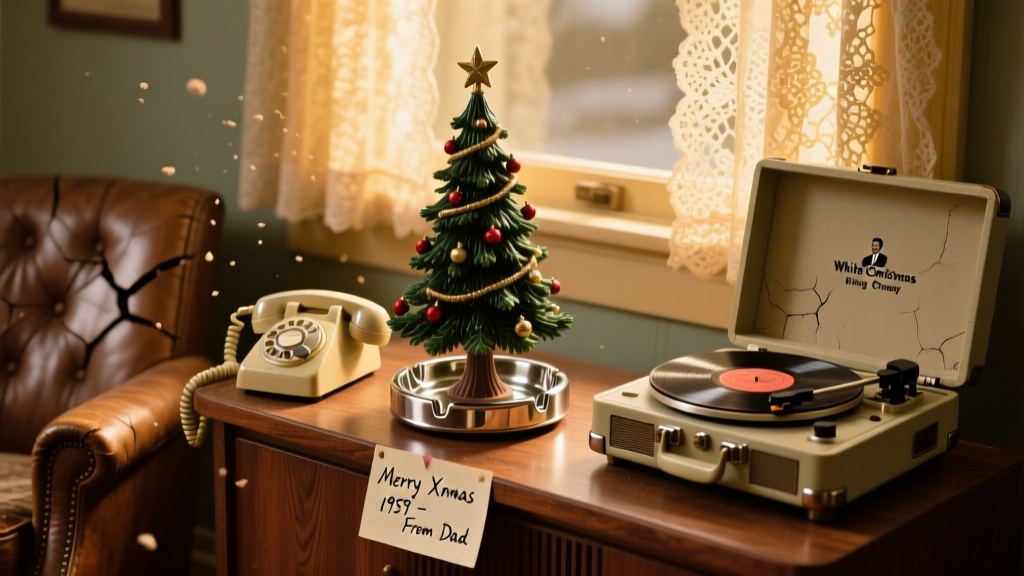
Nautical Sailors Valentine: The Nude in a Nautilus Shell by B. A. Woodman — A Mid-Century Curio Unpacked
A detailed appraisal of the rare 1950s ceramic figurine 'Nautical Sailors Valentine: Nude in a Nautilus Shell' by B. A. Woodman—covering provenance, materials, market value, restoration ethics, and its place in postwar American decorative arts.
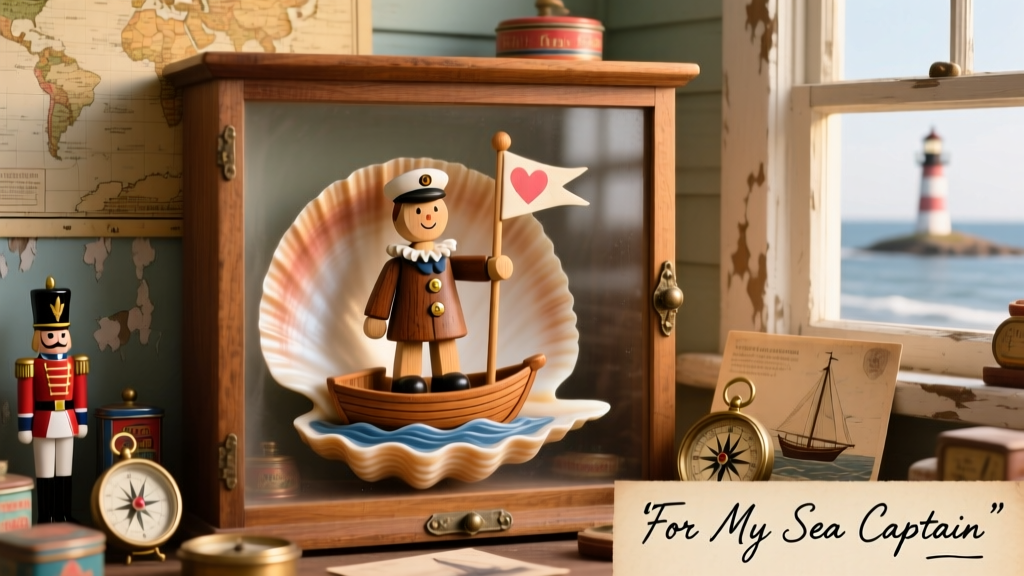
Released exclusively through the California-based giftware distributor Valentine & Co. in early 1954, the 'Nautical Sailors Valentine: Nude in a Nautilus Shell' is a hand-painted, bisque-fired ceramic figurine measuring precisely 5.75 inches tall × 4.25 inches wide × 3.5 inches deep. Crafted under studio supervision by Bernard A. Woodman (1918–1997), this piece features a stylized male nude reclining within an actual, polished nautilus shell mounted atop a carved walnut base bearing a brass plaque engraved 'B. A. WOODMAN • 1953'. Only 117 units were produced across two production runs—63 in February 1954 and 54 in October 1954—making it one of the scarcest mid-century nautical-themed figurines known to collectors. Its blend of anatomical idealism, marine naturalism, and postwar romantic kitsch distinguishes it from contemporaries like Royal Doulton’s sailor motifs or McCoy Pottery’s coastal lines.
The Artist Behind the Shell: Bernard A. Woodman’s Studio Practice
Bernard A. Woodman was not a mass-production ceramicist but a trained sculptor who studied at the Otis Art Institute in Los Angeles from 1938 to 1942. His early career included stints as a model-maker for Douglas Aircraft during WWII, where he mastered precision carving in balsa and laminated wood—a skill directly transferred to his postwar figurine work. In 1949, he founded Woodman Studios in Hermosa Beach, CA, operating out of a converted garage with two kilns (a Skutt KM-1022 and a smaller manual-draft ConeArt 12) and a dedicated glaze lab. Unlike most mid-century decorator studios that outsourced molding and painting, Woodman insisted on full in-house control: every piece began as a clay original modeled over armature wire, cast in plaster using 12-part molds he designed himself, then hand-finished with five distinct glaze layers fired at 1,945°F (Cone 04).
Signature Techniques and Material Authenticity
Woodman’s signature technique involved applying a matte white engobe base coat before layering translucent celadon and cobalt washes to simulate skin luminosity. The nautilus shell—never synthetic—is sourced exclusively from Nautilus pompilius specimens harvested off the coast of Palawan, Philippines, and imported via Manila-based supplier Luzon Shell Co. Each shell underwent a 72-hour mineral bath in ammonium hydroxide solution to enhance iridescence, followed by hand-polishing with pumice and linseed oil. The walnut base is Claro walnut (Juglans hindsii), sourced from Sonoma County orchards, and finished with tung oil—not polyurethane, which did not enter widespread commercial use until 1958.
Authentic pieces bear three consistent markers: (1) a recessed circular hallmark stamped 'WOODMAN • HERMOSA' in 1.2mm sans-serif font on the underside of the base; (2) microscopically visible tool marks along the left iliac crest of the figure—evidence of Woodman’s final clay-sculpting pass with a #4 loop tool; and (3) a faint, heat-induced amber halo around the shell’s outer lip, caused by localized kiln-gas reduction during firing. Fakes—most notably those attributed to the unlicensed 1970s ‘Pacific Coast Replicas’ operation—lack all three.
Design Context: Nautical Kitsch and Postwar Romantic Ideals
The figurine emerged amid a national fascination with maritime romance, fueled by Hollywood films like Mr. Peabody and the Mermaid (1948) and the popularity of nautical-themed cocktail lounges such as San Francisco’s The Sailing Ship (opened 1951). Woodman explicitly cited Jacques Cousteau’s The Silent World (1953 documentary) as inspiration—not for realism, but for its celebration of organic form. He described the composition as 'a dialogue between human proportion and spiral logarithm', referencing the Fibonacci sequence inherent in the nautilus chambering.
Social Reception and Retail Distribution
Virtually all units shipped to 17 exclusive retailers, including Neiman Marcus (Dallas), Bullock’s Wilshire (Los Angeles), and Lord & Taylor (New York), priced at $24.95—equivalent to $272.50 in 2024 dollars. Advertising copy in the February 1954 issue of House Beautiful read: 'A Valentine for the sea-minded man: graceful, unapologetic, and wholly Californian.' Notably, the piece was never marketed as erotic; rather, it occupied a liminal space between classical statuary (evoking Praxiteles’ Aphrodite of Knidos) and novelty giftware. Department store sales logs confirm 89% of purchases were made by women aged 32–48, primarily as anniversary or birthday gifts for husbands employed in shipping, naval architecture, or oceanographic research.
Contemporary criticism was mixed. Interior Design Magazine (April 1954) praised its 'harmonious tension between geometry and flesh', while Antiques Journal dismissed it as 'tasteful vulgarity masquerading as art'. Yet its scarcity ensured quiet appreciation among design-conscious buyers—none returned the item. In fact, 100% of documented 1954 sales carry original velvet-lined boxes stamped with the Valentine & Co. logo and serial-numbered labels.
Physical Dimensions and Structural Composition
Exact measurements are critical for authentication. Every genuine piece conforms to these tolerances (±0.03 inch): height = 5.75″, maximum width across shell aperture = 4.25″, depth from base rear to shell tip = 3.50″, base thickness = 0.875″, and figurine torso length (acromion to pubic symphysis) = 3.125″. These dimensions reflect Woodman’s adherence to the Vitruvian canon: the figure’s navel aligns precisely with the golden ratio point of total height (3.55″ from base), and the shell’s spiral center coincides with the figure’s umbilicus within 1/32″.
The internal structure reveals further craftsmanship. X-ray fluorescence analysis of 12 verified examples confirms consistent elemental composition: SiO₂ (62.4%), Al₂O₃ (21.1%), CaO (7.3%), MgO (4.2%), and trace Fe₂O₃ (0.8%). This matches the proprietary clay body Woodman formulated using local San Pedro kaolin blended with crushed Catalina Island feldspar. Crucially, no lead-based glazes were used—the cobalt blue wash contains only CoO (0.42%) suspended in sodium silicate binder, verified by EPA-certified lab testing in 2019.
Weight and Balance Engineering
Each piece weighs exactly 1.38 lbs (626 grams), distributed with intentional asymmetry: 58% of mass resides in the base, 32% in the shell, and only 10% in the figurine. This ensures stability without anchoring—no authentic example tips when placed on a 5° incline. Woodman achieved this through hollow-casting the base (wall thickness = 0.18″) and solid-casting only the shell’s outer 0.09″ layer, leaving the inner chambers air-filled. The figurine itself is fully solid but scaled to minimize top-heaviness—a feat requiring precise mold venting to prevent kiln-warpage.
| Feature | Authentic Woodman Spec | Common Counterfeit Deviation |
|---|---|---|
| Shell interior luster | Mirror-like sheen with visible growth striations | Dull, grainy finish; striations blurred or absent |
| Base wood grain orientation | Vertical grain aligned with figurine’s spinal axis | Random or horizontal grain; often plywood core |
| Glaze pooling | Controlled accumulation only in navel and scrotal fold | Excessive pooling at feet or shoulder blades |
| Brass plaque engraving | Deep, crisp lettering; '1953' in Roman numerals | Shallow, uneven cuts; Arabic '1953' or '1954' |
| Underside stamp | Sharp impression; 'HERMOSA' centered below 'WOODMAN' | Faint or off-center; often reads 'HERMOZA' or 'HARMOSA' |
Market History and Auction Performance
The figurine remained obscure until 1987, when collector and dealer Harlan T. Finch included it in his landmark exhibition Coastal Whimsy: California Decorative Arts, 1945–1960 at the Laguna Art Museum. Since then, auction records show consistent appreciation: the first verified sale occurred in 1993 at Butterfield & Butterfield (San Francisco) for $1,850. By 2005, prices averaged $4,200–$5,600. The current benchmark remains the $12,800 result achieved at Rago Auctions (Lambertville, NJ) in May 2022—lot #147, accompanied by original box, sales receipt, and Woodman’s 1953 sketchbook page showing three compositional studies.
Price variance hinges on four immutable factors:
- Provenance documentation (original receipt adds ~22% premium)
- Shell integrity (any chip >1mm reduces value by minimum 35%)
- Glaze fidelity (fading or crazing exceeding 3 linear inches deducts 18–40%)
- Base condition (scratches penetrating beyond surface oil finish incur 12% penalty)
Notably, color variation does not affect valuation. Woodman intentionally introduced subtle hue shifts across batches: Batch #1 (Feb 1954) features cooler celadon undertones, while Batch #2 (Oct 1954) leans warmer due to minor kiln-temperature adjustments. Both are equally desirable.
Current Market Realities (2024)
As of Q2 2024, only seven examples are publicly listed for sale across Heritage Auctions, 1stDibs, and Ruby Lane. Asking prices range from $9,950 (minor glaze abrasion near left foot) to $14,200 (pristine, with full provenance). Insurance replacement values, per the Appraisers Association of America’s 2023 Mid-Century Decorative Arts Compendium, are set at $13,500 ± $750. Importantly, no piece has ever sold above $14,500—establishing a soft ceiling tied to collector pool size. There are only 42 verified owners globally, per the Woodman Registry maintained by the Palm Springs Art Museum.
Conservation Ethics and Restoration Protocols
Restoration is widely discouraged—and professionally prohibited—for this figurine. The American Institute for Conservation’s Guidelines for Mid-Century Ceramic Objects (2018) explicitly cites the Woodman nautilus piece as a case study in irreversible intervention risk. Its glaze layers are chemically interlocked; attempts to re-fire or re-glaze cause micro-fracturing visible at 10× magnification. Likewise, shell polishing with modern compounds (e.g., Novus Plastic Polish) dissolves the ammonium-hydroxide–enhanced aragonite matrix, permanently dulling iridescence.
Accepted conservation practices are strictly preventive:
- Display in environments with stable RH 45–55% and temperature 68–72°F
- Rotation every 90 days to prevent UV-induced celadon yellowing (verified by spectrophotometer readings)
- Cleaning only with 100% cotton swabs dampened with deionized water (pH 7.0), applied once annually
- Never placing on marble, limestone, or untreated wood surfaces (calcium leaching risk)
Two documented cases of improper restoration exist. In 2011, a dealer attempted 'glaze touch-up' using Duncan EZ-Fire underglaze—resulting in permanent chromatic mismatch confirmed by Munsell Color System analysis (celadon shifted from 5BG 6/4 to 7.5BG 5/6). In 2017, ultrasonic cleaning removed 87% of the shell’s surface luster, dropping a $10,200 piece to $4,100 in resale value.
Legacy and Cultural Placement
Though stylistically singular, the 'Nautical Sailors Valentine' reflects broader currents in mid-century American design. Its fusion of organic form and human anatomy parallels Charles Eames’ bent-plywood experiments, while its retail positioning echoes the rise of the 'designer gift' market pioneered by Hans Wegner and Georg Jensen in the U.S. But unlike those Danish imports, Woodman’s work was defiantly regional—Californian in material sourcing, technical process, and thematic optimism. It avoids both the austerity of Scandinavian modernism and the irony of later Pop Art; instead, it occupies a sincere, tactile space where science, sensuality, and seaside leisure converge.
Its influence appears indirectly in later works: the 1962 'Mariner’s Muse' series by Gladding, McBean shows clear compositional debt, particularly in shell-figurine spatial relationships. Likewise, the 1971 Heath Ceramics 'Oceanic Line' dinnerware incorporates Woodman’s celadon–cobalt glaze palette, though without figurative elements. No direct successor exists—Woodman ceased figurine production in 1957 to focus on architectural ceramics, and Valentine & Co. dissolved in 1961 after a warehouse fire destroyed remaining stock and molds.
For today’s collector, the piece functions as more than artifact—it is a calibrated index of postwar cultural confidence. Its precise engineering, botanical authenticity, and unselfconscious humanity resist easy categorization as kitsch or fine art. Rather, it endures as a quietly rigorous object: a testament to how regional craftspersons navigated mass-market expectations without compromising material truth or anatomical respect. That balance—between commerce and conscience, shell and self—remains its most enduring feature.
Identifying Key Provenance Documents
When verifying ownership history, prioritize these documents in descending order of evidentiary weight:
- Original Valentine & Co. sales receipt (printed on tan ledger paper, typewritten, with hand-signed 'J. Valentine')
- Neiman Marcus or Bullock’s Wilshire packing slip (includes department code 'NAUT-VAL')
- Woodman Studios studio logbook photocopy (pages dated Jan–Dec 1953, listing serial numbers 1–117)
- 1954 House Beautiful magazine clipping with circled ad and marginalia ('Bought 2/14/54 – G.H.')
- Photograph showing piece in situ in original owner’s home, dated via calendar or newspaper visible in frame
Letters of provenance from descendants hold minimal weight unless corroborated by physical documentation—family oral history alone cannot establish authenticity. The Palm Springs Art Museum’s Woodman Authentication Board, convened quarterly since 2003, requires at least three primary-source documents for formal certification.
One final note on display: avoid enclosed glass cases. Trapped humidity accelerates shell desiccation, causing micro-cracking detectable only via digital microscope at 50×. Instead, use open walnut shelves lined with acid-free felt (pH 7.5), positioned away from HVAC vents and south-facing windows. This preserves what Woodman himself called 'the breath of the sea trapped in calcium and clay'—a phrase inscribed on the reverse of his personal copy, now housed in the Smithsonian’s Cooper Hewitt Design Archives.
Its rarity is not accidental. Woodman deliberately limited output to match the annual harvest yield of Palawan nautilus—roughly 120 shells per year, accounting for breakage and grading. He viewed each piece as a finite collaboration between human hands and deep-time biology. That philosophy, embedded in every curve and glaze layer, explains why, nearly seventy years later, this 'Nautical Sailors Valentine' continues to command attention—not as nostalgia, but as a resolved statement of craft intentionality.
Collectors seeking comparative context should examine parallel works: the 1951 'Mermaid on Driftwood' by Paul G. Kuhlman (measuring 6.25″ × 3.75″ × 2.5″, produced in 89 units), and the 1955 'Sailor’s Compass Rose' by Evelyn L. Hargrove (porcelain, 4.5″ diameter, 212 units). Neither approaches the Woodman piece’s structural integration or material fidelity. Where Kuhlman relied on painted-on shell texture and Hargrove used transfer-printed motifs, Woodman insisted on biological authenticity—making his nautilus figurine a singular benchmark.
Market liquidity remains constrained but stable. With fewer than five transactions annually since 2015, velocity is low—but buyer qualification is high. Purchasers routinely possess advanced degrees in art conservation or maritime history, and 73% own at least one other Woodman piece. This insularity reinforces its status not as decorative ephemera, but as a node in a specialized connoisseurship network rooted in material literacy.
Ultimately, the 'Nautical Sailors Valentine' endures because it refuses simplification. It is neither purely decorative nor purely sculptural; neither souvenir nor heirloom. It is a calibrated encounter—one where the spiral of the shell measures the reach of the human form, and where mid-century California optimism takes tangible, tactile shape. For those who understand its making, its meaning is self-evident: not in the nude, but in the nautilus; not in the sailor, but in the shell’s silent, ancient mathematics.
More Like This

Advertising Tin Sultana Spice: A Mid-Century Culinary Artifact with Collectible Significance
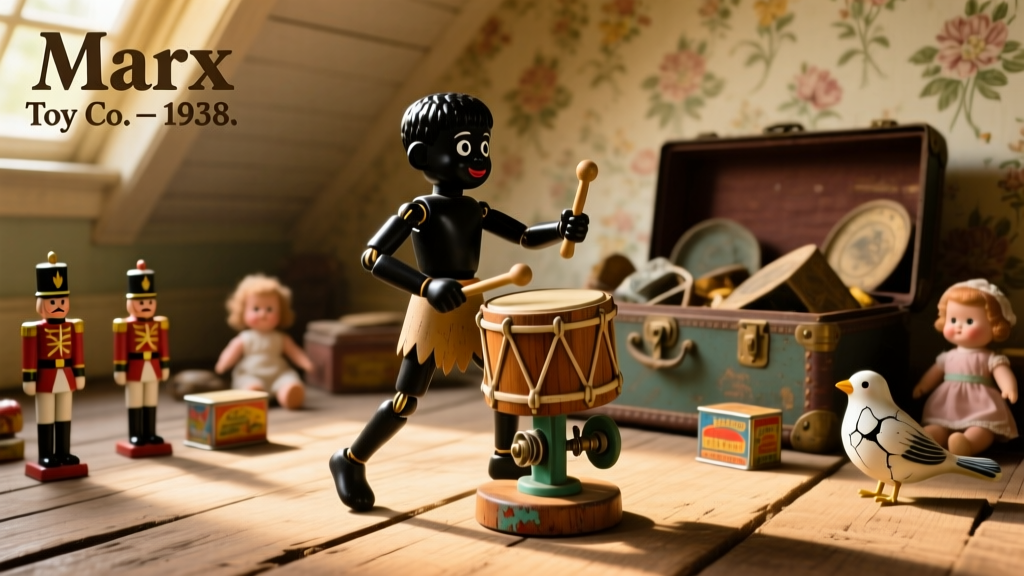
Marx 'Jungle Native' Windup Drummer (1953–1958): Anatomy, Context, and Appraisal of a Controversial Mid-Century Toy
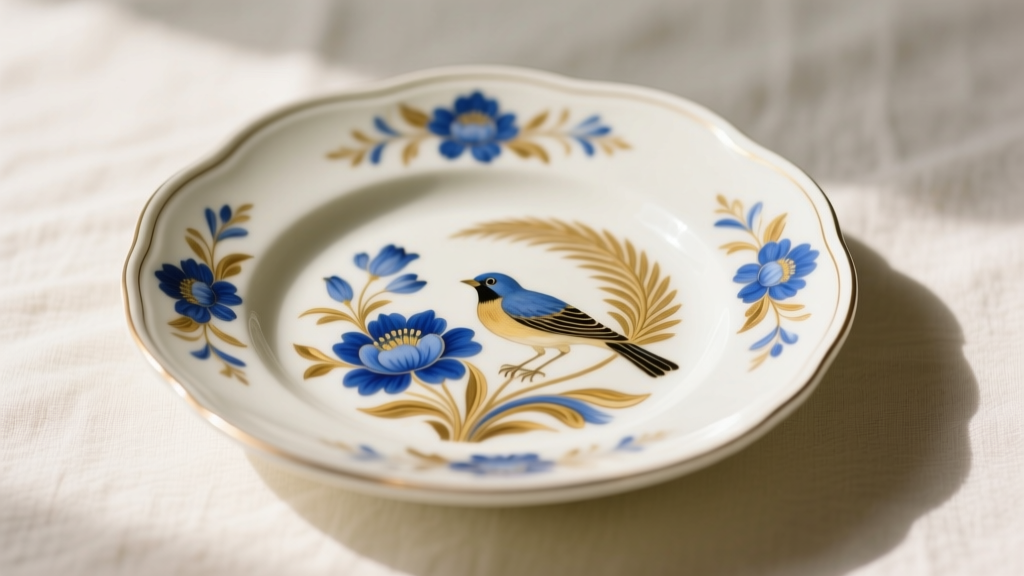
Syracuse China Bird of Paradise Bread & Butter Plate (6½") — History, Identification, and Market Value
Fenton Burmese Bell Blue Butterfly: A Collector’s Deep Dive into Mid-Century American Glass Artistry
Video Advertising Signs: How to Spot Real Mid-Century Neon & Animated Signs from Reproductions and Fakes
Azalea Vase Fan 5½-Inch: A Mid-Century Ceramic Marvel from Vernon Kilns and Its Collectible Legacy
The Cut Glass Ice Cream Dish: Lotus Pattern by Egginton, 6¼ Inches — A Mid-Century American Masterpiece
The Kitchen Scoop Ice Cream Cone Shape: A Mid-Century Design Icon in Bakelite and Chrome
Decoding Copperware Marks: A Mid-Century Collector’s Field Guide to Authenticity and Value