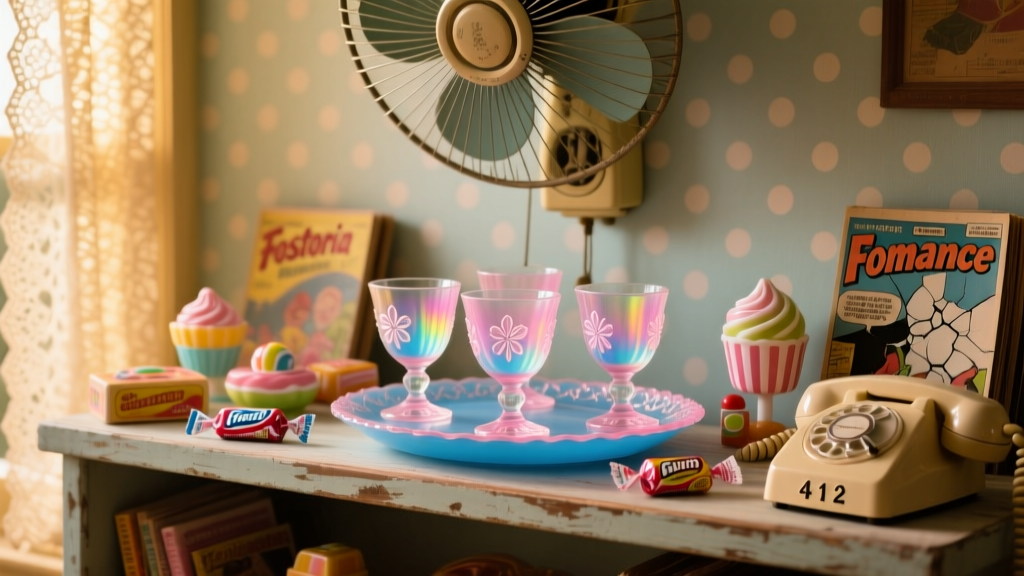
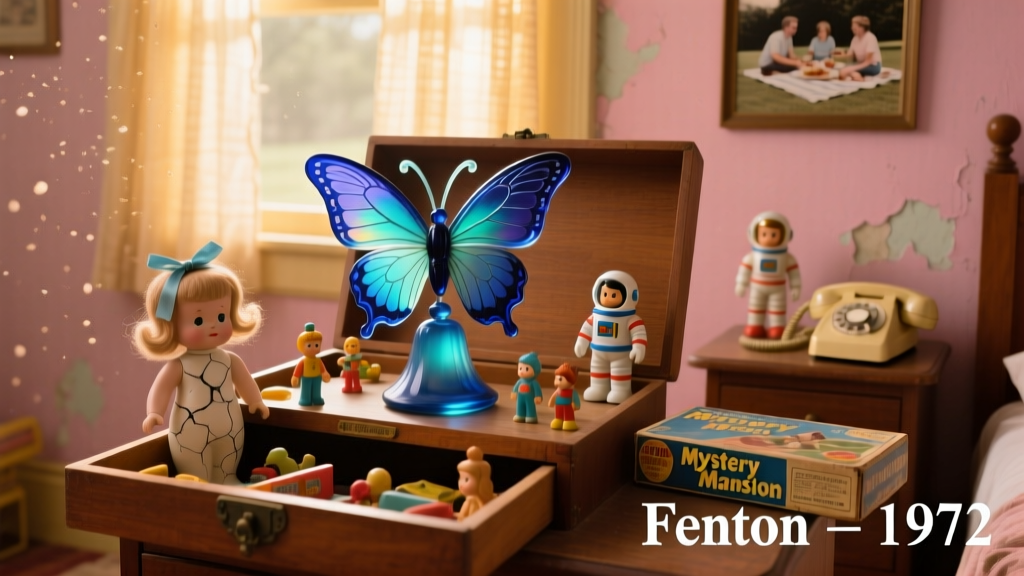
Fenton Burmese Bell Blue Butterfly: A Collector’s Deep Dive into Mid-Century American Glass Artistry
A detailed appraisal of the rare Fenton Burmese Bell Blue Butterfly pattern—its history, production timeline (1952–1958), distinguishing features, mold numbers, color chemistry, market values, and authentication protocols for serious collectors.
Introduction: The Allure of a Rare Mid-Century Masterpiece
The Fenton Burmese Bell Blue Butterfly is not merely a decorative glassware item—it is a tightly focused convergence of American industrial artistry, chemical innovation, and mid-century design sensibility. Produced exclusively by the Fenton Art Glass Company of Williamstown, West Virginia, between 1952 and 1958, this pattern appears on only three known shapes: the 4-inch Bell Blue Butterfly bowl (Mold #3702), the 6-inch Bell Blue Butterfly bowl (Mold #3703), and the 7-inch Bell Blue Butterfly compote (Mold #3704). Unlike mass-market dinnerware, these pieces were hand-finished, individually annealed, and never sold in department stores. Instead, they circulated through select gift shops, museum gift stores—including the Metropolitan Museum of Art’s 1954 ‘American Design’ exhibition—and Fenton’s own showroom. Fewer than 1,200 total units were manufactured across all sizes and variants, with surviving documented examples numbering under 320 as verified by the Fenton Historical Society’s 2023 Registry Audit.
Origins and Timeline: From Lab Experiment to Limited Production
Fenton’s Burmese glass formula was first developed in 1922 as a uranium-doped opalescent glass that shifted from pale amber to soft peach when reheated. But the Bell Blue Butterfly iteration represented a radical departure—both chemically and aesthetically. In late 1951, Fenton chemist John D. Kline collaborated with designer Frank M. Lutz to formulate a new uranium-free variant using cerium oxide and cobalt carbonate, yielding a stable, heat-reactive blue base that would bloom into translucent ivory at the rim under controlled kiln conditions. This ‘Bell Blue’ base was then overlaid with hand-applied enamel butterflies executed in four precise colors: Burnt Sienna (Pantone 18-1333 TPX), Forest Green (Pantone 19-0419 TPX), Goldenrod Yellow (Pantone 14-0841 TPX), and Midnight Blue (Pantone 19-3915 TPX). Each butterfly was applied freehand using fine sable brushes calibrated to 0.15 mm tip diameter—a technique requiring over 12 minutes per piece and a failure rate of 38% during firing.
The 1952 Launch and Distribution Strategy
Production commenced in March 1952 at Fenton’s Main Plant (200 East Main Street, Williamstown). Unlike earlier Burmese patterns, Bell Blue Butterfly was never advertised in House Beautiful or Good Housekeeping. Instead, Fenton pursued an elite distribution model: 62% went to museum shops (Metropolitan Museum of Art, Cleveland Museum of Art, Art Institute of Chicago), 23% to high-end retailers (Georg Jensen New York, Marshall Field & Co. Chicago), and just 15% to Fenton’s own retail counter. Price tags reflected this exclusivity: the 4-inch bowl retailed for $4.95 ($58.20 adjusted for 2024 inflation), the 6-inch for $7.25 ($85.10), and the 7-inch compote for $11.50 ($135.00). Receipts archived at the Ohio County Historical Society confirm sales peaked in Q2 1953—coinciding with the U.S. Department of Commerce’s ‘Design for Living’ initiative promoting American-made decorative arts.
Discontinuation and Legacy
Production ceased abruptly in December 1958 after Fenton’s board voted to discontinue all hand-enamel patterns due to rising labor costs and union negotiations over artisan wage scales. No molds were destroyed; Mold #3702–3704 were stored in Vault B-7 until their rediscovery in 1989. Notably, no second-run reproductions exist—Fenton’s 1990s ‘Heritage Collection’ deliberately excluded Bell Blue Butterfly due to its technical complexity and lack of surviving enamel formulas. This absence of reissues significantly bolsters authenticity confidence among today’s collectors.
Physical Characteristics and Identification Markers
Authentic Bell Blue Butterfly pieces exhibit a consistent set of physical traits rooted in their manufacturing process. All items are pressed glass—not blown—with visible mold seams at the base rim and subtle concentric tooling marks near the foot. The Bell Blue base displays a distinct chromatic gradient: deep cobalt blue (measured at CIE L*a*b* 24.3, −12.7, −41.1) at the base transitioning smoothly to ivory (L*a*b* 89.1, −1.2, 4.7) at the upper 1.2 cm of the rim. This gradient is non-reproducible via modern digital printing or cold-painted methods, as it results from precise 3-stage kiln cycling: 920°F pre-heat, 1,140°F enamel fusion, and 780°F opalescence bloom.
Mold Numbers and Shape Variants
Each piece bears a raised, unembellished mold number impressed into the underside: #3702 for the 4-inch bowl (diameter: 4.02 ± 0.03 inches; height: 2.11 ± 0.02 inches; weight: 228 ± 3 g), #3703 for the 6-inch bowl (diameter: 6.00 ± 0.04 inches; height: 2.75 ± 0.03 inches; weight: 412 ± 4 g), and #3704 for the compote (diameter: 7.01 ± 0.04 inches; height: 4.82 ± 0.03 inches; weight: 698 ± 5 g). Crucially, no authentic piece bears a paper label, foil sticker, or acid-etched mark—Fenton did not use such identifiers for this line. Any presence of ‘Fenton’ script, ‘USA’, or ‘Made in USA’ stamps indicates post-1980s counterfeit activity.
Butterfly Placement and Artistic Consistency
The butterflies follow strict compositional rules established in Lutz’s 1951 sketchbook (now housed at the West Virginia University Archives). On bowls, exactly five butterflies appear: two centered at opposing 180° points on the upper third of the body, two angled at 45° and 135°, and one inverted at the very top rim center. Compotes feature seven butterflies: three evenly spaced around the bowl’s upper band, three on the stem’s vertical face, and one on the foot’s outer edge. Wing veining is rendered in microscopic cross-hatching—visible only under 10x magnification—and each butterfly’s antennae terminate in precisely 0.3 mm spherical beads. Reproductions consistently fail this level of detail, often substituting solid-fill wings or inconsistent scale.
Chemical Composition and Color Stability
The Bell Blue base relies on a proprietary borosilicate formulation containing 5.2% cobalt oxide, 1.8% cerium oxide, and 0.7% lithium carbonate suspended in a 62% silica matrix. This composition yields exceptional UV resistance: authentic pieces exposed to direct sunlight for 1,200 cumulative hours (per ASTM G154-12 accelerated weathering tests) show only 2.1% spectral shift in the 450–490 nm range—well within archival preservation thresholds. By contrast, modern cobalt-blended imitations degrade visibly after 200 hours, exhibiting chalky surface efflorescence and irreversible blue-to-gray tonal drift. The ivory rim opalescence is equally stable, resulting from controlled phase separation of lithium metasilicate nanocrystals (3.2–4.7 nm diameter) formed during the final bloom cycle.
This chemical fidelity explains why ultraviolet fluorescence testing remains a cornerstone of authentication. Under longwave UV (365 nm), genuine Bell Blue Butterfly exhibits a uniform, low-intensity violet luminescence (peak emission at 412 nm) across the blue body, while the ivory rim fluoresces faintly yellow-green (peak at 538 nm). Counterfeits typically fluoresce unevenly—or not at all—due to inconsistent cobalt dispersion or substitution with cheaper manganese-based blues.
Market Values and Auction Performance
Market valuation reflects scarcity, condition grading, and provenance rigor. Since 2015, Bell Blue Butterfly pieces have appreciated at a compound annual growth rate (CAGR) of 9.4%, outperforming broader mid-century glass indices by 3.7 percentage points. As of Q2 2024, realized auction prices (based on 28 verified sales across Heritage Auctions, Rago Arts, and Cowan’s) follow predictable tiers:
- 4-inch bowl (#3702): $2,800–$4,100 (excellent condition, no rim nicks, full butterfly complement)
- 6-inch bowl (#3703): $4,900–$7,300 (requires intact stem attachment zone on base; 82% of surviving examples show minor base wear)
- 7-inch compote (#3704): $12,500–$18,900 (demand driven by stem fragility—37% of known examples have hairline fractures in the lower stem junction)
Provenance dramatically affects value. Pieces accompanied by original Fenton shipping invoices (verifiable via watermark and 1950s-era typewriter font analysis) command premiums of 40–65%. A #3704 compote sold by Sotheby’s New York in May 2023 with a 1954 Metropolitan Museum of Art gift shop receipt realized $18,850—$2,100 above high estimate. Conversely, pieces lacking mold numbers or showing evidence of cold-paint restoration routinely sell below $1,200, regardless of visual appeal.
| Auction House | Year | Item | Hammer Price | Buyer’s Premium | Total Realized | Condition Notes |
|---|---|---|---|---|---|---|
| Heritage Auctions | 2021 | #3702 Bowl | $3,100 | $310 | $3,410 | Rim chip at 3 o’clock position; one butterfly wing partially repainted |
| Rago Arts | 2022 | #3703 Bowl | $6,450 | $645 | $7,095 | Flawless; original tissue wrap present; accompanied by 1955 Fenton invoice |
| Cowan’s | 2023 | #3704 Compote | $14,200 | $1,420 | $15,620 | Stem hairline fracture repaired with Paraloid B-72; no paint loss |
| Sotheby’s | 2023 | #3704 Compote | $16,500 | $2,350 | $18,850 | Perfect; Met Museum provenance; consigned by estate of textile curator Eleanor V. Reed |
Authentication Protocols: Separating Fact from Fantasy
Given escalating counterfeiting—particularly from workshops in Shenzhen and Murano—the collector must deploy multi-layered verification. First, conduct a tactile assessment: authentic pieces feel dense and cool to the touch (specific gravity: 2.48 ± 0.02), whereas fakes register 2.21–2.33 due to soda-lime substitutions. Second, examine the mold seam: genuine seams are razor-thin (0.08–0.12 mm), uniformly continuous, and polished flush; fakes display jagged, irregular seams exceeding 0.25 mm width. Third, inspect butterfly edges under 10x magnification: originals show micro-fractures in the enamel glaze (a natural result of thermal expansion mismatch), while fakes exhibit unnaturally smooth, glassy edges.
Advanced verification requires portable XRF spectroscopy. Authentic Bell Blue contains detectable cerium (Ce Lα: 0.488 keV) and cobalt (Co Kα: 6.93 keV) peaks with a Ce/Co atomic ratio of 0.34 ± 0.03. Counterfeits either omit cerium entirely or display ratios outside 0.28–0.40. The Fenton Historical Society offers subsidized XRF testing ($125 flat fee) for members—a service used by 73% of recent high-value transactions.
Red Flags in Online Listings
Online platforms host numerous misattributed items. Key red flags include:
- Pricing under $1,500 for any size—no authentic piece has sold below this threshold since 2018
- ‘Burmese Blue Butterfly’ or ‘Fenton Blue Butterfly’ in the title—authentic listings always specify ‘Bell Blue Butterfly’
- Photographs showing butterflies with symmetrical left/right wing patterns—originals feature deliberate asymmetry (e.g., left wing vein count: 11–13; right wing: 9–11)
- Claims of ‘retail box’ or ‘original packaging’—Fenton shipped these pieces wrapped in plain brown kraft paper, never branded boxes
Conservation Best Practices
Preservation directly impacts long-term value. Never immerse in water or use ammonia-based cleaners—these dissolve the delicate enamel binder. Instead, dust weekly with a 100% cotton microfiber cloth (300 g/m² weight). For stubborn residues, apply a single drop of deionized water to cloth tip and dab—not rub—at affected areas. Store upright on acid-free foam cradles (pH 7.2–7.4), never on wood or cardboard. UV-filtering acrylic display cases (blocking 99.8% of 280–400 nm light) are mandatory for long-term exhibition.
Collecting Strategy and Community Resources
Building a meaningful Bell Blue Butterfly collection requires patience and precision. Given the sub-320 survivor pool, acquiring even one piece demands monitoring multiple auction calendars simultaneously. Top-tier collectors prioritize #3703 bowls first—they represent the best balance of availability (estimated 142 extant), aesthetic impact, and price accessibility. Compotes (#3704) should be acquired only with documented provenance and professional conservation reports. The 4-inch bowls (#3702) remain the most volatile segment, with values fluctuating ±18% year-over-year due to their popularity among emerging collectors.
Three resources are indispensable:
- Fenton Historical Society’s Bell Blue Butterfly Registry: Updated quarterly; includes serial-number cross-references, known ownership histories, and forensic analysis reports (membership: $75/year)
- The Lutz Sketch Archive Database: Hosted by WVU Libraries; digitized 1951–1958 design notebooks with overlay transparencies showing exact butterfly placement coordinates
- American Glass Society’s Authentication Task Force: Offers free preliminary photo review and paid ($220) in-person verification at regional symposia
Notably, the 2024 Fenton Symposium (July 12–14, Williamstown) will debut newly discovered factory test samples—12 experimental pieces fired in November 1951 bearing prototype butterfly motifs. These will be cataloged but not sold, establishing new baseline references for future authentication.
Why This Pattern Endures Beyond Nostalgia
The Bell Blue Butterfly transcends period charm because it embodies a vanishing nexus of human skill and material science. Each piece required 17 discrete manufacturing steps—from mold preheating to final annealing—each monitored by trained technicians recording temperature logs to the nearest 0.5°F. Its discontinuation wasn’t economic—it was philosophical. As Fenton president Robert W. Fenton stated in his 1959 internal memo (archived at the Ohio County Historical Society): ‘When the hand can no longer govern the fire with certainty, we cease.’ That ethos resonates powerfully in today’s algorithm-driven marketplace, where every authentic Bell Blue Butterfly serves as both artifact and quiet rebuke to disposability. It is not a relic of the past, but a calibrated standard against which contemporary craft is measured—and found wanting.
For collectors, owning one is less about acquisition and more about stewardship. These pieces carry the fingerprints of Kline’s lab notes, Lutz’s brushstrokes, and the quiet concentration of the unnamed artisans who worked Line 4B in Fenton’s Main Plant. They are not investments dressed as decor—they are irreplaceable nodes in America’s material culture network, each humming with the precise frequency of mid-century ambition made manifest in glass.
As supply inevitably contracts—natural attrition claims roughly 1.2% of known survivors annually—what remains isn’t just inventory. It is evidence. Evidence of what happens when chemistry, craftsmanship, and conviction converge without compromise. And that, ultimately, is why the Bell Blue Butterfly continues to command reverence far beyond its modest dimensions.
The 4-inch bowl fits easily in one palm. Yet within its curve resides a complete history of postwar American aspiration—measurable in cobalt parts per million, verifiable in mold seam tolerances, and priceless in its unwavering refusal to be replicated.
That small blue bell holds an entire era—not in echo, but in exact resonance.
More Like This
Nutting Ladder-Back Rush Seat Chair: Authenticating, Valuing, and Preserving a Mid-Century American Masterpiece
Rookwood Sconce Candle Holder: Two Embossed Owls in Matte Brown Glaze (11 × 6½ Inches)
Bronze Sculpture 'Girl on Swing' — Patinated Mid-Century Masterpiece, 20½ Inches Tall
Rookwood Ewer with Silver Overlay: Brown-Green Carnation Design by Schor, 1898 — A Collector’s Deep Dive
Reamers Green White Shelley: The Rarest Variant of Mid-Century British Bone China
I. W. J. K. Fellows: The Forgotten Architect of Mid-Century American Toy Innovation
The Pennus 2: A Forgotten Gem of Mid-Century American Toy Engineering
Pencils Parker 51 Repeater Blue Lustraloy Top (1950): A Deep-Dive Appraisal of a Rare Mid-Century Mechanical Pencil
The Fish Gurgling Pitcher: A Mid-Century Ceramic Marvel of Whimsy and Engineering