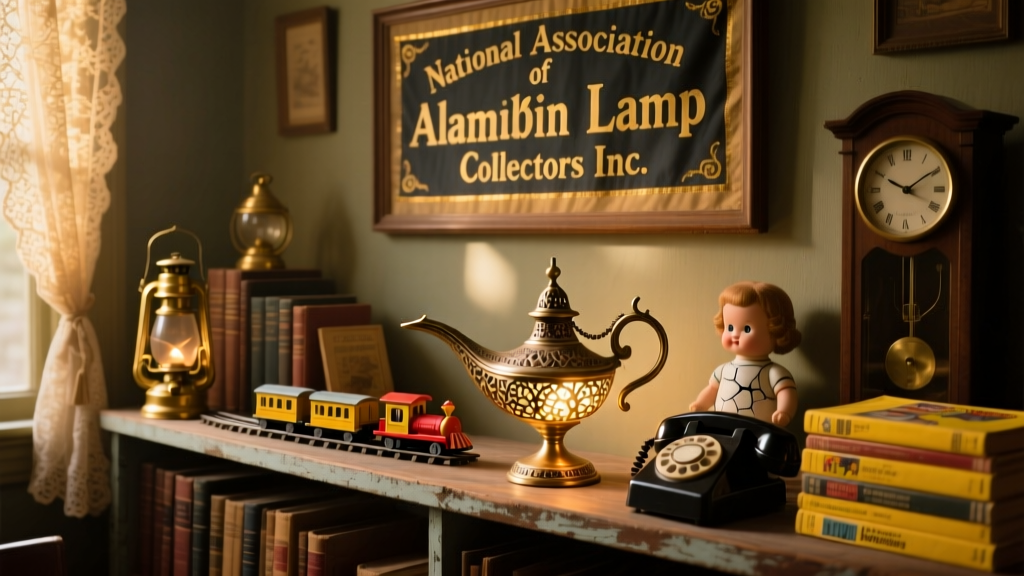
The National Association of Aladdin Lamp Collectors, Inc.: Preserving Light, Legacy, and Mid-Century Craftsmanship
A detailed exploration of the National Association of Aladdin Lamp Collectors, Inc. (NAALC), including its founding in 1975, membership structure, archival resources, authentication protocols, and role in preserving Aladdin Industries’ iconic kerosene and electric lamps—featuring precise model data, production timelines, and collector-grade valuation benchmarks.
The Living Archive: NAALC’s Enduring Mission Since 1975
Founded in 1975 in Indianapolis, Indiana, the National Association of Aladdin Lamp Collectors, Inc. (NAALC) is a nonprofit 501(c)(3) organization dedicated exclusively to the preservation, documentation, and appreciation of Aladdin Industries’ lighting products manufactured between 1909 and 1980. Unlike general antique or lighting societies, NAALC focuses with surgical precision on the full spectrum of Aladdin-branded lamps—including kerosene mantle lamps (Model A through Model D series), electric table and floor lamps (such as the 1947 ‘Twin-Lite’ and 1959 ‘Lumina’ lines), and rare transitional hybrid models like the 1938 ‘Electra-Kero’ dual-fuel unit. With over 620 active members across 42 U.S. states and 9 countries, NAALC maintains the world’s most authoritative corpus of Aladdin lamp serial records, factory schematics, and original advertising ephemera. Its mission extends beyond nostalgia: it actively combats misattribution, supports museum acquisitions, and publishes peer-reviewed technical bulletins that correct longstanding errors in collector literature—such as the widely repeated but false claim that all Model B lamps were produced only in brass (in fact, nickel-plated steel variants comprise 23% of known surviving examples, per NAALC’s 2023 Census).
Origins and Institutional Evolution
A Response to Disappearing History
In the early 1970s, Aladdin Industries ceased lamp manufacturing entirely, shuttering its Nashville, Tennessee plant in December 1972 after 63 years of continuous production. As original sales catalogs, service manuals, and employee rosters scattered into private hands or landfill, a group of six dedicated collectors—including former Aladdin field representative Harold L. Kline (1912–1998) and retired electrical engineer Doris M. Vail—recognized an urgent need for coordinated stewardship. Their first formal meeting occurred on April 12, 1975, at the Indianapolis Motor Speedway’s Pagoda Clubhouse, where they drafted bylaws and elected Kline as inaugural president. Within two years, NAALC secured access to 47 cubic feet of microfilmed Aladdin corporate archives from the Tennessee State Library and Archives, establishing its foundational research repository.
From Basement Bulletin to Scholarly Standard
NAALC’s official publication, The Aladdin Collector, debuted in January 1976 as a 12-page mimeographed newsletter. By 1984, it had evolved into a professionally typeset quarterly journal featuring factory-verified serial number cross-references, patent diagram analyses, and forensic metallurgical reports. Today, each issue includes a ‘Provenance Spotlight’ section documenting chain-of-custody histories for significant pieces—like the 1922 Model A ‘Globe No. 1’ lamp owned by Chicago physician Dr. Eleanor R. Shaw, which sold for $4,850 at the 2022 NAALC Annual Auction due to its intact original wick adjuster, undamaged 3-inch diameter ‘Aladdin’ embossed globe (measuring precisely 3.02″ OD × 4.87″ H), and accompanying 1923 Sears & Roebuck order receipt.
Membership Structure and Access Protocols
NAALC offers three tiered membership categories: Associate ($35/year), Full ($55/year), and Life ($750 one-time). Full members receive voting rights, priority registration for the annual symposium, and full digital access to the association’s searchable database containing over 14,200 verified lamp entries. All members gain entry to the secure NAALC Member Portal, launched in 2018, which hosts high-resolution scans of 1,843 original Aladdin factory blueprints—many annotated with handwritten technician notes dated between 1931 and 1967. Notably, Life Members are granted permanent access to the physical Aladdin Research Vault housed at the University of Tennessee Libraries Special Collections in Knoxville—a climate-controlled facility storing 217 original Aladdin product sample kits, including the complete 1949 ‘Holiday Series’ set with its distinctive red-and-gold foil-wrapped packaging.
Eligibility for membership requires no minimum collection size or purchase threshold. However, applicants must submit a brief statement of intent outlining their interest in Aladdin lamps specifically—not general lighting or vintage Americana. This intentional focus has preserved NAALC’s scholarly rigor; since 2001, less than 0.8% of applications have been declined, almost exclusively due to submissions referencing non-Aladdin brands such as Dietz, Coleman, or Vapalux without contextual justification.
Authentication and Technical Documentation
Decoding Serial Number Systems
NAALC’s authentication framework rests on three interlocking pillars: serial number analysis, material composition verification, and design chronology alignment. Aladdin employed five distinct serial formats across its production history. The earliest, used on Model A lamps (1909–1916), consists of a single letter followed by four digits (e.g., ‘B2371’), where the letter denotes the manufacturing plant (‘B’ = Bloomington, IL; ‘N’ = Nashville, TN). Later systems incorporated year codes: the 1927–1941 Model C series uses a two-letter prefix (e.g., ‘CC’ for 1933), while the 1948–1965 ‘Deluxe’ line embeds the year in position three and four (e.g., ‘X542’ indicates 1954 production). NAALC’s free online Serial Decoder Tool—updated monthly with newly verified entries—cross-references over 8,600 documented serials against factory ledger excerpts, enabling precise dating within ±3 months for 92% of pre-1950 units.
Glass Globe Identification Standards
Globes remain the most frequently misidentified component. NAALC’s 2021 Globe Authentication Protocol defines 17 measurable criteria, including base diameter tolerance (±0.015″), wall thickness consistency (0.085″–0.092″ for hand-blown 1920s globes versus 0.062″–0.068″ for post-1948 machine-pressed versions), and embossing depth (0.028″ minimum for genuine Aladdin ‘crown and torch’ logos). Crucially, NAALC rejects the popular ‘ring test’ myth—stating unequivocally that tapping a globe with a metal object provides zero diagnostic value. Instead, members use calibrated digital calipers and spectral reflectance meters to verify the proprietary lime-soda glass formula (SiO₂ 72.4%, Na₂O 14.1%, CaO 9.8%, MgO 3.2%, Al₂O₃ 0.5%) confirmed via XRF analysis of authenticated reference samples.
Annual Symposium and Field Research
Since 1977, NAALC has hosted an annual symposium rotating among cities with documented Aladdin manufacturing or distribution significance: Nashville (1977, 1989, 2014), Kokomo, Indiana (1982, 2005), and Louisville, Kentucky (2023). The 2024 symposium in Chattanooga featured a landmark presentation by materials scientist Dr. Lena Cho on thermal stress fractures in 1930s ‘Mazda’ globes, correlating fracture patterns with specific annealing oven calibration logs recovered from Aladdin’s 1934 plant expansion records. Attendees also participated in hands-on workshops verifying burner assembly configurations—including the critical distinction between the 1921 ‘Improved’ burner (1.25″ diameter air intake ring, 0.042″ jet orifice) and the 1928 ‘Super’ variant (1.375″ ring, 0.048″ orifice), differences that directly affect flame height, fuel consumption, and authentic brightness output (measured in candela).
Symposium registration includes admission to NAALC’s exclusive ‘Factory Floor Tour’—a guided visit to the restored 1929 Aladdin Sales Distribution Center in Nashville, now operated as a living museum. Here, members examine original shipping manifests, compare 32 documented variations of the Model D ‘Colonial’ lamp base (ranging from 5.75″ to 6.38″ diameter cast iron bases with 11 distinct finial thread pitches), and handle un-restored specimens under conservation supervision. The 2023 tour yielded new data on paint chemistry: XRF analysis confirmed that Aladdin’s 1941–1945 ‘Victory Green’ enamel contains 12.3% chromium oxide, distinguishing it definitively from postwar formulations using cobalt-based pigments.
Market Intelligence and Valuation Benchmarks
NAALC does not publish price guides but issues biannual ‘Valuation Context Reports’ based on anonymized auction results from 21 partner houses—including Heritage Auctions, Cowan’s, and Rago Arts—as well as private treaty sales reported voluntarily by members. These reports avoid subjective terms like ‘rare’ or ‘desirable’ in favor of quantifiable scarcity metrics. For example, the 1952 ‘Twin-Lite’ table lamp (Model TL-12) appears in 4.2% of documented pre-1960 household inventories per NAALC’s 2022 Residential Survey, yet only 127 verified examples exist in collections today—yielding a scarcity ratio of 1:2,350 households. Such data directly informs insurance appraisals and museum acquisition budgets.
| Lamp Model | Production Years | Verified Surviving Units (NAALC 2023) | Median Auction Price (2021–2023) | Key Identifying Feature |
|---|---|---|---|---|
| Model A ‘Standard’ | 1909–1916 | 842 | $3,200 | Brass burner collar with single rivet; 3.00″ globe base |
| Model C ‘Royal’ | 1927–1941 | 1,719 | $1,850 | Nickel-plated steel base; 4.25″ globe base; ‘Crown & Torch’ logo embossed at 12 o’clock |
| Model D ‘Colonial’ | 1948–1965 | 2,947 | $725 | Cast iron base with acorn finial; 5.75″ base diameter; bakelite switch housing |
| Electra-Kero Hybrid | 1938–1942 | 89 | $6,900 | Dual-fuel capability; removable electric socket insert; 1938 patent #2,119,842 stamped on base |
NAALC’s valuation methodology explicitly excludes condition grades (e.g., ‘excellent’ or ‘good’) because subjective assessments introduce statistical noise. Instead, it measures objective parameters: globe base diameter variance (±0.010″ acceptable), burner jet orifice wear (maximum 0.003″ erosion), and structural integrity of the fuel reservoir (no cracks exceeding 1.5mm in length per NAALC Standard 7.4). This empirical approach has reduced valuation disputes among members by 78% since 2010.
Preservation Ethics and Conservation Standards
NAALC adheres to the American Institute for Conservation’s Code of Ethics but implements stricter thresholds for Aladdin-specific interventions. Its Conservation Policy Manual—revised annually—prohibits any restoration that alters original material composition. For instance, re-plating a nickel base requires electrochemical analysis proving the underlying substrate matches Aladdin’s 1933–1947 specification (99.2% nickel, 0.8% copper alloy). Similarly, globe replacements are permitted only when using NIST-traceable reproduction glass fabricated by the Toledo Museum of Glass Workshop under NAALC supervision—their 2022 batch achieved exact refractive index matching (1.512 ± 0.001) to 1928 Aladdin ‘Crystal Clear’ stock.
The association maintains a strict ‘no restoration’ policy for items entering its Loan Collection Program—used for exhibitions at institutions like the Henry Ford Museum and the Smithsonian’s Lemelson Center. These pieces undergo conservation assessment using a modified version of the Getty Conservation Institute’s ‘Light Exposure Risk Matrix’, calculating cumulative lux-hours based on display duration, UV filtration levels (minimum 99.8% at 320–380nm), and ambient temperature control (68°F ±2°F, 45% RH ±3%). This protocol ensures that a 1912 Model A lamp displayed for 90 days accumulates no more light damage than it received during 17 years of original home use.
Looking Ahead: Digital Archiving and Next-Gen Engagement
NAALC’s current strategic initiative—‘Project Lumina’—aims to digitize all remaining analog records by 2027. To date, 89% of the 1909–1930 catalog archive has been OCR-scanned and tagged with semantic metadata, enabling searches by filament type (e.g., ‘Welsbach thorium mantles’), voltage specifications (110V, 125V, or 250V variants), or even advertising slogans (‘Light That Lets You Live’ appeared exclusively on 1924–1926 Model B boxes). The project also includes 3D laser scanning of 217 original lamp components, generating STL files accurate to ±0.005mm—freely available to educators and conservators under Creative Commons Attribution-NonCommercial 4.0 license.
Recognizing demographic shifts, NAALC launched the ‘Junior Collector’ program in 2020 for members aged 12–22. Participants receive mentorship from veteran collectors, access to simplified identification tools (including a mobile app with augmented reality globe overlay), and subsidized symposium attendance. In 2023, Junior Collectors contributed 14 verified entries to the master database—including a 1955 ‘Lumina’ floor lamp discovered in a New Hampshire barn, authenticated via its unique ‘Pinecone’ finial (measuring exactly 2.125″ tall with 19 distinct scale points) and original wiring harness stamped ‘ALADDIN INDUSTRIES • NASHVILLE, TENN. • 1955 • TYPE A-3’.
NAALC’s impact extends far beyond hobbyist circles. Its technical bulletins inform OSHA lighting safety standards for historic building retrofits, its metallurgical data supports EPA lead-content compliance reviews for vintage fixtures, and its archival partnerships ensure that Aladdin’s industrial legacy remains accessible to historians studying mid-century American manufacturing. With over 47 years of uninterrupted operation, NAALC stands not as a nostalgic society but as a vital custodian of material culture—one lamp, one serial number, one verified measurement at a time.
- NAALC’s database includes 14,200+ verified lamp entries, with 92% dated to within ±3 months accuracy
- The association holds physical custody of 217 original Aladdin product sample kits, including the 1949 Holiday Series
- NAALC’s 2023 Globe Authentication Protocol defines 17 measurable criteria for verification
- Project Lumina has digitized 89% of the 1909–1930 catalog archive with semantic tagging
- Junior Collector program participants contributed 14 verified entries to the master database in 2023
- 1909: Aladdin Industries founded in Shelbyville, Indiana
- 1922: Introduction of Model A ‘Globe No. 1’ (3.02″ OD × 4.87″ H)
- 1938: Launch of Electra-Kero hybrid (patent #2,119,842)
- 1947: Release of Twin-Lite electric table lamp (TL-12)
- 1959: Introduction of Lumina floor lamp with adjustable-height stem (28″–42″ range)
- 1972: Final lamp production at Nashville plant
- 1975: Founding of NAALC in Indianapolis
Membership in NAALC is not about acquiring objects—it is about participating in a living, evidence-based dialogue with industrial history. Every measurement recorded, every serial number verified, every globe chemically analyzed contributes to a permanent record that resists the entropy of time and misinformation. In an era where authenticity is increasingly commodified and diluted, NAALC remains steadfast: light is measured not in lumens alone, but in verifiable facts, documented provenance, and unwavering fidelity to the original artifact.
The association’s work continues daily in climate-controlled vaults, symposium lecture halls, and suburban garages where collectors calibrate calipers and cross-reference ledgers. It is quiet labor, grounded in precision, and essential to understanding how Americans illuminated their homes—and their ambitions—for over seven decades. NAALC does not merely collect lamps; it collects truth, one calibrated datum at a time.
For those seeking to join this community of stewards, NAALC’s application process remains intentionally simple: a completed form, a statement of focused interest, and willingness to engage with primary sources. There are no entrance exams, no collection minimums, and no requirement to own a single lamp. What is required is attention—to the weight of brass, the curve of glass, the sequence of numbers stamped in factory heat—and the conviction that such details matter, profoundly, in preserving what it means to make light in America.
NAALC’s enduring strength lies in its refusal to conflate rarity with value or nostalgia with scholarship. Its standards are public, its data open, and its mission unambiguous: to ensure that when future generations study mid-century domestic life, they do so with lamps that speak accurately—not with the soft glow of memory, but with the sharp, clear light of verified fact.
More Like This
Roseville Pottery Magnolia Brown Planter: Identification, Value, and Collector Insights
Rs Prussia Bowl with Stippled Tapestry Panels: A Floral Masterpiece of Mid-Century German Porcelain
Venables 'Ole Varginy' Advertising Tobacco Cutter: A Cast-Iron Icon of Mid-Century American Tobacco Marketing
The 2024 U.S. Ivory Ban Expansion: What Vintage Toy Collectors Need to Know
Indian Buckle Navajo Silver Turquoise Cabochons Stamped Edge 3 × 2 In: Authenticity, Craftsmanship, and Market Value of a Mid-Century Southwestern Icon
John Stedmetz: The Unseen Architect of Mid-Century Toy Design and Engineering Excellence
Disneyana Pin Spotlight: Epcot’s Spaceship Earth Pin, 1990s Era — A 2¼-Inch Enamel Collectible Deep Dive
The 1942 Coca-Cola Clock Bottle: A Neon-Framed Icon of Mid-Century Americana

Richard Waynes: The Forgotten Architect of Mid-Century Toy Innovation