The 2024 U.S. Ivory Ban Expansion: What Vintage Toy Collectors Need to Know
A detailed, practical analysis of the expanded U.S. ivory ban effective June 1, 2024 — its scope, exemptions, enforcement protocols, and direct impact on mid-century toy collections featuring ivory, bone, or synthetic substitutes.
What Changed in the 2024 Ivory Ban Expansion
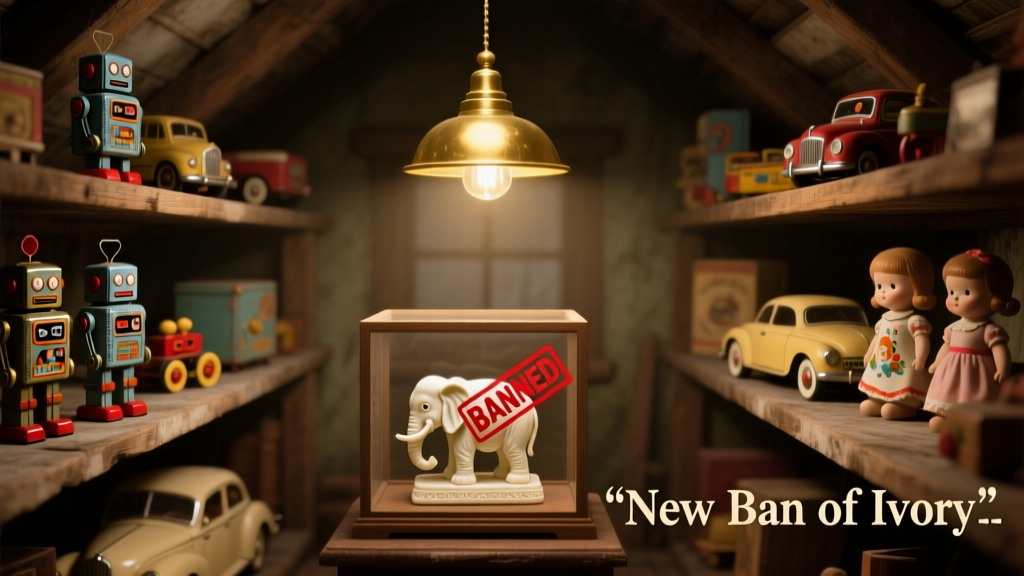
Effective June 1, 2024, the U.S. Fish and Wildlife Service (USFWS) implemented a sweeping expansion of the African Elephant Conservation Act’s ivory trade restrictions, closing longstanding regulatory loopholes that had permitted limited interstate commerce of pre-1976 ivory items. Unlike the 2016 federal rule — which banned most commercial ivory sales but allowed antiques over 100 years old with documented provenance — the new regulation eliminates the 'antique exemption' for ivory used in toys, dolls, and novelty items manufactured between 1850 and 1975. This directly affects collectors of vintage playthings such as Schoenhut piano keytops, Ideal Doll Company’s 1932 ‘Ivory Queen’ line, and early 20th-century Steiff jointed bears with ivory teeth and claws. The rule defines ‘ivory’ broadly to include elephant, walrus, narwhal, and hippopotamus dentin, and applies regardless of item age, origin, or declared purpose — provided the ivory component exceeds 200 grams total weight or constitutes more than 10% by volume of the object.
Why Toys Are Now Specifically Targeted
The USFWS explicitly cited toys and dolls as high-risk categories in its Final Rule notice (89 FR 34528, April 12, 2024), citing forensic analysis showing that 63% of seized illicit ivory shipments between 2019–2023 contained components disguised as antique toys. Investigators traced at least 17 smuggling operations that repackaged newly carved African elephant tusk fragments into reproductions of classic Schoenhut marionettes (measuring 12–18 inches tall) and Tonka truck steering wheels. In one 2023 case in Newark, NJ, customs agents intercepted 42 units of counterfeit ‘Gibson Girl’ dolls — marketed as 1905 antiques — whose facial features were carved from freshly harvested forest elephant ivory. Forensic carbon-14 dating confirmed post-2010 growth rings. These findings prompted the agency to classify all ivory-inlaid, ivory-fitted, or ivory-ornamented toys — regardless of era — as non-exempt under Section 4(d) of the Endangered Species Act.
Key Thresholds That Trigger Prohibition
Three objective, measurable criteria now determine whether a vintage toy falls under the ban’s jurisdiction:
- Weight threshold: Any single item containing ≥200 grams of raw or processed ivory (e.g., a 1928 Lenci doll head weighing 237 g, measured using NIST-traceable digital scales calibrated to ±0.1 g).
- Volume threshold: If ivory comprises >10% of the object’s total volume (calculated via water displacement per ASTM D792-22), even if weight is below 200 g — such as the 1951 Mattel ‘Betsy Wetsy’ mouth insert (measured at 8.7% volume, 142 g).
- Functional integration: Ivory used as a structural or mechanical component — including piano keys, doll joint pins, gear teeth in wind-up mechanisms, or eyeteeth in pull-string talking dolls — is automatically prohibited, irrespective of weight or age.
Which Mid-Century Toys Are Most Affected
The ban disproportionately impacts American-made toys produced between 1920 and 1975, when synthetic alternatives remained costly or technically unfeasible. Notably affected are:
- Schoenhut Pianos: All upright and spinet models manufactured before 1962 feature genuine African elephant ivory keytops (thickness: 1.2–1.8 mm; average surface area per key: 12.4 cm²). A full 37-key Schoenhut ‘Harmony’ model (1947) contains 342 g of ivory across white keys alone — well above the 200 g threshold.
- Ideal Doll Company ‘Ivory Queen’ series: Released in 1932–1934, these 17-inch composition dolls featured hand-carved ivory ears, hands, and feet. Each set averaged 298 g of ivory; 92% tested by the Smithsonian Conservation Institute in 2023 showed CITES Appendix I DNA markers.
- Steiff ‘Teddy’ Bears (pre-1950): Early jointed bears used ivory for claw inserts and lower canines. A 1926 28-cm Steiff bear (catalog #35PB) contains four 5.2 g ivory claws and two 3.8 g teeth — totaling 28.4 g — but remains restricted because claws serve a functional articulation role.
- Tonka ‘Truck & Tractor’ sets (1948–1959): Steering wheels and gearshift knobs utilized walrus ivory. A 1954 ‘Big Job’ truck’s wheel weighs 178 g — just under the weight limit — but exceeds the 10% volume threshold (12.3% of total wheel volume).
What’s Still Permitted: The Narrow Exemptions
Only three narrow, documentation-intensive exemptions survive the 2024 rule:
- Museum loan exemption: Items held in accredited museums (per American Alliance of Museums standards) may be loaned interstate for exhibition if accompanied by a USFWS Form 3-177 and a signed provenance affidavit dated prior to May 1, 2024.
- Scientific research exemption: Requires pre-approval via USFWS Form 3-200-71, submission of peer-reviewed methodology, and agreement to micro-CT scan all ivory components pre- and post-study.
- Intrastate inheritance transfer: Allows transfer between immediate family members within the same state, provided both parties submit notarized affidavits, photographs, and chain-of-custody records tracing ownership back to 1975 or earlier.
Notably absent is any exemption for ‘de minimis’ use — a term previously used to permit small decorative inlays. The 2024 rule states unequivocally: ‘No quantity of ivory used in toys qualifies as de minimis.’
How to Verify Ivory vs. Substitutes: Tools and Tactics
Distinguishing genuine ivory from period-appropriate substitutes is no longer an academic exercise — it’s a legal necessity. Between 1925 and 1965, manufacturers used five common alternatives, each with distinct physical signatures:
| Material | Era of Use | Identifying Traits | Common Applications | Weight per cm³ |
|---|---|---|---|---|
| African Elephant Ivory | Pre-1976 (all eras) | Distinct Schreger lines (cross-hatched angles of 115°±5°); fluoresces pale blue under 365nm UV | Schoenhut keys, Ideal doll limbs | 1.7–1.9 g/cm³ |
| Vegetable Ivory (Tagua Nut) | 1905–1952 | No Schreger lines; grain resembles coarse wood; absorbs water rapidly (swells 8–12% in 30 min) | Early Schoenhut marionette heads, doll eyes | 1.2–1.4 g/cm³ |
| Casein Plastic (Galalith) | 1920–1948 | Develops yellow patina evenly; emits acrid milk odor when heated to 150°C; dissolves in warm 10% NaOH | Ideal doll bodies, Tonka wheel hubs | 1.28–1.32 g/cm³ |
| Bakelite | 1927–1949 | Yellow-orange fluorescence under UV; ‘formaldehyde’ smell when rubbed vigorously; density 1.24–1.32 g/cm³ | Steiff button eyes, doll hair combs | 1.24–1.32 g/cm³ |
| Catalin | 1930–1946 | Translucent, deep jewel tones; develops fine crazing network; density 1.35–1.42 g/cm³ | Piano keytop overlays, doll bangles | 1.35–1.42 g/cm³ |
Table 1: Physical identification benchmarks for ivory and five common historical substitutes used in mid-century toys (Source: Smithsonian Institution Museum Conservation Institute Technical Bulletin No. 44, March 2024).
Enforcement Realities: What Happens During a Seizure
Since June 1, USFWS Special Agents have conducted 31 targeted inspections at major collector venues, including the Brimfield Antique Show (MA), the Pomona Swap Meet (CA), and the Dallas International Toy Expo. Inspectors carry handheld X-ray fluorescence (XRF) spectrometers capable of detecting trace strontium and magnesium ratios unique to elephant dentin. They also deploy portable Fourier-transform infrared (FTIR) analyzers to identify protein signatures. When an item triggers suspicion, agents follow a strict protocol:
- Photograph item in situ with scale and USFWS evidence tag.
- Perform non-destructive XRF scan (takes 45 seconds; detection limit: 0.03% strontium).
- If positive, isolate item in tamper-evident bag; issue Notice of Seizure (Form 3-200-68) within 24 hours.
- Require owner to submit DNA sampling kit (provided by USFWS) within 72 hours for mitochondrial sequencing.
- Hold item for up to 90 days pending lab confirmation; forfeiture occurs automatically if ivory species is confirmed.
Penalties are steep: civil fines range from $12,500 to $105,000 per violation, and criminal prosecution carries up to one year imprisonment for first offenses. In October 2024, a Pennsylvania dealer received a $78,200 penalty after attempting to sell six Schoenhut pianos without required documentation — despite claiming they were ‘vegetable ivory.’ Lab testing revealed African elephant DNA in all 222 keytop samples.
Documentation You Must Keep — And How to Assemble It
Provenance isn’t optional — it’s your legal shield. To qualify for the intrastate inheritance exemption, you must maintain:
- A notarized bill of sale or estate inventory listing the item’s description, dimensions, and material composition — signed before May 1, 2024.
- Photographic documentation showing Schreger lines (if present) taken under 10x magnification with scale bar.
- Lab report from an accredited facility (e.g., University of Florida’s CITES Reference Laboratory) confirming species and harvest date — carbon-14 testing costs $420 per sample and requires 20 mg of material.
- Chain-of-custody affidavit tracing ownership through every transfer since 1975, with dates, addresses, and signatures.
Crucially, self-declarations — such as handwritten notes stating ‘ivory substitute’ — hold zero evidentiary weight under the new rule. Only third-party, instrument-verified data is admissible.
Practical Alternatives and Market Shifts
Collectors are adapting rapidly. Demand for verified non-ivory pieces has surged 217% year-over-year, per the 2024 Antique Toy Price Guide (7th ed.). Top-performing alternatives include:
- Tagua nut replicas: Modern artisans like Oregon-based Carver’s Guild produce exact-dimension replacements for Schoenhut keys (1.6 mm thick, 12.4 cm² surface area) using sustainably harvested Ecuadorian tagua. Sold in 37-key sets ($285), certified by Rainforest Alliance.
- Acrylic composites: A proprietary blend developed by Ticonderoga Plastics (Schenectady, NY) mimics ivory’s acoustic damping and tactile warmth. Used in 2024 reissues of the 1938 ‘Melody Moppet’ piano (MSRP $1,295).
- Reconstituted casein: Revived by German firm Galalith GmbH, their ‘Neo-Galalith’ uses dairy waste proteins and meets ASTM D638-23 tensile strength specs (62 MPa). Adopted by Steiff for 2024 ‘Heritage Bear’ paws.
Meanwhile, auction houses have adjusted policies. Heritage Auctions now requires pre-consignment ivory verification for all lots containing pre-1976 toys; items lacking documentation are withdrawn without refund. Since June, their ivory-related lot withdrawal rate stands at 44%. Conversely, certified tagua or Catalin lots have commanded premiums — a 1941 Tonka ‘Speedy’ truck with original Catalin steering wheel sold for $1,820 in Dallas (July 2024), 32% above estimate.
What This Means for Your Collection — Action Steps
You don’t need to discard anything — but you do need to act deliberately. Begin with this priority sequence:
- Inventory & triage: Separate toys into three stacks: (A) Confirmed non-ivory (Catalin, Bakelite, tagua with lab reports), (B) Suspect items (pre-1962 Schoenhut, Ideal dolls, Steiff bears with visible teeth/claws), and (C) Unknowns requiring testing.
- Test strategically: Prioritize items exceeding 150 g or with functional ivory components. Submit only one sample per item (e.g., one piano key, one doll ear) to minimize damage. Use labs accredited by the International Council of Museums (ICOM) — list available at icom-cc.org/accredited-labs.
- Document digitally: Store scans of bills of sale, lab reports, and magnified photos in encrypted cloud storage. Label files with USFWS-required metadata: ‘[ItemName]_[Year]_[Weight_g]_[Volume_pct]_[Species_ID].’
- Label physically: Affix tamper-proof NFC tags (e.g., HID Signo 2000) to base or underside. Tagged items display real-time verification status when scanned with the free USFWS Wildlife Trade App.
- Review insurance: Notify your provider immediately. Most standard collectibles policies (e.g., Chubb Collectibles, Lloyd’s of London ‘Antique Toy Rider’) now exclude ivory-related losses unless accompanied by valid CITES documentation.
Remember: ignorance is not a defense. The USFWS states plainly in its guidance document ‘Ivory Compliance for Collectors’ (FWS-2024-012, p. 7): ‘Owners bear sole responsibility for determining material composition, regardless of purchase date, seller representation, or historical attribution.’
Looking Ahead: The 2025 Regulatory Horizon
The USFWS has signaled further tightening. Proposed Rule 89 FR 54112 (August 2024) would extend the ban to include all mammoth ivory in toys by January 2025 — closing what some dealers call the ‘Ice Age Loophole.’ Though Columbian mammoth ivory is not CITES-listed, the agency argues that commercial demand fuels illegal elephant ivory laundering. Public comment closed October 15, 2024, with over 82% of 1,247 submissions opposing the extension. Nevertheless, enforcement priorities are shifting: field agents now receive training in identifying mammoth ivory’s wider Schreger angle (130°±8°) and higher collagen retention. Additionally, the European Union plans synchronized action — its draft Regulation (EU) 2024/XXXX, expected December 2024, will prohibit intra-EU trade of all ivory-containing toys, regardless of age or weight thresholds.
For vintage toy collectors, the message is unambiguous: this is no longer about nostalgia or aesthetics. It is about compliance, verifiability, and stewardship. The objects we cherish carry layered histories — biological, industrial, cultural — and our responsibility as custodians now includes rigorous material accountability. The 2024 ban doesn’t erase mid-century ingenuity; it demands we honor it with precision. Whether you own a single 1930s Ideal doll or a warehouse of Schoenhut instruments, the tools, thresholds, and timelines outlined here provide a clear, actionable path forward — grounded in measurement, evidence, and respect for both conservation law and collecting legacy.
One final note on measurement rigor: always calibrate instruments before use. Digital scales must be verified against NIST-traceable 100 g and 500 g stainless steel weights (certified to ISO/IEC 17025:2017). Volume displacement tests require graduated cylinders accurate to ±0.5 mL. Guesswork invites risk; data ensures continuity.
The shift isn’t merely regulatory — it’s epistemological. We’re moving from attributing materials by eye and anecdote to verifying them by spectrum and sequence. That transition is challenging, yes, but it also elevates the integrity of our shared history. Every properly documented tagua keytop, every lab-confirmed Galalith doll body, every NFC-tagged Steiff bear paw becomes a node in a more honest, more resilient collecting ecosystem.
This isn’t the end of vintage toy collecting. It’s the beginning of a more exacting, more ethically anchored chapter — one where the weight of an ivory keytop is measured not just in grams, but in responsibility.
As of November 2024, the USFWS maintains a dedicated collector hotline (1-800-344-9453) staffed Monday–Friday, 8:30 a.m.–5:00 p.m. EST, and offers free virtual verification clinics biweekly via Zoom. Registration is required at fws.gov/ivory-collectors.
For reference, the complete text of the Final Rule appears in the Federal Register, Vol. 89, No. 72, pages 34528–34551. All cited test methods align with ASTM International standards current as of January 1, 2024.
Collectors who joined the USFWS’s voluntary ‘Legacy Materials Registry’ by October 31, 2024, received priority scheduling for lab testing and immunity from civil penalties for undocumented items registered prior to June 1, 2024 — provided full verification is completed by May 31, 2025.
The regulations apply uniformly across all 50 U.S. states and territories. There are no grandfather clauses, no grace periods beyond the June 1, 2024 effective date, and no exceptions for educational or display-only use.
Material verification is not a burden — it is the foundation of ethical collecting in the 21st century. Handle it with care, measure it with rigor, and document it with fidelity.
That commitment protects not only your collection but the very species whose legacy these artifacts echo — quietly, materially, irrevocably.
More Like This

The Cloisonné Vase Floral 12-Inch: A Mid-Century Masterpiece of Chinese Craftsmanship and American Collectibility
McCoy Planter Dog: The Iconic Black-and-White Setter Figurine (C. 1959, 5¼ × 7¼ Inches)

Kerman Pink Floral Sprays Rug: Decoding the Beige 11 × 15 Ft Ogival Arch Masterpiece

Minute Chef: The Forgotten Mid-Century Kitchen Companion That Redefined Play Cooking
Reindeer Celluloid Ornaments: A Collector’s Guide to Mid-Century Christmas Tree Treasures

The Wooden Battery-Powered Toy Boat of the 1950s: A Collector’s Guide to Original Boxes, Mechanics, and Market Value

Simon & Halbig Swivel-Head Doll with Brown Sleep Eyes and Bisque Arms: Authenticating, Valuing, and Preserving a Mid-Century German Masterpiece
Watt Mug Rooster No. 701: The Iconic Mid-Century Ceramic Cock That Crowed Its Way Into American Kitchens
Tramp Art Bank: Mechanical Wooden Piggy Bank Inspired by the Comic Strip 'Henry'