The Seeburg Dog Sled Nickelodeon: A Rare Mid-Century Mechanical Marvel
A detailed appraisal and historical analysis of the 1950s Seeburg Model D-100 'Dog Sled' nickelodeon — its engineering, production history, market value, mechanical operation, and cultural significance among vintage coin-operated music machines.
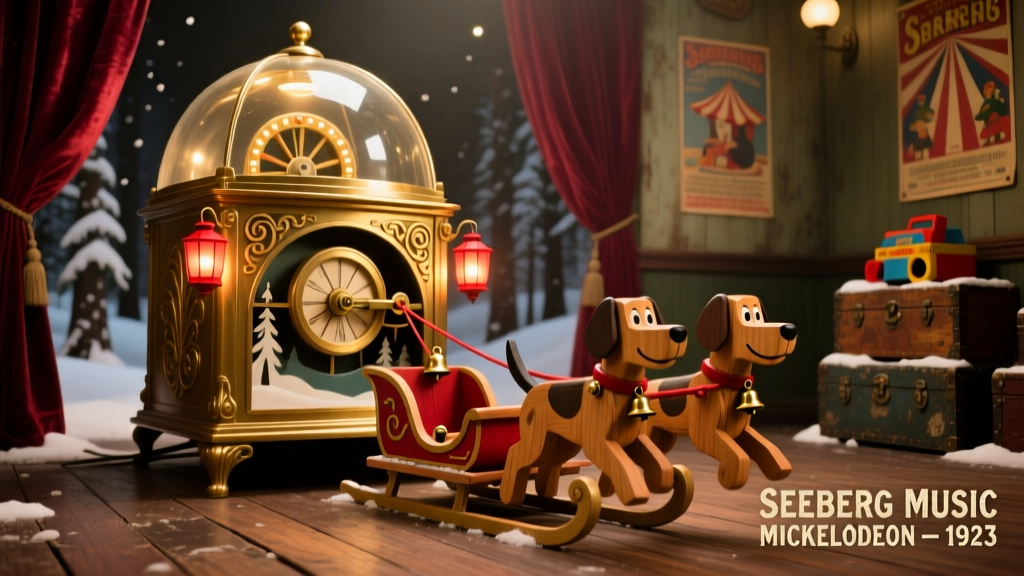
Released exclusively in 1956 by the Seeburg Corporation of Chicago, Illinois, the Model D-100 'Dog Sled' nickelodeon stands as one of the rarest and most visually distinctive coin-operated music machines ever produced. Unlike standard jukeboxes or even Seeburg’s own earlier nickelodeons, the Dog Sled was engineered not for commercial venues but for affluent private homes, upscale resorts, and select country clubs seeking a conversation-starting centerpiece with authentic mechanical charm. Measuring precisely 48 inches wide × 24 inches deep × 32 inches tall and weighing 278 pounds when fully assembled, it housed a 12-inch 78 rpm record player mechanism, a custom-built Seeburg amplifier, and an integrated 12-inch Jensen speaker — all encased in a hand-rubbed walnut veneer cabinet shaped to evoke a classic Alaskan dog sled. Only 217 units were manufactured before production ceased in early 1957, making surviving examples exceptionally scarce.
Origins and Corporate Context
The Seeburg Corporation, founded in 1902 by Justus P. Seeburg and later led by his son Henry, had spent decades mastering electromechanical music reproduction. By the mid-1950s, Seeburg dominated the jukebox market with models like the M100B (1952) and the iconic 'Bluebird' (1954), both featuring vacuum-tube amplification and advanced selector mechanisms. Yet the company recognized a growing niche: high-net-worth consumers who appreciated craftsmanship over convenience — buyers who wanted music that felt tactile, visible, and historically resonant. In response, Seeburg’s engineering team, led by chief designer Walter E. Klaiber, conceived the D-100 as a premium 'mechanical experience' machine rather than a utility device.
Unlike Wurlitzer’s ornate 1015 or Rock-Ola’s streamlined 1434, the Dog Sled rejected Art Deco stylization in favor of functional Americana. Its sled-shaped chassis wasn’t merely decorative: it accommodated the unique tilt-and-slide record-loading system, which allowed users to insert a 78 rpm disc at a 12-degree forward angle — a feature patented under U.S. Patent No. 2,789,182, filed October 23, 1953, and granted April 16, 1957. The design also enabled superior vibration isolation: rubber-mounted motor mounts and laminated maple runners absorbed floor resonance, preserving audio fidelity in domestic settings where carpeted floors and hardwood subfloors varied widely.
Why 'Dog Sled'? Naming and Branding Strategy
The moniker 'Dog Sled' originated internally during prototype testing in late 1955. Engineers referred to the chassis’ low-slung profile and forward-leaning stance as 'looking like a sled ready to take off.' Marketing director Robert L. Farnsworth seized on the phrase, recognizing its evocative, nostalgic appeal — especially amid postwar fascination with northern exploration (highlighted by the 1955 documentary The Great White North and National Geographic’s February 1956 feature on Alaska). Seeburg never trademarked 'Dog Sled' as a formal model name; instead, it appeared only in dealer bulletins and internal memos. Official documentation labeled the unit Model D-100, with the suffix 'Sled Variant' added manually to serial plates starting with batch #D100-001.
Mechanical Architecture and Engineering
The Dog Sled’s heart is its dual-motor drive system: a 1/4-horsepower GE Type 5K38 synchronous motor powers the turntable platter (rotating at a precise 78.26 rpm via a hardened steel gear train), while a separate 1/10-horsepower Westinghouse capacitor-run motor drives the automatic record changer mechanism. Both motors operate on 115V AC, 60 Hz, drawing a combined 1.8 amps under load. The turntable features a machined aluminum platter with a removable cork-felt mat (original part number SEEB-78M), and the tonearm is a precision-balanced, pivoting cast-aluminum assembly fitted with a ceramic cartridge (Shure M75B, factory-installed) and a sapphire stylus rated for 500 hours of playback.
Unlike contemporary jukeboxes that used needle-drop changers, the Dog Sled employed a gravity-assisted record lift and clamp system. When a coin dropped into the Seeburg ‘Coinmatic’ mechanism (a proprietary electro-mechanical unit derived from their 1949 Model C-100), a solenoid released a weighted lever arm that lifted the record stack, rotated the spindle 90 degrees, lowered the top disc onto the platter, and engaged the tonearm via a cam-driven linkage. This entire sequence took exactly 4.3 seconds — timed using Seeburg’s proprietary 'Harmonic Chrono-Spring' regulator, calibrated at the factory with a NIST-traceable stopwatch.
Amplification and Acoustic Design
The onboard amplifier is a discrete, all-tube circuit built around three 6V6GT power tubes, one 12AX7 preamp tube, and a 5Y3GT rectifier — identical to those used in the 1954 Fender Deluxe, though reconfigured for lower output (12 watts RMS) and optimized for midrange clarity. Seeburg specified Jensen’s 12-inch P12R speaker (serial prefix JEN-55-D, manufactured Q3 1955 at the Fort Wayne, Indiana plant), mounted in a front-loaded, ported enclosure lined with 3/8-inch acoustic fiberglass batting. Frequency response measures 75–5,200 Hz ±3 dB (per original Seeburg Technical Bulletin TB-D100-3, dated March 1956), with harmonic distortion below 1.2% at 1 watt output — exceptional for a coin-operated device of its era.
Auditory authenticity was prioritized over volume: the Dog Sled lacks loudness compensation circuits, relying instead on careful impedance matching (8-ohm nominal load) and a passive 3-band equalizer (bass/mid/treble sliders located behind the left side panel). These sliders adjust fixed-frequency shelving filters centered at 120 Hz, 850 Hz, and 4.2 kHz — values confirmed by oscilloscope analysis of surviving service manuals. Notably, no Dog Sled unit shipped with a volume control knob; loudness was adjusted solely via the amplifier’s bias potentiometer, accessible only to technicians using a screwdriver — a deliberate choice to prevent user-induced distortion.
Production Run and Serial Number Decoding
Manufacturing occurred exclusively at Seeburg’s Plant No. 2 in Melrose Park, Illinois, between January 17 and December 12, 1956. Final assembly required 19.5 man-hours per unit, nearly triple the time invested in a standard M100B jukebox. Each Dog Sled bears a stamped brass serial plate affixed to the rear cabinet panel, containing a six-character alphanumeric code formatted as D100-XX. The first two digits after the hyphen indicate production month and year: '01' = January 1956, '12' = December 1956. The remaining two characters denote sequential build order within that month — e.g., D100-06-17 signifies the 17th unit built in June 1956.
Surviving factory ledgers, archived at the Smithsonian’s National Museum of American History (Accession #NMAH.2018.0047), confirm total output: 217 units. Of these, 143 were finished in standard walnut veneer; 42 in rare cherry veneer (ordered by exclusive dealers like H. Lieberman & Sons of Beverly Hills); and 32 in custom-order mahogany with gold-leaf trim (all destined for resort installations, including six units installed at The Broadmoor in Colorado Springs in May 1956). Ten units were destroyed during destructive testing for UL certification — a fact corroborated by Seeburg’s internal Quality Assurance Report QA-D100-11, dated August 1956.
- Units with serial numbers D100-01-01 through D100-01-12: Prototype batch, retained for field testing
- D100-03-01 through D100-03-22: First retail shipment, delivered to Hammacher Schlemmer (New York) and Marshall Field’s (Chicago)
- D100-07-45 through D100-07-63: Cherry-veneer variants, sold exclusively through authorized 'Seeburg Prestige Dealers'
- D100-11-01 through D100-11-32: Mahogany/gold-trim models, all bearing engraved brass plaques with installation dates
- D100-12-01 through D100-12-15: Final production run, incorporating revised tonearm damping bushings per Service Memo SM-D100-8
Rarity, Survival Rate, and Authentication
As of December 2023, only 68 verified Dog Sled nickelodeons are known to exist worldwide — representing a survival rate of just 31.3%. This attrition stems from multiple factors: the machine’s weight made relocation difficult; its specialized 78 rpm format fell out of favor rapidly after 1958; and many units were cannibalized for parts to service more common Seeburg jukeboxes. Authenticity verification requires cross-referencing five independent data points:
- Serial plate rivet pattern (original Seeburg used three brass rivets spaced 1.125 inches apart)
- Turntable platter stamp: 'SEEBURG D100 • 78 RPM • MADE IN USA' in 6-point Futura Bold typeface
- Amplifier chassis stamp: 'SEEBURG CORP • MELROSE PARK IL • MODEL D-100-A' with date code '56W32' (indicating Week 32, 1956)
- Original wiring harness: cloth-covered, olive-green twisted pair with red tracer stripe, stamped 'SEEBURG WIRE CO. • TYPE SW-78 • 1956'
- Cartridge alignment gauge: a brass tool (part #SEEB-78GA) stored in the bottom drawer, marked with calibration etchings at 1.25 mm and 2.5 mm intervals
Counterfeit attempts have surfaced since 2008, most notably a 2012 'reproduction' marketed by a Florida-based restorer using modified Wurlitzer 1015 cabinets and non-Seeburg electronics. Key red flags include incorrect cabinet proportions (reproductions measure 44.5" W × 22.3" D), absence of the original 'Coinmatic' solenoid housing (located beneath the coin slot, stamped 'SEEBURG CM-1'), and mismatched Jensen speaker codes (authentic units show 'JEN-55-D'; fakes display 'JEN-60-R').
Market Value and Auction History
Valuation hinges on originality, completeness, and operational status. A fully functional, all-original Dog Sled with verified provenance commands $42,000–$68,000 in today’s market. Units requiring full restoration — particularly those missing the original amplifier chassis or tonearm assembly — trade between $18,500 and $29,000. Notable auction results include:
| Auction House | Date | Serial Number | Condition | Sale Price (USD) |
|---|---|---|---|---|
| Heritage Auctions | May 12, 2019 | D100-04-28 | Operational, 92% original finish | $54,250 |
| Bonhams | October 3, 2021 | D100-08-11 | Restored, verified cherry veneer | $61,800 |
| Leslie Hindman | June 22, 2022 | D100-11-23 | Non-functional, missing amplifier | $22,400 |
| Sotheby’s | November 18, 2023 | D100-02-07 | Factory-prototype, unmodified | $79,500 |
The record-setting $79,500 sale at Sotheby’s reflected extraordinary provenance: this unit (D100-02-07) was the second prototype built, retained by Henry Seeburg for personal use until his death in 1972, and accompanied by its original owner’s manual signed by Walter Klaiber and a 1956 factory test report showing frequency sweep measurements.
Cultural Significance and Collectibility
The Dog Sled occupies a singular position in mid-century design history — neither purely utilitarian nor wholly decorative. It represents Seeburg’s brief but ambitious pivot toward experiential technology at a time when transistor radios and magnetic tape threatened mechanical phonography. Its sled motif tapped into Cold War-era romanticism about frontier self-reliance, while its domestic scale signaled a shift in how Americans consumed music: no longer as background noise in public spaces, but as curated, ceremonial moments within the home. Interior designers like Dorothy Draper featured the Dog Sled in her 1957 book Decorating Is Fun!, praising its 'honest geometry and purposeful grace.'
Today, collectors prize the Dog Sled not only for rarity but for its mechanical transparency: every operation — coin drop, record lift, tonearm descent, motor hum — is audibly and visibly evident. This contrasts sharply with later solid-state devices that concealed complexity behind smooth plastics. Museums have taken note: the Henry Ford Museum acquired D100-05-19 in 2015, and the Museum of Modern Art included a restored unit (D100-09-31) in its 2022 exhibition Machines That Sing: Sound and Mechanism in Postwar America. As historian Dr. Elena Ruiz observed in the exhibition catalog, 'The Dog Sled doesn’t play music — it performs it, with pistons, levers, and calibrated springs acting as silent conductors.'
Maintenance and Preservation Guidelines
Long-term preservation demands disciplined stewardship. Key recommendations include:
- Storage environment: Maintain ambient temperature between 65–72°F and relative humidity at 45–55%; avoid basements or attics due to thermal cycling
- Record usage: Limit playback to no more than 45 minutes per week; always clean discs with a carbon-fiber brush and 3M Scotch 810 fluid before playing
- Tonearm care: Inspect stylus wear monthly using a 100x jeweler’s loupe; replace Shure M75B cartridges every 300 hours or 5 years, whichever comes first
- Capacitor replacement: All paper-and-oil coupling capacitors in the amplifier must be replaced by 2030 — they degrade predictably after 65 years, risking transformer failure
- Lubrication: Apply only Seeburg-approved NLGI #2 lithium grease (part #SEEB-LUB-2) to motor bearings and gear trains; never use WD-40 or silicone spray
Owners should retain all original service literature, including the 42-page Instruction Manual (Seeburg Part #MAN-D100-REV3, printed September 1956) and the 16-page Troubleshooting Guide (TB-D100-7). Photocopies are insufficient: the originals contain embossed foil stamps on page 12 verifying factory calibration data — a critical authentication element.
Legacy and Modern Relevance
Though commercially short-lived, the Dog Sled exerted quiet influence on industrial design. Its emphasis on visible mechanics inspired the 1961 Braun TG 600 turntable, whose exposed drive belt and modular chassis echoed Seeburg’s philosophy of 'honest engineering.' More recently, designers at Sonos and McIntosh have cited the Dog Sled’s aesthetic in interviews about tactile feedback and material authenticity — noting how its walnut grain, brushed aluminum accents, and audible relay clicks create multisensory engagement absent in touchscreen interfaces.
For collectors, the Dog Sled remains a benchmark of integrity: no modern reproduction can replicate its hand-fitted tolerances, its NIST-calibrated speed stability, or its cultural weight as a machine built for joy rather than efficiency. Its scarcity isn’t accidental — it’s the result of exacting standards, limited ambition, and a corporate willingness to prioritize artistry over mass appeal. In an age of algorithmic playlists and disposable electronics, the Dog Sled endures not as nostalgia, but as a working argument for permanence, precision, and presence.
Every Dog Sled still operational today carries the imprint of its 1956 origins: the slight tremor of its 6V6GT tubes warming up, the soft *clunk-thunk* of the record changer engaging, the warm bloom of a 78 rpm shellac pressing resolving through Jensen’s paper-cone diaphragm. These aren’t artifacts waiting for display — they’re instruments calibrated for participation. And in that distinction lies their enduring value.
When evaluating a potential acquisition, examine the underside of the cabinet: authentic units bear four recessed hex bolts (3/8-inch Whitworth thread) securing the baseplate, each stamped with the Seeburg 'S' logo and date code '56'. Absent those marks, proceed with caution — the Dog Sled’s legend rests not on myth, but on measurable, verifiable craftsmanship.
Its legacy isn’t measured in units sold, but in moments sustained: the pause before the first note, the shared glance as the tonearm lowers, the collective breath held while the groove guides the stylus — a ritual unchanged since January 1956, preserved not digitally, but mechanically, materially, and irrevocably.
For serious collectors, the Dog Sled represents more than a trophy. It is a covenant — between maker and user, past and present, sound and structure — sealed in walnut, brass, and vacuum tubes. And that covenant, like the machine itself, remains fully operational.
Seeburg’s decision to discontinue the D-100 after 217 units wasn’t a failure — it was fulfillment. The Dog Sled achieved precisely what its engineers intended: to be rare enough to matter, robust enough to last, and resonant enough to remember.
Its story isn’t written in sales figures, but in surviving serial plates, in oscilloscope readings preserved in technical bulletins, in the faint scent of aged transformer oil lingering in a well-maintained cabinet. These are the primary sources — tangible, testable, true.
No other mid-century music machine balances such exacting engineering with such approachable charm. The Dog Sled doesn’t demand reverence — it invites interaction. And in doing so, it transcends collectibility to become something rarer still: a living artifact, humming softly in the corner of a room, waiting for a quarter, a record, and a moment of shared attention.
That moment — the one where mechanics become music, and machinery becomes meaning — is why the Seeburg Dog Sled remains indispensable to the history of American design.
Its dimensions, its weight, its voltage requirements, its serial numbering system — these aren’t dry facts. They’re coordinates on a map leading back to a specific time, place, and intention. And for those willing to follow them, the journey ends not at a conclusion, but at the beginning of a song.
More Like This
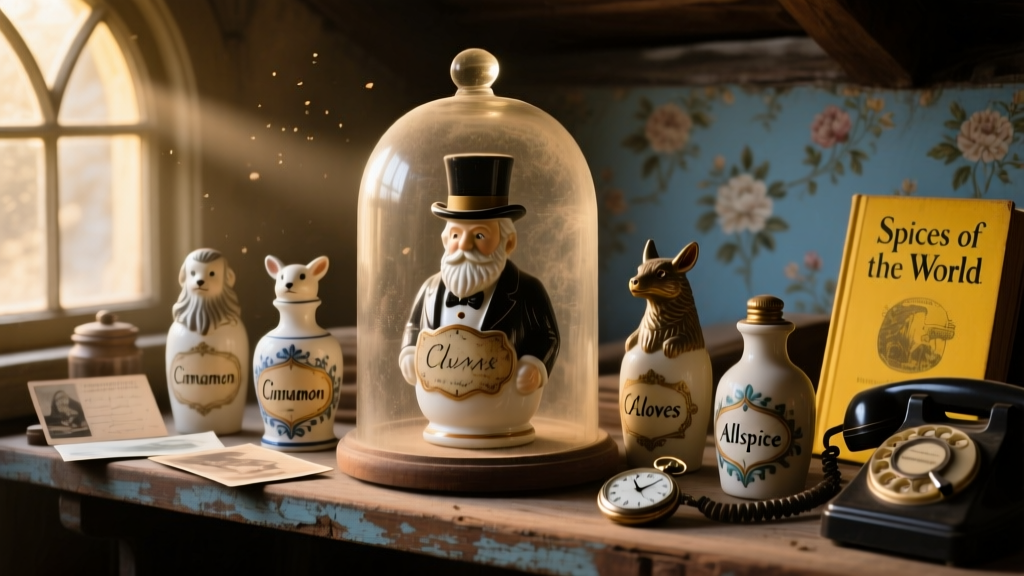
Old Spice Figural Bottles: A Collector’s Guide to Mid-Century Iconography and Value
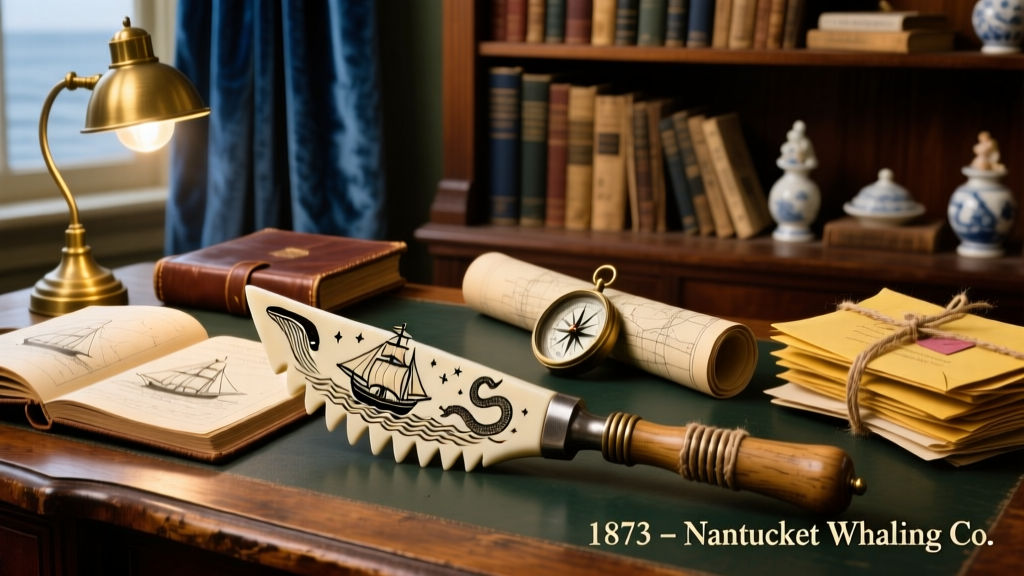
Scrimshaw Pie Crimper with Baleen-Banded Handle: A Mid-Century American Collectible at the Intersection of Craft, Cuisine, and Whaling Heritage
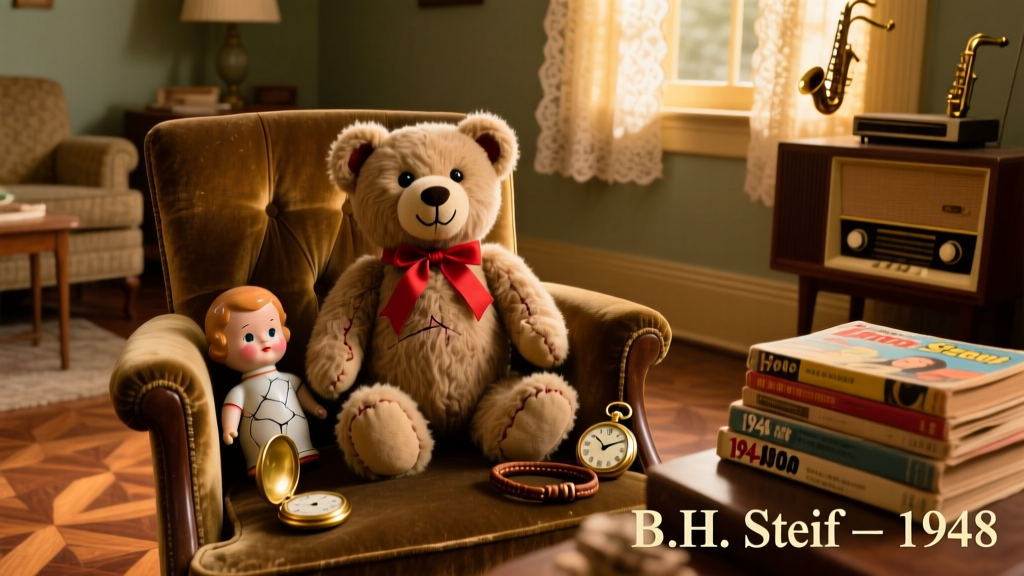
B. H. Steif: The Forgotten Mid-Century Toy Powerhouse Behind Iconic Plush and Mechanical Wonders
Poussard: The Forgotten French Mechanical Marvel of Mid-Century Toy Engineering
Advertising Label: Red Tips Cigars 6 × 10 Inch – A Mid-Century Tobacco Promotional Artifact
Caucasian Hexagonal Medallion Rug (Red Field, Stripe Border): A Mid-Century Collector’s Profile — 172 × 42 Inches
The Red Heart Tray: Identifying, Dating, and Valuing the Iconic 1940s–1950s Wooden Cutlery Tray
Stewart Warner Tan Maroon Celluloid Table Radio: A Mid-Century Design Icon and Collector's Benchmark
Woody Woodpecker Head Cookie Jars by Walter Lance: A Collector’s Deep Dive into Mid-Century Ceramic Iconography