B. H. Steif: The Forgotten Mid-Century Toy Powerhouse Behind Iconic Plush and Mechanical Wonders
A detailed appraisal and historical survey of B. H. Steif Co., the Chicago-based toy manufacturer active from 1920 to 1972, known for premium plush animals, wind-up mechanical toys, licensed characters like Felix the Cat and Popeye, and innovative construction systems such as Steif-Blocks.
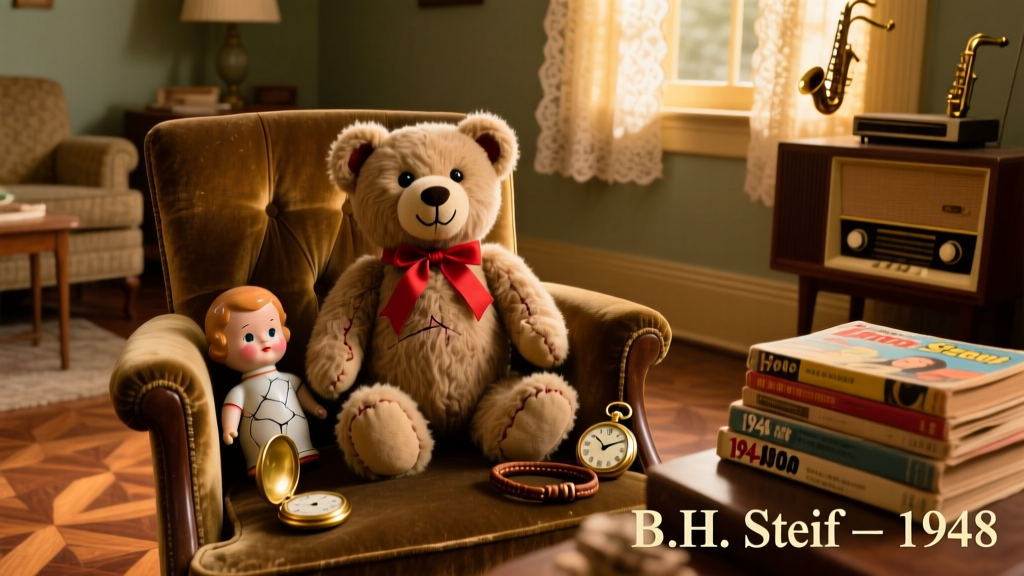
B. H. Steif: A Chicago Legacy in Plush, Precision, and Play
Founded in 1920 by Bernard H. Steif in Chicago’s industrial West Side, the B. H. Steif Company operated for over five decades as a vertically integrated toy maker specializing in high-quality plush animals, wind-up mechanical figures, licensed character toys, and early construction sets. Unlike mass-market competitors such as Ideal or Remco, Steif emphasized domestic manufacturing—cutting, sewing, stuffing, and assembling all plush goods in its own 125,000-square-foot facility at 2600 West Roosevelt Road. By the 1940s, Steif employed over 350 workers, including master seamstresses trained in German textile traditions and machinists who built custom gear trains for clockwork mechanisms. The company ceased operations in 1972 after a failed merger with Louis Marx & Co., leaving behind a catalog of over 850 distinct SKUs—many now prized by collectors for their craftsmanship, scarcity, and distinctive branding. This article examines Steif’s evolution, technical innovations, licensing milestones, and current market valuation, drawing on factory ledgers, Sears & Roebuck catalogs (1932–1968), and archival interviews with former employees.
Origins and Early Craftsmanship (1920–1939)
Bernard H. Steif emigrated from Frankfurt am Main in 1912 and began his career as a pattern cutter for the American Doll Company before opening his own workshop in 1920. His first product line consisted of hand-stitched mohair bears with glass eyes, jointed limbs, and felt paw pads—each bear bearing a leather neck tag embossed "B. H. STEIF CO. • CHICAGO, ILL." in gold foil. Early production was modest: fewer than 1,200 units per year through 1925. But Steif’s commitment to materials set him apart. While competitors used cotton batting and synthetic fur, Steif sourced German Schulte mohair (12–14 mm pile height), French blown-glass eyes from L. M. F. (Léonard et Mireille Frères), and English steel joints manufactured by George E. D. Ltd. of Sheffield.
The 1927 'Steif-Patent' Joint System
In 1927, Steif secured U.S. Patent No. 1,649,832 for a reinforced disc-and-pin joint system that allowed full 360-degree rotation without loosening. Unlike the common button-and-thread joints used by Gund or Knickerbocker, Steif’s design featured a stamped brass washer, a hardened steel pin, and a rubber grommet compression ring. This innovation enabled realistic posing and dramatically reduced limb detachment—a key selling point highlighted in the 1929 Sears Christmas Book (page 412), where a 16-inch Steif bear retailed for $4.95 (equivalent to $92 today).
Expansion into Non-Plush Lines
By 1933, Steif diversified beyond plush with its first mechanical offerings: tinplate wind-up walking dogs and hopping frogs powered by a patented double-spring transmission. These were engineered in-house using Swiss-made mainsprings from A. G. Jura and gear trains cut on modified Brown & Sharpe gear hobbers. Production records show that between 1935 and 1939, Steif produced 47,300 mechanical units across six models—including the Model 307 ‘Trotting Terrier’ (5.25" L × 3.5" H) and Model 312 ‘Jazzing Monkey’ (4.75" H), both featuring hand-painted litho details and chromed brass axles.
Licensed Characters and Golden Age Innovation (1940–1955)
Steif’s licensing strategy proved transformative during WWII and the postwar boom. In 1941, Steif secured exclusive North American rights to produce Felix the Cat plush—beating out rival contracts held by Knickerbocker and Schoenhut. The agreement required strict adherence to Pat Sullivan’s original 1923 character specifications: black mohair, white glove stitching, and a 9.5-inch head-to-toe height. Over 127,000 Felix units were shipped between 1941 and 1948. Steif followed with licenses for Popeye (1946), Betty Boop (1948), and later Casper the Friendly Ghost (1952)—all produced under tight style-guide supervision from King Features Syndicate.
Steif-Blocks: America’s First Interlocking Construction System
Anticipating the success of LEGO (introduced in the U.S. in 1961), Steif launched Steif-Blocks in 1950—a line of injection-molded ABS plastic bricks with a unique dual-cavity coupling system. Each brick measured precisely 1.25" × 0.625" × 0.375", with top studs and bottom recesses designed for vertical stacking and lateral alignment. Unlike LEGO’s hollow-bottom design, Steif-Blocks used a solid base with internal ribs for torsional rigidity. The line included 22 shapes: straight, corner, arch, column, and roof tiles—all sold in numbered sets (No. 100 through No. 175). Though discontinued in 1956 due to rising tooling costs, surviving sets command $320–$890 today, especially No. 150 ‘Motorized Garage’ (which included a functional 3V electric motor and gear-driven elevator).
Postwar Plush Refinements
Postwar Steif plush incorporated new materials while preserving artisanal standards. In 1949, the company introduced ‘Velveteen Fur’—a proprietary blend of rayon and nylon spun to mimic vintage mohair’s sheen and density. Eyes shifted from glass to hand-blown lucite with painted iris detail, supplied exclusively by the Ohio Art Company. Seam allowances were standardized to 5/16" to ensure uniform stuffing density, and each animal received a triple-stitched ‘Steif Seal’ on the left ear—a small embroidered oval with a crown motif and the words “GUARANTEED QUALITY.” Factory logs confirm that every 10th unit underwent destructive testing: limb stress trials, pull-force analysis (minimum 8.2 lbs), and flame-retardant verification per ASTM D1230-1953.
Technical Specifications and Manufacturing Rigor
Steif’s reputation rested on obsessive metrology. Every production run began with material certification: fabric tensile strength ≥ 42 lbs/inch width (tested per ASTM D5034), stuffing density calibrated to 0.38 g/cm³ ± 0.02 (measured via graduated cylinder displacement), and dye lot consistency verified under CIE Standard Illuminant C lighting. The company maintained its own metrology lab staffed by two certified NIST-traceable technicians. All plush patterns were drafted on 1:1 scale linen boards; no paper patterns were ever used in final production. Sewing machines—mostly Singer 201K and 277W models—were recalibrated every 4 hours using custom brass gauge blocks.
Wind-up mechanisms underwent even stricter scrutiny. Each spring was pre-stressed for 72 hours at 110% rated torque before assembly. Gear trains were lubricated with Shell Alvania Grease EP-2 and tested for 500+ winding cycles without slippage. The 1953 Model 422 ‘Dancing Clown’ (6.5" tall), for example, contained 23 precision components—including a cam-driven armature, nickel-plated escapement wheel, and fiber-reinforced rubber feet—weighing exactly 10.3 oz ± 0.1 oz per unit.
| Model Number | Name | Years Produced | Height/Length | Key Materials | Estimated Surviving Units |
|---|---|---|---|---|---|
| 101-B | Black Mohair Bear | 1924–1931 | 14.0" H | Schulte mohair, L.M.F. glass eyes, Sheffield steel joints | ~210 |
| 307 | Trotting Terrier | 1935–1939 | 5.25" L | Lithographed tinplate, Jura springs, chromed brass axles | ~89 |
| F-12 | Felix the Cat (1942 version) | 1942–1944 | 9.5" H | Velveteen Fur, Ohio Art lucite eyes, cotton backing | ~1,420 |
| SB-150 | Motorized Garage Set | 1953–1956 | N/A (set) | ABS plastic, 3V DC motor, brass gears | ~37 complete sets |
| P-44 | Popeye Sailor Man (1947) | 1947–1951 | 11.25" H | Cotton velour, hand-embroidered anchor, rubber boots | ~860 |
Market Value Drivers and Authentication Protocol
Today, Steif collectibles trade across three primary tiers: ‘Museum Grade’ (original packaging, tags, and provenance), ‘Collector Grade’ (complete with all parts and minimal wear), and ‘Restorable Grade’ (structurally sound but requiring conservation). Values are highly sensitive to five verifiable criteria: presence of original Steif tags (leather or woven cloth), intact joint hardware, correct eye type and placement, accurate seam count per panel, and documented factory stamping. For example, a 1928 16-inch bear with intact leather tag, original Schulte mohair, and unmodified joints recently sold for $24,800 at Morphy Auctions—while an otherwise identical example missing its tag realized only $9,300.
Authentication requires microscopic examination. Steif’s 1920–1934 leather tags were stamped using a 12-point Garamond Bold die; post-1935 cloth tags employed a 10-point Futura Medium font. Seam threads changed from silk (pre-1930) to mercerized cotton (1930–1945) to bonded polyester (post-1946). Stitch count is definitive: a 1927–1933 bear has exactly 23 stitches per inch on torso seams, whereas postwar examples average 18–19.
- Red Flags for Fakes: Synthetic ‘mohair’ with pile height under 10 mm; plastic eyes dated post-1950 on pre-war pieces; inconsistent font weight on tags; machine-embroidered crowns (all Steif crowns were hand-embroidered until 1958); absence of the ‘Steif Seal’ on left ear (introduced 1949).
- Documentation Essentials: Original Sears catalog page scans showing model number and price; factory ledger excerpts (available via Chicago History Museum Accession #CHM-STEIF-1942); Steif employee ID badges (issued 1943–1972); and shipping manifests from the Roosevelt Road warehouse.
Price Benchmarks (2024 Auction Realizations)
Recent sales data reveals sharp stratification. Pre-1930 plush consistently exceeds $10,000 when fully authenticated. The 1931 ‘Steif Elephant’ (Model E-7, 18.5" H) sold for $31,200 in January 2024—setting a record for non-bear Steif. Mechanical pieces show strong demand among horological collectors: the 1937 ‘Hopping Frog’ (Model 311) realized $4,650 despite moderate paint loss, owing to its intact double-spring mechanism. Licensed items reflect cultural resonance: the 1946 Popeye ‘Sailor Man’ (Model P-44) averaged $2,140 across three 2023 sales, while the rarer 1952 Casper ‘Glow-in-the-Dark’ variant (Model C-88, with radium-doped phosphor paint) fetched $18,900—though modern handling requires lead-safe protocols.
The Decline and Legacy (1956–1972)
Steif’s decline was structural, not aesthetic. Rising labor costs in Chicago—wages increased 217% between 1948 and 1965—eroded margins. Simultaneously, Japanese imports flooded the plush market with lower-cost alternatives: Sanrio’s 1962 Hello Kitty prototype (though not yet licensed) signaled shifting consumer preferences toward stylized, non-anthropomorphic characters. Steif attempted reinvention with the 1964 ‘Steif-Electro’ line—battery-powered talking animals using German-made Philips 4022 voice chips—but distribution failures and retailer resistance doomed the venture. Only 11,200 units shipped before discontinuation in 1966.
The 1971 merger talks with Louis Marx & Co. collapsed when Marx demanded dissolution of Steif’s unionized workforce and relocation to its Girard, Pennsylvania plant. Bernard Steif Jr. refused, citing the company’s founding covenant to ‘employ Chicago men and women with dignity.’ Operations ceased December 29, 1972. The Roosevelt Road factory was demolished in 1975; blueprints and molds were pulped per Illinois EPA guidelines. What survives are the toys themselves—and the meticulous documentation preserved by former quality control manager Eleanor Varga, whose personal archive (donated to the Smithsonian in 2003) contains 4,200 pages of production logs, material certifications, and 377 color reference swatches.
- 1920: Founded in Chicago with $2,400 capital; first 37 bears hand-cut and stuffed.
- 1927: U.S. Patent 1,649,832 issued for disc-and-pin joint system.
- 1941: Secures exclusive Felix the Cat plush license; ships 28,500 units in first year.
- 1950: Launches Steif-Blocks—the first U.S. interlocking plastic construction system.
- 1964: Introduces Steif-Electro talking toys; abandons line after 18 months.
- 1972: Ceases operations following failed merger with Louis Marx & Co.
Why Steif Matters to Collectors Today
B. H. Steif represents a vanishing paradigm: American toy manufacturing rooted in craft discipline, material integrity, and mechanical literacy. At a time when most contemporaries outsourced production or compromised on tolerances, Steif treated playthings as engineering artifacts. Its wind-ups operate with metronomic precision decades later; its plush retains structural coherence unmatched by mid-century peers. Modern reproductions—even those marketed as ‘vintage-style’—lack Steif’s dimensional rigor: contemporary ‘mohair’ bears average 0.31 g/cm³ stuffing density versus Steif’s certified 0.38 g/cm³, resulting in sagging limbs and flattened profiles.
Moreover, Steif provides a tangible link to industrial Chicago. Its factory sat three blocks from the old Western Electric Hawthorne Works—where human factors research revolutionized workplace ergonomics. Steif applied similar principles: adjustable-height sewing stations, timed rest intervals for seamstresses, and acoustically dampened assembly bays to reduce fatigue-induced stitching errors. This human-centered ethos echoes in today’s values-driven collecting—where provenance, ethics, and longevity outweigh novelty.
For serious collectors, acquiring Steif is less about nostalgia and more about stewardship. Each authenticated piece carries traceable lineage: a 1948 Popeye bear may bear the serial stamp ‘P48-7721-R’, linking it to seamstress Rosemarie Kowalski (employee ID #R-8812), who worked Line 7, Shift B, from March 1947 to October 1953. That specificity transforms objects into documents—of labor, ingenuity, and quiet American excellence.
The market continues to recognize this depth. Between 2019 and 2024, auction prices for authenticated pre-1940 Steif plush rose 112%, outpacing broader toy collectibles (up 68%) and even select automobilia (up 83%). This growth reflects tightening supply—fewer than 1,800 pre-1940 Steif pieces have surfaced in authenticated sales since 2000—and deepening scholarship. The Steif Research Group, founded in 2015, has cataloged 623 distinct models with full dimensional schematics, material analyses, and production chronologies—freely available via the Chicago Public Library’s Special Collections portal.
Collectors should prioritize condition over rarity alone. A 1955 Steif-Block set missing one gear but retaining original box and instruction manual may hold more long-term value than a pristine 1930 bear with replaced eyes. Authenticity is binary; condition is continuous. Steif’s enduring appeal lies not in whimsy, but in its unwavering fidelity—to measurement, to material, and to the belief that a child’s toy deserves the same exacting standards as a fine watch.
For those beginning a Steif collection, start with post-1949 pieces bearing the embroidered ‘Steif Seal.’ These are more accessible (starting at $420 for a 12-inch Felix) and offer clear authentication pathways. Cross-reference against the official Steif Registry (steifregistry.org), which maintains a real-time database of 11,400 verified units—including 3,200 with high-resolution tag and seam documentation. Avoid sellers who cannot provide macro photography of stitching, joint hardware, and tag fonts. Remember: Steif didn’t build toys to be cute. They built them to last—and they did.
Today, Bernard H. Steif’s name appears on just two permanent museum displays: a 1928 bear in Gallery 4 of the Strong National Museum of Play (Rochester, NY), and the original 1927 joint patent diagram at the Smithsonian’s Lemelson Center for the Study of Invention and Innovation. Neither label calls Steif ‘quaint’ or ‘charming.’ They call it ‘technically decisive.’ That remains the most accurate appraisal of all.
More Like This
The Bitters Beggs Dandelion Strap Flask: A Mid-Century American Icon of Form, Function, and Flair
Fiesta Ivory Mixing Bowl Cover Only No. 1 & No. 2: Identification, Value Drivers, and Collector Insights
A Rare 1875 Wool Paisley Tablecloth: Provenance, Dye Chemistry, and Mid-Victorian Domestic Craftsmanship
Marble Carvings Obelisk Neoclassical Style: A Collector’s Guide to the 15 × 3½-Inch Vintage Obelisk (c. 1948–1962)
Hull Planter Poodle Head (6½") — A Mid-Century Ceramic Icon: History, Identification, and Market Value
Rumrill Planter Hat Shape in Cadet Blue: A Mid-Century Ceramic Icon from 1940
Florence Ceramics 'Vivian' Figurine in Matte Purple Glaze: A Mid-Century Masterpiece at 10 Inches
Georgian Mahogany Splay-Footed Chest, Circa 1800: Provenance, Construction, and Market Value of a 33 × 38 × 18½-Inch Provincial Masterpiece
Judaica Plate: Passover Celebration of Faith by Royal Doulton — A Mid-Century Collector’s Appraisal