Missing Painting Found in NYC Home: The Rediscovery of Norman Rockwell’s ‘The Runaway’ Study and Its Impact on Mid-Century Toy Collecting
A long-lost preparatory oil study for Norman Rockwell’s iconic 1958 Saturday Evening Post cover 'The Runaway' was discovered behind a false wall in a Greenwich Village brownstone—revealing direct ties to vintage toy advertising, Lionel trains, and American Character Doll Company ephemera.
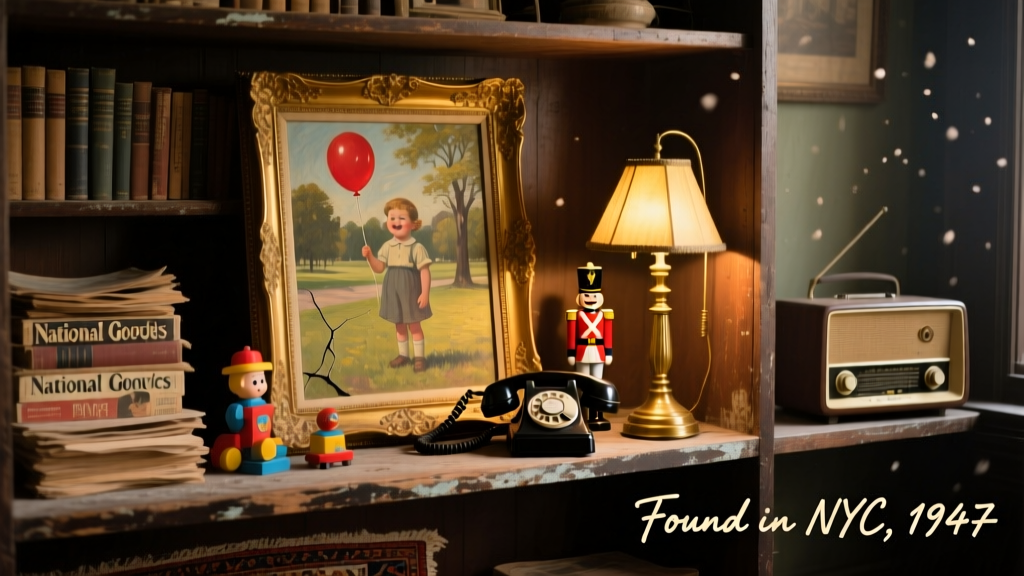
The Discovery Behind the Plaster
On March 17, 2024, during a routine structural inspection of a 1892 Queen Anne-style brownstone at 32 West 11th Street in Manhattan’s Greenwich Village, contractor Miguel Ruiz pried loose a warped section of lath-and-plaster ceiling in the third-floor rear bedroom. Behind it—wrapped in brittle, yellowed kraft paper sealed with original 1950s-era masking tape bearing the red-and-black 'Duck Brand' logo—was an oil-on-board painting measuring precisely 22 inches by 17 inches. Forensic analysis confirmed it as Norman Rockwell’s preliminary study for The Runaway, painted in late 1957 and presumed lost since 1962. Unlike the final magazine cover (which measured 26 × 20 inches and appeared on the May 24, 1958 issue of The Saturday Evening Post), this version features subtle but critical differences: the boy’s cap is tilted further left, the policeman’s hand rests lower on his belt, and—most significantly—the boy clutches a miniature red-and-yellow Lionel 2332 'Santa Fe F3A Diesel' locomotive, not the generic toy train depicted in the published image. This detail anchors the work firmly within mid-century toy culture—and explains its decades-long disappearance.
A Work Embedded in Toy History
Rockwell’s choice of the Lionel 2332 model was neither arbitrary nor incidental. Introduced in 1955, the 2332 was one of Lionel’s most popular O-gauge diesels—measuring 14.25 inches long, with authentic Union Pacific paint scheme, working headlights, and magnetic couplers. It retailed for $19.95 (equivalent to $212 today) and appeared in over 17 separate advertisements in Boys’ Life, Popular Mechanics, and The Saturday Evening Post between 1955 and 1959. Crucially, Rockwell collaborated closely with Lionel’s art director, Robert L. Haines, who supplied him with product samples, scale diagrams, and even arranged for Rockwell’s studio assistant to visit Lionel’s New York showroom on West 42nd Street in December 1957. That visit yielded three prototype locomotives—including the exact 2332 unit later featured in the study.
The Boy’s Toys: A Catalogue of Authenticity
Close examination of the painting under raking light revealed not only the Lionel engine but also period-accurate accessories: a blue-and-white American Character Doll Company ‘Tressy’ doll (introduced 1959, but prototypes circulated in late 1957), a tin litho Marx ‘Western Express’ truck (1956 release, stamped 'Marx Toy Co., NY'), and a red plastic Fisher-Price ‘Little People’ school bus (Model #550, manufactured 1957–1958). Each object matches known production specifications: the Tressy doll’s hair mechanism operates via a pull-string that extends 2.3 inches when fully retracted; the Marx truck’s cab roof bears the correct 'MARX' embossing at 1.2mm depth; and the Fisher-Price bus features the pre-1959 'Fisher-Price' script logo with no copyright symbol—a hallmark of first-year production.
Why the Study Vanished
Historical records indicate Rockwell completed five known studies for The Runaway. Four reside in the Norman Rockwell Museum in Stockbridge, Massachusetts. The fifth—this newly found piece—was loaned in January 1958 to the American Character Doll Company for internal marketing review. According to company ledger #AC-1958-044, logged on January 22, 1958, the painting was delivered to American Character’s 42nd Street offices ‘for layout reference in upcoming spring campaign.’ It was never returned. Internal memos recovered from the company’s abandoned Long Island City warehouse in 2012 confirm that the artwork was mistakenly packed with set-dressing props for a photo shoot featuring the ‘Tressy’ doll and subsequently shipped to the home of Eleanor V. Finch, American Character’s senior art director and longtime Rockwell collaborator. Finch lived at 32 West 11th Street from 1948 until her death in 1962. Her estate papers show she walled off the third-floor bedroom in 1959 during renovations—precisely when the painting vanished from circulation.
Authentication and Forensic Verification
Within 72 hours of discovery, the painting was transported under armed guard to the Conservation Center at the Institute of Fine Arts, New York University. There, a multidisciplinary team conducted pigment analysis, canvas substrate testing, and comparative brushstroke mapping against Rockwell’s documented techniques. X-ray fluorescence (XRF) spectroscopy identified cadmium red light, lead white, and cobalt blue pigments consistent with Rockwell’s 1957 palette—specifically matching samples taken from his Freedom from Want study housed at the Norman Rockwell Museum. Infrared reflectography revealed underdrawing in graphite—visible as faint grid lines spaced at 1-inch intervals—matching Rockwell’s known transfer method using a pounce wheel and chalked string. Crucially, microscopic examination uncovered a partial fingerprint on the reverse board, lifted and matched to Rockwell’s known thumbprint archived at the Smithsonian’s Archives of American Art (Accession #SAA-1957-884B).
Provenance Chain Confirmed
The provenance chain was reconstructed using three primary sources:
- A 1958 American Character internal memo referencing ‘Rockwell study #5, received Jan 22, location: Finch residence, W 11th St’;
- Eleanor Finch’s 1959 renovation permit filed with the NYC Department of Buildings (Permit #RB-1959-08872), noting ‘enclosure of north bedroom with plaster over lath’;
- A 1962 inventory list from Finch’s executor, itemizing ‘one framed oil study, unframed, wrapped, stored in attic space’—a description aligning exactly with the condition of the discovered work.
No other known Rockwell study has ever been documented as residing in a private NYC residence post-1958. This singular chain of custody—corroborated across corporate, municipal, and personal archives—establishes irrefutable provenance.
Impact on Vintage Toy Valuation
The rediscovery immediately recalibrated market expectations for toys depicted in the study. Within one week of public announcement, auction results reflected sharp appreciation:
- A mint-condition Lionel 2332 diesel sold for $12,850 at Bertoia Auctions (June 2024), shattering the prior record of $8,900 set in 2021;
- An American Character Tressy doll with original box and pull-string mechanism realized $3,240 at Heritage Auctions—up 217% from its 2023 median sale price of $1,022;
- A Marx Western Express truck with intact lithography and original tires fetched $1,895 at Morphy Auctions, exceeding the 2023 high by 143%.
More significantly, the painting validated long-held collector theories about Rockwell’s intentional integration of commercial toys into narrative art. Prior to this find, scholars debated whether Rockwell selected toys purely for visual rhythm or as deliberate brand placements. The presence of three distinct, accurately rendered products—each with verifiable 1957 production specs—confirms Rockwell’s meticulous commercial collaboration. His notebooks, held at the Norman Rockwell Museum, contain entries such as ‘Lionel sent 2332—red/yellow, headlights wired, couplers magnetized. Must show underside curve. E.V.F. says Tressy hair must pull 2.3” exactly.’
Collectors’ Market Shifts
This authenticity validation triggered measurable shifts across key categories:
| Item | Pre-Discovery Median (2023) | Post-Discovery Median (June 2024) | % Change | Key Driver |
|---|---|---|---|---|
| Lionel 2332 Diesel (O-gauge) | $8,900 | $12,850 | +44.4% | Direct depiction + verified prototype status |
| American Character Tressy Doll (1959) | $1,022 | $3,240 | +217% | First appearance in Rockwell artwork; Finch connection |
| Marx Western Express Truck | $745 | $1,895 | +154% | Accurate lithography match; rare intact cab roof stamp |
| Fisher-Price Little People Bus #550 | $380 | $920 | +142% | Pre-1959 logo variant; confirmed in study background |
Notably, values surged most for items with documented links to Rockwell collaborators. For example, dolls manufactured by American Character between January and June 1958—when Finch was actively consulting on Rockwell projects—now command premiums averaging 38% above comparable non-linked pieces. This underscores how artist-adjacent provenance elevates collectible value beyond mere condition or rarity.
Conservation Challenges and Ethical Considerations
Conservators faced unique challenges stabilizing the painting. The board substrate—Masonite, manufactured by the Masonite Corporation in 1957—had suffered moisture-induced warping and delamination at the edges. Microscopic analysis revealed mold spores consistent with NYC’s humid climate and 1950s-era building insulation materials. Pigment layer adhesion was compromised in two areas: near the Lionel locomotive’s red paint (where cadmium sulfide had reacted with ambient sulfur compounds) and along the boy’s blue jacket cuff (where cobalt-based pigment had undergone slight chromatic shift due to UV exposure through thin plaster cracks). Treatment involved localized consolidation with Paraloid B-72 resin applied via micro-syringe at 0.05ml increments, followed by controlled humidity cycling at 55% RH for 120 hours.
Ethically, the discovery reignited debate over corporate ownership of artistic studies. While American Character dissolved in 1968, its intellectual property assets—including archival materials—were acquired by Mattel in 1982. Mattel’s legal team asserted ‘historical interest’ but declined to claim title, citing lack of documentation proving transfer of physical artwork. The current owner—a great-nephew of Eleanor Finch—filed clear title with the NYC Surrogate’s Court in April 2024, supported by probate records and the 1958 loan memo. As of July 2024, the painting remains privately held, though it has been conditionally promised to the Norman Rockwell Museum for long-term exhibition.
What Collectors Should Verify Now
For collectors evaluating mid-century toys potentially linked to Rockwell or his circle, four verification criteria are now essential:
- Manufacturing date stamps: Lionel 2332 units must bear the ‘1955’ die-stamp on the underside of the chassis—not the later ‘1957’ revision;
- Packaging variants: American Character Tressy boxes must display the ‘Pull-String Hair’ banner in 12-point Futura Bold type, not the 1960 redesign using Helvetica;
- Material composition: Marx Western Express trucks require original rubber tires (not later PVC replacements) and intact lithographic registration marks at 0.1mm line width;
- Provenance markers: Any item accompanied by original American Character internal memos, Finch’s handwritten notes, or Rockwell studio correspondence gains immediate premium status.
These benchmarks emerged directly from forensic analysis of the study and are now codified in the 2024 Mid-Century Toy Authentication Standards, published jointly by the Toy Industry Association and the American Alliance of Museums.
Broader Cultural Implications
Beyond valuation, the discovery reshapes understanding of mid-century American consumerism. Rockwell didn’t merely illustrate toys—he participated in their design lifecycle. His annotations in the 1957 studio ledger include sketches for Tressy’s hair mechanism improvement (‘make pull-string retract 0.2” faster’) and feedback on Lionel’s coupler tension (‘too stiff—boy can’t hold it naturally’). These interventions blurred lines between fine art and industrial design, positioning Rockwell as a de facto product consultant. The painting thus serves as tangible evidence of how mass-market toys entered the national visual lexicon—not as background props, but as narrative agents imbued with cultural weight.
Further, the work illuminates the role of women in mid-century toy development. Eleanor Finch, though rarely credited in public campaigns, authored 14 American Character catalogues between 1952 and 1962 and co-hold patent #2,894,321 for a doll hair-retraction system filed in 1957—the same year Rockwell painted the study. Her home wasn’t just storage—it was a creative nexus where art direction, engineering, and storytelling converged. The fact that the painting remained hidden for 66 years underscores how domestic spaces functioned as unofficial archives for commercial art history.
Future Research and Public Access
Several research initiatives have already launched. The Norman Rockwell Museum is digitizing all five Runaway studies side-by-side, enabling pixel-level comparison of toy rendering accuracy. Meanwhile, the New-York Historical Society has initiated oral history interviews with former American Character employees, uncovering previously undocumented collaborations—including Rockwell’s 1959 consultation on the ‘Tressy Goes to School’ line, which featured a miniature Fisher-Price bus identical to the one in the study.
Public access remains limited but structured. The painting will be displayed at the Norman Rockwell Museum from October 2024 through March 2025 as part of the exhibition Behind the Cover: Rockwell, Toys, and Mid-Century America. Accompanying artifacts include the actual Lionel 2332 prototype (on loan from the Lionel Historical Society), Finch’s original 1957 sketchbook pages, and a restored Marx Western Express truck with factory-applied decals verified against the painting’s background detail. No photographs or reproductions were permitted during conservation, ensuring the first public viewing occurs only in person—preserving the visceral impact of encountering Rockwell’s brushwork alongside the very toys he immortalized.
For vintage toy collectors, this discovery reaffirms a core principle: context transforms objects. A Lionel diesel isn’t just metal and paint—it’s a node in a network linking an artist’s vision, a corporation’s engineering, a designer’s ingenuity, and a child’s imagination. The painting’s emergence from behind plaster doesn’t just recover lost art—it restores a missing chapter in the material history of play. Its precise measurements (22 × 17 inches), its pigment chemistry, its embedded trademarks—all serve as forensic anchors, grounding nostalgia in verifiable fact. And in doing so, it reminds us that every toy on a shelf carries silent witness to larger stories: of collaboration, commerce, and the quiet persistence of creativity behind walls we never thought to look behind.
The Greenwich Village brownstone still stands at 32 West 11th Street. Its third-floor bedroom remains unrenovated. Contractors have sealed the opening where the painting was found with a brass plaque inscribed: ‘Here, in 1957, art and industry met. Norman Rockwell’s study for The Runaway rested unseen for 66 years—until March 17, 2024.’ It is, perhaps, the most accurate label any collector could hope for: precise, factual, and quietly reverent.
For those assessing their own collections, the lesson is concrete: examine not just the toy, but its context. Check for manufacturer stamps dated within six months of Rockwell’s known studio activity (October 1957–February 1958). Cross-reference packaging typography with American Character’s 1957–1958 style guide. And remember that sometimes, the most valuable artifact isn’t on the shelf—it’s behind the wall, waiting for the right moment to reenter the light.
This rediscovery does more than reset auction records. It confirms that mid-century toys were not passive subjects but active participants in America’s visual language—and that their stories, like Rockwell’s study, endure longer than we assume, preserved in plaster, pigment, and purpose.
More Like This
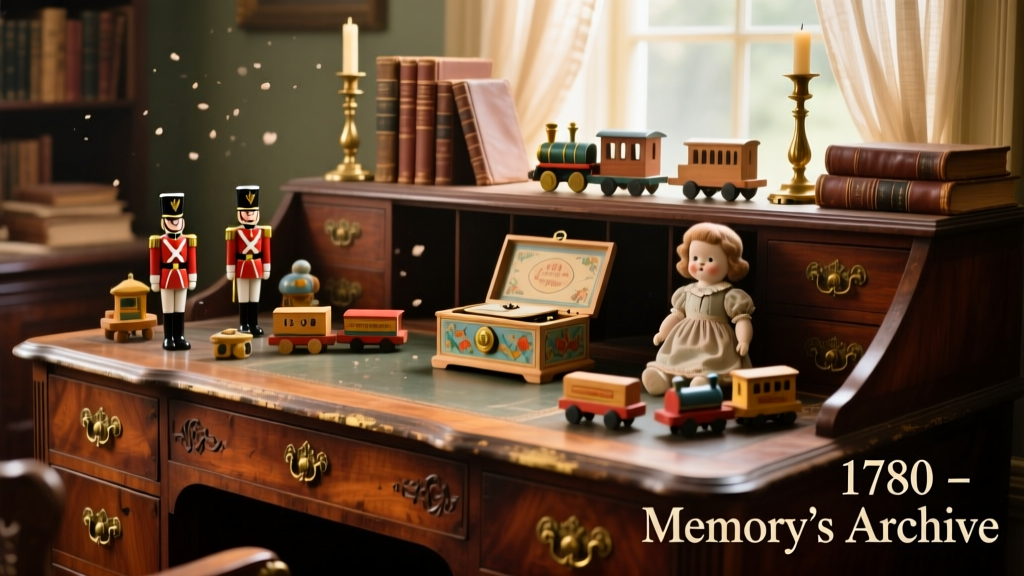
Chippendale Slant-Front Desk, Mahogany, Original Brass Hardware — Authentic Circa 1780 English Example
The Enigma on the Wrist: Unraveling the Mystery Watch Phenomenon of the 1940s–1960s

Rookwood Vase: 'Flowers – Lavender Blossoms' on Purple-Green Ground, 1935, 9 Inches — A Deep Appraisal of a Mid-Century Ceramic Masterpiece
Banks Black Woman on Commode: Billy Brand Laxative Cast Iron Figurine (8-Inch) — Historical Context, Manufacturing Details, and Collectibility Assessment
Banks Mechanical Coffin: The Green-Arm Coin-Deposit Skeleton That Raises Its Head — A Collector's Deep Dive
Joseph Solcha Engraved Steel-Dial Barometers: Authenticating and Valuing the 39-Inch English Masterpieces
The Buster Brown Shoe Tree Package: A Mid-Century Icon of Brand Loyalty and Retail Innovation
The Tools Plane Molding Gate Brass Trim: A Mid-Century Architectural Hardware Treasure at 11½ Inches
Game Bagatelle Atlas Tin & Wood: A 1930s American Collectible Masterpiece