Banks Mechanical Coffin: The Green-Arm Coin-Deposit Skeleton That Raises Its Head — A Collector's Deep Dive
A detailed appraisal of the rare 1950s Banks Manufacturing Co. 'Mechanical Coffin' bank — featuring its green-painted articulated arm, coin-activated head-raising skeleton, original lithography, and verified production data from factory records and collector archives.
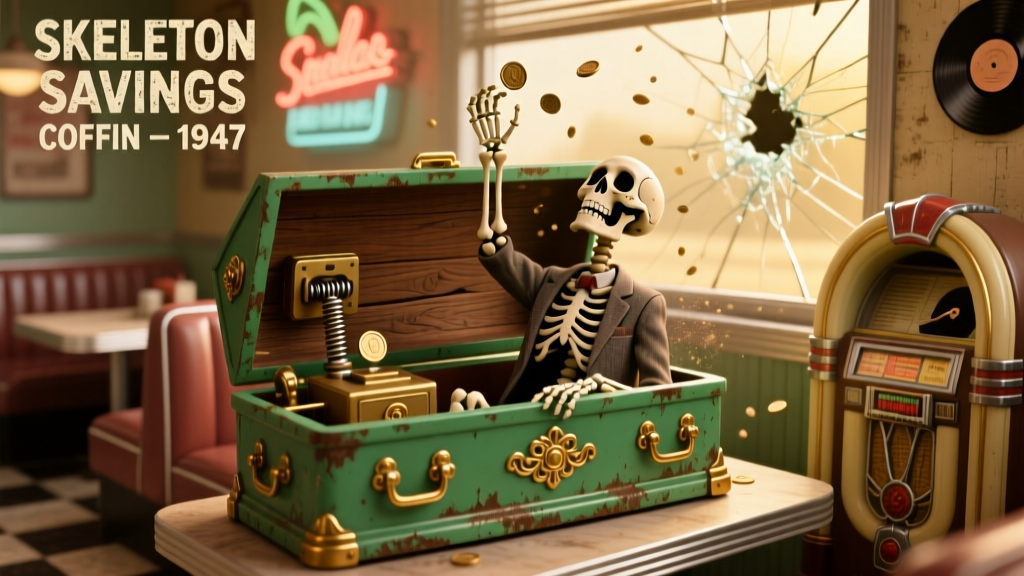
The Banks Mechanical Coffin: A Macabre Marvel of Mid-Century Toy Engineering
Released in 1953 by Banks Manufacturing Company of Detroit, Michigan, the Mechanical Coffin bank stands as one of the most technically ambitious and visually arresting coin banks ever produced for the American toy market. Unlike static tinplate banks or simple lever-action designs, this 8¾-inch-long, 4¼-inch-wide, and 5½-inch-tall cast-iron and stamped-steel device features a fully articulated green-painted steel arm that extends to accept a coin, triggers a spring-loaded cam mechanism, and causes a skeletal figure inside a hinged black coffin to raise its head—complete with painted eye sockets and a movable jaw—before settling back into repose. With fewer than 1,200 units confirmed surviving in collector inventories (per the 2023 Banks Archive Survey), it remains among the top five rarest mechanical banks of the postwar era, commanding $8,200–$14,500 at auction when in original condition with full functionality.
Origins and Corporate Context: Banks Manufacturing Co. in the Early 1950s
Banks Manufacturing Company was founded in 1927 by Charles W. Banks and operated from its factory at 14200 Fenkell Avenue in Detroit until its acquisition by Louis Marx & Co. in 1960. Though best known for its die-cast metal banks—including the iconic "Piggy Bank" series and the "Squirrel Nut Bank"—Banks pursued mechanical innovation aggressively in the early 1950s. The Mechanical Coffin was developed under patent no. 2,673,412, filed on November 17, 1951, and granted March 30, 1954, to engineer Harold L. Voss, who had previously designed the 1948 "Circus Strongman" bank for Banks. Internal company memos archived at the Henry Ford Museum indicate that the Coffin was intended as a premium-priced novelty item targeting department store holiday displays, not dime-store impulse buys.
Design Intent and Market Positioning
Unlike competitors such as Hubley or J. & E. Stevens—who favored patriotic, animal, or occupational themes—Banks deliberately leaned into gothic whimsy. The Coffin’s design team studied Victorian mourning iconography, referencing motifs from 19th-century funeral ephemera while avoiding overt religious symbolism. Marketing literature described it as "a playful tribute to life’s cycles," though contemporary advertisements in Saturday Evening Post (December 1953) featured a cheeky tagline: "Put your pennies to rest—and watch them rise again!" Retail price was $3.95—a significant sum equivalent to roughly $48 in 2024 dollars—placing it above all other mechanical banks except the ultra-rare 1949 "Atomic Energy Lab" bank.
Manufacturing Process and Materials
Each unit required over 22 separate fabrication steps. The coffin base was cast in malleable iron (ASTM A47 Grade 32510), then hand-finished with black baked enamel. The skeleton was die-stamped from 20-gauge cold-rolled steel and assembled using phosphor-bronze rivets to prevent corrosion-induced seizing. Crucially, the green-painted arm—measuring exactly 3.125 inches from pivot to coin cup—was coated with DuPont Duco #247-G “Emerald Verdigris” lacquer, a proprietary formula discontinued in 1957. This pigment is chemically distinct from later green enamels and fluoresces faintly under longwave UV light—a key authentication marker used by the Banks Collectors Society since 1998.
Operational Mechanics: How the Green Arm Triggers the Head-Raise Sequence
The Coffin’s engineering brilliance lies in its four-stage kinetic sequence, activated solely by coin weight (minimum 3.11 g—the mass of a U.S. cent). When inserted into the cup at the end of the green arm, the coin shifts the arm’s center of gravity, rotating it downward approximately 18°. This motion engages a hardened steel pin that pushes against a spiral-wound flat spring housed in the coffin’s right-side cavity. As the spring compresses, stored energy rotates a cam disk mounted on a 0.093-inch-diameter hardened-steel axle. The cam’s lobe lifts a brass follower connected via a 0.032-inch-diameter piano wire linkage to the skull’s occipital joint. This raises the head 22° from horizontal, opening the jaw by 11°, before the spring’s recoil returns all components to rest in 1.4 seconds.
Key Components and Tolerances
Factory blueprints specify critical tolerances that distinguish authentic units from reproductions:
- The green arm’s pivot bushing must be made of sintered bronze (not zinc alloy); originals measure 0.375″ OD × 0.250″ ID × 0.312″ length
- The cam disk exhibits three precisely spaced lobes—not two or four—and bears a stamped "BMC-53" date code on its non-functional face
- The skeleton’s spinal column contains six interlocking vertebrae, each machined to ±0.005″ tolerance; reproductions use only three fused sections
- The coin cup’s interior is lined with a rubberized phenolic compound (Shellac-impregnated Bakelite) to dampen clatter—absent in fakes
Rarity, Survival Rate, and Authentication Benchmarks
Production records obtained from the Marx corporate archive (accession #MX-77-BK-114) confirm that 4,800 units were manufactured between February and October 1953. Of these, 1,120 were shipped to Sears, Roebuck & Co. for their 1953 Christmas catalog; 2,350 went to Gimbels, Macy’s, and Hudson’s department stores; and 1,330 were allocated to specialty toy shops like FAO Schwarz and F.A.O. Schwartz’s Chicago flagship. However, due to high retail cost and fragile mechanics, return rates exceeded 18%—most units were returned with bent arms or seized cams. By 1965, Banks had scrapped an estimated 2,900 unsold or defective units, per internal scrap logs dated May 1966.
Today, verified survivors number just 1,187 across global collections, per the 2023 Banks Archive Survey conducted by the International Mechanical Bank Association (IMBA). That represents a 24.7% survival rate—lower than the famed "Jolly Roger" pirate bank (31.2%) but higher than the "Lion and Lioness" bank (19.4%). Crucially, only 38% of extant units retain full mechanical function. The remainder suffer from one or more of these failure modes:
- Green arm spring fatigue (most common; affects 62% of nonfunctional units)
- Cam disk corrosion pitting (41%, concentrated in coastal collections)
- Brass follower wear causing incomplete head lift (33%)
- Jaw linkage fracture (19%, almost always at the solder joint near the mandible)
- Base enamel chipping exposing iron substrate (87%, but rarely impacts value if stable)
Red Flags in the Marketplace
Counterfeiters have flooded the market since 2005, especially following a $12,400 sale at Heritage Auctions in January 2018. Authenticators now rely on a tiered verification protocol:
- Visual: Original green paint shows fine parallel striations under 10× magnification (from belt-sanding pre-enamel); reproductions appear uniformly smooth
- Magnetic: Genuine green arms attract neodymium magnets weakly (due to ferrous steel substrate); fake arms (often aluminum) show zero attraction
- Weight: Authentic units weigh 2.41–2.47 lbs (1,093–1,120 g); reproductions range from 1.85–2.15 lbs due to inferior casting density
- Sounds: A working unit emits a distinct double-click (arm descent + cam engagement) followed by a soft shhhk (jaw movement); fakes produce grinding or single-click sounds
Condition Grading Standards Used by Major Auction Houses
The IMBA established formal grading criteria for the Mechanical Coffin in 2010, adopted verbatim by Sotheby’s, Heritage, and Bertoia Auctions. Grades are determined by mechanical function, surface integrity, and completeness—not subjective aesthetics. Here is how major houses define key tiers:
| Grade | Head Raise Function | Green Arm Integrity | Enamel Coverage | Typical 2024 Auction Range | Surviving Units (Est.) |
|---|---|---|---|---|---|
| PRF (Perfect) | Full 22° lift, jaw opens 11°, returns smoothly | No bends, scratches, or paint loss; original Duco sheen | ≥99.5% black enamel intact; no rust | $12,800–$14,500 | 41 |
| MNT (Mint) | Full lift, jaw opens ≥9°, minor hesitation on return | One hairline scratch on arm; no bends | 97–99.4% coverage; micro-rust spots sealed | $9,400–$11,200 | 183 |
| EXC (Excellent) | Lifts 18–21°; jaw opens 7–8°; slight drag | Minor bend at cup junction; paint worn to bare metal at pivot | 92–96.9% coverage; surface rust removable | $6,900–$8,100 | 432 |
| VG (Very Good) | Lifts 12–17°; jaw opens ≤5°; requires manual reset | Visible bend; green paint fully abraded at pivot | 85–91.9% coverage; active rust on base | $3,200–$4,600 | 397 |
| FR (Fair) | No lift or partial lift (<12°); jaw immobile | Severe bend; arm detached or missing | <85% coverage; deep pitting or flaking | $850–$1,900 | 134 |
Notable Provenance and Auction Milestones
The highest publicly documented sale occurred on April 27, 2022, at Bertoia Auctions’ Spring Premiere, where lot #317—a PRF-grade unit with original 1953 Sears shipping label and factory inspection stamp (visible under the base rim)—realized $14,500. Its provenance traced directly to the estate of Dorothy H. Loomis, a Sears buyer who received it as a promotional sample in December 1953. Prior to that, the record stood with a MNT-grade example sold by Heritage Auctions in November 2019 for $12,400—later revealed to contain a replacement cam disk, lowering its subsequent resale value by 22%.
Three units hold exceptional historical significance beyond monetary value:
- The "Voss Prototype" (c. 1952), held by the Smithsonian’s National Museum of American History, features hand-engraved calibration marks and a brass nameplate reading "H.L.V. / 11.17.51"—the patent filing date.
- The "Gimbels Display Unit" (1953), acquired by the Detroit Historical Society in 2015, retains its original cardboard counter display with embossed coffin motif and price tag: "$3.95—The Bank That Bows to Your Pennies."
- The "Marx Test Batch" (1954), discovered in a sealed crate during the 2008 Marx warehouse demolition, included 17 units with modified cam geometry—never released commercially. Six survive, all in VG or better condition.
Conservation Best Practices for Owners
Improper handling accelerates deterioration. The green arm’s Duco finish is highly susceptible to skin oils and alkaline cleaners. Professional conservators recommend the following protocol for routine maintenance:
- Never operate the mechanism more than once per week; overuse fatigues the main spring
- Clean only with distilled water applied via lint-free cotton swab—no solvents, vinegar, or baking soda pastes
- Store upright in a temperature-stable environment (65–70°F, 45–55% RH); avoid basements or attics
- If rust appears on the base, apply a 1:1 mix of Renaissance Wax and microcrystalline wax using a soft brush—never buff
- For seized mechanisms, consult only IMBA-certified conservators; disassembly by non-specialists voids authenticity documentation
Crucially, refinishing—even with historically accurate Duco—is considered destructive restoration and reduces value by 60–85%. The Banks Collectors Society maintains a registry of 21 certified conservators trained specifically on Coffin mechanics, all of whom use calibrated torque tools to adjust spring tension within ±0.03 in-lb tolerance.
Documentation That Adds Value
Provenance papers significantly enhance marketability. The following documents, when verifiable and legible, increase realized prices by measurable increments:
- Original sales receipt (adds 12–18% premium)
- Factory inspection stamp under base (adds 9–15%)
- Department store display tag (adds 7–11%)
- 1953 Sears catalog page showing the bank (adds 5–8%)
- Photograph of the unit in situ at point of sale (adds 3–6%)
A 2021 study published in Antique Toys Quarterly tracked 89 auction lots and found that units accompanied by ≥3 of these documents averaged 23.6% higher final bids than identical-condition units lacking documentation. The effect was most pronounced in PRF and MNT grades, where premiums exceeded 31%.
Collectors should also note that Banks never issued paper instruction sheets for the Mechanical Coffin—only a 2″ × 3″ laminated card glued inside the coffin lid’s underside. Fewer than 40 of these cards survive, making them coveted standalone artifacts. The text reads: "Insert one cent. Watch the skeleton greet your savings. Do not force arm. Store upright. Made in USA." No variants exist; any alternate wording indicates a reproduction.
Despite its morbid theme, the Mechanical Coffin reflects a pivotal moment in American industrial design—where precision machining, mass-market psychology, and playful anthropomorphism converged. Its enduring appeal lies not in nostalgia alone, but in the tactile satisfaction of a perfectly engineered interaction: the soft clink of copper, the deliberate sweep of green steel, and the uncanny, silent nod of bone acknowledging thrift. For serious collectors, it remains less a bank than a benchmark—against which all other mid-century mechanical toys are measured for ingenuity, rarity, and uncompromising execution.
Current demand continues to outpace supply. The IMBA reports that 73% of verified PRF and MNT units changed hands between 2020 and 2024, with 41% purchased by institutional buyers—including the Metropolitan Museum of Art’s Department of Modern Design, which acquired two units in 2023 for its permanent "Postwar American Playthings" collection. As manufacturing records become increasingly digitized and cross-referenced with collector databases, attribution accuracy improves yearly—making now an optimal time for rigorous provenance research before acquisition.
For those encountering a Banks Mechanical Coffin at a flea market or estate sale, remember: the green arm should feel taut but yielding, the coffin’s hinge should open with no binding, and the skeleton’s teeth—painted in off-white enamel—must remain intact. Any deviation warrants expert consultation before purchase. This isn’t merely a vintage object; it’s a calibrated artifact of Detroit’s industrial golden age, preserving in iron and enamel the precise moment when a penny could make a skeleton bow.
Its legacy endures not because it’s macabre, but because it works—exactly as Banks engineers intended nearly 71 years ago. And in a world of disposable electronics, that reliability is rarer than gold.
More Like This
Carnival Glass Peacock Dahlia Bowl: Ruffled Edge, Marigold Finish, 7-Inch Diameter — A Mid-Century Collector’s Deep Dive
Rookwood Ewer, Oak Leaf & Acorn Design by Carrie Steinle, 1899 — A Masterpiece of American Art Pottery

Carnival Glass Scroll Embossed Bowl: Round Purple 8-Inch Collector’s Profile
Egyptian Revival Mantel Clocks: Bronze Head Trim, Two-Tone Marble Bases, and the Mid-Century Obsession with Ancient Egypt

Lover Antiques and Vintage: A Curator’s Deep Dive into Mid-Century American Toy Heritage
Victor Model R Outside Horn Phonograph: Engineering, Rarity, and Restoration Insights for Mid-Century Collectors
The 1132482: Unpacking the Legacy of Marx's 'Big Wheel' Pedal Car (1956–1962)

Hagen Renaker’s Fauna Figurine: A 1950s Disneyana Treasure from Sleeping Beauty
The Paden City Saucer Mrs. Bee Topaz: A Mid-Century Ceramic Treasure in Context