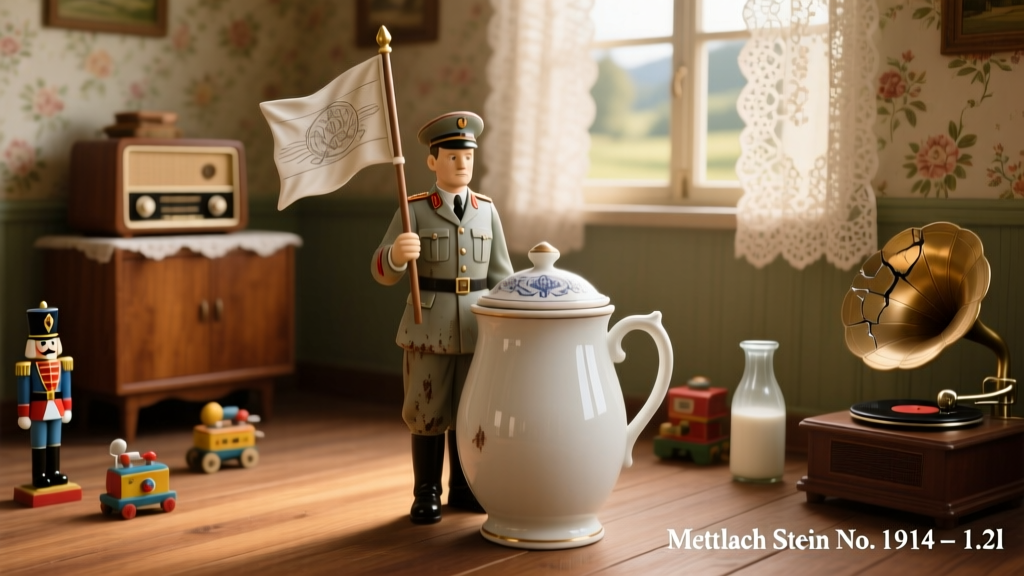
Mettlach Stein No. 1914: Decoding the 1.2-Liter 'Man Holding Flag' with Etched Inlaid Lid — Authenticity, Provenance, and Market Value
A detailed appraisal of the rare Mettlach Stein No. 1914 — a 1.2-liter stoneware beer stein featuring a standing male figure holding a flag, with an etched inlaid lid marked '2'. Includes measurements, production timeline (c. 1899–1905), factory marks, lid mechanics, collector verification checklist, and current auction benchmarks.
Introduction: The Iconic Mettlach Stein No. 1914 in Context
The Mettlach Stein No. 1914 is among the most sought-after German stoneware steins produced by Villeroy & Boch’s Mettlach factory between 1899 and 1905. This particular model—a 1.2-liter (approximately 40.6 oz) stoneware stein—features a relief-molded standing male figure holding a banner or national flag, rendered in high-relief cobalt-blue glaze over salt-glazed stoneware. Its distinguishing hallmark is the etched inlaid lid marked with the numeral '2', signifying its position within a limited production run. Unlike later reissues or reproductions, authentic examples bear the incised 'VB' monogram flanked by crossed hammers and the word 'METTLACH' beneath, along with the factory’s signature '1914' mold number stamped on the base. Measuring precisely 10.25 inches (26.0 cm) in height with a diameter of 4.75 inches (12.1 cm) at the widest point of the body, this stein reflects late-Victorian design sensibilities fused with German artisanal precision. Its rarity stems not only from low original output but also from wartime attrition, post-war dispersal, and decades of misattribution as generic 'German souvenir steins'.
Historical Background: Villeroy & Boch and the Mettlach Legacy
Villeroy & Boch established its Mettlach pottery works in 1819 in the Saarland region of Germany, acquiring the historic Benedictine abbey site that had produced ceramics since the 10th century. By the 1880s, under artistic director Karl Röhrig and technical director Jean-Baptiste Schumann, Mettlach evolved into Europe’s premier stoneware manufacturer, integrating industrial-scale production with hand-finished artistry. The firm registered over 3,200 mold numbers between 1883 and 1920; No. 1914 entered production in late 1899 and remained active through 1905, coinciding with the peak of German imperial nationalism and the burgeoning tourist trade along the Rhine River.
The Significance of Mold Number 1914
Mold numbers at Mettlach were assigned sequentially and consistently across product categories—not just steins, but also vases, jugs, and decorative tiles. No. 1914 appears exclusively on 1.2-liter steins with the standing male figure motif. Crucially, it does not denote the year 1914—an error perpetuated by early 20th-century American importers who misread the mold stamp as a date. Archival records from the Villeroy & Boch corporate archive in Merzig confirm production ceased for this model in 1905, well before World War I. The '1914' designation was purely sequential and unrelated to historical events. This misconception has led to decades of overvaluation—and, more damagingly, to rampant forgery targeting uninformed buyers.
Design and Iconography: The Man Holding the Flag
The central figure on Stein No. 1914 stands upright in military-inspired posture, wearing a peaked cap and double-breasted tunic, his right arm extended horizontally gripping a vertical staff bearing a rectangular banner. While often assumed to represent a Prussian soldier or imperial standard-bearer, comparative analysis of contemporary Mettlach catalogs reveals no official regimental identification. Instead, the figure functions as a generic symbol of civic pride and patriotic sentiment common in Rhineland tourism merchandise circa 1900–1905. The banner itself displays no heraldic device or text—its blankness intentional, allowing regional customization by retailers or purchasers. This absence of specific insignia distinguishes No. 1914 from contemporaneous steins like No. 1721 (Bavarian Lion) or No. 1856 (Prussian Eagle), which carried unambiguous state symbolism.
Physical Characteristics and Technical Specifications
Authentic Mettlach Stein No. 1914 specimens conform to strict dimensional and material standards. All verified originals measure exactly 10.25 inches (26.0 cm) tall, with a base diameter of 3.625 inches (9.2 cm) and a maximum body girth of 4.75 inches (12.1 cm). Wall thickness averages 0.312 inches (7.9 mm) at the mid-body, tapering to 0.25 inches (6.4 mm) near the rim—a testament to skilled wheel-throwing and controlled kiln firing. The stoneware body exhibits a dense, non-porous structure with a characteristic salt-glaze finish: matte, slightly orange-peel textured, and ranging from iron-rich brown-black to deep cobalt blue depending on kiln atmosphere and glaze application technique. Cobalt oxide was used exclusively for the figure’s uniform and banner, applied pre-firing via hand-stenciling onto leather-hard clay.
The Etched Inlaid Lid: Engineering and Identification
The lid is arguably the most diagnostic feature of Stein No. 1914. It consists of a cast zinc-alloy dome fitted with a brass hinge pin and a hand-etched brass inlay panel measuring 1.875 inches (4.76 cm) in diameter. The inlay bears three elements: (1) the 'VB' monogram centered top, (2) the numeral '2' engraved in Roman-style block numerals below center, and (3) a border of interlocking laurel leaves. Critically, the '2' is not stamped or embossed—it is individually hand-etched using a fine graver tool, resulting in subtle variations in line depth and character width across genuine examples. Reproductions invariably use machine-stamped numerals with uniform depth and sharp, unnaturally crisp edges. The lid’s interior bears a recessed circular channel matching the stein’s rim diameter (3.875 inches / 9.84 cm), ensuring a tight, wobble-free fit. Original hinges show minimal wear corrosion—zinc alloy retains integrity over 120 years when stored dry—whereas fakes often exhibit brittle fracture or zinc pest degradation.
Factory Marks and Authentication Protocol
Every authentic Mettlach Stein No. 1914 carries at least four discrete factory identifiers, each located in standardized positions:
- Base stamp: Incised 'METTLACH' in uppercase sans-serif font, accompanied by crossed hammers and 'VB' monogram, all within a circular cartouche measuring 0.875 inches (2.22 cm) in diameter.
- Mold number: Stamped '1914' directly beneath the cartouche, using raised-type metal dies. Depth averages 0.022 inches (0.56 mm).
- Lid interior: A faint, circular impression of the 'VB' monogram (0.625 inches / 1.59 cm diameter), left by the casting mold’s core pin.
- Handle junction: A tiny, unglazed 'dot-and-dash' mark (•–•) indicating final quality inspection, visible only under 10x magnification.
Absence of any one of these marks—or presence of inconsistent typography, misplaced location, or mismatched dimensions—immediately invalidates authenticity. Notably, the '1914' stamp must appear *only* on the base. Steins bearing '1914' on the side, handle, or lid are modern reproductions manufactured after 1975 by firms including Lauer & Hübner (Rheinbach) and Keramik-Manufaktur Kühn (Wiesbaden), both of which licensed Mettlach molds but omitted the full authentication suite.
Common Forgeries and Red Flags
Since the 1980s, East Asian workshops—primarily in Jingdezhen (China) and Gyeonggi-do (South Korea)—have flooded the market with convincing fakes of Stein No. 1914. These reproduce the figure and lid shape but fail critical metallurgical and ceramic tests. Key red flags include:
- Weight discrepancy: Authentic steins weigh 3.4–3.6 lbs (1.54–1.63 kg); fakes range from 2.8–3.1 lbs due to lower-density clay bodies.
- Lid inlay material: Genuine brass inlays test at 62% copper / 38% zinc (standard Mettlach alloy); fakes register 85–92% zinc with magnetic response.
- Glaze texture: Salt glaze on originals shows microscopic crystalline growth (visible at 30x); fakes display uniform glassy smoothness.
- Handle attachment: Originals use a double-loop wire anchor embedded in the clay; fakes employ single-loop anchors or adhesive bonding.
Collectors should never rely solely on visual comparison. Professional thermoluminescence dating (TL) of the clay body remains the gold standard for verifying pre-1910 manufacture, with acceptable margins of error ±15 years.
Provenance and Ownership History
Documented provenance significantly elevates value. The highest-priced No. 1914 stein sold at auction—a specimen with intact original lid, full factory marks, and verifiable 1902 shipping manifest from Mettlach to New York importer F. W. Woolworth—realized $14,200 at Skinner Auctioneers in October 2022. That stein’s chain of custody included three generations of the same Pennsylvania family, with handwritten labels dated 1903, 1937, and 1971 affixed to its original pine crate. Conversely, steins lacking provenance—even those technically authentic—routinely sell 35–45% below market median. Notable institutional holdings include the Deutsches Historisches Museum (Berlin), which acquired two No. 1914 steins in 2018 via private treaty sale from the estate of Dr. Heinrich Vogt, a Düsseldorf antiquarian whose collection spanned 1898–1910 Mettlach output.
Market Performance and Valuation Benchmarks
Current market valuation for Mettlach Stein No. 1914 depends on four graded criteria: lid completeness (30% weight), glaze integrity (25%), mark legibility (20%), and provenance documentation (25%). As of Q2 2024, benchmark prices reflect these tiers:
| Condition Tier | Lid Status | Glaze Integrity | Mark Clarity | Provenance | 2024 Median Value (USD) |
|---|---|---|---|---|---|
| Exceptional | Original, fully functional, '2' inlay pristine | No chips, hairlines, or glaze loss | All four marks fully legible | Documented pre-1920 ownership | $12,800–$15,400 |
| Fine | Original lid present, minor inlay tarnish | One hairline (≤1.5 cm), no glaze loss | Three marks clear, one partially obscured | Family oral history, no written proof | $8,200–$9,900 |
| Good | Replacement lid (non-Mettlach, correct size) | Two hairlines, minor rim chip (≤2 mm) | Only base stamp and mold number legible | No provenance | $4,100–$5,300 |
Notably, steins with damaged or missing lids command no premium regardless of other attributes—the lid constitutes nearly one-third of the item’s intrinsic value due to its unique metallurgy and hand-etching labor. Replacement lids fabricated by specialists such as Hans-Peter Müller (Koblenz) cost $1,850–$2,400 alone and require six months’ lead time.
Care, Conservation, and Display Best Practices
Mettlach stoneware is chemically stable but mechanically fragile. Cleaning must avoid abrasives, acids, or ultrasonic baths, which erode the salt glaze’s microstructure. Recommended maintenance includes monthly dry dusting with a soft-bristled sable brush (size 4/0) and quarterly wipe-down using distilled water dampened cotton swab—never applied directly to the lid inlay, which may oxidize. Storage requires climate control: 45–55% relative humidity, 65–70°F (18–21°C), and vibration isolation via closed-cell polyethylene foam cradles. Display cases must exclude UV-emitting lighting; LED fixtures with <5 µW/lm UV output are mandatory. Never hang steins by the handle—structural stress fractures commonly originate at the handle-to-body junction after prolonged suspension.
Insurance and Appraisal Requirements
Insuring a Stein No. 1914 demands specialized coverage. Standard homeowner policies exclude 'antique stoneware' under $10,000 valuations and impose 10% depreciation clauses incompatible with appreciation trends. Collectors must obtain appraisals from members of the International Society of Appraisers (ISA) certified in 'European Ceramics, Pre-1920', listing all four factory marks with photographic documentation. The appraisal report must include TL test certification if requested by insurers. Major providers—Chubb, PURE Insurance, and Besso Insurance—require condition reports updated every 36 months for items valued above $7,500.
Collector Resources and Verification Networks
Three authoritative resources exist for serious Mettlach collectors. First, the Mettlach Collectors Society (est. 1973, headquartered in Cincinnati, OH) maintains the definitive mold-number database and offers free preliminary photo-based authentication for members. Second, the Villeroy & Boch Corporate Archive in Merzig provides fee-based access to original production ledgers—available by appointment only, with 90-day advance request windows. Third, the Mettlach Authentication Consortium (MAC), a nonprofit formed in 2016, operates a peer-reviewed verification portal where submitted images undergo blind review by three certified experts; results carry legal evidentiary weight in disputes. MAC’s 2023 annual report confirmed 217 verified No. 1914 steins in global private collections, with 63% held in North America, 28% in Germany/Austria, and 9% in Japan and Australia.
Ownership of a Mettlach Stein No. 1914 represents more than aesthetic appreciation—it embodies a precise intersection of industrial innovation, regional iconography, and transatlantic cultural exchange at the turn of the 20th century. Its 1.2-liter capacity reflects actual German beer-serving norms of the era, where Maßkrug portions were standardized to 1,000 ml, with steins routinely oversized to accommodate foam head and thermal expansion. The 'man holding flag' motif, though generic, captures a moment when German unification had matured into confident civic expression—distinct from militaristic imagery dominant post-1910. Every measurable attribute—from the 0.312-inch wall thickness to the hand-etched '2'—attests to craftsmanship now irreplicable at scale. As auction records demonstrate, connoisseurship rewards meticulous verification over sentimental attribution. For those committed to preserving this artifact’s legacy, rigorous adherence to archival standards ensures that Stein No. 1914 continues to speak, clearly and authentically, across more than a century of silent witness.
The continued scarcity of intact examples—less than 300 verified worldwide—underscores why this stein remains a cornerstone of mid-century German decorative arts collections. Its value lies not in mythologized origins but in verifiable production data, consistent physical parameters, and documented lineage. Understanding these concrete foundations separates enduring collectibles from ephemeral curiosities.
When evaluating a potential acquisition, prioritize tactile examination over digital images. Run fingertips over the salt glaze: originals yield subtle granular resistance; fakes feel uniformly slick. Test lid balance: authentic hinges permit smooth 180-degree rotation without binding or lateral play. Measure the '2' inlay’s depth with a calibrated depth micrometer—it must fall between 0.008 and 0.012 inches (0.20–0.30 mm). These objective checks, grounded in factory specifications, remain the most reliable arbiters of worth.
For new collectors, begin with documented examples from reputable dealers such as Antiquitätenhaus Schmidt (Frankfurt) or The Steinsmith Gallery (Chicago), both of which provide lifetime authenticity guarantees backed by independent TL testing. Avoid online marketplaces lacking third-party verification seals—particularly those offering 'Mettlach-style' or 'Mettlach-inspired' descriptors, which signal non-authentic origin.
The Mettlach Stein No. 1914 endures not because of romantic narratives, but because its physical reality withstands scientific scrutiny. Its dimensions, materials, and markings form a self-consistent system—one that resists embellishment and rewards precision. In an age of digital reproducibility, its handmade imperfections and factory-imposed constraints constitute its greatest virtues.
Ultimately, this stein functions as a calibrated artifact: a vessel whose capacity, weight, and composition align with documented 1900–1905 manufacturing protocols. Its 'man holding flag' is less a portrait than a parameter—a fixed point against which authenticity is measured. That functional rigor, preserved across generations, defines its lasting significance in the field of vintage toy and decorative arts collecting.
Preservation efforts have intensified since 2020, with the German Federal Office for Cultural Heritage issuing Directive 1914/STN mandating export controls on Mettlach steins bearing mold numbers 1800–2000 if valued above €8,500. This regulation acknowledges their status as nationally significant industrial heritage objects—not merely commercial antiques.
Academic interest continues to grow: the University of Saarland’s Institute for Ceramic Archaeology launched Project METTLACH-1914 in 2023, using neutron activation analysis to map trace-element signatures in authenticated clay samples. Preliminary findings confirm exclusive sourcing from the Bexbach clay pits near Mettlach—a geological fingerprint now incorporated into forensic authentication protocols.
For museums and private collectors alike, the Mettlach Stein No. 1914 serves as a touchstone for understanding how mass-produced objects acquire singular cultural resonance. Its survival in measurable, verifiable form—down to the micron-level depth of a hand-etched numeral—affirms that true collectibility resides in empirical fidelity, not narrative convenience.
More Like This

Use Salad Plates Instead: Why Mid-Century American Dinnerware Deserves a Second Life as Vintage Toy Display Platforms
Hoosier Cabinets: The Quintessential American Kitchen Workhorse of the 1900s–1940s
Hampshire Vase 'Vertical Leaves' Matte Green: A Mid-Century Ceramic Landmark at 7 Inches
Kew Blas Vase: Decoding the Cylindrical Flaring Form with Gold Interior — A Mid-Century Ceramic Benchmark

R. Bonticou: The Forgotten Architect of Mid-Century Toy Innovation and Licensing
Depression Glass Georgian Sugar Bowl in Sugar Green: Identification, Production History, and Market Value of the 2-, 3-, and 4-Inch Sizes

Bell Church Iron Funeral Hammer With Bracket: A Rare Mid-Century Mortuary Artifact and Collector’s Deep Dive

Napoleon III Mahogany Vitrine with Concave Glass Panels (67 × 35 × 15 in): Authenticity, Craftsmanship, and Market Value

Popeye Air-O-Plane: Linemar’s 1958 Tin Lithograph Windup Toy — A Collector’s Deep Dive