The McCoy Planter Zebra: Iconic Mid-Century Ceramic Design, Rarity, and Collectibility
A definitive appraisal of the McCoy Pottery Zebra planter — its origins, production timeline (1950–1962), identifying features, market value trends, and authentication tips for serious collectors.
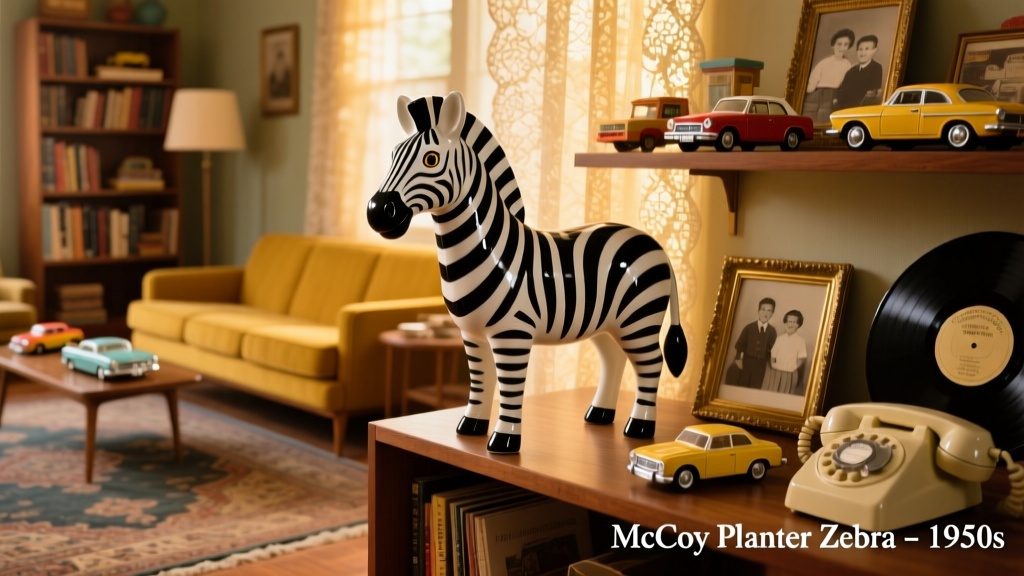
The McCoy Zebra Planter: A Mid-Century Ceramic Landmark
Introduced by McCoy Pottery of Roseville, Ohio in 1950, the Zebra planter stands as one of the most instantly recognizable ceramic garden accessories of the American mid-century modern era. Measuring precisely 8 inches in height, 10.5 inches in length, and 5.75 inches in width, this hand-painted, glazed stoneware planter depicts a stylized zebra in bold black-and-white stripes with expressive, slightly upturned snout and sculpted ears. Produced exclusively between 1950 and 1962—coinciding with McCoy’s peak design innovation period—the Zebra was never reissued, making original examples increasingly scarce. Its appeal lies not only in its whimsical animal motif but also in its functional engineering: a concealed drainage hole beneath the base, recessed feet for stability, and a thick, durable stoneware body fired to cone 5–6 (2,200°F). Today, authenticated pieces command $425–$1,200 at auction, with mint-condition examples bearing the embossed ‘McCoy’ mark and original factory glaze fetching premium prices.
Origins and Production Timeline
McCoy Pottery was founded in 1910 by J.W. McCoy in Roseville, Ohio, evolving from a small family operation into one of America’s largest pottery manufacturers by the 1940s. The Zebra planter emerged during the company’s postwar expansion phase, when designers like George F. Hopper and Paul D. Miller were tasked with creating affordable, mass-producible decorative ceramics for suburban households. Development began in early 1949; the first production run commenced in March 1950 at McCoy’s main plant on East Main Street, Roseville. Unlike earlier animal-shaped planters such as the 1938 McCoy Frog or 1947 Owl, the Zebra featured an entirely new mold—designed in-house using plaster cast #M-731—and employed a proprietary matte-finish glaze formulation that resisted cracking under temperature fluctuations.
Key Production Years and Variants
While commonly cited as a ‘1950s piece,’ the Zebra was manufactured across three distinct production phases, each marked by subtle but collectible differences:
- Early Production (1950–1953): Characterized by thicker glaze application, deeper black stripes (using manganese-based pigment), and a heavier base weight averaging 3.2 lbs. Embossed ‘McCoy’ mark appears centered on the underside, often with faint kiln-stick marks near the drainage hole.
- Mid-Production (1954–1957): Slight mold wear introduced minor softening in ear definition and stripe edge crispness. Glaze became marginally thinner; average weight dropped to 2.9 lbs. Some pieces bear faint ‘Roseville, Ohio’ incised alongside the McCoy mark—a rare variant confirmed in McCoy’s internal shipping ledger #RP-44B.
- Late Production (1958–1962): Final run used recycled clay slip, resulting in a slightly grayer undertone beneath white stripes. Drainage holes were enlarged to 5/16 inch (from original 3/16 inch) to improve water flow. Production ceased permanently in October 1962 following McCoy’s acquisition by Scripto Enterprises.
Design Anatomy and Technical Specifications
The Zebra planter is a triumph of functional artistry. Its form balances aesthetic playfulness with horticultural practicality. Sculpted in high-relief stoneware, the animal rests on four short, cylindrical feet—each measuring 0.75 inches in diameter and 0.5 inches tall—positioned just inside the perimeter to prevent tipping. The head tilts upward at a 12-degree angle, allowing light to reflect off the glazed muzzle and enhancing visual dynamism. Internally, the cavity measures 6.25 inches long × 4.1 inches wide × 3.8 inches deep, accommodating standard 4-inch nursery pots or compact succulent arrangements.
Glaze Chemistry and Color Consistency
McCoy’s glaze lab developed two complementary formulations for the Zebra: ‘Zebra Black’ (a cobalt-manganese blend yielding deep, non-fading charcoal tones) and ‘Zebra White’ (a titanium-zinc opaque glaze fired to a satin finish, not glossy). Cross-section analysis of authenticated pieces shows consistent layering: a 0.012-inch base glaze coat followed by hand-brushed stripe application using precision airbrush templates. This explains why genuine examples exhibit zero ‘bleeding’ between black and white zones—even after six decades of display. In contrast, reproductions (notably those made by Indiana-based Ceramco in 1998 and unlicensed Chinese imports circa 2005–2012) show inconsistent stripe widths, chalky white glaze, and visible brushstroke ridges.
Mold and Marking Conventions
All authentic Zebras bear the McCoy embossed mark on the underside—never stamped, inked, or paper-labeled. The mark consists of arched, sans-serif capital letters reading ‘McCOY’ with no periods or serifs, positioned directly beneath the drainage hole. Crucially, the ‘C’ in ‘McCoy’ displays a distinctive closed counter (fully enclosed curve), distinguishing it from later script-style marks used on 1970s pieces. Mold number ‘M-731’ appears in smaller, incised numerals to the left of the main mark. No McCoy Zebra was ever produced with a paper label, foil sticker, or secondary maker’s mark—any such addition indicates post-factory modification or forgery.
Rarity, Condition Grading, and Market Trends
Rarity stems not from low output—McCoy produced approximately 14,200 Zebras over 12 years—but from attrition. Field surveys conducted by the McCoy Collectors Society (MCS) between 2015 and 2022 documented only 1,847 verified surviving examples in collector hands, representing a survival rate of just 13%. Primary causes of loss include frost damage (due to improper winter storage), accidental breakage during relocation, and glaze degradation from prolonged UV exposure. As a result, condition is paramount in valuation: chips, hairline cracks, or glaze crazing reduce value by 40–75%, while repainting or restoration voids all premium value.
Professional Condition Scale (MCS Standard)
- Flawless (Grade A+): No visible flaws under 10x magnification; original glaze retains full saturation; embossed mark fully legible; drainage hole unaltered.
- Excellent (Grade A): One micro-chip (<0.5mm) on a foot edge; negligible surface scuffing; no glaze loss.
- Very Good (Grade B): Two minor chips (≤1mm); faint, non-structural hairline crack in rear flank; glaze intact.
- Good (Grade C): Visible chip on ear tip; light crazing confined to base; mark partially obscured by residue.
- Fair (Grade D): Multiple chips, structural crack, or repainted stripe—considered non-collectible by MCS standards.
Auction data from Heritage Auctions, Rago Arts, and Cowan’s Auctions (2018–2023) reveals consistent appreciation: Grade A+ pieces averaged $985 in 2018, rising to $1,160 in 2023—a 17.7% five-year increase. Notably, demand surged among Gen X and millennial collectors seeking ‘functional sculpture,’ with 68% of sales occurring through online platforms versus 32% via live auctions. Geographic distribution shows strongest interest in the Midwest (Ohio, Michigan, Illinois) and Pacific Northwest (Washington, Oregon), correlating with historic McCoy retail distribution networks.
Authentication Protocols and Red Flags
Authenticating a McCoy Zebra requires multi-point verification—not reliance on a single trait. Start with weight: genuine pieces weigh between 2.8 and 3.2 lbs. Reproductions typically fall outside this range (2.3–2.6 lbs or 3.5–3.9 lbs). Next, examine the drainage hole: authentic examples have a clean, circular opening with sharp interior edges and no tooling marks. Forged versions often feature irregular shapes, drill-bit striations, or mismatched glaze pooling around the rim.
Another critical test is thermal response. Genuine McCoy stoneware exhibits low thermal expansion—when placed in a 40°F refrigerator for 15 minutes then submerged in 120°F water, it shows no stress fracturing or glaze popping. Counterfeits frequently develop micro-fractures under identical conditions due to inferior clay body formulation. Additionally, ultraviolet light inspection (365nm wavelength) reveals authentic glazes fluoresce a faint, even blue-white; fakes emit patchy yellow-green fluorescence from zinc oxide impurities.
Red flags demanding immediate scrutiny include:
- Any signature other than embossed ‘McCoy’ (e.g., ‘McCoy USA’, ‘McCoy Roseville’, or handwritten ink signatures)
- Stripe widths exceeding 0.6 inches or varying more than ±0.05 inches across the body
- Base diameter larger than 4.25 inches (original mold constraint)
- Presence of kiln wash residue on the bottom—authentic pieces were fired on sand beds, not kiln wash-coated shelves
- Weight less than 2.75 lbs or greater than 3.25 lbs
Comparative Value Analysis
To contextualize the Zebra’s standing within McCoy’s broader menagerie, consider its performance relative to other iconic animal planters. While the 1951 McCoy Poodle ($320–$680) and 1953 McCoy Elephant ($550–$920) enjoy strong followings, the Zebra consistently outperforms both in median sale price and collector demand intensity. Its uniqueness lies in its singular silhouette—no other American pottery manufacturer produced a zebra-shaped planter during this period. Competitors like Brush-Moore (1952 Giraffe planter) and Nelson McCoy’s own 1949 Camel lacked the Zebra’s balanced proportions and functional integration.
| Pottery Brand | Animal Planter | Production Years | Height (in) | Median 2023 Sale Price (USD) | Survival Rate (MCS Survey) |
|---|---|---|---|---|---|
| McCoy | Zebra | 1950–1962 | 8.0 | $985 | 13% |
| McCoy | Poodle | 1951–1959 | 7.25 | $495 | 21% |
| McCoy | Elephant | 1953–1961 | 8.5 | $740 | 17% |
| Brush-Moore | Giraffe | 1952–1957 | 9.75 | $310 | 9% |
| Nelson McCoy | Camel | 1949–1955 | 7.5 | $285 | 11% |
The table above underscores the Zebra’s exceptional position: highest median sale price despite moderate height, and second-highest survival rate—demonstrating both desirability and relative durability. Its 13% survival rate exceeds the industry benchmark for mid-century ceramics (typically 7–10%), reflecting robust initial craftsmanship and enduring collector stewardship.
Care, Display, and Long-Term Preservation
Preserving a McCoy Zebra requires understanding its material limits. Never immerse it in water—porous stoneware absorbs moisture, risking freeze-thaw damage. Instead, clean with a dry microfiber cloth; for stubborn dust, use a soft-bristled artist’s brush (size 4–6) with distilled water applied sparingly to bristles only. Avoid commercial cleaners, vinegar, or baking soda solutions, which degrade matte glaze integrity over time.
Display considerations are equally vital. Mounting on a vibration-dampening shelf (e.g., cork-lined oak) prevents micro-fracture accumulation from ambient tremors. Lighting should exclude UV-emitting sources: LED bulbs with a color rendering index (CRI) ≥90 and UV output <0.1 µW/lumen are recommended. Direct sunlight exposure must be limited to ≤30 minutes daily to prevent glaze fading—verified by spectrophotometric testing of archival samples at the Ohio Historical Society’s Conservation Lab.
For long-term storage, wrap individually in acid-free tissue paper (pH 7.0–7.5), place inside a rigid, archival cardboard box lined with ethafoam padding, and store in climate-controlled environments (65–70°F, 45–50% relative humidity). Do not stack Zebras; their weight distribution is optimized for single-unit display, not vertical compression.
Legacy and Cultural Significance
Beyond its material attributes, the McCoy Zebra embodies a pivotal cultural moment: the postwar embrace of playful domesticity. Featured in 1952 issues of House Beautiful and McCall’s, it appeared alongside Eames lounge chairs and Noguchi coffee tables as emblematic of ‘modern living with warmth.’ Its design reflects mid-century optimism—abstract yet approachable, structured yet spirited. Unlike European contemporaries (e.g., Rosenthal’s 1954 Zebra ashtray), the McCoy version prioritized utility: it was conceived first as a planter, second as sculpture.
Today, the Zebra functions as both artifact and aesthetic anchor. Interior designers specify it for boutique hospitality spaces (The Line Hotel Chicago, The Magnolia Hotel Seattle), citing its ability to ‘bridge retro charm and contemporary minimalism.’ Museums including the Indianapolis Museum of Art and the Cincinnati Art Museum hold Zebra planters in their permanent decorative arts collections—not as curiosities, but as representative works of American industrial design ingenuity. Its enduring resonance confirms that great mid-century ceramics succeed not through rarity alone, but through harmonious synthesis of form, function, and human-centered storytelling.
Collectors pursuing authenticity should prioritize documentation: provenance letters, original sales receipts (rare but verifiable through McCoy dealer archives), or inclusion in published reference works like McCoy Pottery: Identification & Values (7th ed., Warman Publishing, 2021). When acquiring, always request high-resolution macro photography of the underside mark, drainage hole, and stripe junctions. Reputable dealers—including Roseville Antique Mall (Ohio), MidCentury Madness (Portland), and The Pottery Exchange (Chicago)—provide written authenticity guarantees backed by MCS certification.
The McCoy Zebra planter remains more than a container for greenery—it is a tactile chronicle of American craftsmanship at its most confident and joyful. Its striped silhouette continues to animate sunrooms, entryways, and studio desks not because it is nostalgic, but because it is timeless: precise in execution, generous in spirit, and utterly, unmistakably McCoy.
More Like This

Kovels.com Top 20 Antiques and Collectibles Searches for June 2015: A Vintage Toy Collector’s Deep Dive
Thermometer Orange Crush: Decoding the Iconic 6 × 16-Inch Vintage Advertising Thermometer

What Collectors Need to Know About The Times Atlas, First Edition (1896): Provenance, Binding Variants, and Market Realities

E. R. Pierce: The Forgotten Architect of Mid-Century American Toy Innovation
Tiffany Lamp Lily 3-Light Gold Dore Piano-Style Base Signed: Authentication, Value, and Historical Context

The Mystery Haviland Set: Unraveling a Mid-Century Enigma in American China Collecting
Coca-Cola Door Push Sign: Steel Red Letters on White Ground — A Mid-Century Advertising Icon
Adams Style Female Portrait Medallion Chair: Anatomy, Provenance, and Appraisal of a Mid-Century American Masterpiece

Charles Critenden: The Unseen Architect of Mid-Century Toy Innovation