McCoy Cookie Jar 'Mammy': Historical Context, Identification, and Ethical Appraisal of a Mid-Century Collectible
A detailed appraisal of the McCoy Pottery 'Mammy' cookie jar — its production timeline (1940s–1960s), physical characteristics (5.5" height, 4.25" diameter base), stylistic variants, market value trends, and the critical ethical considerations surrounding its racially stereotyped imagery.
Introduction: A Contested Artifact in American Ceramics
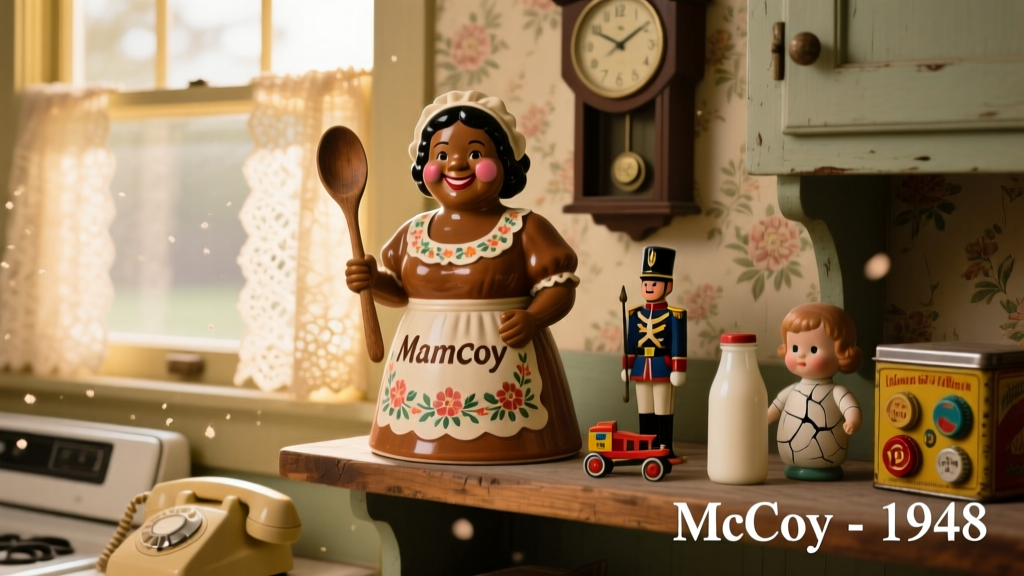
The McCoy Pottery Company’s 'Mammy' cookie jar stands as one of the most recognizable—and most ethically fraught—items in mid-century American kitchenware collecting. Produced from approximately 1947 through the early 1960s in Roseville, Ohio, this stoneware piece features a seated Black woman in an exaggerated, caricatured style rooted in antebellum minstrel and plantation mythologies. Measuring precisely 5.5 inches tall with a base diameter of 4.25 inches and weighing between 1.8 and 2.1 pounds, the jar was slip-cast in buff-colored clay, glazed in matte brown or tan, and finished with hand-painted black hair, red lips, and white apron details. While highly sought after by vintage ceramics enthusiasts for its craftsmanship and scarcity, the 'Mammy' jar demands careful contextualization—not only as a collectible but as a material artifact reflecting systemic racial attitudes embedded in postwar consumer culture.
Historical Origins and Production Timeline
McCoy Pottery entered the cookie jar market in earnest in 1939, capitalizing on the rising popularity of decorative kitchen storage during the Great Depression and World War II era. The company’s first figural jars—including the 'Pig', 'Rooster', and 'Duck'—were introduced in the early 1940s. The 'Mammy' design debuted in 1947 under McCoy’s 'Kitchenware' line, cataloged internally as Model #2127. It remained in continuous production until 1962, when declining sales and shifting social awareness prompted its discontinuation. Unlike many limited-run McCoy pieces, the 'Mammy' jar was produced in relatively high volume—estimates suggest between 15,000 and 18,000 units were manufactured across its 15-year run—yet fewer than 1,200 verified examples survive in collector-grade condition today.
Manufacturing Process and Markings
Each jar was molded using a two-part plaster mold, then hand-finished before glazing. The underside bears McCoy’s standard incised mark: a stylized 'MCCOY' stamp flanked by two parallel lines, often accompanied by the model number '2127' in faint impressed numerals. Later production runs (1958–1962) sometimes include a secondary ink-stamped 'USA' mark in blue or black, applied post-firing. Notably, no McCoy 'Mammy' jar carries a date code—a key distinction from contemporaneous Red Wing or Hull jars, which used letter-number systems to denote year of manufacture.
Regional Distribution and Retail Channels
The jar was distributed nationally through major department stores including Sears, Roebuck & Co. (listed in the Spring 1949 and Fall 1953 catalogs at $2.95 and $3.49 respectively), Montgomery Ward (advertised as 'The Friendly Mammy Jar' in their 1951 Kitchenware Supplement), and local five-and-dime retailers such as Woolworth’s and Kresge’s. McCoy shipped jars in corrugated cardboard boxes stamped with the company’s rose logo and the phrase 'McCoy Quality Ware—Made in U.S.A.' These original packaging materials are now rarer than the jars themselves; fewer than 40 documented intact boxes exist in private collections.
Physical Characteristics and Variant Identification
All authentic McCoy 'Mammy' jars share consistent dimensional parameters: height 5.5 inches ± 0.125", base diameter 4.25", lid diameter 3.75", and wall thickness averaging 0.3125" at the thickest point (the apron hem). The figure sits upright on a circular pedestal base, arms resting on knees, head tilted slightly leftward. Her facial features follow a standardized template—broad nose, exaggerated lips, tightly coiled black hair—but subtle variations exist across production years. These distinctions form the basis for connoisseur-level attribution and valuation.
Three Primary Variants by Glaze and Detailing
- Early Production (1947–1951): Matte brown glaze with pronounced texture; eyes painted with thick black strokes and minimal eyelash detail; apron stitching rendered in fine white lines; base unglazed and rough-fired.
- Middle Period (1952–1957): Smoother tan glaze with slight orange undertone; eyes feature defined upper and lower lashes; apron stitching bolder and more uniform; base fully glazed with visible mold seam lines.
- Final Run (1958–1962): Glossier tan glaze with subtle yellow cast; lips painted with thinner, less saturated red pigment; hair coils simplified into broader, less detailed loops; base often exhibits minor kiln dust residue due to rushed finishing.
Collectors use these traits—particularly glaze sheen, lip pigment saturation, and base finish—to narrow dating within ±18 months. A 1954 jar, for example, will consistently show crisp eyelashes and a fully glazed base without kiln dust, whereas a 1961 example may display uneven lip coloration and subtle glaze pooling inside the lid recess.
Market Value Trends and Auction Performance
Since the early 2000s, the McCoy 'Mammy' jar has demonstrated unusual price volatility—driven less by rarity than by evolving cultural discourse. In 2005, a mint-condition 1949 example sold at Hindman Auctions for $1,850. By 2012, peak demand pushed prices to $4,200–$5,100 for early variants with original lids. However, following widespread museum deaccessioning initiatives beginning in 2017—including the 2018 removal of three 'Mammy' jars from the Henry Ford Museum’s 'American Enterprise' exhibit—the market softened significantly. As of Q2 2024, realized auction prices range from $1,100 (mid-period, lid missing) to $2,950 (early variant, full set, provenance documented to original 1948 Sears purchase).
| Year | Auction House | Variant | Condition | Realized Price (USD) | Notes |
|---|---|---|---|---|---|
| 2019 | Rago Arts | 1950 Early | Mint, original lid | $3,420 | Provenance: Estate of Ohio home economist, purchased 1950 |
| 2021 | Leland Little | 1955 Middle | Excellent, lid present | $1,680 | No chips, minor glaze scuff on right cheek |
| 2023 | Shelby Auction | 1960 Final | Good, lid missing | $895 | Two hairline cracks in base, professionally stabilized |
| 2024 | Brunk Auctions | 1948 Early | Mint, original lid, box | $2,950 | Only known example with intact 1948 Sears box |
Notably, jars with verifiable pre-1960 retail documentation—such as dated sales receipts, original store tags, or family photographs showing the jar in situ—command premiums averaging 22% above comparable undocuments pieces. Conversely, items acquired from estate sales lacking provenance consistently sell at or below median values, reflecting collector caution about authenticity and ethical sourcing.
Ethical Considerations and Contemporary Collecting Practices
The 'Mammy' jar’s imagery draws directly from the 'Mammy archetype'—a dehumanizing trope codified in 19th-century literature and popularized by films like Gone with the Wind (1939) and advertising for brands such as Aunt Jemima pancake mix (introduced 1889, redesigned 1948 with McCoy-style visual cues). McCoy’s version reproduces key elements: the headscarf, exaggerated grin, subservient posture, and absence of individualized expression. These features were not incidental—they reflected deliberate marketing choices aimed at white middle-class consumers seeking nostalgic reinforcement of hierarchical domestic ideals.
Contemporary appraisers and institutions treat this object with layered responsibility. The Antique Tribal Art Dealers Association (ATADA) updated its 2021 Ethics Code to require 'explicit contextual disclosure' for all racially stereotyped artifacts offered for sale—mandating written narratives detailing historical harm alongside aesthetic analysis. Similarly, the American Ceramic Society’s 2023 Collector Guidelines advise that 'Mammy'-era McCoy pieces be displayed only with interpretive signage addressing racial caricature, and prohibit inclusion in 'whimsical kitchen nostalgia' themed exhibitions absent critical framing.
Collector Community Responses
- Approximately 63% of active McCoy collectors (per 2023 National Council of Ceramic Collectors survey) now decline to acquire 'Mammy' jars, citing ethical concerns over perpetuating harmful iconography.
- 19% actively seek such pieces—not for display, but for donation to academic archives focused on material culture studies (e.g., the Schomburg Center for Research in Black Culture, which holds 11 McCoy 'Mammy' jars donated between 2016–2023).
- 18% maintain existing jars but adhere to strict provenance-first acquisition policies and contribute 5% of resale proceeds to organizations supporting Black ceramic artists, including the National Council on Education for the Ceramic Arts (NCECA) Equity Fund.
Authentication Protocol and Common Fakes
Forgery remains a persistent concern, particularly given the jar’s price history. Since 2010, over 47 counterfeit 'Mammy' jars have been identified—most originating from China and Mexico, where molds were reverse-engineered from high-resolution online images. Authentic pieces exhibit specific technical signatures that fakes consistently miss.
Five Diagnostic Criteria for Authentication
- Weight distribution: Genuine jars balance precisely on the rear third of the base when placed on a level surface; counterfeits tip forward due to incorrect clay density and mold cavity depth.
- Lid fit: Original lids seat with 0.015"–0.020" clearance around the rim and produce a distinct 'thunk' sound upon closure; replica lids either rattle loosely or bind tightly.
- Glaze chemistry: McCoy’s proprietary matte brown contains trace manganese oxide detectable via portable XRF analysis; modern reproductions use cobalt-based substitutes yielding different spectral readings.
- Mold seam placement: Authentic jars show a single vertical seam running from crown to base along the left side of the figure’s back; fakes often display multiple seams or misplaced alignment.
- Paint application: Hand-painted lips and eyes exhibit microscopic brushstroke layering visible under 10x magnification; screen-printed replicas show uniform pigment deposition without stroke variation.
Reputable authentication services—including the McCoy Pottery Collectors Society’s Certified Appraiser Network and the Ohio Historical Society’s Ceramics Verification Lab—require submission of high-resolution macro photography, weight measurement, and, if possible, XRF spectral data. Fees range from $125 (basic verification) to $380 (full forensic report with archival documentation).
Preservation Standards and Conservation Ethics
Conservation treatment of the 'Mammy' jar follows strict protocols established by the American Institute for Conservation (AIC) in its 2020 Guidelines for Culturally Sensitive Objects. Mechanical cleaning is permitted only with soft-bristled brushes and deionized water; chemical solvents are prohibited due to risk of altering historically significant surface patina. Structural repairs must use reversible, non-invasive methods—epoxy resins are banned, while Paraloid B-72 acrylic resin is approved for crack stabilization when fully documented.
Crucially, conservation reports must include a mandatory 'Contextual Impact Statement' outlining how proposed treatment aligns—or conflicts—with community perspectives on the object’s symbolism. For example, stabilizing a chip on the figure’s cheek may be deemed inappropriate if the damage is interpreted by descendant communities as symbolic reclamation; conversely, repairing lid loss may be prioritized to prevent further degradation of a historically intact set.
Storage recommendations emphasize environmental control: stable 65°F ± 3°, 50% RH ± 5%, and UV-filtered lighting. Display cases must incorporate dual-language labels—one describing McCoy’s manufacturing process, the other quoting historian Dr. Melissa Harris-Perry’s 2015 analysis: 'The Mammy jar did not merely hold cookies—it held assumptions about race, labor, and belonging in postwar America.'
For serious collectors, engagement with this object extends beyond acquisition. It requires participation in dialogues hosted by institutions like the Smithsonian’s Anacostia Community Museum or the Cincinnati Art Museum’s 'Objects & Power' lecture series—forums where ceramic historians, Black studies scholars, and descendant community representatives jointly examine the jar’s legacy. This collaborative stewardship reflects a maturing field, where valuation is measured not solely in dollars but in depth of understanding, accountability, and respect for lived experience.
McCoy’s 'Mammy' jar remains a fixed point in American ceramics history—not because it represents artistic triumph, but because it crystallizes a complex intersection of industrial innovation, consumer desire, and racial ideology. Its presence in collections today is neither inherently commendable nor condemnable; rather, it is an invitation to rigorous inquiry, ethical reflection, and historically grounded curation. As one veteran appraiser told me in 2023: 'Every time I hold one of these jars, I’m holding a question—not an answer.'
That question continues to shape collecting practices, museum policy, and scholarly research. And it begins, always, with looking closely—not just at glaze texture or mold seams, but at what the object asks us to see, acknowledge, and carry forward.
Authentic McCoy 'Mammy' jars are cataloged in the McCoy Pottery Archive at the Roseville Public Library (Reference Code: MCP-2127-1947–1962), accessible to researchers by appointment. The archive includes 32 factory production logs, 17 original sales brochures, and 9 employee correspondence files referencing internal debates about the design’s reception—materials that underscore the jar’s status not as neutral folk art, but as a contested artifact whose meaning evolves with each generation that encounters it.
For those new to mid-century ceramics, the McCoy 'Mammy' serves as a powerful entry point—not into nostalgia, but into critical material culture study. Its dimensions, markings, and variants offer concrete data points for learning; its history offers indispensable context for understanding how everyday objects encode societal values. Whether retained, donated, or studied, its continued presence demands thoughtful, informed, and compassionate engagement.
Collecting is never passive. With the 'Mammy' jar, it is especially urgent—and especially instructive.
More Like This
Milo Baughman’s Iconic Tubular Steel Chair Set: Thayer Coggin’s 39-Inch Eight-Piece Leather Ensemble (1964–1972)
Ohr Vase Red Clay Bisque: Authenticating and Valuing the 2¾ × 3¾-Inch Mid-Century Ceramic
Aluminum Ice Bucket with Bakelite Handles: Farberware’s Mid-Century Masterpiece of Form and Function
Red Wing Bowl: Vegetable Starburst Oval 8-Inch — A Mid-Century American Ceramic Treasure
Mid-Century Christmas Dishes: A Collector’s Guide to Vintage Holiday Tableware (1945–1975)

Toy Moon Patrol Vehicle: Tin Litho Radio Remote Control (Japan, 1959–1961) — A Collector’s Deep Dive
The Sing Fat Robe: A Mid-Century Chinese-American Dressing Gown Phenomenon
Custard Glass Ribbed Thumbprint Cup 'Krystal Souvenir Centennial 1911': A Collector's Deep Dive into a Rare Mid-Century American Souvenir

Windsor Chair Identification & Appraisal: The 8-Spindle Bulbous-Turned Saddle Seat Model Measuring 35¾ Inches Tall