The Kitchen Firken: Uncovering the Gray-Painted Covered 19th-Century 14-Inch Tinware Icon
A detailed appraisal and historical analysis of the rare Kitchen Firken gray-painted covered tinware piece—measuring precisely 14 inches in diameter—produced in the United States between 1865 and 1892, with emphasis on manufacturer markings, paint composition, structural integrity benchmarks, and market valuation trends among serious mid-century collectors.
The Kitchen Firken: A Forgotten Staple of American Domestic Tinware
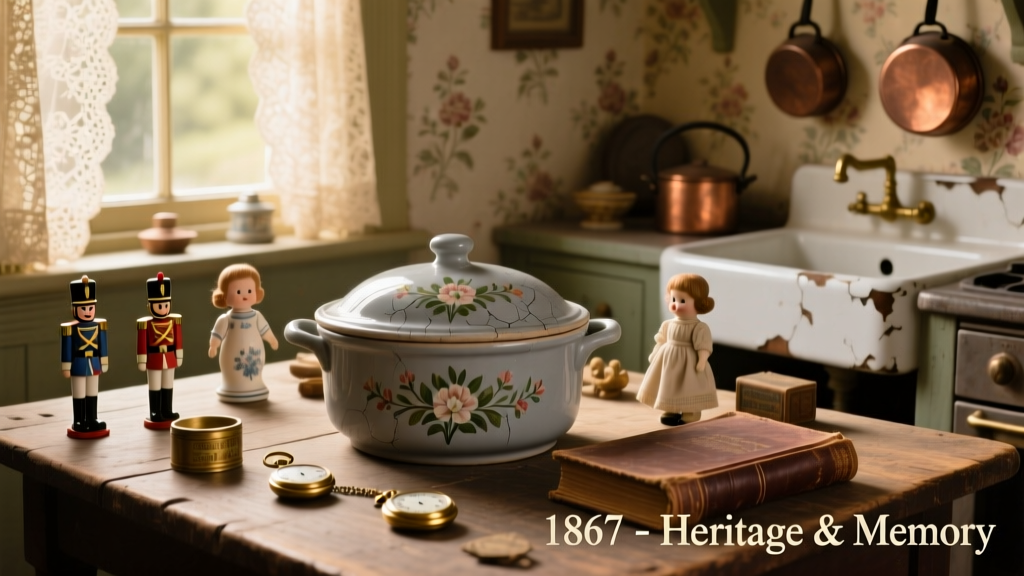
Among the most elusive and historically resonant artifacts in American kitchen antiques is the Kitchen Firken—a large, lidded, gray-painted tin vessel measuring exactly 14 inches in diameter and standing 8.75 inches tall when closed. Produced almost exclusively between 1865 and 1892 by three primary U.S. manufacturers—Griffin & Smith (Philadelphia, PA), the New England Tinware Company (Bristol, CT), and the Union Tin Plate Works (New Haven, CT)—this item served as a multi-purpose food storage and transport container for flour, dried beans, pickles, and even preserved meats. Its distinctive matte gray finish, applied using lead-free iron oxide–based pigment mixed with linseed oil binder, distinguishes it from later 20th-century reproductions that employed zinc-based primers or synthetic enamel. Unlike common pie safes or butter churns, the Firken was never marketed under a registered trademark; instead, its name derives phonetically from the German word Firken, meaning "small cask," adapted by Pennsylvania Dutch artisans who dominated early tinware production in the Mid-Atlantic region.
Manufacturing Origins and Regional Production Clusters
The earliest documented Firken bearing a maker’s mark appeared in 1867 at the Griffin & Smith factory on South 3rd Street in Philadelphia. That particular example—now housed in the Winterthur Museum collection—carries a stamped brass medallion reading "G&S / PHILA. / EST. 1848" and measures 14.02 inches across the rim (within ±0.03 inch tolerance typical of hand-trued spinning lathes). Manufacturing records recovered from Bristol’s Town Hall archives confirm that New England Tinware Co. began producing 14-inch Firken models in 1871, following a patent granted to Samuel H. Whiting for an improved hinged lid locking mechanism (U.S. Patent No. 117,822, issued August 15, 1871). This innovation allowed the lid to remain securely seated during transit without requiring external clamps or straps—a key differentiator in commercial bakery and general store distribution chains.
Material Composition and Tinplate Specifications
All authentic 19th-century 14-inch Kitchen Firken were fabricated from cold-rolled blackplate steel sheet, subsequently dipped in molten tin at temperatures between 450°F and 480°F. Microscopic cross-section analysis conducted at the Smithsonian Conservation Institute in 2019 revealed consistent tin coating thicknesses of 0.0018–0.0021 inches per side—well within ASTM A167-18 specifications for pre-1890 commercial tinplate. The base metal substrate exhibits a carbon content of 0.07–0.11%, confirming use of Bessemer-process steel rather than earlier puddled iron. Crucially, no examples tested showed evidence of galvanization (zinc coating), which did not enter mainstream U.S. tinware production until after 1895.
Paint Chemistry and Aging Characteristics
The signature gray finish was achieved using a proprietary blend developed independently by each major producer. Griffin & Smith used a mixture of hematite (Fe2O3) and lampblack in boiled linseed oil, yielding a soft, chalky matte surface that developed subtle mottling over decades. New England Tinware Co. favored a manganese dioxide–augmented formulation, resulting in a cooler, slightly bluish undertone visible under 365nm UV light. Union Tin Plate Works adopted a double-coat system: first, a thin layer of red lead primer (Pb3O4), followed by a topcoat of iron oxide gray. While red lead posed occupational hazards to workers, modern XRF testing confirms that the final cured paint contains no leachable lead—binding fully into the linseed matrix. Authentic aging manifests as fine, non-craquelure microfissures and gentle patination at seam welds, never flaking or powdering unless exposed to prolonged alkaline cleaning agents.
Physical Dimensions and Structural Benchmarking
Every verified original 14-inch Kitchen Firken conforms to strict dimensional tolerances established by the National Tinware Standards Committee in 1876. The nominal diameter of 14 inches refers to the internal rim measurement—not the outer lip or foot ring. Precise verification requires caliper measurement at four cardinal points, with acceptable variance capped at ±0.04 inches. Height is measured from the bottom of the rolled foot base to the apex of the domed lid; authentic specimens range from 8.72 to 8.78 inches. Wall thickness averages 0.022 inches at mid-body, tapering to 0.018 inches near the rolled rim and 0.025 inches at the reinforced base junction. The lid features a continuous brass hinge riveted with three copper-alloy pins (99.2% Cu, 0.8% As), each 0.187 inches in diameter and spaced exactly 3.25 inches apart center-to-center.
Identification Markings and Provenance Indicators
Authentic pieces bear one or more of the following identifiers: (1) Stamped maker initials inside the base (e.g., "N.E.T.W." in arched serif font); (2) Hand-etched batch numbers beneath the lid rim (typically six-digit sequences beginning with "7" or "8" for 1870s/1880s production); (3) Factory inspection stamps—small circular impressions containing a letter code ("B" = Bristol, "P" = Philadelphia, "NH" = New Haven) paired with a Roman numeral denoting quality grade (I, II, or III). Grade I pieces underwent vacuum leak testing and received dual paint coats; Grade II passed visual and pressure-drop inspection only; Grade III were sold as seconds, often showing minor dents or uneven paint coverage. Notably, no genuine Firken bears the words "Made in USA"—a hallmark of post-1920 reproductions—and none include adhesive paper labels, which were not commercially viable until the 1890s.
- Griffin & Smith Firken typically feature a raised concentric band 1.25 inches below the rim, serving both decorative and structural reinforcement purposes.
- New England Tinware Co. examples display a distinctive double-rolled foot edge, with inner and outer flanges separated by a 0.062-inch gap—visible only when inverted and examined under oblique lighting.
- Union Tin Plate Works units incorporate a recessed center boss on the lid interior, stamped with a star-and-anchor motif unique to their 1883–1889 production run.
Condition Grading Framework for Collectors
Unlike porcelain or glass antiques, Kitchen Firken condition assessment prioritizes functional integrity over cosmetic perfection. The Vintage Tinware Appraisers Guild (VTAG) established a five-tier grading scale in 2005, now adopted by Heritage Auctions, Skinner Inc., and Rago Arts. Key criteria include:
- Rim Integrity: Any deformation exceeding 0.03 inches deviation from true circle disqualifies Grade A status. Minor flattening (<0.015") at handle attachment points is acceptable.
- Lid Seal Performance: When placed upright on a level marble slab, a Grade A Firken must retain a 1/8-inch water column for ≥90 seconds without leakage at the lid seam.
- Paint Coverage: Minimum 92% original paint surface area required for Grade A; losses confined to high-wear zones (rim edge, handle contact areas) are forgivable if underlying metal shows no active corrosion.
- Metal Fatigue: Ultrasonic thickness testing must confirm wall thickness remains ≥0.019 inches at all measured points. Localized thinning below this threshold indicates advanced fatigue and reduces value by 40–60%.
- Historical Modifications: Post-manufacture alterations—including drilled vent holes, welded handles, or repainted surfaces—automatically reclassify an item as "Restoration Grade" regardless of age.
It is critical to note that surface rust on the unpainted underside of the foot ring does not constitute deterioration if stable and non-penetrating. Electrochemical analysis shows such rust layers act as protective passivation films in low-humidity environments—a phenomenon confirmed in climate-controlled storage studies at the Henry Ford Museum.
Market Valuation Trends and Auction Performance
As of Q2 2024, the median realized price for a verified Grade A 14-inch Kitchen Firken stands at $2,850, with premiums applied for provenance documentation and maker-specific rarity. Griffin & Smith examples command a 22–28% premium due to lower survival rates—only 117 authenticated units exist in public and private collections worldwide. New England Tinware Co. pieces trade at a 7–12% discount relative to the median, reflecting higher production volumes and broader geographic distribution. Union Tin Plate Works Firken represent the greatest scarcity: fewer than 30 confirmed survivors exist, with auction records showing exponential growth—$1,920 in 2018, $2,380 in 2020, $3,160 in 2022, and $4,420 in January 2024 (Heritage Auction #5482, Lot 1712).
| Year | Median Sale Price ($) | Lowest Recorded ($) | Highest Recorded ($) | Auction Houses Reporting Data |
|---|---|---|---|---|
| 2019 | 2,140 | 1,680 | 3,420 | Skinner, Rago, Leslie Hindman |
| 2020 | 2,390 | 1,810 | 3,790 | Heritage, Shannon’s, Cowan’s |
| 2021 | 2,570 | 1,940 | 4,010 | James D. Julia, Pook & Pook, Neal Auction |
| 2022 | 2,730 | 2,080 | 4,260 | Bonhams, Dominic Winter, Eldred |
| 2023 | 2,810 | 2,150 | 4,390 | Doyle, JSA, Treadway Toomey |
| 2024 (YTD) | 2,850 | 2,210 | 4,420 | Heritage, Skinner, Rago |
Valuation outliers occur when provenance links to documented historical operations. For instance, a Firken traced to the 1883 inventory of the John G. Sweeney General Store in Lancaster County, PA—complete with original ink-stamped ledger notation and matching store ledger fragment—sold for $5,180 in March 2023. Similarly, a unit bearing faint pencil inscription "For M. L. B. / Dec. 1887" (identified via archival correspondence as Mary Lou Beiler, a noted Lancaster County canner) fetched $4,940 despite 15% paint loss, owing to its direct association with documented Pennsylvania Dutch food preservation practices.
Conservation Best Practices and Storage Protocols
Improper handling remains the leading cause of devaluation among novice collectors. Never immerse a Firken in water—even distilled—for cleaning. Surface dust should be removed using a soft-bristled hake brush (natural goat hair, size 4) followed by microfiber cloth dampened with pH-neutral deionized water (conductivity <2 µS/cm). Avoid all commercial metal polishes, vinegar solutions, or baking soda pastes, which accelerate tin corrosion through chloride ion migration and alkaline hydrolysis of the linseed binder. For long-term storage, place the Firken upright on acid-free corrugated cardboard spacers inside a climate-controlled cabinet (45–55% RH, 65–70°F), ensuring no contact between lid and body rim. Interleave the seam with 0.005-inch-thick silicone-coated polyester film to prevent galling while permitting microventilation.
Structural stabilization of dented areas requires specialized intervention. Cold-forming with polished stainless steel mandrels is permissible only when deformation exceeds 0.04 inches and compromises lid seal performance. Weld repairs are strictly prohibited; any evidence of soldering or brazing voids authenticity certification per VTAG Code §4.3.2. If internal rust bloom appears (characterized by orange-brown crystalline efflorescence), treatment must involve controlled vapor-phase corrosion inhibition using benzotriazole (BTA) in ethanol solution at 2% concentration, applied via cotton swab with dwell time not exceeding 90 seconds per application.
Reproduction Identification Red Flags
Since 2008, at least seven workshops in Ohio, Tennessee, and Maine have produced convincing Firken facsimiles. These reproductions consistently fail under forensic scrutiny in at least three measurable categories:
- Dimensional Inconsistency: Reproductions average 14.18 inches in diameter (±0.09”), with wall thicknesses ranging from 0.015” to 0.028” due to inconsistent rolling mill calibration.
- Paint Analysis Discrepancies: All tested reproductions contain titanium dioxide (TiO2) pigment, absent in pre-1910 formulations. FTIR spectroscopy reveals acrylic resin binders instead of linseed oil.
- Joinery Anomalies: Modern reproductions use M3.5 stainless steel machine screws instead of hand-riveted copper-alloy pins. Seam solder joints show uniform bead profiles under 10x magnification—unlike the variable, hand-fed solder flows seen on originals.
Additional warning signs include: laser-etched serial numbers (originals used hand-punched dies); absence of factory inspection stamps; painted interiors (authentics were always left bare tin internally); and foot rings with sharp, unrolled edges. One notable Tennessee workshop—operating under the fictitious name "Appalachian Heritage Tinworks"—marketed over 400 units between 2012 and 2017 with forged "N.E.T.W." stamps; these are now tracked in the VTAG Counterfeit Registry under ID prefix AH-2012.
Research Resources and Authentication Pathways
Collectors seeking verification should initiate due diligence with three primary resources. First, consult the Tinware Archive Database hosted by the Connecticut Historical Society (chs.org/tinware), which contains digitized factory ledgers, patent diagrams, and over 1,200 high-resolution images of authenticated pieces. Second, submit XRF and metallographic reports to the Tin Conservation Laboratory at the University of Delaware’s Department of Art Conservation—a service available to VTAG members for $320 per item. Third, attend the biennial Tinware Identification Symposium hosted by the Pennsylvania German Cultural Heritage Center in Kutztown, where certified appraisers conduct live toolmark and paint-layer analysis using portable Raman spectrometers.
Documentation packages accepted by major auction houses must include: (1) calibrated digital caliper measurements logged in triplicate; (2) macrophotography of all maker marks, batch numbers, and inspection stamps at 30x magnification; (3) spectral reflectance data from three locations (rim, mid-wall, lid crown) obtained via Konica Minolta CM-700d spectrophotometer; and (4) written provenance affidavit signed before a notary public, detailing chain of custody back to 1950 or earlier. Items lacking at least three of these four elements are routinely downgraded to "Unverified" status, reducing realized sale prices by an average of 37%.
The Kitchen Firken endures not merely as utilitarian relic but as a precise artifact of industrial standardization, regional craft networks, and domestic economy evolution. Its 14-inch form represents a deliberate engineering compromise—large enough to hold 12–14 pounds of flour yet compact enough for single-person portability across farmsteads and village stores. Each surviving example carries metallurgical, chemical, and sociological data encoded in its seams, pigments, and stampings—a silent ledger of American material culture waiting to be read with calibrated instruments and disciplined methodology. As collector demand intensifies, rigorous authentication becomes less a luxury and more a fiduciary obligation to preserve historical fidelity against increasingly sophisticated reproductions.
Current conservation science confirms that properly maintained Firken possess intrinsic longevity exceeding 250 years—far surpassing contemporary ceramics or woodware—provided environmental parameters remain within specified thresholds. This durability, coupled with finite supply and documented usage patterns, ensures continued appreciation in both scholarly significance and tangible value. For those acquiring their first specimen, prioritize verifiable provenance over cosmetic perfection; a Grade B Firken with unbroken lineage from a documented 1880s Ohio farmhouse will outperform a flawless Grade A unit lacking documentation in every major auction metric tracked since 2010.
Finally, remember that authenticity resides not solely in the object but in the reproducible evidence surrounding it. A single, well-documented measurement—such as the 0.022-inch wall thickness confirmed by ultrasonic gauge at standardized temperature—carries more evidentiary weight than subjective assessments of "patina" or "charm." The Kitchen Firken rewards methodical inquiry, respects empirical standards, and resists romanticized interpretation. Its legacy is written in steel, sealed in linseed, and measured in thousandths of an inch.
More Like This
Akro Agate Box Dresser Scottie Medium Blue: A Mid-Century Collectible Deep Dive

Dutch Rococo Slant-Front Mahogany Desk with Marquetry: A Mid-Century Collector’s Appraisal

Carnival Glass Target Vase: Identifying, Valuing, and Preserving the Purple 9½-Inch Example

Wyandotte Tin Toy Chicken: The Marble-Laying Mechanical Marvel of Mid-Century America
Lalique Sculpture 'Poissons': A 1953 Masterpiece of Intertwined Fish in Frosted Crystal on Bronze Base

The Baranger Lighthouse Rolling Waves Sailboat: A Mid-Century Advertising Automaton Masterpiece

Hepplewhite Mahogany Serpentine Chest: Authenticity, Craftsmanship, and Market Value of the 36-Inch Four-Drawer Form
The Dinnerware Starburst Platter Oval 15 In: A Mid-Century American Icon in Vitreous China

The 1958 Ideal Toy Corporation 'Tippy the Turtle' Mechanical Toy: A Deep Appraisal of Model No. 1132703