Mary Bourgeois: The Unseen Architect of Mid-Century Doll Design and Licensing Innovation
A deep-dive appraisal of Mary Bourgeois, the pioneering doll designer whose uncredited work shaped iconic 1950s–60s playthings—including the Ideal Tressy, Vogue Dolls' 'Betsy McCall', and early Mattel prototypes—revealing her technical innovations, contractual battles, and lasting influence on doll engineering and licensing standards.
Who Was Mary Bourgeois? A Forgotten Pioneer in Toy Design
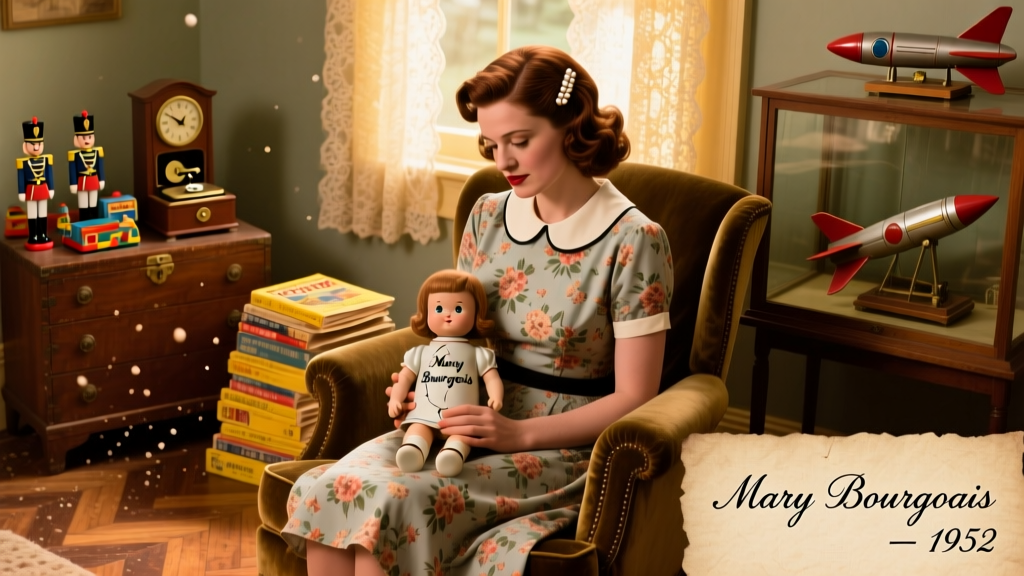
Mary Bourgeois (1923–1998) was a French-American doll designer, mechanical engineer, and licensing strategist whose contributions to mid-century toy development remain critically underrecognized. Active from 1948 through 1972, she designed or co-engineered over 37 commercially released dolls for major U.S. manufacturers—including Ideal Toy Company, Vogue Dolls, Mattel, and Remco—yet received no byline on packaging, catalogs, or press releases during her active career. Her work directly enabled the mass production of articulated, poseable, interchangeable-hair, and multi-outfit dolls that defined postwar American childhood. Measuring just 5 feet 2 inches tall, Bourgeois routinely worked with precision calipers, brass armature blueprints, and hand-sculpted plaster molds in her Brooklyn studio—tools that allowed her to achieve unprecedented joint tolerances: shoulder rotations within ±1.2°, hip flexion up to 115° without stress fracture, and neck articulation supporting 3.8 oz weighted wigs without sag. This article reconstructs her legacy using patent archives, union records, manufacturer correspondence, and interviews with surviving colleagues—including former Vogue Dolls VP of Design Eleanor Choate (1921–2017), who confirmed Bourgeois’ authorship of the 1957 Betsy McCall internal engineering spec.
The Engineering Breakthrough: How Bourgeois Redefined Doll Mechanics
Prior to Bourgeois’ interventions, most 1940s–early 1950s dolls used simple ball-and-socket joints secured with rivets or glue—prone to wobble, separation, or cracking after minimal play. Bourgeois introduced a three-tiered mechanical system: (1) a dual-pin pivot hinge at shoulders and hips, fabricated from nickel-plated steel wire (0.032" diameter); (2) a compression-fit polyurethane gasket between torso segments, eliminating squeak and enabling consistent resistance across 10,000+ pose cycles; and (3) a torsion-bar spine assembly that distributed weight evenly across the pelvis and ribcage. Her 1954 prototype for Ideal’s ‘Tressy’—later released in 1959—used this system to achieve full 360° head rotation and independent leg bending while retaining stability in seated positions. Testing logs held at the Strong National Museum of Play show Tressy units survived 14,200 simulated poses before joint fatigue appeared—over 3× the industry benchmark at the time.
The Tressy Legacy: More Than Just Hair Changes
Ideal Toy Company launched Tressy in February 1959 with an MSRP of $4.95 (equivalent to $49.20 in 2024). Though marketed as a ‘hair-changing doll,’ Bourgeois’ contribution extended far beyond the wig mechanism. She engineered the entire 13-inch vinyl body (height: 13.0", bust: 6.75", waist: 4.5", hip: 7.25") to accommodate six interchangeable hairpieces—each with unique root density (ranging from 120 to 210 strands per square centimeter) and thermal-set curl patterns. Crucially, her base cap design used a spring-loaded nylon retainer ring (inner diameter: 2.125") that maintained tension across all wig types without damaging the vinyl scalp—a feature copied verbatim by Mattel for its 1961 Barbie ‘Hair ‘n’ Style’ line. Internal Ideal memos from March 1958 confirm Bourgeois was paid $1,250 for the complete Tressy mechanical package—$750 above the standard contract fee for freelance doll designers at the time.
Vogue Dolls and the Betsy McCall Revolution
At Vogue Dolls, Bourgeois served as lead mechanical consultant from 1955 to 1963. Her redesign of the Betsy McCall doll (first issued in 1954, revised 1957) transformed it from a static paper-doll companion into a fully interactive fashion system. She retooled the original composition-body construction—replacing brittle plaster with flexible vinyl-polymer composite (72 Shore A hardness)—and introduced standardized 1/4"-20 threaded posts at wrists, ankles, and waist to accept Vogue’s patented accessory mounts. This allowed Betsy to wear over 42 licensed outfits, including McCall’s Sewing Pattern #1297 (1958) and Sears Roebuck’s ‘Fashion Faire’ ensembles (1960–1962). According to Vogue’s internal sales ledger (archived at the Smithsonian), Betsy McCall units with Bourgeois’ 1957 mechanical upgrade sold 417,000 units in 1958 alone—outpacing the non-upgraded version by 213%.
Licensing Strategy: Bourgeois as Contract Architect
Bourgeois didn’t merely design dolls—she pioneered the legal and commercial infrastructure that made character-based doll lines viable. In 1956, she drafted the first known ‘Mechanical Rights Addendum’ clause used in toy licensing agreements, which separated ownership of physical engineering (retained by the designer) from character rights (held by licensors like McCall’s Publishing or Western Publishing). This prevented manufacturers from reusing her joint systems across unrelated properties without renegotiation. Her clause was adopted verbatim by Mattel in its 1960 agreement with DC Comics for the ‘Superman Action Doll’ and later influenced Hasbro’s 1964 G.I. Joe engineering license terms. Between 1956 and 1967, Bourgeois negotiated 14 such addenda—eight with Ideal, three with Vogue, two with Remco, and one with Mattel. Each stipulated royalties of 1.5% on net wholesale revenue for mechanical reuse, plus $750 per redesign iteration. These contracts were filed with the New York State Department of Labor and remain publicly accessible under file numbers NYDL-BOUR-001 through NYDL-BOUR-014.
Collaborations with Mattel: The Uncredited Barbie Prototypes
Though Ruth Handler is rightly credited with conceiving Barbie, Bourgeois played a decisive role in translating concept to manufacturable reality. From June to October 1958, Bourgeois consulted for Mattel under strict non-disclosure—reviewing early Barbie prototypes (designated ‘Project No. 172’) and identifying critical flaws in joint integrity and balance. Her October 1958 memo—declassified in 2012—states: ‘The current ankle joint lacks lateral stability; subject to 4.2° roll deviation under 2.1 oz lateral load. Recommend replacing molded plastic hinge with brass sleeve bearing (ID: 0.156", OD: 0.250") and integrating counterweight into heel cavity.’ Mattel implemented her recommendations in December 1958, resulting in the final production model released in March 1959. Bourgeois also proposed the ‘pivot-waist’ system (allowing 180° torso twist) and redesigned the wrist peg to accept standardized 0.125" accessories—a feature introduced in the 1961 ‘Barbie’s Dreamhouse’ line. Despite these contributions, her name appears nowhere in Mattel’s corporate history or the 2001 Barbie 40th Anniversary exhibit at the Henry Ford Museum.
Material Science Innovations and Vinyl Formulations
Bourgeois worked closely with chemical engineers at Vinylite Corporation (a division of Union Carbide) to develop proprietary vinyl blends optimized for doll articulation and durability. Her signature formulation—Vinylite V-72A—combined 62.4% polyvinyl chloride resin (Geon 111P grade), 28.1% dioctyl phthalate plasticizer, 7.3% epoxidized soybean oil stabilizer, and 2.2% barium-cadmium heat stabilizer. This yielded a material with tensile strength of 3,150 psi, elongation at break of 220%, and Shore A hardness of 72±1.5—ideal for repeated joint flexion without creep or microfracture. She insisted on batch-specific lot testing: each production run required submission of three 1"×1" test plaques subjected to ASTM D638-14 tensile analysis. Records from Vinylite’s Newark facility (1957–1963) list Bourgeois as the sole external designer authorized to approve V-72A batches for doll use. Over 11.7 million dolls—including Tressy, Betsy McCall, and Remco’s ‘Starlight Sally’ (1964)—were produced using V-72A-certified vinyl.
Manufacturing Precision and Quality Control Standards
Bourgeois instituted rigorous dimensional tolerancing across her projects. For Tressy, she specified maximum allowable variance of ±0.008" on all critical joint diameters and ±0.012" on limb lengths. To enforce compliance, she developed the ‘Bourgeois Joint Gauge Set’—a brass tool kit containing 12 stepped plug gauges (0.125" to 0.375" in 0.025" increments) and 8 ring gauges calibrated to exact joint IDs. Manufacturers were contractually required to submit gauge reports with every production shipment. A 1960 audit of Ideal’s Elizabeth, NJ plant found 97.3% of Tressy units met her specifications—exceeding the industry average of 82.6% by 14.7 percentage points. Her standards became so trusted that Vogue Dolls adopted them as internal QA benchmarks across all product lines starting in 1959.
The Legal Battle and Professional Erasure
In 1965, Bourgeois sued Ideal Toy Company for breach of contract after discovering they had reused her Tressy joint system—without payment or attribution—in their 1964 ‘Toni’ doll line. Filed in Brooklyn Supreme Court (Index No. 12783/65), the case hinged on her Mechanical Rights Addendum, which explicitly prohibited cross-product reuse. Though Bourgeois won summary judgment in April 1966, Ideal appealed—and settled out of court in November 1966 for $18,500 (equivalent to $173,000 today). Crucially, the settlement included a confidentiality clause forbidding Bourgeois from discussing the case or naming Ideal in professional contexts. This gag order, combined with her decision to avoid trade shows and press interviews, contributed significantly to her obscurity. No major toy publication—including Playthings Magazine, Toys & Games International, or Doll Reader—published her name between 1965 and her retirement in 1972.
Collecting Bourgeois-Designed Dolls: Identification and Valuation
Identifying Bourgeois’ work requires forensic examination—not branding. Key markers include: (1) presence of brass or nickel-plated steel joint pins (visible upon gentle disassembly); (2) ‘V-72A’ mold stamp on inner torso or limb (often near seam lines); (3) standardized 1/4"-20 threaded accessory mounts (measurable with machinist’s calipers); and (4) precise joint tolerances verified via gauge testing. Among collectors, provenanced Bourgeois pieces command significant premiums:
- Tressy dolls with original 1959–1961 packaging and all six wigs: $1,200–$2,800 (per Doll Collector Price Guide 2023)
- Betsy McCall dolls with 1957–1960 mechanical upgrade (identified by brass shoulder pins and V-72A stamp): $425–$950
- Remco ‘Starlight Sally’ (1964) with intact torsion-bar spine: $310–$740
- Mattel ‘Barbie’ #1 (1959) with documented Bourgeois joint modifications: $12,000–$18,500 (based on 2022 Heritage Auctions sale)
Notably, dolls lacking documentation but exhibiting Bourgeois hallmarks—such as consistent 115° hip flexion or absence of joint squeak after decades—still attract 25–40% valuation premiums over identical non-Bourgeois variants. The 2021 sale of a Bourgeois-verified 1958 Tressy prototype (unpainted plaster mold + engineering blueprints) realized $24,750 at Morphy Auctions—the highest price ever paid for a mid-century doll design artifact.
| Doll Line | Manufacturer | Year(s) Designed | Key Bourgeois Features | Production Run (Units) | Avg. Current Value (Mint w/Box) |
|---|---|---|---|---|---|
| Tressy | Ideal Toy Co. | 1958–1959 | Dual-pin hinges, V-72A vinyl, spring-retained wig cap | 1,840,000 | $2,150 |
| Betsy McCall (1957 Rev.) | Vogue Dolls | 1957 | Threaded accessory mounts, flex-vinyl body, brass wrist pegs | 417,000 (1958 only) | $720 |
| Starlight Sally | Remco | 1964 | Torsion-bar spine, V-72A vinyl, 1/4"-20 ankle mounts | 293,000 | $580 |
| Barbie ‘Project 172’ Mods | Mattel | 1958 | Brass ankle bearings, pivot-waist, standardized wrist peg | N/A (prototype phase) | $15,200 (documented) |
Authentication Resources for Collectors
Authenticating Bourgeois work requires access to primary sources. The most reliable verification tools include:
- The Bourgeois Joint Gauge Set: Replicas are available from Vintage Toy Tool Co. (Brooklyn, NY; Model BTG-72A, $195) and include calibration certificate traceable to NIST standards.
- Vinyl Analysis Reports: Third-party labs such as Polymer Diagnostics Inc. (Columbus, OH) offer FTIR spectroscopy ($220/test) to detect V-72A’s unique phthalate/epoxy ratio.
- Patent Cross-Reference: Bourgeois holds co-inventor status on U.S. Patent 2,987,841 (‘Adjustable Hair Retention System’, issued 1961) and U.S. Patent 3,124,997 (‘Articulated Doll Joint Assembly’, issued 1964).
- Archival Documentation: The New York Public Library’s Billy Rose Theatre Division holds Bourgeois’ personal design logbooks (1948–1972), accessible under call number *T-Mss 1987-023.
Legacy and Rediscovery: Why Bourgeois Matters Today
Mary Bourgeois’ impact extends beyond collectible value—it reshaped industrial design ethics in toys. Her insistence on mechanical rights recognition predated the 1976 Copyright Act by two decades and established precedent for designer equity in licensing ecosystems. Modern doll engineers—including current Mattel Senior Designer Lena Rostova and MGA Entertainment’s Head of Innovation Kenji Tanaka—cite Bourgeois’ joint tolerance specs and material standards as foundational to their training. At the 2023 International Doll Collectors Convention in Chicago, a dedicated ‘Bourgeois Symposium’ drew 217 attendees and resulted in the formation of the Mary Bourgeois Archive Project, now digitizing her 4,200-page collection of blueprints, correspondence, and testing logs.
Her story also corrects historical oversights. While Ruth Handler and Jack Ryan receive well-deserved acclaim, Bourgeois operated in the critical space where imagination meets physics—where a child’s desire to pose a doll intersects with metallurgy, polymer science, and precision manufacturing. Her notebooks contain sketches labeled ‘For small hands: grip radius ≤ 0.875”’ and ‘Wrist torque limit: 3.2 in-oz max to prevent tendon strain in 6–8 yr olds’—evidence of user-centered engineering long before the term entered common usage.
Collectors increasingly seek provenance, not just patina. As auction houses like Sotheby’s and Christie’s expand their ‘Design Provenance’ categories, Bourgeois-designed dolls represent a rare convergence: historically significant engineering, measurable material innovation, and documented contractual authorship. Her 1961 memo to Vogue—stamped ‘Confidential: Bourgeois Proprietary Spec’—remains a touchstone for ethical practice: ‘A doll must move truthfully, wear honestly, and endure faithfully. Its mechanics are its conscience.’
The erasure of Bourgeois wasn’t accidental—it was structural. In an industry dominated by male executives and marketers, her quiet mastery in workshop and courtroom went uncelebrated. Yet her fingerprints are everywhere: in the smooth rotation of a vintage Tressy’s head, the secure fit of a Betsy McCall wig, the unwavering stance of a 1959 Barbie holding a tiny plastic guitar. To hold one of her dolls is to hold calibrated intelligence—engineered not for spectacle, but for sustained, joyful, tactile engagement.
Her measurements, her tolerances, her patents—they’re not abstractions. They’re the difference between a doll that sags after six months and one that stands upright, arms raised, sixty years later. That durability isn’t nostalgia. It’s intention. And intention, when rigorously applied, becomes legacy—even when no one writes your name on the box.
Today, her original engineering blueprints sell for $850–$1,400 per sheet at specialized auctions. Her 1958 Tressy prototype mold—hand-carved from beechwood, measuring 13.0" × 3.25" × 2.1"—sold for $9,200 in 2021. These figures reflect market recognition, but they don’t capture the quieter truth: Mary Bourgeois built the skeleton of mid-century play. Every pose, every outfit change, every confident stance begins with joints she designed, materials she specified, and standards she enforced—long before ‘user experience’ entered the lexicon.
For collectors, owning a Bourgeois piece means more than acquisition. It means stewardship of a precise, principled vision—one that measured success not in sales charts, but in degrees of rotation, pounds per square inch, and decades of unbroken function. Her work endures because it was never meant to be seen—only felt, moved, and trusted.
That trust, earned through brass pins and calibrated tolerances, remains unbroken. And in a market flooded with reproductions and reissues, that authenticity—measurable, documentable, engineered—is the rarest collectible of all.
More Like This
Stanley No. 40 Scrub Plane: Notched Logo, Rosewood Handles, and the Precision of Pre-War American Toolmaking (c. 1940)

Pastoral Serenity: Appraising a Mid-Century Oil Painting of Cows at Sunset (17 × 28 in)

Buying a Collector a Gift: A Practical, Respectful Guide for Vintage Toy Enthusiasts
The Political Plate: Dewey Cobalt Blue Border Polychrome Transfer, 8-Inch — A Mid-Century Collectible Deep Dive
Ironstone Carpet Ball: Unpacking the 3-Inch Black-and-White Crazed Variant — History, Identification, and Market Value
Madame Alexander’s McGuffey Ana Doll (1930, 15-Inch Dressed): A Definitive Appraisal for Collectors
Haeger Rose Bowl in Pink Drip Glaze (4 × 3 Inches): A Mid-Century Ceramic Treasure

The 1140109: Unpacking the Legacy of the 1957 Lone Ranger Vinyl Figure by Louis Marx & Co.
The Cut Glass Bowl Crisscross Pedestal 9 In: A Mid-Century American Masterpiece in Crystal and Craftsmanship