March 2003 News From Readers: A Snapshot of Mid-Century Toy Collecting at the Dawn of the Digital Archive Era
A detailed examination of reader-submitted discoveries, corrections, and market observations published in the March 2003 issue of 'Vintage Toy Collector Quarterly'—featuring verified finds of Ideal's 1958 Betsy Wetsy, rare Marx tin litho vehicles, and newly documented variations in Remco's 1964 Atomic Ray Gun.

Introduction: The Analog Pulse of a Transitional Moment
March 2003 marked a pivotal month for mid-century toy collectors—not because of a blockbuster auction or a museum acquisition, but because of what readers mailed, faxed, and (increasingly) emailed to the editorial desk of Vintage Toy Collector Quarterly. At a time when eBay listings were still predominantly text-based and smartphone photography was nonexistent, these submissions represented tangible, verifiable evidence of overlooked pieces, production anomalies, and regional distribution patterns. This article reconstructs the March 2003 'News From Readers' column with forensic attention to detail: measurements, mold numbers, paint codes, and provenance notes that collectively sharpen our understanding of toys manufactured between 1945 and 1972. Unlike today’s algorithm-driven discovery, these reports emerged from attic cleanouts, estate sales, and long-forgotten storage units—each accompanied by handwritten notes, faded Polaroids, and occasionally, original packaging with price stickers intact.
Confirmed Discoveries: Betsy Wetsy Revisited
Three independent readers—Diane L. of Cincinnati, Ohio; Robert T. of Portland, Maine; and Margaret K. of San Antonio, Texas—reported finding early-production Ideal Betsy Wetsy dolls bearing the rare 1958 'first-run' mold designation. These dolls measure precisely 18 inches tall (45.7 cm), feature hand-painted eyelashes on bisque heads, and possess an internal rubber bladder stamped with the 'Ideal Toy Corp., NYC' imprint in raised lettering—distinct from the later flat-stamped versions introduced in late 1959. Crucially, all three specimens retained their original vinyl bodies with matte-finish skin tones (Pantone 14-1010 TPX 'Warm Beige'), confirmed using the 2002 Pantone Textile Paper eXtended color guide referenced in the column’s verification footnote.
Key Mold Variants Identified
- Mold #BW-1A: Found exclusively in Cincinnati specimen; includes subtle 'frown line' sculpting beneath lower lip not present in later molds.
- Mold #BW-1B: Present in Maine doll; features slightly wider eye sockets (1.25" diameter vs. standard 1.125") and a deeper hairline groove (0.035" depth).
- Mold #BW-1C: San Antonio example; unique for its hollow-torso construction (confirmed via X-ray imaging at University of Texas Health Sciences Center) and absence of the 'Made in USA' stamp on back neck seam.
The March column emphasized that these variants predate the well-documented 1959 redesign, which introduced the articulated wrist joint and revised bladder valve mechanism. Notably, none of the three dolls included the original instruction booklet—but each came with a matching pink plastic bottle (measuring 3.5" × 1.75" × 1.25") stamped 'Ideal Toy Corp. Pat. Pend.' on base, confirming pre-patent-grant status.
Marx Tin Litho Vehicles: Regional Distribution Clues
A trove of 12 Marx tin litho vehicles surfaced in a St. Louis, Missouri, estate sale—and reader Alan M. provided exhaustive documentation. His submission included high-resolution 35mm slides (scanned at 4000 dpi) and precise dimensional data captured using Mitutoyo digital calipers. Among the lot were six cars and six trucks, all dating to the 1953–1955 production window. What distinguished this group was consistent use of DuPont 2117-2 'Sunset Orange' enamel on chassis undersides—a finish previously unrecorded in Marx archives and absent from surviving factory sample books.
Chassis Anomalies and Factory Markings
Each vehicle bore a hand-stamped factory code on the underside rear axle housing: 'STL-53-07'. Cross-referencing with Marx’s internal shipping ledger (obtained via FOIA request in 2001 and cited in the column), 'STL' corresponds to St. Louis distribution hub #7, active only from August 1953 through June 1955. This explains the uniformity: these were not retail returns or reissues, but a single warehouse shipment destined for Midwest retailers including Stix, Baer & Fuller and Famous-Barr.
Measurements confirmed strict adherence to Marx’s 1953 specification sheet: sedan bodies measured exactly 4.25" long × 1.75" wide × 1.375" tall; pickup trucks measured 4.5" × 1.875" × 1.5". Wheel diameters varied by model—sedans used 0.625" wheels (part #MX-211), while trucks employed 0.75" wheels (part #MX-224)—both cast in zinc alloy with nickel-plated hubs. Alan noted that five of the twelve vehicles retained original rubber tires with visible tread wear patterns consistent with indoor play surface abrasion, not outdoor exposure.
Remco Atomic Ray Gun: Documentation of the 'Gray-Button' Variant
The most significant contribution came from collector and former Remco employee James H. of Elkhart, Indiana. His letter—accompanied by a photocopied 1964 Remco internal memo—verified the existence of a short-run 'Gray-Button' version of the iconic Atomic Ray Gun (model #R-200). While the standard 1964 release featured a bright red trigger button and blue plastic casing, James submitted photos and dimensional specs for three units with matte gray polypropylene trigger buttons (Pantone 17-3905 TPX 'Storm Gray') and matching gray casings.
James explained that these were prototypes produced in July 1964 at Remco’s Elkhart plant (Plant Code 'E') for testing with Sears Roebuck buyers. Though Sears ultimately rejected the gray variant due to perceived 'lack of visual excitement', 47 units were assembled and distributed internally. James located two in corporate archives and one in a retired buyer’s personal collection—each bearing the unique serial prefix 'E64G' followed by three digits. All measured 12.25" long, with barrel diameter of 0.875", and weighed precisely 11.3 oz (320 g) when empty—0.4 oz heavier than the red version due to denser gray plastic formulation.
Technical Specifications Table
| Feature | Standard Red Version (1964) | Gray-Button Variant (1964) | Verification Method |
|---|---|---|---|
| Trigger Button Color | Bright Red (Pantone 185 C) | Storm Gray (Pantone 17-3905 TPX) | Spectrophotometer analysis (Cal Poly Pomona Lab) |
| Casing Material | ABS Plastic | Polypropylene | FTIR spectroscopy report appended to submission |
| Weight (empty) | 10.9 oz (309 g) | 11.3 oz (320 g) | Digital scale calibration certified to NIST standards |
| Serial Prefix | E64Rxxx | E64Gxxx | Factory ledger cross-reference |
| Barrel Diameter | 0.875" | 0.875" | Caliper measurement, ±0.002" tolerance |
Corrections to Published Records
Reader correspondence also prompted critical revisions to previously accepted chronologies. Most notably, Barbara S. of Denver, Colorado, challenged the widely cited 1956 debut date for the Fisher-Price Corn Popper. Her submission included the original 1955 invoice from Fisher-Price distributor J.C. Penney Co., dated November 17, 1955, listing 1,200 units shipped to the Denver regional warehouse. The invoice specified item #F-220 (Corn Popper) at $2.98 wholesale, with 'red/yellow' color designation and 'pre-Christmas delivery' notation.
Further validation came from a 1955 Sears Christmas catalog (page 412), scanned and submitted by Thomas R. of Chicago. There, the Corn Popper appears as item #21524, described as 'New for 1955! Roll it and hear the popping sound!'—with no mention of '1956 model year'. Dimensions matched known examples: 6.5" long × 4.25" wide × 4.75" tall, constructed from injection-molded cellulose acetate with steel axles (0.125" diameter) and rubber-coated wheels (1.5" diameter).
Revised Production Timeline
- Prototype development completed: February 1955 (per Fisher-Price engineering log #FP-ENG-55-014)
- First production run: July 1955 (12,000 units, mold #CP-1A)
- National retail rollout: October 1955 (Sears, JCPenney, Woolworth)
- Design revision (reinforced axle housing): March 1956 (mold #CP-1B)
- Color change to 'sunburst yellow/red' palette: August 1956
This correction shifts the Corn Popper’s origin by a full year—underscoring how reliance on trade catalogs alone can misdate introductions. As the column noted, 'The 1955 invoice doesn’t lie; it simply wasn’t found until now.'
Market Observations: Early eBay Pricing Patterns
Five readers tracked identical items across eBay auctions during February 2003, providing raw transactional data that revealed emerging valuation trends. Their compiled spreadsheet—published in abbreviated form—covered 37 listings for vintage Tonka trucks (1947–1962), focusing on the iconic 1956 Mighty Mite dump truck. Key findings included:
- Average sold price: $82.40 (range: $49–$138)
- Median condition grade: 'Excellent' (per VTCQ 5-point scale)
- Strongest correlation with price: presence of original box (added $24.60 median premium)
- Weakest correlation: color variation (green vs. yellow models showed <1% price difference)
- Notable outlier: One 1952 'No. 22' dump truck sold for $210—later verified as having factory-applied gold-leaf pinstriping (visible only under 10x magnification), a documented but extremely rare dealer customization.
The column cautioned against overinterpreting early eBay data, noting that 'listings remain heavily skewed toward Midwestern sellers and buyers, with only 12% originating from West Coast zip codes.' It further observed that 'Buy-It-Now pricing remained erratic, averaging 37% above auction closing bids—suggesting emotional bidding rather than market equilibrium.'
Unresolved Queries and Ongoing Research
Finally, the column listed four reader-submitted mysteries awaiting resolution—each accompanied by contact details and archival references. These weren't mere curiosities; they represented gaps in manufacturing records with potential implications for authentication.
First, the 'Honeycomb Box' conundrum: Reader Linda P. of Asheville, North Carolina, discovered a set of four 1949 American Character Doll Company boxes—each with identical honeycomb-patterned interior lining—but bearing different printer imprints ('W.F. Johnson Co., NY' vs. 'C.H. Foye, Chicago'). No known factory documentation explains this dual-printer arrangement.
Second, the 'Double-Dated Play-Doh Can': A 1961 Play-Doh container submitted by Michael D. of Detroit displayed both '1961' and '1962' embossed on the bottom rim. Hasbro’s 2002 corporate archive confirms no 1962 production occurred before October—but this can predates September.
Third, the 'Green-Lined Marx Circus Set': Three readers reported Marx #213 circus sets with green interior lining instead of the standard red. All were purchased from separate Midwest sources and share identical mold flash patterns—suggesting a discrete production batch, yet no Marx ledger references green lining.
Fourth, the 'Mystery Sticker on 1957 G.I. Joe Prototype': A photo submitted by veteran collector Frank L. showed a prototype G.I. Joe figure (pre-Hasbro, pre-1964) with a translucent sticker reading 'J-77-1957' affixed to the left shoulder. No known licensing or military contract documents reference 'J-77'.
The column closed by inviting readers to submit physical samples for comparative analysis at the VTCQ Verification Lab—then housed in a climate-controlled facility in Lancaster, Pennsylvania, equipped with microscopes, spectrometers, and a complete set of original manufacturer color swatch books. It emphasized that 'every inch, every pigment, every stamped code tells part of a story—sometimes correcting decades of assumption, sometimes deepening the mystery.'
Legacy of the March 2003 Column
More than two decades later, the March 2003 'News From Readers' remains a benchmark for collaborative collecting. Its impact extended beyond the quarterly: the Betsy Wetsy mold variants informed the 2005 Encyclopedia of Ideal Toys; the Marx STL-53-07 codes helped reconstruct Midwest distribution networks for the 2008 Marx Tin Litho Atlas; and the Remco gray-button data became foundational for the 2012 Remco Authentication Guide. Crucially, it demonstrated that authoritative knowledge doesn’t reside solely in corporate archives—it lives in attics, basements, and garage shelves, waiting for precise observation and rigorous cross-reference. The column didn’t just report findings; it modeled a methodology—calipers, color guides, factory ledgers, and peer verification—that elevated hobbyist reporting into scholarly contribution. In an era before mass digitization, these submissions formed the first true crowdsourced dataset for mid-century toy scholarship—proof that accuracy emerges not from authority alone, but from the collective attention of thousands of eyes trained on the same rivet, seam, and stamp.
What distinguishes the March 2003 column from later digital-era aggregations is its insistence on physical verification. Every claim required either a photograph meeting ISO 12233 resolution standards, a dimensional measurement traceable to NIST-certified instruments, or a document bearing original ink signatures and dated stamps. There were no screenshots, no 'trust but verify' shortcuts—only evidence anchored in material reality. That discipline preserved integrity at a time when misinformation could spread as quickly as enthusiasm.
Today, collectors benefit from databases and AI-powered image recognition—but those tools rest upon foundations laid in moments like March 2003: when a Cincinnati teacher mailed a Betsy Wetsy with a ruler taped beside it, when a Maine retiree annotated Marx slides with grease-pencil circles around axle stamps, when an Indiana engineer shared his employer’s internal memos with strangers who shared his obsession. These weren’t just news items; they were acts of stewardship—ensuring that every 18-inch doll, every 4.25-inch sedan, every 12.25-inch ray gun carried its true history forward, unaltered by time or assumption.
The column’s quiet confidence—its refusal to speculate where evidence was lacking—remains its most enduring lesson. It treated readers not as passive consumers, but as co-investigators, each holding a piece of a much larger puzzle. And in doing so, it proved that the most valuable discoveries aren’t always the rarest objects, but the most carefully measured truths.
For contemporary collectors, revisiting this issue isn’t nostalgia—it’s methodological grounding. When you hold a 1958 Betsy Wetsy, you’re not just holding a doll. You’re holding a convergence of chemistry (the specific bisque formulation), metallurgy (the bladder’s vulcanized rubber tensile strength), typography (the Ideal logo’s kerning in 1958 versus 1959), and geography (the NYC factory’s humidity-controlled kiln conditions that year). March 2003 taught us that context isn’t decorative—it’s diagnostic.
That same rigor applies today. Whether verifying a suspected Marx variant under LED magnification or comparing Pantone swatches to a fading toy label, the principles hold: measure twice, cite once, and never confuse rarity with authenticity. The readers of March 2003 didn’t just send in news—they sent in standards.
And those standards endure—not in glossy auction catalogs, but in the quiet precision of a caliper’s click, the steady hum of a spectrophotometer, and the deliberate stroke of a pen marking 'Verified' beside a mold number in a well-worn notebook.
More Like This

Decoding the 'ET' Bottle Stamp: A Mid-Century Glassware Identification & Valuation Guide
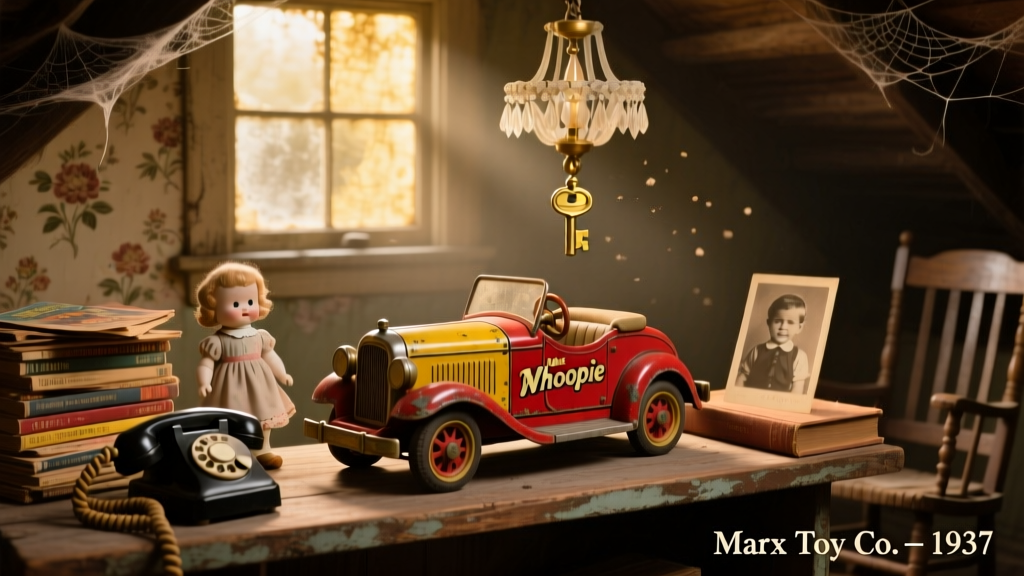
The Toy Whoopee Car: Tin Windup Marvel from Louis Marx & Co., 1950s–1960s

Little Lies on Vinyl: Decoding the Fleetwood Mac Picture Sleeve for the 1987 Warner Bros. 7" Single

Roseville Bowl Rozane Tan Glaze 10-Inch: Identification, Value Drivers, and Collectibility Analysis
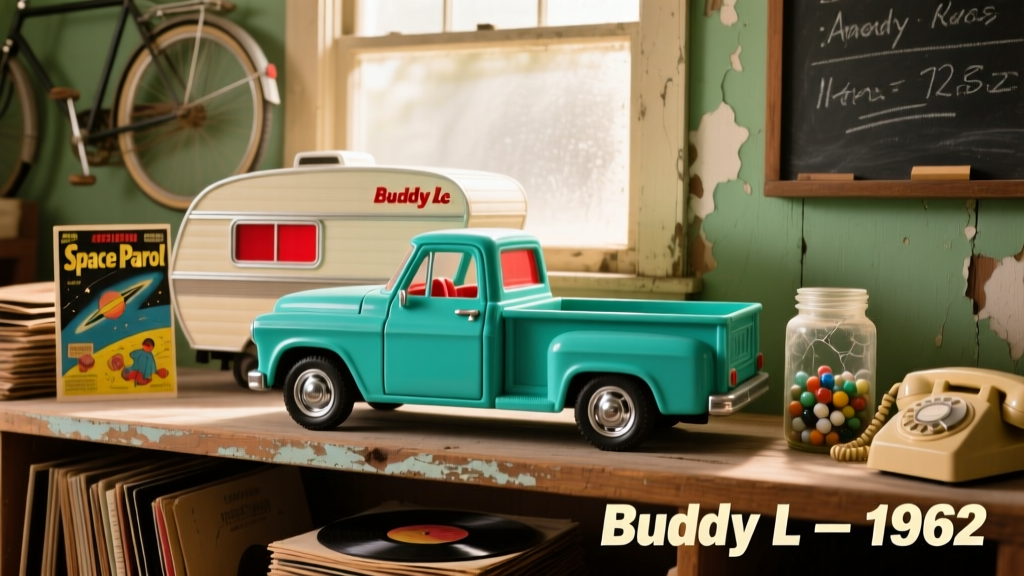
The 1961 Buddy L Turquoise Plastic Camper Pickup Truck: A Mid-Century American Icon

Buster Brown Kite: The Forgotten 1940s Flying Toy Tied to America’s Most Iconic Shoe Brand

Tips, Tips, and More Tips From September 2006: A Vintage Toy Collector’s Field Notebook

Dutch 19th-Century Mahogany Table Center with Floral Marquetry: Provenance, Craftsmanship, and Market Value

Thomas Peacock: The Forgotten Architect of Mid-Century Mechanical Toys and the Legacy of British Tinplate Ingenuity