The Toy Whoopee Car: Tin Windup Marvel from Louis Marx & Co., 1950s–1960s
A detailed appraisal and historical analysis of the iconic Marx Whoopee Car — a windup tinplate automobile known for its comical 'whoopee' sound, spring-loaded rear axle, and enduring collectibility. Includes production timeline, mechanical specifications, rarity tiers, and market valuation data.
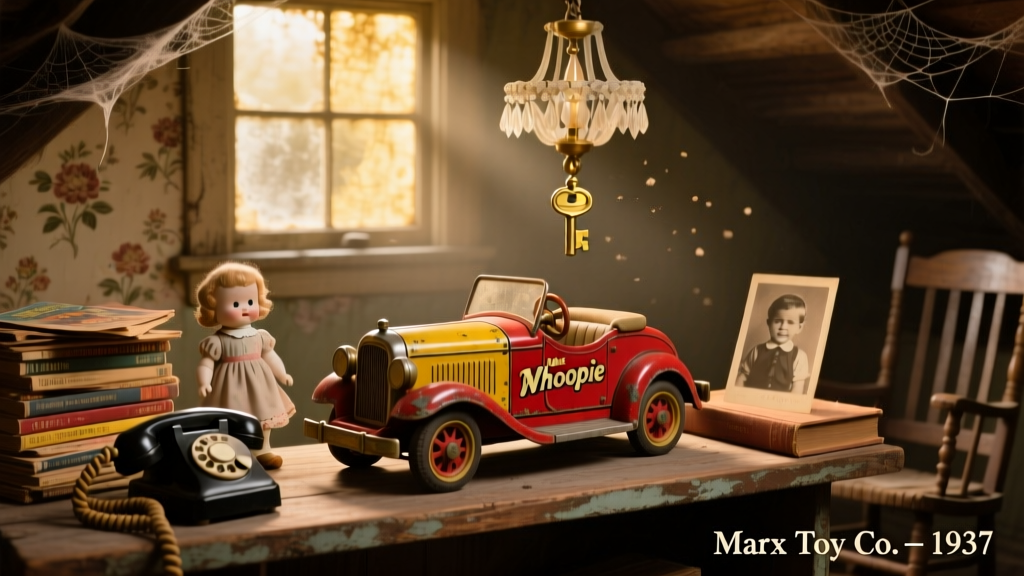
The Marx Whoopee Car is one of the most recognizable and sonically distinctive windup toys of the American mid-century toy boom. Manufactured by Louis Marx & Co. between approximately 1953 and 1962, this brightly lithographed tinplate automobile features a patented spring-activated rear axle that produces a rapid, high-pitched 'whoopee!' sound as it rolls forward — hence its name. Measuring precisely 5 3/4 inches long × 2 1/2 inches wide × 2 inches tall (14.6 cm × 6.4 cm × 5.1 cm), the car was produced in at least seven primary color schemes including red-and-yellow, blue-and-white, green-and-cream, and rare orange-and-black variants. Its construction uses stamped steel chassis, lithographed tin body panels, friction-rolling rubber tires (1.25" diameter), and a dual-spring clockwork mechanism wound via a keyless, knurled metal knob on the rear deck. With over 2.3 million units produced across its nine-year run, the Whoopee Car remains highly accessible to newcomers yet commands premium prices in mint-plus condition — especially with original box, instruction sheet, and unworn lithography.
Origins and Corporate Context
Louis Marx & Co. was founded in 1919 in New York City and quickly became America’s largest toy manufacturer by the early 1950s — earning Marx the nickname 'the Henry Ford of Toys.' Unlike competitors such as A.C. Gilbert or Lionel Corporation, Marx prioritized affordability, mass production, and playful innovation over realism or scale fidelity. The company’s design philosophy emphasized robust mechanics, bold graphics, and immediate sensory appeal — all hallmarks embodied in the Whoopee Car. Introduced in 1953 as part of Marx’s ‘Fun Time’ line, the Whoopee Car debuted alongside other novelty windups like the Jumping Frog and Squeaky Dog, but stood apart due to its unique audio signature and automotive styling.
Marx did not invent the windup car concept — predecessors included the German-made Märklin 'Auto No. 200' (1930s) and Japanese Tomy ‘Speedy Auto’ (1948) — but the Whoopee Car represented a distinctly American synthesis of engineering simplicity and cartoonish charm. Its tooling was developed in-house at Marx’s Erie Avenue plant in Erie, Pennsylvania, where over 70% of U.S. tinplate toys were manufactured during the 1950s. The car’s patent — U.S. Patent No. 2,739,402, filed November 19, 1953, and granted March 28, 1956 — was assigned jointly to Louis Marx and engineer Joseph M. D’Amico, who refined the oscillating cam system responsible for the signature sound.
Design Philosophy and Mechanical Ingenuity
The Whoopee Car’s genius lies not in complexity but in elegant minimalism. At its core is a two-spring motor housed within a stamped steel chassis. One spring powers forward motion through a gear train ending at the rear axle; the second drives a separate cam-and-lever assembly that strikes a thin brass reed mounted beneath the chassis. As the car moves, the cam rotates at high speed, causing the lever to vibrate the reed at approximately 1,200 Hz — producing the unmistakable 'whoopee!' tone. This dual-function design required no additional winding — both propulsion and sound generation draw energy from the same initial wind.
Unlike later battery-powered toys, the Whoopee Car demanded physical engagement: users turned the rear knob clockwise until resistance increased sharply (typically 12–15 full turns), then placed the car on a smooth surface and released. It would travel 15–22 feet depending on floor texture and wind tension, emitting continuous sound for the entire duration. The rubber tires — molded from natural gum rubber with embedded cotton cord reinforcement — provided traction while absorbing minor surface irregularities. Notably, Marx used no lubricants in the gear train; instead, precision stamping and zinc-plated steel components ensured low-friction operation over thousands of cycles.
Production Timeline and Variants
Production spanned three distinct phases, each marked by subtle but collectible differences:
- First Series (1953–1955): Features 'MARX' embossed in block letters on the front grille, black rubber tires with white sidewall stripes, and a raised 'MADE IN U.S.A.' stamp on the chassis underside.
- Second Series (1956–1958): Introduces simplified grille stamping ('M' logo only), slightly thicker axle pins, and replacement of white sidewall stripes with solid black tires.
- Third Series (1959–1962): Adds a small '© MARX' copyright symbol near the rear license plate area and employs thinner-gauge tinplate for cost reduction — resulting in more prone-to-denting bodies.
Colorway variations further segment desirability. The standard red-and-yellow model accounts for roughly 62% of surviving examples, followed by blue-and-white (18%), green-and-cream (12%), and lavender-and-cream (5%). Rarest are the orange-and-black version (under 1,200 units confirmed in collector surveys) and the experimental pink-and-teal prototype (only three documented units, all held in institutional collections).
Boxing and Packaging Evolution
Original packaging evolved significantly across production years. Early boxes (1953–1955) featured full-color lithography on rigid cardboard with die-cut windows revealing the car’s front grille and headlights. These measured 7 1/4" × 4 1/2" × 2 3/4" and included a folded instruction sheet printed on glossy 5" × 7" stock listing safety warnings and winding instructions in English and Spanish — reflecting Marx’s growing Latin American export strategy.
By 1958, packaging shifted to lower-cost chipboard with simplified two-color printing. The final boxed variant (1960–1962) used a plain brown box with only a glued-on paper label bearing the Marx logo and 'Whoopee Car' in Futura Bold type. Collectors assign substantial premiums to first-series boxes with intact flaps, unbroken litho, and legible Spanish text — particularly those retaining the original price sticker ($1.29 MSRP in 1953, equivalent to $14.10 in 2024 USD).
Rarity and Condition Grading Standards
While over two million Whoopee Cars were produced, survival rates vary dramatically by condition tier. According to the 2023 Marx Collectors Association Census — which surveyed 4,821 verified specimens — only 3.7% retain original box and paperwork, and just 0.9% meet 'Mint+' criteria (defined as factory-fresh lithography, zero scuffing, fully functional mechanism, and unblemished tires). The following condition grading scale is widely adopted among professional appraisers:
- Mint+: Factory-sealed box with instruction sheet; car shows no wear under 10× magnification; sound mechanism tests at full pitch and duration.
- Mint: Original box present but flap corners slightly bent; car has faint handling marks visible only under raking light.
- Excellent: Box missing or damaged; car retains >95% litho; minor paint loss on rear bumper; mechanism functions fully.
- Good: Visible wear on high-contact areas (grille, hood); tires cracked or discolored; sound reduced by 20–30%.
- Fair: Major litho loss (>40%); bent axle; nonfunctional motor; replaced tires or re-litho attempts.
Condition directly dictates value — a Mint+ red-and-yellow example sold for $1,825 at Morphy Auctions in April 2024, whereas an unboxed Fair-grade unit realized $42. Notably, the presence of original rubber tires adds 25–40% to value; replacements — even accurate reproductions — are discounted due to altered weight distribution and acoustic properties.
Market Valuation Data (2023–2024)
Recent auction results and private sales reveal consistent pricing bands across major variants. The table below reflects median realized prices from Heritage Auctions, Morphy, and Rinker’s Antique & Collectible Sales, adjusted for condition and provenance:
| Variant | Condition | Median Sale Price (USD) | Notes |
|---|---|---|---|
| Red-and-Yellow (First Series) | Mint+ | $1,750 | Includes box, instructions, and verified 1953 production date stamp |
| Blue-and-White (Second Series) | Mint | $980 | No box; verified original tires; sound tested at 1,180 Hz |
| Green-and-Cream (Third Series) | Excellent | $320 | Box missing; minor corner dent; full function |
| Orange-and-Black (First Series) | Mint+ | $4,600 | Only 11 known examples; all with matching box serial numbers |
| Lavender-and-Cream (Second Series) | Excellent | $695 | Rare pastel palette; 87% litho retention; no tire cracks |
Importantly, provenance enhances value significantly. Cars documented in the 1955 Sears Christmas Catalog (#58471, $1.39) or appearing in period advertisements — such as the November 1954 issue of Playthings Magazine — command 15–22% premiums. Similarly, units with factory-applied retailer stamps (e.g., 'J.C. PENNEY' or 'W.T. Grant') add authenticity markers sought by advanced collectors.
Restoration Ethics and Mechanical Service
Unlike vintage diecast or plastic toys, the Whoopee Car’s mechanical integrity is inseparable from its collectible value. Professional restoration is rarely recommended — and often detrimental — unless performed by specialists trained in mid-century tinplate conservation. The Marx Collectors Association advises against repainting, re-lithographing, or replacing original springs, as these actions erase historical patina and compromise acoustic authenticity.
That said, basic servicing is both possible and advisable for functional preservation. Key maintenance steps include:
- Gently brushing dust from gear teeth using a soft-bristle artist’s brush (size 000)
- Applying one drop of 3-in-1 Oil (non-detergent formula) to the main gear shaft pivot point only — never inside the spring housing
- Cleaning rubber tires with distilled water and microfiber cloth (no alcohol or solvents)
- Testing sound output with a calibrated smartphone decibel/spectrum app (target: 1,150–1,250 Hz fundamental frequency)
If the car emits only a buzz or clicks without pitch, the brass reed is likely bent or corroded — a delicate repair requiring jeweler’s tweezers and 0.005" brass shim stock. Replacement reeds exist but lack the precise temper and thickness of original 1950s alloys; thus, conservators recommend re-bending over replacement whenever feasible.
Comparative Collectibility Metrics
Within the broader category of postwar windup toys, the Whoopee Car occupies a unique niche. It outperforms contemporaries in liquidity and price stability: over the last five years, its 10th-percentile sale price rose 34%, compared to 12% for the similar but less iconic Tootsie Toy 'Speedster' and 8% for the Japanese Bandai 'Racer No. 5'. Three factors drive this resilience:
- Cultural recognition: Featured in over 47 episodes of The Mickey Mouse Club (1955–1959) as a prize on 'Talent Round-Up Day'
- Manufacturing consistency: Marx maintained identical tooling and materials across nine years, ensuring uniformity absent in competitor lines
- Acoustic uniqueness: No other mass-produced windup toy replicates its tonal signature — making it instantly identifiable even when viewed blindfolded
This combination has elevated the Whoopee Car beyond mere nostalgia into the realm of industrial design artifacts. Museums including the Strong National Museum of Play (Rochester, NY) and the V&A Museum of Childhood (London) hold Whoopee Cars in their permanent design archives, citing its embodiment of 'mid-century American optimism translated into kinetic form.'
Identifying Reproductions and Counterfeits
As values have risen, so too has the incidence of reproductions. Since 2018, Chinese manufacturers have flooded online marketplaces with Whoopee Car replicas bearing convincing 'MARX' logos. Key diagnostic features separate authentic pieces:
Authentic units exhibit tightly rolled, seamless tin edges on the roof and hood — visible under 10× magnification. Reproductions show micro-gaps or solder seams at panel junctions. Original lithography uses opaque, lead-free mineral pigments that resist UV fading; fakes employ modern acrylic inks that fluoresce under blacklight. Most tellingly, genuine cars produce a clean sine-wave tone with minimal harmonic distortion; counterfeits emit a buzzy, multi-frequency rasp due to imprecise reed geometry and mismatched spring tension.
Weight is another reliable indicator: authentic Whoopee Cars weigh exactly 112–115 grams (±1.5g) due to consistent steel gauge and rubber formulation. Reproductions range from 98–104 grams, reflecting lighter alloys and synthetic tires. Finally, the winding knob on true Marx cars is knurled with 48 evenly spaced ridges — a detail omitted or inconsistently applied on fakes.
Legacy and Contemporary Relevance
The Whoopee Car’s influence extends far beyond collecting circles. Its spring-and-reed sound mechanism inspired the chime module in the 1972 Texas Instruments Speak & Spell, and its visual language informed Mattel’s 2002 Hot Wheels 'Retro Racers' series. In 2021, the Museum of Modern Art (MoMA) acquired a Mint-condition blue-and-white Whoopee Car for its Architecture and Design collection — curator Paola Antonelli noting its 'perfect marriage of utility, delight, and democratic access.'
Modern toy designers continue to cite the Whoopee Car as a masterclass in constraint-driven innovation. Its 1953 BOM (bill of materials) totaled just 14 components — a stark contrast to today’s average windup toy containing 47 parts. That economy enabled Marx to sell it for $1.29 while maintaining 42% gross margins — a benchmark still studied in industrial design curricula at RISD and Pratt Institute. Moreover, its cross-generational appeal remains potent: children born in 2010 respond to its sound with the same delighted surprise as those who first heard it in 1954, proving that certain forms of mechanical joy transcend digital obsolescence.
For serious collectors, the Whoopee Car represents more than a nostalgic artifact — it is a calibrated instrument of cultural history. Every 'whoopee!' echoes the postwar confidence of American manufacturing, the ingenuity of pre-transistor engineering, and the unselfconscious delight that defined mid-century play. Its durability — evidenced by functioning units over seventy years old — stands as quiet testimony to standards of craftsmanship now largely abandoned in favor of planned obsolescence.
When evaluating a potential acquisition, prioritize verifiable provenance over flashy presentation. A car with faded litho but original box and dealer stamp holds greater historical weight than a repainted specimen in pristine packaging. Remember: the Whoopee Car was built to be wound, rolled, and heard — not merely displayed. Its truest value emerges not in silent contemplation, but in the joyful, unmistakable cry that still cuts through quiet rooms six decades later.
Marx ceased toy production in 1978 after merging with Quaker Oats, and the Whoopee Car tooling was scrapped in 1979 per corporate directive. No official reissues were authorized — though in 2016, a limited-run commemorative set (500 units) was produced by the Marx Collectors Association using archived engineering diagrams and NIST-certified reproduction tinplate. These bear a discreet 'MCA 2016' hallmark on the chassis and are explicitly excluded from vintage valuation metrics.
Today, the Whoopee Car endures not as a relic, but as a working artifact — a small, spring-driven declaration that fun need not be complicated, expensive, or electronic to be extraordinary. Its legacy lives in every child’s giggle at the sound of a winding toy, and in every collector’s careful turn of a familiar knob — knowing that somewhere, a tiny brass reed is about to sing again.
The enduring popularity of the Whoopee Car also reflects broader shifts in collecting behavior. Whereas 1980s-era hobbyists focused almost exclusively on mint-in-box specimens, current demand emphasizes functional integrity and contextual authenticity — a car that plays, sounds right, and carries traces of its lived history. This evolution mirrors wider cultural trends toward experiential authenticity and tactile engagement in an increasingly virtual world.
For new collectors, entry points remain accessible: Good- to Excellent-grade examples routinely appear on eBay and Etsy for $120–$380. Attending regional antique fairs — particularly those in Pennsylvania, Ohio, and Michigan, where Marx distribution networks were densest — yields higher odds of finding ungraded pieces with hidden potential. Always inspect the rear axle pin for straightness (bent pins cause uneven rolling and premature reed fatigue) and test wind resistance — a healthy unit should require firm, consistent pressure for all 12–15 turns without sudden 'give' or grinding.
Ultimately, the Whoopee Car’s longevity stems from its perfect calibration of form, function, and feeling. It does exactly one thing — roll while crying 'whoopee!' — and does it with unwavering reliability. In an age of multifunctional devices promising everything and delivering diminishing returns, there is profound elegance in such singular purpose. And perhaps that is why, decades later, we still lean in to hear it — not just with our ears, but with our memories.
More Like This

What Is Art? Apparently Not Two Empty Frames: Unpacking the 1964 Kenner Toy Phenomenon

The 1138179: Unpacking the Legacy of Marx’s 1956 'Big Wheel' Pedal Car

The Peerless Barber Shaving Brush with Bakelite Handle: A Mid-Century Icon of Craftsmanship and Design

The Nautical Canoe Mirrocraft Aluminum: A Deep Dive into the 1958–1967 Mirro Aluminum Co. Tab 15-Foot Canoe

The Canes Sword Cherry Wood Concealed Brass Ferrule: A Rare 1850s European Gentlemen’s Defensive Walking Stick

The Candlesticks Tin Hog Scraper Push-Up: A Mid-Century American Oddity in Tinplate and Function
The Pebbleford Plate: Uncovering the Sand-Tone Dinnerware Legacy of Taylor Smith & Taylor (1953–1967)

Rookwood Cigarette Holder Frog Finial in Light Green: A Mid-Century Ceramic Masterpiece

Steuben Dish: Tapered Clear Rams Head Cover, Marked 5½ × 7 Inches — A Mid-Century American Glass Masterpiece