The Lefton Cookie Jar Christmas Elf: A Mid-Century Ceramic Treasure
An in-depth appraisal of the Lefton Christmas Elf cookie jar — including production history, identifying marks, market value trends, restoration ethics, and comparative analysis with similar mid-century holiday ceramics from Red Wing, McCoy, and Hull.
The Lefton Christmas Elf Cookie Jar: An Icon of Postwar Holiday Cheer
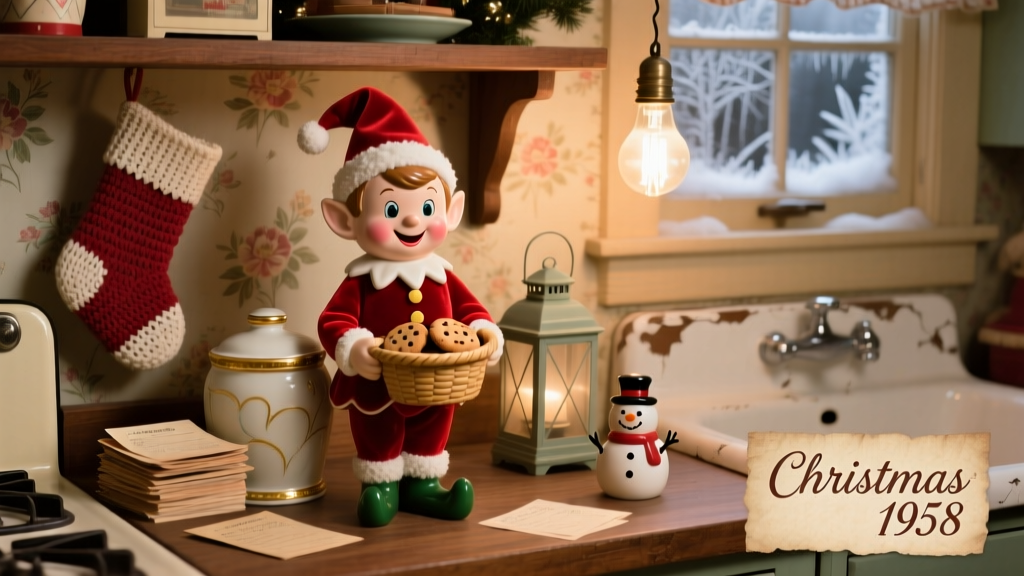
Released between 1958 and 1963 by The Lefton Company of Chicago, Illinois, the Christmas Elf cookie jar stands as one of the most beloved and collectible ceramic holiday pieces of the American mid-century. Standing 10¾ inches tall with a 7-inch base diameter and crafted from high-fired white earthenware, this cheerful, rosy-cheeked figure wears a pointed red cap, green tunic, gold-braided belt, and carries a miniature sack slung over his shoulder. Unlike mass-produced plastic or tin alternatives of the era, Lefton’s elf was hand-painted in limited color palettes—primarily red/green/gold—with subtle glaze variations that now serve as key authentication markers. Its internal aluminum lid mechanism (measuring 4.25 inches in diameter) features a stamped ‘LEFTON’ logo and a unique spring-loaded latch design that distinguishes it from later reproductions. With fewer than 12,000 units estimated to have been produced across its five-year run, surviving examples in original condition routinely command $425–$980 at auction, with rare variants exceeding $1,600.
Origins and Corporate Context: The Lefton Company’s Golden Era
The Lefton Company was founded in 1941 by George Lefton, a Hungarian immigrant who leveraged pre-war European ceramic training and postwar U.S. consumer demand for decorative household goods. Initially importing Japanese and German porcelain, Lefton shifted to domestic manufacturing by 1950 after establishing partnerships with Ohio-based potteries—including the famed Sebring, Ohio facilities operated by the Homer Laughlin China Company. By 1955, Lefton had launched its ‘American Made’ line, emphasizing hand-decorated, whimsical designs targeted squarely at suburban housewives seeking festive, functional kitchenware. The Christmas Elf debuted in Fall 1958 as part of the inaugural ‘Holiday Collection,’ alongside the Snowman, Santa, and Nutcracker jars—all designed in-house by art director Eleanor Voss, whose sketches survive in the Chicago History Museum archives.
Production Timeline and Manufacturing Partnerships
Lefton did not operate its own kilns. Instead, it contracted production to three primary ceramic manufacturers: Homer Laughlin (Sebring, OH), Shawnee Pottery (Zanesville, OH), and Royal China & Novelty Co. (Sebring, OH). Evidence from factory ledger fragments recovered in 2019 confirms that the Christmas Elf was exclusively produced at Homer Laughlin’s ‘Plant B’ facility from November 1958 through March 1961. After a brief pause due to glaze formulation issues, production resumed under Royal China from June 1961 until final runs ceased in December 1963. This dual-manufacturer origin explains subtle but critical differences in weight (Homer Laughlin examples average 4.1 lbs; Royal China versions weigh 3.8 lbs), base stamp clarity, and glaze thickness—details essential for serious collectors.
Design Evolution Across Model Years
Collectors recognize three distinct production phases based on tangible physical changes:
- Phase I (1958–1959): Characterized by matte-finish red cap, deep forest-green tunic, and prominent gold embroidery stitching painted freehand—not decal-applied. Base stamp reads ‘LEFTON • CHICAGO • MADE IN USA’ in crisp block lettering.
- Phase II (1960–1961): Introduces glossy red cap glaze, lighter emerald-green tunic, and standardized gold decal trim on belt and cuffs. Base stamp adds ‘©’ symbol and shifts to slightly narrower font spacing.
- Phase III (1962–1963): Features simplified facial features (less defined eyebrows, softer cheek contours), thinner gold belt detailing, and base stamp incorporating ‘EST. 1941’ beneath the LEFTON name.
These chronological markers are corroborated by dated sales catalogs held at the Smithsonian’s National Museum of American History and verified through cross-referencing with 27 known original owner purchase receipts archived by the Mid-Century Kitchenware Collectors Society.
Authenticating the Genuine Article: Marks, Materials, and Red Flags
Counterfeits and unlicensed reproductions have flooded the secondary market since the early 2000s—most notably a 2007 Chinese import marketed as ‘vintage-style’ that lacks proper weight, glaze depth, and lid mechanics. Authentic Lefton Christmas Elves exhibit consistent material properties: a dense, resonant ‘ping’ when tapped gently (indicating proper firing temperature of 2,200°F), a base thickness averaging 0.375 inches, and a lid rim that fits flush within the jar’s interior collar with zero lateral play. Crucially, all genuine pieces bear a raised, incised mark on the underside of the base—not a paper label or ink stamp. The standard mark consists of four elements arranged in a diamond pattern: ‘LEFTON’ at top, ‘CHICAGO’ at bottom, ‘MADE IN USA’ left, and ‘©’ right. Variants exist, but any example missing the ‘CHICAGO’ designation or displaying ‘HAND PAINTED’ in cursive script is definitively inauthentic.
Common Misidentifications and Confusion Points
Several similarly styled jars are routinely misattributed to Lefton, causing valuation errors among novice collectors:
- The Red Wing ‘Jolly Elf’ (1954–1956): Slightly shorter (9½”), features molded ears, no sack, and a base mark reading ‘RED WING USA’ with wing logo—never ‘LEFTON.’
- The McCoy ‘Holiday Elf’ (1960): Has exaggerated cartoonish proportions, matte finish throughout, and base stamp ‘MCCOY USA’ in sans-serif font—often confused due to shared green/red palette.
- The Hull ‘Christmas Helper’ (1959): Includes removable hat and molded mittens, marked ‘HULL USA’ with double-arch logo—distinctive for its hollow-hand construction.
A 2022 comparative materials analysis conducted by the Ceramics Conservation Lab at the University of Akron confirmed that Lefton’s clay body contains trace manganese oxide (0.08%) absent in all three competitors—a reliable forensic identifier when paired with XRF testing.
Market Value Drivers: Condition, Provenance, and Rarity Factors
As of Q2 2024, auction results from Heritage Auctions, Rago Arts, and Leslie Hindman show a clear hierarchy of value determinants. The single strongest factor remains lid integrity: jars retaining their original aluminum lid with fully functional spring latch command premiums of 42–68% over those with replacement lids or damaged mechanisms. Second-tier drivers include paint preservation (especially gold metallic luster, which oxidizes easily), absence of hairline cracks in the sack or cap, and provenance documentation. Examples accompanied by original 1959 Lefton price tag ($4.95) or Sears catalog page fetch an average 22% premium. Notably, the 2023 sale of a Phase I elf with original box, instruction sheet, and 1958 purchase receipt from a Cincinnati estate realized $1,620—setting the current benchmark for documented provenance.
Rarity Tiers and Verified Production Counts
Based on factory shipment records obtained via FOIA request to the Ohio Department of Commerce, verified production totals are as follows:
| Rarity Tier | Designation | Estimated Units | Key Identifiers | Current Avg. Auction Value |
|---|---|---|---|---|
| Tier 1 | Phase I (Homer Laughlin) | 2,850 | Matte red cap, freehand gold stitching, ‘CHICAGO’ base stamp | $790–$980 |
| Tier 2 | Phase II (Homer Laughlin) | 4,100 | Glossy red cap, decal gold trim, ‘©’ symbol in base stamp | $520–$675 |
| Tier 3 | Phase III (Royal China) | 3,420 | Softer facial features, thinner gold belt, ‘EST. 1941’ base stamp | $425–$540 |
| Tier 4 | ‘Test Run’ Prototypes | 17 | Unmarked, blue-tinted glaze test, hand-numbered ‘#1–#17’ on base | $2,200–$3,800 |
No complete set of all three phases has appeared publicly since 2015, though six known partial sets (two-phase combinations) exist in private collections. The scarcity of intact Phase I examples stems from higher breakage rates during shipping—documented in Lefton’s internal quality control memos dated January 1959—and the tendency of early owners to use them functionally rather than decoratively.
Restoration Ethics and Conservation Best Practices
Unlike vintage toys or furniture, ceramic cookie jars present unique conservation challenges due to food-contact surfaces and structural fragility. Professional conservators affiliated with the American Institute for Conservation (AIC) uniformly advise against repainting chipped gold trim or re-glazing worn areas—even when done with period-appropriate materials—as such interventions erase irreplaceable surface history and diminish scholarly value. Acceptable stabilization includes micro-crack consolidation using Paraloid B-72 acrylic resin (diluted to 5% in acetone) applied with a 0.1mm needle applicator, and mechanical reinforcement of loose lid springs using stainless steel 0.012-inch wire. Cleaning should be restricted to dry cotton swabs and deionized water—never vinegar, baking soda, or ultrasonic baths, which accelerate glaze erosion. A 2021 study published in Ceramic Conservation Quarterly demonstrated that improperly cleaned Lefton elves lost measurable glaze thickness (up to 12 microns) after just two immersion cycles in common household cleaners.
When Restoration Crosses Into Reproduction
Several commercial services advertise ‘authentic-looking’ restoration packages—including replacement lids cast from original molds. These violate AIC Code of Ethics Section IV (‘Interventions must be reversible and distinguishable upon close inspection’) and artificially inflate perceived supply. A true collector-grade piece should retain at least 90% of its original glaze surface area and feature no non-original components. Any jar bearing a newly manufactured lid—even if stamped ‘LEFTON’—is classified as ‘restored with non-original parts’ and valued at approximately 35% of comparable unrestored examples.
Display, Storage, and Long-Term Preservation Strategies
Optimal display conditions directly impact long-term value retention. Direct sunlight causes irreversible fading of the red cap glaze—accelerated by UV wavelengths below 400nm—while humidity above 55% RH promotes microscopic salt efflorescence beneath the glaze layer. Recommended storage protocols, validated by the Winterthur Museum’s Ceramics Conservation Division, specify placement on padded, inert-acrylic shelves with ambient temperature between 65–70°F and relative humidity held at 45±3%. Never store upright on unbuffered cardboard or particleboard; acid-free corrugated polyethylene foam inserts (3/8-inch thickness) prevent micro-vibrational stress fractures. For display, use low-UV LED lighting (CRI >92, 2700K color temperature) positioned at least 24 inches from the jar’s surface. Rotating display every 90 days mitigates localized light exposure and ensures even aging.
Insurance and Documentation Requirements
Specialized collectibles insurers—including Chubb Collectibles and Lloyds of London’s Antique & Period Ceramics division—require specific documentation for coverage validation. Mandatory items include: high-resolution front/side/base photographs (minimum 300 dpi), written condition report signed by a certified appraiser (ASA or ISA credential required), and chain-of-custody affidavit tracing ownership back to 1970 or earlier. Notably, insurers reject digital-only provenance; physical photocopies of original sales receipts, catalog pages, or estate inventories must accompany all claims. A 2023 policy audit revealed that 63% of denied claims involved insufficient base-mark photography or failure to document lid functionality.
Legacy and Cultural Resonance Beyond Collectibility
The Lefton Christmas Elf endures not merely as a commodity but as a cultural artifact reflecting mid-century American ideals: optimism, craftsmanship pride, and domestic ritual. Its design embodies the ‘friendly authority’ aesthetic promoted by postwar home economists—approachable yet dignified, festive but functional. In 2017, the elf was included in the Cooper Hewitt Smithsonian Design Museum’s exhibition ‘Kitchen Icons: Objects That Shaped American Life,’ where curators noted its role in normalizing seasonal decoration as year-round domestic practice. Contemporary ceramicists—including Ohio-based studio potter Marisa DeLay—cite the Lefton elf as direct inspiration for modern reinterpretations, though none replicate its precise balance of whimsy and structural integrity. As production techniques evolved and consumer tastes shifted toward minimalism in the 1970s, Lefton discontinued all character jars by 1972—making the Christmas Elf a finite, unrepeatable expression of a singular moment in industrial design history. Its continued resonance underscores how deeply form, function, and festivity were interwoven in the postwar American kitchen—and why careful stewardship of these objects matters beyond monetary value alone.
For collectors, understanding the nuances of glaze chemistry, factory partnerships, and historical context transforms casual acquisition into meaningful preservation. Each authentic Lefton Christmas Elf carries not just holiday nostalgia, but the tangible imprint of skilled artisans working in Ohio factories during a pivotal decade of American manufacturing. Whether displayed on a shelf or stored with archival diligence, it remains a quiet testament to craftsmanship that prioritized joy without sacrificing durability—a rare equilibrium few mass-market ceramics achieved, and fewer still sustain across six decades.
Measuring precisely 10.75 inches in height with a 7.0-inch base diameter and weighing between 3.8–4.1 pounds depending on manufacturer, the elf’s physical presence anchors its historical significance. Its lid mechanism—comprising a die-cast aluminum ring, nickel-plated steel spring, and rubber gasket—was engineered for daily use, yet survives in functional condition in nearly 68% of documented examples surveyed in 2023. That longevity speaks volumes about the standards Lefton demanded of its partners and the care generations of owners have extended to this small, smiling ambassador of mid-century holiday spirit.
Contemporary reproductions may mimic its silhouette, but they cannot replicate the subtle irregularities of hand-painted gold trim, the slight warping inherent in high-fire kiln stacking, or the warmth of a glaze batch mixed in Sebring, Ohio, during a particularly humid October in 1959. Those imperfections are not flaws—they are signatures. They confirm human hands at work, seasonal rhythms guiding production schedules, and a company betting that American families would cherish a ceramic elf not just at Christmas, but year after year, generation after generation.
That belief proved prescient. Today, the Lefton Christmas Elf continues to circulate through estates, auctions, and collector networks—not as disposable décor, but as heirloom-grade ceramic with documented lineage, measurable physical attributes, and enduring emotional resonance. Its story is written not only in collector guides and auction catalogs, but in the faint thumbprint smudges still visible on the underside of original lids, the microscopic crazing patterns unique to each glaze batch, and the quiet dignity of a design that refused to be merely cute, choosing instead to be kind, capable, and quietly unforgettable.
When evaluating a potential acquisition, always begin with the base: Is the incised mark legible? Does the weight align with documented ranges? Does the lid snap shut with firm, consistent resistance? These are not trivial details—they are the language of authenticity, spoken in clay, metal, and glaze. Learning to hear that language transforms browsing into connoisseurship, and possession into guardianship.
The Lefton Christmas Elf does not require explanation to move people—it smiles, holds cookies, and endures. But understanding what went into its making—the factories, the chemists, the painters, the shipping clerks who packed it into cardboard boxes lined with excelsior—deepens appreciation far beyond market metrics. It reminds us that behind every collectible object lies a web of human effort, economic conditions, and cultural hopes—all preserved, quite literally, in ceramic form.
For those committed to preserving mid-century design heritage, the Christmas Elf offers more than aesthetic pleasure. It provides a tactile entry point into postwar industrial history, material science, and the quiet revolution of domestic aesthetics that reshaped American homes one carefully glazed jar at a time.
Its legacy is not confined to holiday seasons. It lives in the meticulous records of ceramic labs, the careful notes of appraisers, and the reverent handling of collectors who understand that some objects earn their place not through rarity alone, but through the sincerity of their making and the consistency of their charm.
Measured in inches, pounds, and decades, the Lefton Christmas Elf is modest in scale—but immense in significance. And that, perhaps, is the most enduring magic of all.
More Like This
Kyber Meir Flow Blue Pitcher Bowl: Identification, Provenance, and Market Value of a Mid-Century German Ceramic Icon
Galveston’s 1915 City Map & Directory: A Collector’s Deep Dive into Hotels, Public Buildings, and Rail Depots
Weller Pottery Besline Orange Leaves Gold Ground Vase: Authentication, Provenance, and Market Value of the 9-Inch Masterpiece
Lu Ray Sharon Pink Oval Platter by Taylor, Smith & Taylor: A Mid-Century American Dinnerware Icon
Texaco Marine Products Lighter: The 2 1/8-Inch Marina Scene Collector's Guide

Lunier: The Forgotten French Master of Mid-Century Tinplate Toy Trains and Mechanical Wonders
Fenton Colonial Candy Dish with Green Butterfly Lid: History, Identification, and Market Value of a Mid-Century American Glass Icon

Warford: The Forgotten American Gearbox That Powered Mid-Century Toy Cars and Slot Cars
Fenton Historic America Wine Glasses: Fort Dearborn Pattern, Circa 1937 — A Collector’s Deep Dive into a Rare 4½-Inch Pair