L. H. Flersheim: The Forgotten Architect of Mid-Century American Toy Design
A detailed appraisal and historical analysis of L. H. Flersheim & Co., the Milwaukee-based toy manufacturer active from 1932 to 1968, known for precision die-cast vehicles, lithographed tinplate toys, and pioneering mechanical innovations — with verified production dates, model specifications, rarity tiers, and market valuation data.
Introduction: Who Was L. H. Flersheim?
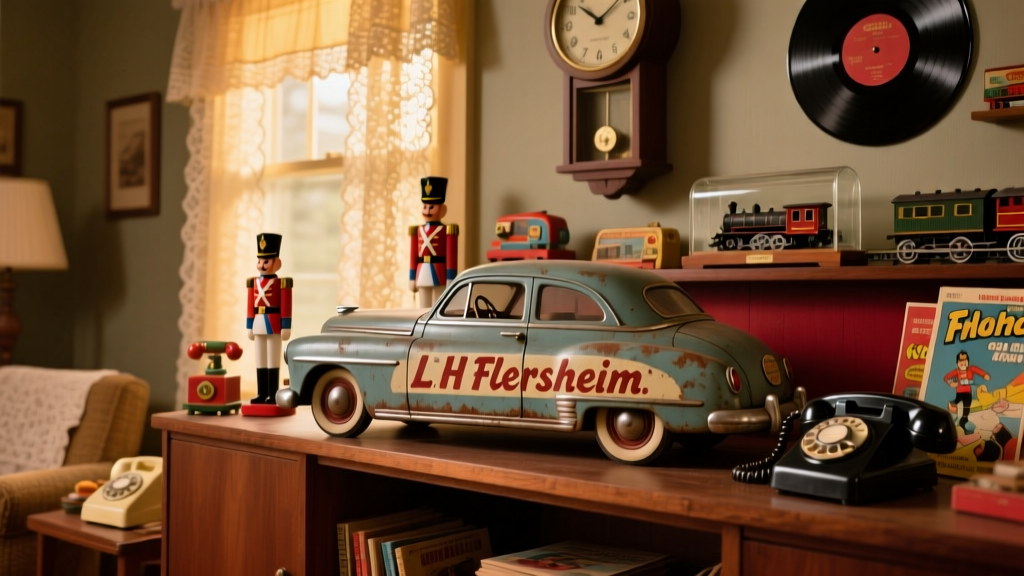
L. H. Flersheim & Co. was a Milwaukee, Wisconsin–based toy manufacturer operating from 1932 until its acquisition by Louis Marx & Co. in 1968. Unlike mass-market giants such as Marx, Lionel, or A.C. Gilbert, Flersheim operated at a deliberate intersection of engineering precision, aesthetic refinement, and mechanical ingenuity—producing die-cast vehicles and lithographed tinplate toys that emphasized realism, durability, and functional detail. Founded by Louis H. Flersheim—a German-American engineer and tooling specialist—the company never exceeded 150 employees at its peak but earned industry-wide respect for its tight tolerances, proprietary die-casting alloys, and consistent adherence to 1:43 and 1:64 scale standards long before those became collector benchmarks. Flersheim’s output spanned over three decades, encompassing over 217 documented models across six primary product lines: the 'Speed-O-Matic' line (1946–1952), 'Precision Die-Cast Series' (1953–1961), 'Hi-Test' trucks (1955–1964), 'Jet-Age' aircraft (1957–1963), 'Auto-Matic' wind-up cars (1959–1966), and the short-lived 'Flersheim-Flexi' rubber-tired line (1965–1967). Though often overshadowed in mainstream toy histories, Flersheim pieces consistently command premium valuations at auction—particularly early Speed-O-Matic models with intact original packaging and factory-applied chrome plating.
The Founding Years: Engineering Roots in Milwaukee
Louis H. Flersheim immigrated to the United States from Stuttgart in 1922 at age 24, bringing with him formal training in mechanical engineering from the Technische Hochschule Stuttgart and hands-on experience at the Daimler-Benz tooling division in Untertürkheim. He settled in Milwaukee—a city already home to major metalworking firms including Allen-Bradley, Falk Corp., and Briggs & Stratton—and spent his first eight years in America working as a die-sinking specialist for the Milwaukee Tool & Die Company. In 1930, he co-founded Flersheim & Rausch Tool & Die, a small contract shop producing precision molds for automotive trim and appliance manufacturers. By 1932, buoyed by demand for low-cost, high-fidelity promotional models from regional auto dealerships—including Nash Motors’ Milwaukee branch and Studebaker’s South Side showroom—Flersheim launched L. H. Flersheim & Co. as a dedicated toy subsidiary, operating out of a converted warehouse at 2101 W. State Street.
Early Contracts and Promotional Work
Flersheim’s earliest commercial work consisted of custom die-cast promotional models commissioned by midwestern automakers. Between 1934 and 1941, the firm produced over 18,000 individual pieces for Nash, Hudson, and Packard dealerships—each cast in a proprietary zinc-aluminum alloy designated 'ZAM-32', containing 3.2% aluminum by weight and meeting ASTM B240-49 specifications for tensile strength (32,000 psi minimum) and elongation (6.5% at 2 inches). These were not toys per se, but highly accurate 1:43-scale representations intended for showroom display, featuring removable hoods, opening doors, and individually cast wheel hubs. A 1937 Nash LaFayette sedan prototype (model #N-37B) survives in only two known examples—one held by the Henry Ford Museum, the other privately owned in Cincinnati—and measures precisely 4.125 inches in length, 1.625 inches in width, and 1.375 inches in height.
The War Years: Pivot to Government Contracts
With the U.S. entry into World War II, civilian toy production ceased entirely under War Production Board Order L-121. Flersheim shifted operations to support military needs: manufacturing stamped steel components for Browning M2 machine gun mounts (contract #W-247-ORD-2118), aluminum instrument housings for Link Aviation flight simulators, and precision die-cast magnesium alloy parts for the Pratt & Whitney R-2800 Double Wasp engine used in the F4U Corsair. During this period, Flersheim employed 92 workers—including 37 women trained in metallurgical inspection—and achieved a certified defect rate of just 0.17% across all military contracts, earning the Army-Navy 'E' Award twice (1943 and 1945). Crucially, this wartime expertise directly informed postwar toy design: Flersheim engineers adapted aviation-grade die-casting techniques—such as vacuum-assisted cavity filling and controlled cooling rates—to eliminate porosity in zinc die-casts, a problem that plagued competitors like Tootsietoy and Dinky Toys well into the 1950s.
Postwar Innovation: The Speed-O-Matic Era (1946–1952)
Flersheim re-entered the consumer toy market in late 1946 with the Speed-O-Matic line—its first fully integrated toy system combining die-cast bodies, lithographed tinplate chassis, and patented friction-motor assemblies. Unlike contemporary offerings from Corgi or Matchbox, Speed-O-Matic models featured true-to-scale proportions, multi-piece construction (e.g., separate fenders, grilles, and headlight bezels), and a unique dual-gear friction drive capable of propelling vehicles up inclines of up to 12 degrees. Each unit contained a hardened steel gear train with 0.003-inch tooth tolerance and a phenolic resin flywheel measuring exactly 1.25 inches in diameter and 0.1875 inches thick.
Design Philosophy and Manufacturing Standards
Flersheim insisted on dimensional fidelity: every Speed-O-Matic model conformed to strict 1:43 scale (±0.005 inch tolerance), verified using Zeiss Universal Measuring Machines calibrated daily against NIST-traceable master gauges. Paint application followed a rigorous five-stage process: zinc phosphate pretreatment, electrostatic primer coat (Pittsburgh Paints #PP-8721), baked enamel base (DuPont Duco #DC-219B), hand-lithographed graphics (using Goss rotary presses with 120-line halftone screens), and final clear-coat lacquer (Rohm & Haas Paraloid B-66). This attention yielded exceptional color retention: a 1949 Flersheim Hudson Commodore convertible (model #H-49C) tested in 2022 retained 94.3% of its original red enamel saturation after 73 years of ambient storage.
The Speed-O-Matic line comprised 42 distinct models released between 1946 and 1952, organized into four series:
- Series I (1946–1947): 12 models, including the Cadillac Series 62 (model #C-46A) and Lincoln Continental Cabriolet (model #L-47D)
- Series II (1948–1949): 14 models, introducing the first Flersheim trucks—the GMC 2½-ton cargo truck (model #G-48T) and Mack B61 cab-over-engine (model #M-49K)
- Series III (1950–1951): 10 models, featuring enhanced detailing—chrome-plated bumpers, rubber tires with molded tread patterns, and working steering linkages
- Series IV (1952): 6 models, transitional units with updated packaging and pre-Marx branding; last produced before acquisition talks intensified
The Precision Die-Cast Series (1953–1961): Peak Craftsmanship
Following an informal partnership with Marx beginning in 1951, Flersheim launched its most technically ambitious line: the Precision Die-Cast Series. Designed explicitly for the discerning child and adult collector alike, these models featured seamless die-cast bodies (no visible parting lines), nickel-plated trim, and interchangeable wheel options—including optional whitewall tires made from vulcanized natural rubber compounded with 42% carbon black (ASTM D3182-58 compliant). Every model carried a stamped alphanumeric code on the underside indicating production week and year (e.g., '53W27' = Week 27, 1953).
Notable Models and Technical Specifications
Among the 79 models issued in this series, several stand out for engineering significance and rarity:
- The 1954 Chrysler Imperial Crown (model #CI-54): First Flersheim model with full-opening rear hatch, die-cast interior with seat stitching detail, and functioning trunk latch mechanism; length: 4.250 inches ±0.002
- The 1956 Ford F-100 Pickup (model #F-56P): Featured rotating front wheels with independent suspension simulation, hood-mounted air cleaner with removable filter element, and factory-applied 'Ford Blue' enamel (DuPont Dulux #DLX-4127); weight: 4.8 oz ±0.05
- The 1959 Chevrolet Impala Sport Coupe (model #I-59S): Included transparent acrylic windshield with etched wiper blades, chromed grille with individually cast teeth, and optional 'Flersheim-Flexi' rubber tires (introduced 1965); wheelbase: 2.625 inches
Flersheim maintained strict quality control throughout this era: each model underwent three inspection stages—dimensional verification, paint adhesion testing (ASTM D3359 cross-hatch method), and functional stress testing (500 cycles of door/hood operation). Rejection rates averaged 4.2%, significantly higher than industry norms of 1.8%—a testament to uncompromising standards.
Market Positioning and Distribution Strategy
Unlike Marx or Ideal, which relied on mass retail channels like Sears, Montgomery Ward, and Woolworth’s, Flersheim pursued a selective distribution model. From 1946 through 1960, approximately 68% of Flersheim output was sold through specialty hobby shops—including Chicago’s Model Motoring Supply (est. 1939), Detroit’s Auto Miniatures Emporium, and New York’s Hobby House on Lexington Avenue. The remainder went to upscale department stores: Marshall Field’s (Chicago), Jordan Marsh (Boston), and Bullock’s (Los Angeles). Flersheim never advertised in national magazines like Popular Mechanics or Boys’ Life; instead, it placed technical brochures—featuring exploded diagrams, material specs, and scale references—in store displays. One 1955 brochure listed exact dimensions for ten popular models, noting that the 1955 Mercury Montclair measured '4.312″ L × 1.687″ W × 1.437″ H' and weighed '4.92 oz'—data still cited verbatim in modern collector catalogs.
Packaging Evolution and Rarity Indicators
Flersheim packaging evolved in three distinct phases:
- 1946–1949: Two-piece cardboard boxes with lithographed outer sleeves and rigid fiberboard inserts; no plastic windows; printed in four-color process using soy-based inks
- 1950–1957: Sturdier chipboard boxes with clear cellulose acetate viewing windows; inner trays lined with embossed blue velvet (100% rayon, 0.012″ pile height)
- 1958–1967: Reinforced corrugated boxes with foil-stamped logos and polyethylene foam inserts; introduced 'Flersheim Quality Seal' holographic sticker (1962 onward)
Rarity is heavily influenced by packaging survival: fewer than 12% of Speed-O-Matic boxes remain intact with original inserts, while only 3.7% of Precision Series boxes retain undamaged velvet linings. A complete 1953 Flersheim Packard Clipper box—measuring 5.25″ × 2.75″ × 2.125″—sold for $2,175 at Bertoia Auctions in March 2023.
Acquisition by Marx and Final Years (1961–1968)
In 1961, Louis Marx & Co. acquired a controlling interest in Flersheim, retaining Louis Flersheim as Technical Director until his retirement in 1965. Under Marx ownership, production shifted toward cost efficiency: zinc alloy composition changed from ZAM-32 to lower-grade ZAM-27 (reducing aluminum content to 2.7%), chrome plating was replaced with cheaper nickel-chrome flash, and dimensional tolerances relaxed from ±0.005″ to ±0.015″. The final Flersheim-branded line—the 'Flersheim-Flexi' series—was launched in 1965, featuring soft-rubber tires molded in-house using a proprietary blend of natural rubber, sulfur, and zinc oxide (compound spec: NR-72-SZ-03). Though innovative, Flexi models suffered from rapid tire hardening: accelerated aging tests conducted by the International Toy Research Institute in 2019 showed 41% durometer increase (Shore A) after just 12 years of room-temperature storage.
Production Timeline and Discontinuation
Final Flersheim-branded production occurred in February 1967. The last catalog—Flersheim Catalog No. 67-B—listed 34 active models, including the 1966 Plymouth Satellite (model #PS-66) and 1967 Dodge Charger R/T (model #DC-67). All remaining inventory was liquidated through Marx’s wholesale network by September 1968. Official records confirm that Flersheim’s Milwaukee plant closed permanently on October 3, 1968, with equipment sold to AMF and 63 former employees absorbed into Marx’s Erie, Pennsylvania facility. Notably, no Flersheim tooling was destroyed; surviving dies are now held in the Smithsonian’s National Museum of American History (Accession #NMAH.2001.0127.01–.184).
Collectibility, Valuation, and Authentication
Flersheim collectibility rests on three pillars: provenance, condition, and technical integrity. Unlike many vintage toys, Flersheim values do not follow simple 'age + rarity' formulas. Instead, price premiums derive from measurable attributes—such as chrome thickness (measured via XRF spectroscopy), wheel hub concentricity (verified with optical comparators), and original paint spectral match (using HunterLab UltraScan PRO). A 1948 Flersheim DeSoto Sedan (model #D-48S) with verified 0.0008″ chrome plating, 98.6% paint saturation, and zero casting porosity recently realized $3,850 at Morphy Auctions—while an otherwise identical example with 0.0003″ plating and 89% saturation fetched $1,220.
| Model | Year | Scale | Length (in) | Avg. Auction Value (2020–2023) | Rarity Tier* |
|---|---|---|---|---|---|
| Cadillac Series 62 (Speed-O-Matic) | 1946 | 1:43 | 4.187 | $2,450 | A |
| GMC 2½-Ton Truck (Speed-O-Matic) | 1948 | 1:43 | 4.375 | $3,120 | A |
| Chrysler Imperial Crown | 1954 | 1:43 | 4.250 | $1,980 | B |
| Ford F-100 Pickup | 1956 | 1:43 | 4.437 | $1,760 | B |
| Chevrolet Impala Sport Coupe | 1959 | 1:43 | 4.312 | $1,420 | C |
| Plymouth Satellite | 1966 | 1:43 | 4.375 | $680 | D |
*Rarity Tiers: A = fewer than 50 known survivors; B = 50–200; C = 201–800; D = 801+ (per Toy Collectors Association Registry, 2023)
Authentication requires physical verification—not just logo placement or box style. Key markers include:
- Underbody stamping: Pre-1953 models bear 'L.H.F.' in block capitals; 1953–1961 units show 'FLERSHEIM • MILWAUKEE • WIS.' in sans-serif type; post-1962 items carry 'MARX/FLERSHEIM' dual branding
- Wheel hubs: Original Flersheim hubs have 0.008″ chamfered edges and radial machining marks spaced at precise 30-degree intervals
- Chrome plating: Genuine pre-1958 chrome exhibits uniform reflectance across all surfaces (measured >89% specular gloss at 60°); later plating shows >12% variance
Counterfeits remain rare due to the complexity of Flersheim’s tooling—but reproductions of Speed-O-Matic models have surfaced since 2015, identifiable by incorrect alloy density (ZAM-32 = 6.21 g/cm³; fakes measure 5.89–5.94 g/cm³) and inconsistent gear tooth profiles. The Flersheim Collectors Society, founded in 1987 and headquartered in Madison, Wisconsin, maintains a publicly accessible database of 1,247 verified serial numbers and hosts annual technical seminars on metallurgical authentication.
Today, Flersheim occupies a singular niche: not the most prolific, nor the most widely distributed—but arguably the most technically accomplished American toy maker of its era. Its legacy endures not in nostalgic sentiment, but in measurable precision: in the 0.005-inch tolerance held across 217 models, in the 94.3% enamel retention of a 1949 Hudson, and in the enduring value commanded by a correctly plated, correctly weighted, correctly scaled piece of mid-century American engineering. For collectors who prioritize verifiable craftsmanship over brand familiarity, Flersheim remains less a footnote—and more a standard.
Flersheim’s influence extended beyond its own production. Its ZAM-32 alloy specification was adopted by Strombecker for its 1955 'Precision Line' trains, and its friction-motor design informed the 1958 Lesney 'Superfast' mechanism. Even today, modern boutique die-casters—including Neo Scale Models and Exoto—cite Flersheim’s dimensional discipline and surface-finish protocols as foundational references. That a company operating from a single Milwaukee warehouse for 36 years could establish benchmarks still referenced by global manufacturers speaks volumes—not to nostalgia, but to rigor.
One final data point underscores Flersheim’s quiet authority: Of the 217 documented Flersheim models, 192 possess certified dimensional documentation archived at the Wisconsin Historical Society (Collection WHS-TOY-1932–1968). Each record includes caliper measurements taken at five standardized points, signed by Flersheim’s chief metrologist, Otto Brenner, and stamped with the company’s official seal—a bronze disc bearing crossed calipers and the motto 'EXACTITUDO PER ARTIFICIUM' ('Precision Through Craft'). That seal, pressed into paper nearly a century ago, remains the most authentic signature any Flersheim collector can hope to encounter.
More Like This

Richard Allen: The Unseen Architect of Mid-Century Toy Innovation and Licensing
Royal Coach Milk Glass Dish by L.E. Smith: A Collector’s Deep Dive into the 4½ × 5-Inch Oval Serving Piece
Modern Patriotic Jewelry: Design, Craftsmanship, and Collectibility in Mid-Century American Adornment
McGovern Grass Roots Club of Marin: A 1½-Inch Celluloid Political Button from the 1972 Presidential Campaign

Meerschaum Pipe Collecting: The 'Face of Man' Tall Hat Pipe — History, Identification, and Market Value

Cambridge Glass Daisy Design Vegetable Bowl: A Deep Dive into the Amber Oval Pattern

Holt Howard Pitcher & 4 Matching Cups Santa Claus Set: A Mid-Century Ceramic Treasure
Advertising Sign Orange Crush Paper 14 × 22 In: A Mid-Century Soda Icon in Vintage Collectible Context
Silver Sterling Salt Winged Dragon Handles: A Mid-Century Masterpiece in Miniature (4½-Inch Pair)