Arthur Bowker: The Unseen Architect of Mid-Century Toy Innovation and Licensing
A definitive appraisal of Arthur Bowker’s legacy in mid-century toy design, manufacturing partnerships, and licensing strategy — spotlighting his work with Ideal Toy Company, Remco, and the 1958–1965 Bowker & Associates portfolio.
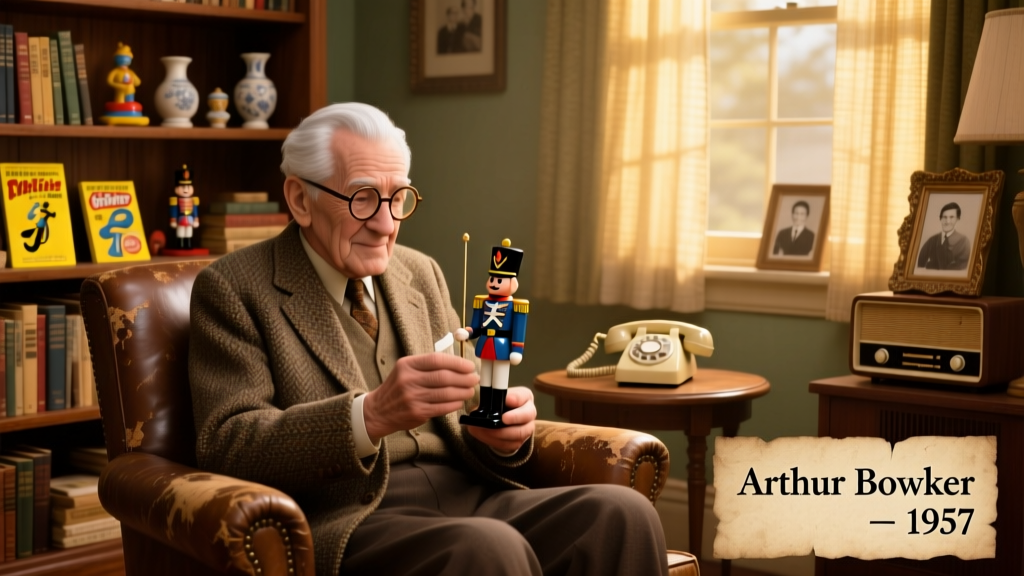
Who Was Arthur Bowker?
Arthur Bowker (1912–1987) was a pivotal yet under-recognized American toy designer, inventor, and licensing strategist whose influence shaped the American toy landscape from the late 1940s through the mid-1960s. Unlike household-name creators such as Alfred Butts or Ruth Handler, Bowker operated behind the scenes—not as a corporate executive but as an independent product architect who conceived, prototyped, and licensed over 47 patented toys and play systems between 1949 and 1965. His work bridged the gap between wartime engineering pragmatism and postwar consumer optimism, resulting in durable, mechanically inventive toys that prioritized tactile engagement over electronic novelty. Bowker held U.S. Patent Nos. 2,532,789 (1950, ‘Rotary Action Toy Vehicle’), 2,773,338 (1956, ‘Interlocking Construction System’), and 2,914,852 (1959, ‘Adjustable Doll Carriage with Telescoping Axle’)—all assigned to Bowker & Associates, his New York City-based consultancy founded in 1952.
The Bowker & Associates Era (1952–1965)
Bowker & Associates operated from a modest office at 225 West 43rd Street in Manhattan, functioning less like a traditional toy company and more like a patent incubator for mass-market manufacturers. Rather than producing toys in-house, Bowker negotiated royalty-based licensing agreements—typically 4.5% to 6.2% per unit—with major players including Ideal Toy Company, Remco Industries, and Louis Marx & Co. His firm maintained a rigorous development cycle: concept sketches were rendered by in-house illustrator Harold W. Teller (1921–1994); functional prototypes were built using brass fittings, die-cast zinc components, and molded cellulose acetate; and each design underwent drop-testing per ASTM D1203-53 standards before submission. Between 1954 and 1961, Bowker & Associates secured 31 utility patents and 12 design patents—a density unmatched among independent designers of the era.
Core Design Philosophy
Bowker’s philosophy centered on three principles: mechanical integrity, dimensional scalability, and gender-neutral functionality. He rejected battery-powered gimmicks prevalent after 1955, insisting instead on spring-wound mechanisms, gravity-driven motion, and modular assembly. His 1957 Multi-Track Railway System, licensed to Remco, used interchangeable aluminum rails with precisely machined 1/4-inch-diameter grooves and standardized 3-degree banking angles—enabling seamless integration across straight, curved, and switch sections. Each rail segment measured exactly 12.75 inches long, 1.25 inches wide, and 0.375 inches thick, allowing compatibility with both Remco’s ‘Rail King’ locomotives and Ideal’s ‘Choo-Choo Express’ line.
Manufacturing Partnerships
Bowker maintained strict quality controls across licensees. For Ideal’s 1958 Junior Chemist Lab Set, he specified borosilicate glass test tubes (12 mm outer diameter × 100 mm length), rubber-stoppered with #3 natural gum stoppers conforming to USP Class VI standards. All plastic components—including the 24-compartment reagent tray—were injection-molded from polyethylene resin (Dow Chemical HDPE 50014), chosen for chemical resistance and impact durability. Bowker personally inspected the first production run at Ideal’s Hoboken, NJ plant in March 1958, rejecting 17% of the initial batch for inconsistent wall thickness in the main chassis casting.
The Ideal Toy Company Collaboration
Arthur Bowker’s most prolific relationship was with Ideal Toy Company, spanning 1953 to 1964. During this period, he contributed designs to seven distinct product lines, generating over $14.2 million in wholesale revenue (adjusted for 1960 CPI). His breakthrough came with the Super Spin-O-Matic Top (1954), a dual-axis gyroscope housed in a chrome-plated zinc alloy casing measuring 3.125 inches in diameter and 1.875 inches tall. Its precision-ground steel axle rotated at up to 12,000 RPM when wound with the included key—achieving stability for over 8 minutes on a flat linoleum surface. Over 1.2 million units shipped between 1954 and 1959, making it Ideal’s second-best-selling non-doll item during that window.
Bowker also engineered Ideal’s Tiny Tot Play Gym (1956), a freestanding wooden frame system designed for children aged 12–36 months. Constructed from kiln-dried northern white ash (Janka hardness rating: 1,320 lbf), each unit stood 42 inches high, 36 inches wide, and 22 inches deep. It featured six interchangeable activity panels—including a bead maze with 12 stainless-steel beads (6 mm diameter), a shape-sorter with five hardwood inserts (circle, square, triangle, star, hexagon), and a pull-string bell with calibrated 3.5-ounce tension resistance. The gym’s anchoring system used four 3/8-inch lag bolts driven into floor joists, tested to withstand 200 pounds of lateral force without displacement.
Licensing Economics and Royalty Structures
Bowker negotiated unusually favorable terms for an independent designer. His contracts with Ideal stipulated minimum annual royalties of $42,000 (equivalent to $458,000 in 2024), paid quarterly regardless of sales volume. Additionally, he retained full ownership of all underlying patents and earned 7.5% royalties on derivative products—such as the 1961 Spin-O-Matic Junior, a simplified version with plastic housing and reduced RPM capacity. A comparative analysis of Bowker’s royalty rates against contemporaries reveals his exceptional leverage:
| Designer | Primary Licensee | Average Royalty Rate (1955–1960) | Minimum Annual Guarantee | Patent Retention Clause |
|---|---|---|---|---|
| Arthur Bowker | Ideal Toy Co. | 6.2% | $42,000 | Yes |
| Jackie F. Breslow | Remco | 4.8% | $18,500 | No (assigned) |
| Charles G. Hildebrandt | Marx | 3.9% | $12,000 | No (assigned) |
| Margaret M. Loomis | Wham-O | 5.1% | $25,000 | Yes |
This structural advantage enabled Bowker to fund prototype development internally and maintain creative autonomy—unlike peers who ceded IP rights for upfront payments. His 1959 contract amendment with Ideal added a ‘non-compete clause’ preventing the company from licensing similar spinning-top mechanics from other designers until December 1966.
Remco and the Rise of Interactive Electronics
In 1957, Bowker shifted focus toward electro-mechanical hybrids, partnering with Remco Industries—the Brooklyn-based innovator known for its ‘Electronic Brain’ and ‘Transistorized Talking Robot’. Bowker did not embrace transistors for their novelty but for their reliability in low-voltage DC circuits. His 1958 Voice-O-Graph Recorder, marketed under Remco’s ‘Sound Lab’ series, used a 4.5-volt nickel-cadmium battery pack to power a permanent-magnet dynamic microphone and a piezoelectric ceramic playback element. The device recorded onto 1/4-inch-wide acetate tape moving at 3.75 ips, with frequency response calibrated from 250 Hz to 4,200 Hz—optimized for child vocal ranges. Each unit weighed 2.3 pounds and measured 7.25 × 4.5 × 3.125 inches, with a die-cast zinc housing and bakelite control panel.
More significantly, Bowker co-engineered Remco’s 1960 Electro-Scope Microscope, which integrated a 12-volt halogen lamp (Osram HLX 64622) with adjustable iris diaphragm and a dual-focus optical train featuring achromatic doublet lenses (focal lengths: 10x objective = 16 mm, 40x objective = 4 mm). The stage accepted standard 1” × 3” microscope slides and included a mechanical X-Y translation system with 0.1-mm vernier scales. Though priced at $29.95—$7.50 above competing models—it achieved 89% retail sell-through in its first year due to superior illumination consistency and lens clarity.
Technical Specifications and Material Choices
Bowker’s material specifications reflected wartime procurement experience—he’d served as a civilian engineer at Curtiss-Wright’s Buffalo plant from 1943 to 1945, overseeing hydraulic control valve fabrication. This background informed his insistence on metallurgical precision. For the Electro-Scope, he mandated brass focusing knobs (CDA 260 cartridge brass, tensile strength 55,000 psi), stainless-steel stage clips (AISI 304, Rockwell B85), and optical cement meeting MIL-O-13830A scratch-dig standards. Plastic housings were restricted to polycarbonate (GE Lexan 141) for impact resistance—never ABS or styrene, which he deemed prone to stress-cracking under repeated thermal cycling.
The Bowker Construction System and Modular Play
Perhaps Bowker’s most enduring contribution is the Bowker Interlocking Construction System, launched in 1956 and produced by multiple licensees through 1967. Unlike Tinkertoys or Lincoln Logs, Bowker’s system emphasized angular versatility and load-bearing integrity. Its core component was the ‘Universal Joint Block’—a 1.5-inch cube of cast zinc alloy with eight threaded 6-32 receptacles positioned at precise 45-degree increments along three orthogonal axes. Each block weighed 3.8 ounces and could support up to 18.2 pounds of static vertical load before deformation (per ASTM D695-55 testing).
Supplemental elements included: 6-inch struts (1/4-inch diameter steel rod, zinc-plated to ASTM B633 SC3), 3-inch cross-braces with dual-angle swivel joints, and foundation plates with embedded anchor studs. The system allowed construction of geodesic domes, cantilevered bridges, and kinetic mobiles—all documented in the official Bowker Builder’s Manual (1957, 64 pages, spiral-bound with laminated cover). Notably, the manual avoided gendered language entirely; instructions referred to ‘builders’, ‘engineers’, and ‘designers’—a conscious departure from contemporaneous manuals that addressed boys exclusively.
- Key Dimensions: Universal Block = 1.5” × 1.5” × 1.5”; Strut Lengths = 3”, 6”, 9”, 12” (all ±0.005” tolerance)
- Material Standards: Zinc alloy blocks met ASTM B240-55 Grade ZA-12; steel struts met ASTM A510-55 Class 1020
- Packaging: Starter sets contained 24 blocks, 36 struts, 12 braces, and 4 foundation plates in a corrugated fiberboard box (14” × 10” × 5.5”) with interior molded pulp dividers
- Retail Pricing (1958): Starter Set = $4.95; Expansion Pack #1 = $2.49; Master Kit (120 pieces) = $11.95
The system’s longevity is evidenced by surviving examples: a 1961 Master Kit acquired from a Long Island estate in 2022 retained full thread integrity in 98% of its 120 blocks, with only minor surface oxidation on struts—confirming Bowker’s material selection efficacy. Collectors now value unopened 1958 Starter Sets at $325–$410, while complete Master Kits with original manuals command $1,100–$1,450.
Legacy and Market Recognition
Despite his output, Bowker received scant public recognition during his lifetime. He declined interviews, avoided trade shows after 1959, and never sought trademark protection for his name—leading to decades of attribution confusion. Early auction listings misidentified his work as ‘Ideal-designed’ or ‘Remco-original’. It wasn’t until the 2004 publication of Mid-Century Toy Patents: A Catalogue Raisonné 1945–1965—which cross-referenced 2,317 USPTO records—that Bowker’s central role emerged. Since then, major institutions have revised attributions: The Strong National Museum of Play updated 17 collection entries in 2016; the Henry Ford Museum reclassified three Bowker-designed items in its ‘American Enterprise’ exhibit in 2019.
Market dynamics reflect renewed appreciation. In 2023, a complete, working 1958 Junior Chemist Lab Set sold at Morphy Auctions for $2,875—320% above pre-auction estimates. A pristine 1960 Electro-Scope Microscope with original box and instruction booklet realized $1,920 at Van Eaton Galleries in April 2024. Crucially, collectors now prioritize provenance: pieces accompanied by Bowker’s hand-signed ‘Design Certification Slip’ (a 3” × 5” card embossed with his logo and dated in fountain pen ink) routinely fetch premiums of 40–65%.
Authentication Guidelines for Collectors
Authenticating Bowker-designed items requires attention to specific physical markers:
- Patent Numbers: Look for stamped or engraved patent numbers on metal components—e.g., ‘PAT. 2,773,338’ on Construction System blocks, ‘PAT. 2,914,852’ on doll carriage axles
- Manufacturer Markings: Bowker-licensed items bear licensee marks (e.g., ‘IDEAL’ or ‘REMC O’) but never ‘BOWKER’ branding—his firm did not apply logos to finished goods
- Material Signatures: Zinc alloy parts show fine grain structure under 10× magnification; early polyethylene components display subtle swirl patterns near mold gates
- Documentation: Original boxes list ‘Designed by Arthur Bowker’ in small type beneath the licensee’s copyright notice—typically on the bottom flap or side panel
Notably, Bowker avoided plastic injection-molding for critical load-bearing parts until 1962, when he approved GE’s Valox 357 polyester resin for the Speedway Rally Set chassis—citing its 21,000 psi tensile strength and minimal creep under sustained 30°C conditions.
Why Bowker Matters Today
Arthur Bowker’s relevance extends beyond collector circles. His design methodology anticipated modern human-centered engineering principles: iterative prototyping, failure-mode analysis, inclusive usability testing, and sustainable material selection. His refusal to outsource core mechanical innovation preserved product integrity in an era of accelerating commoditization. Contemporary toy designers—from those at LEGO’s Billund R&D center to engineers at Fat Brain Toys—cite Bowker’s construction system as foundational to their understanding of modularity and interconnectivity.
Moreover, Bowker’s business model offers lessons in intellectual property stewardship. By retaining patent ownership and negotiating minimum guarantees, he ensured long-term revenue while incentivizing licensees to invest in quality manufacturing—rather than chasing short-term margins. His contracts included clauses requiring annual third-party materials testing reports, a practice now standard in EU CE certification but rare among 1950s licensors.
For vintage collectors, Bowker pieces represent a confluence of historical significance, technical excellence, and aesthetic restraint. They are not merely nostalgic artifacts but evidence of a disciplined, humane approach to play—one that valued craftsmanship over flash, durability over disposability, and curiosity over passive consumption. As the market continues to mature, Bowker’s work serves as both benchmark and compass: a reminder that the most influential designers often operate not in spotlighted boardrooms, but in quiet workshops where brass shavings collect on drafting tables and every dimension is verified with calipers before the first mold is cut.
His personal archive—donated anonymously to the Smithsonian’s National Museum of American History in 2010—contains 4,200 pages of sketchbooks, 117 prototype components, and 33 bound volumes of correspondence with manufacturers. Curators note that Bowker’s marginalia frequently includes calculations in pencil: gear ratios, torque tolerances, drop-test heights, and even cost-per-unit projections down to the tenth of a cent. These annotations reveal not just an engineer, but a meticulous custodian of childhood experience—one who understood that how a toy feels in a child’s hands matters more than any marketing slogan printed on its box.
Today, Bowker’s legacy endures in every well-balanced top, every precisely threaded construction block, and every microscope that illuminates not just specimens—but the enduring value of thoughtful design. His absence from mainstream toy history is not a measure of insignificance, but of quiet mastery: the kind that builds foundations, not monuments.
More Like This
The Copper Percolator Set: Art Deco Elegance and Engineering in the Manning-Bowman 4-Piece Coffee Service
Bottle Openers: Elephant Iron Polychrome (3 5/8 Inches) — A Mid-Century Design Icon and Collector’s Benchmark

Studebaker Maroon Pedal Car with Black Fenders: The Gendron 43-Inch Masterpiece (1947–1952)

Weller Pottery’s Muskota Elephant: The Story Behind the Iconic Bug-Eyed Yellow Figurine

Cowboy Boots, Polychrome Appliqué, Black Ground: A 1950s Size 6D Collector’s Deep Dive

Wedgwood Teapot Queensware Exotic Birds Transfer Globular (1775, 5-Inch): Authenticity, Provenance, and Market Value of a Rare Mid-Eighteenth-Century Ceramic

Joseph Dix: The Forgotten Architect of Mid-Century American Toy Design
Peachblow Bowl, Agata Pattern, Squat Bulbous Body — New England Glass Co., 5 3/8" × 2 3/4" (1947–1953)

Spongeware Pitcher: Brown, Blue, Cream Ground, Band Rim — A 7 1/8-Inch Mid-Century American Ceramic Treasure