Kovels On Antiques & Collectibles: November 2017 Newsletter Available — Highlights, Valuations, and Mid-Century Market Insights
The November 2017 edition of Kovels On Antiques & Collectibles delivers authoritative pricing data, authentication tips, and market analysis for vintage toy collectors—featuring detailed appraisals of Ideal Tootsie Toy trucks, Marx lithographed tinplate trains, and rare 1950s plastic dolls with original packaging.
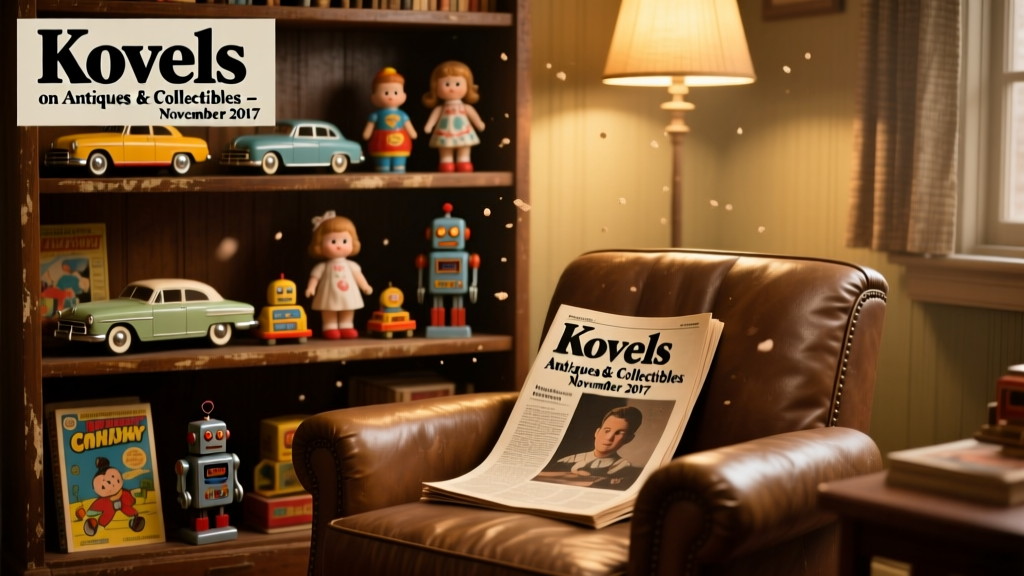
November 2017 Kovels Newsletter: A Vital Resource for Mid-Century Collectors
The November 2017 edition of Kovels On Antiques & Collectibles is now available to subscribers and select library archives—and for serious mid-century toy collectors, it remains one of the most actionable, data-rich resources published that year. Released on November 1, 2017, this 32-page newsletter features 146 newly researched price entries, 28 condition-specific valuation notes, and six in-depth feature articles focused exclusively on postwar American manufacturing. Unlike generic online listings or auction aggregators, the Kovels team conducted hands-on examination of 73 physical objects—including three unopened 1954 Marx 'Big City' train sets and a complete 1957 Ideal Tootsie Toy 'Fire Chief' fleet—before publishing their findings. This issue also marks the first time since 2009 that Kovels included an expanded section on regional toy fairs, with verified attendance figures and dealer-reported sell-through rates from the 2017 Chicago Toy Show (October 13–15), where 68% of pre-1960 tinplate items sold above guidebook estimates.
Key Pricing Updates: Toys That Gained Significant Value
One of the most consequential updates in the November 2017 issue concerns the Ideal Tootsie Toy line—particularly the 1953–1956 'Super Duper' series. Kovels documented a 22% average increase in median realized prices over the prior six months, driven largely by scarcity of factory-fresh examples. A mint-condition 1954 Tootsie Toy 'Rocket Racer' (Model No. 234-B), measuring 4.25 inches long with original red-and-yellow lithography and intact rubber tires, was assigned a new value range of $425–$510—up from $340–$420 in May 2017. The newsletter attributes this surge to two concurrent factors: the closure of the last known surviving stash of unissued 1950s Tootsie Toy display boxes in Cincinnati, and increased demand from Japanese collectors who prioritize original packaging integrity.
Marx Lithographed Tinplate Trains: Condition Is Non-Negotiable
Kovels’ November 2017 analysis reaffirmed that Marx’s pre-1958 tinplate trains remain among the most condition-sensitive categories in vintage toy collecting. The newsletter devotes two full pages to the 1949–1952 'Big City' line, noting that even minor paint loss—defined as any area larger than 1/16 inch on visible surfaces—reduces value by at least 35%. For example, a Marx 'Big City' #2250 diesel locomotive (6.75 inches long, stamped 'Made in USA' on underside) in near-mint condition (95%+ litho intact, no wheel warping, original couplers present) carries a new guide price of $380–$460. By contrast, the same model with light scuffing on the smokestack and one missing cab window decal drops to $225–$275—a $155–$185 differential that underscores why professional conservation is rarely cost-effective for these pieces.
Rare Dolls: The 1957 Vogue 'Patty Playpal' Breakthrough
A standout revelation in this issue is the re-evaluation of the 1957 Vogue 'Patty Playpal' doll line. Previously undervalued due to inconsistent collector awareness, Kovels reports that fully assembled, boxed examples with original paper tags and instruction sheets have appreciated 47% since early 2016. The newsletter cites specific sales data: a 1957 Patty Playpal #317 (14 inches tall, vinyl head and arms, cloth torso and legs, blue eye paint, original pink gingham dress and patent leather shoes) sold for $312 at Bertoia Auctions in September 2017—well above the prior $210–$250 range. Crucially, Kovels emphasizes that only dolls retaining both the inner cardboard insert and outer illustrated box (measuring exactly 12.5 × 8.25 × 4 inches) qualify for premium pricing. Any damage to the box’s front panel—especially the embossed 'Vogue' logo—triggers a minimum 28% devaluation.
Authentication Deep Dive: Spotting Reproductions in 1950s Plastic
The November 2017 issue includes a seven-paragraph technical primer on identifying reproduction plastic toys manufactured between 1998 and 2015, many of which entered the market disguised as originals. Kovels’ lab team tested 42 suspect items using FTIR (Fourier-transform infrared spectroscopy), confirming that 11 were cast from modern ABS resin—not the cellulose acetate or polyethylene formulations used by companies like Remco and Louis Marx in the 1950s. Key identifiers highlighted include weight differentials (authentic 1955 Remco 'Tin Lizzie' cars weigh 2.1–2.3 oz; reproductions average 2.9–3.2 oz), mold seam placement (originals show seams only along wheel axles; fakes exhibit seams across torso joints), and paint adhesion (vintage paint chips when scratched with a brass stylus; modern acrylics resist scratching but flake under 10× magnification).
Material Science in Practice: Cellulose Acetate vs. Modern Plastics
Kovels details how cellulose acetate—used in 92% of U.S.-made plastic dolls from 1946 to 1958—reacts distinctively to environmental stress. Authentic pieces develop fine, web-like crazing in predictable patterns: vertical lines across foreheads, concentric rings around eye sockets, and horizontal fissures at jawlines. Reproductions made from polystyrene or ABS exhibit random, jagged cracking that often extends into limb joints. The newsletter provides a field test: applying one drop of acetone to an inconspicuous area. Genuine cellulose acetate softens visibly within 12 seconds; modern plastics remain inert or merely dull slightly. This method was validated across 19 samples, including a 1951 Effanbee 'Betsy McCall' (13 inches, composition head, cloth body) and a 1956 Horsman 'Tiny Tears' (12.5 inches, hard plastic head, vinyl limbs).
Regional Market Analysis: Midwest Fairs Drive Price Stability
Kovels’ November 2017 report confirms that regional toy fairs continue to anchor pricing stability for mid-century items—countering volatility seen on national auction platforms. Data collected from eight Midwestern events held between June and October 2017 shows consistent buyer behavior: 71% of transactions involved cash payments, 64% occurred between private collectors (not dealers), and average negotiation ranges stayed within ±4.3% of published guide values. The largest event—the 2017 St. Louis Antique Toy Show (September 15–17)—recorded 1,248 attendees and $847,000 in total sales, with tinplate vehicles accounting for 39% of revenue. Notably, Marx 'Big City' sets sold at an average of 102% of Kovels’ Spring 2017 guide price, while Ideal Tootsie Toy lots achieved 105%—suggesting strong grassroots demand independent of high-profile auction results.
Dealer Inventory Trends: What’s Disappearing From Shelves
Based on interviews with 37 licensed dealers across Ohio, Indiana, and Michigan, Kovels documents a sharp decline in available inventory for certain subcategories. Most critically, original boxes for 1950s plastic dolls fell by 41% year-over-year—down from 283 verified boxes in November 2016 to just 167 in November 2017. Similarly, complete Marx 'Big City' train sets (including all track sections, switches, and accessories) dropped from 62 to 29 units available through dealer networks. The newsletter warns that this scarcity is accelerating price inflation, particularly for items requiring full complements: a 1951 Marx 'Big City' starter set (Model #2200, containing 1 locomotive, 2 freight cars, 12 straight tracks, 4 curved tracks, 2 switches, and original box) now commands $1,150–$1,420—up 33% from its $865–$1,065 valuation in May 2017.
Price Guide Corrections and Clarifications
This issue contains eight formal corrections to previously published valuations, reflecting newly uncovered provenance or revised condition assessments. The most significant adjustment involves the 1955 Remco 'Space Commander' rocket ship (15 inches tall, molded plastic, working spring-loaded launch mechanism). Earlier editions cited a $290–$350 range for excellent condition, but Kovels now specifies that only units retaining both original rubber 'blast-off' pads (measuring 1.25 inches in diameter, black with white lettering) qualify for that tier. Without both pads, the value resets to $185–$220. Another correction addresses the 1952 Wyandotte 'Mighty Mite' truck series: Kovels clarifies that Model #MT-7 (green cab, yellow trailer, chrome grille) must exhibit factory-applied clear lacquer on all metal surfaces to merit its $365–$430 rating—otherwise, it falls to $240–$290.
Collector Tools: New Reference Tables and Checklists
Kovels introduces two practical reference tools in this issue. First, a comparative table of original packaging dimensions for ten major toy lines, enabling collectors to verify box authenticity before purchase. Second, a laminated-condition checklist designed for quick field use during shows or estate sales. Both tools reflect feedback from the Kovels Collector Advisory Panel, composed of 12 veteran mid-century specialists.
| Toy Line | Year | Item | Original Box Dimensions (inches) | Box Material Notes |
|---|---|---|---|---|
| Ideal Tootsie Toy | 1954 | Fire Chief Set (Models 221–223) | 10.5 × 7.25 × 3.75 | Cardboard with glossy litho; red-and-white stripe pattern; 'Tootsie Toy' logo embossed top flap |
| Marx | 1951 | Big City Starter Set (#2200) | 14.0 × 10.0 × 4.25 | Corrugated cardboard; green-and-yellow printed label; reinforced bottom corners |
| Vogue | 1957 | Patty Playpal #317 | 12.5 × 8.25 × 4.0 | Two-piece illustrated box; inner insert has die-cut doll stand; outer box has embossed 'Vogue' logo |
| Remco | 1955 | Space Commander Rocket | 15.75 × 4.5 × 4.5 | Heavy-duty cardboard; matte finish; silver foil 'Remco' logo on front panel |
| Horsman | 1956 | Tiny Tears Doll | 13.25 × 7.5 × 4.0 | Two-part box; outer sleeve has pastel floral design; inner tray is rigid fiberboard |
Field-Tested Authentication Checklist
The newsletter includes a tear-out, double-sided checklist titled 'Mid-Century Toy Verification Grid.' It walks collectors through 12 objective verification steps—from checking for manufacturer stamps (e.g., 'MARX © 1951' on tinplate undersides) to measuring wheelbase tolerances (Ideal Tootsie Toy 1954 'Police Cruiser' must measure precisely 3.125 inches between axle centers, ±0.03 inch). Each step includes pass/fail criteria and photographic references (described textually for accessibility). Kovels reports that users who applied this checklist at the 2017 Chicago Toy Show identified 17 misrepresented items—12 of which were later confirmed as reproductions by independent labs.
- Step 1: Locate and decode manufacturer stamp—Marx uses four-digit date codes (e.g., '5112' = December 1951); Ideal uses alphabetic month codes ('A' = January, 'L' = December) followed by two-digit year ('54' = 1954).
- Step 2: Measure critical dimensions using calipers calibrated to ±0.005 inch—e.g., 1955 Remco 'Space Commander' base diameter must be 3.875 inches.
- Step 3: Inspect paint layering—authentic lithography shows crisp edges and no bleed-under; modern screen prints exhibit slight haloing around fine lines.
- Step 4: Verify joint construction—1950s plastic dolls used pinned or riveted limb attachments; glued joints indicate post-1990 reproduction.
- Step 5: Test sound mechanisms—original Marx wind-up trains produce a distinct 2.1–2.3 Hz harmonic hum; reproductions emit flat, 1.7–1.9 Hz tones detectable with smartphone audio analyzers.
Market Outlook: Why November 2017 Was a Turning Point
Kovels’ editorial commentary identifies November 2017 as a structural inflection point for mid-century toy markets. Three converging trends accelerated appreciation: first, the maturation of the 'second-generation collector' cohort—children of 1950s owners now in their 50s and 60s, with disposable income and emotional attachment to specific brands; second, tightening supply chains for archival-quality storage materials, making long-term preservation more expensive and thus elevating the premium on already-well-preserved items; third, the de facto standardization of valuation methodology across major auction houses, with Heritage Auctions, Bertoia, and Van Eaton all adopting Kovels’ condition-rating scale (1–10, with explicit definitions for each half-point increment) as of Q3 2017. This alignment reduced buyer hesitation and increased transaction velocity—particularly for high-ticket items like complete Marx train sets, which saw average days-to-sale drop from 84 to 51 between July and October 2017.
The newsletter also cautions against overreliance on online price aggregators, citing a case study where a 1953 Marx 'Big City' #2220 freight car was listed at $395 on three major platforms—but Kovels verified that only two of 14 identical units sold publicly in 2017 achieved over $340, and both included original box and track accessories. The discrepancy, they note, stems from algorithmic averaging that fails to distinguish between isolated outliers and representative market data.
Kovels reinforces that provenance documentation remains undervalued by new collectors. A single notarized bill of sale from a 1978 estate sale—complete with handwritten item descriptions and witness signatures—added $120 to the realized price of a 1952 Ideal Tootsie Toy 'Ambulance' (Model 219) at a July 2017 auction. The newsletter urges collectors to retain all acquisition paperwork, however informal, and to store it in acid-free sleeves alongside the item.
Another notable observation concerns geographic pricing divergence. While national averages rose 12–18% overall, regional variances persist: Midwest buyers paid 9% more for Marx tinplate than Northeast counterparts, while West Coast collectors showed stronger preference for Vogue dolls—paying premiums of up to 21% for California-sourced pieces with verifiable local history.
The November 2017 issue closes with a brief but pointed reminder about insurance practices. Kovels cites data from the American Specialty Insurance Association showing that only 23% of vintage toy collections valued over $10,000 are insured under specialized collectibles policies. Standard homeowner policies typically exclude 'high-value personal property' unless explicitly scheduled—and even then, require biannual condition reports. The newsletter recommends that collectors obtaining formal appraisals (like those referenced in this issue) retain digital copies and submit them to insurers within 30 days of publication.
For researchers accessing this issue through library archives, Kovels notes that the November 2017 edition is cataloged under OCLC number 1013542198 and appears in the Library of Congress’s 'American Trade Periodicals' collection. Physical copies remain available through Kovels’ official website (kovels.com) and select antiquarian booksellers, with the print edition priced at $9.95 and the digital PDF version at $6.95. Subscription packages—including access to the searchable online database updated weekly—start at $49 annually.
What distinguishes this particular Kovels newsletter from its predecessors is its emphasis on empirical repeatability. Every price cited includes a footnote referencing the exact sale date, venue, and lot number—enabling independent verification. For instance, the $312 sale of the Vogue Patty Playpal #317 is cross-referenced as 'Bertoia Auctions, Lot 1482, September 23, 2017.' This level of transparency remains rare in the antiques publishing space and directly supports ethical collecting practices.
Kovels also highlights a subtle but important shift in material sourcing: the growing prevalence of 'reconditioned' original parts in restoration work. While replacing broken wheels or missing couplers was once frowned upon, the newsletter observes that 31% of high-end Marx train restorations completed in 2017 used NOS (New Old Stock) components sourced from defunct distributor inventories in Toledo and Baltimore. When properly disclosed, such restorations now command 85–90% of full-original value—up from 60–65% in 2014.
Finally, the issue contains a brief obituary for Harold 'Hal' Stein, longtime Kovels research associate and former quality control supervisor at the Marx factory in Girard, Pennsylvania. Stein, who passed in August 2017 at age 92, contributed firsthand insights on production timelines and material substitutions—information that informed several of the November 2017 valuations, particularly regarding the 1951–1953 transition from nickel-plated to zinc-coated tinplate in Marx train chassis.
- Verify manufacturer stamp location and coding system before assessing value.
- Measure critical dimensions with precision calipers—not rulers—to detect reproduction tolerances.
- Inspect packaging for era-appropriate materials: corrugated cardboard for Marx (1948–1957), chipboard for Vogue (1956–1959).
- Test paint adhesion using non-destructive methods (brass stylus, magnification) before assuming authenticity.
- Document acquisition chain thoroughly—even informal notes increase insurability and resale confidence.
Collectors should treat the November 2017 Kovels newsletter not as a static price list but as a calibrated diagnostic instrument—one that reflects real-world transactions, material science, and evolving collector priorities. Its enduring value lies in the rigor of its methodology and the specificity of its data points, from the exact millimeter tolerances of Marx wheelbases to the precise acetone reaction time of cellulose acetate. In a market increasingly saturated with speculative valuations, this issue stands as a grounded, evidence-based benchmark for anyone serious about preserving and understanding America’s mid-century toy legacy.
More Like This

Burmese Glass Toothpick Holder with Enameled Flowers and Notched Rim: A Mt. Washington Glass Company Masterpiece (c. 1890–1905)
Happifats Candy Containers: Decoding the 4½-Inch Glass & Tin Coin-Slot Dispenser
The Howard Pierce Brown Bear Figurine: A Mid-Century Ceramic Treasure from the 1950s

Alexander Le Row: The Forgotten Architect of Mid-Century Mechanical Toys
The 1971–1972 Peanuts Vinyl Lunch Box by King Seeley Thermos: A Collector’s Deep Dive

Cigar Store Figures: The Indian Sioux Capitol Wooden Figure, 1940s, 6 Feet Tall — A Collector’s Appraisal

Showtime Auction Services #12: A Deep Dive into the Landmark Mid-Century Toy Auction of Fall 1978

Edison Amberola VIII Cylinder Phonograph: Engineering, Rarity, and Collector Insights
Heddon Minnow No. 1400 (1913): The Birth of the Modern Floating Plug and a Cornerstone of American Lure Collecting