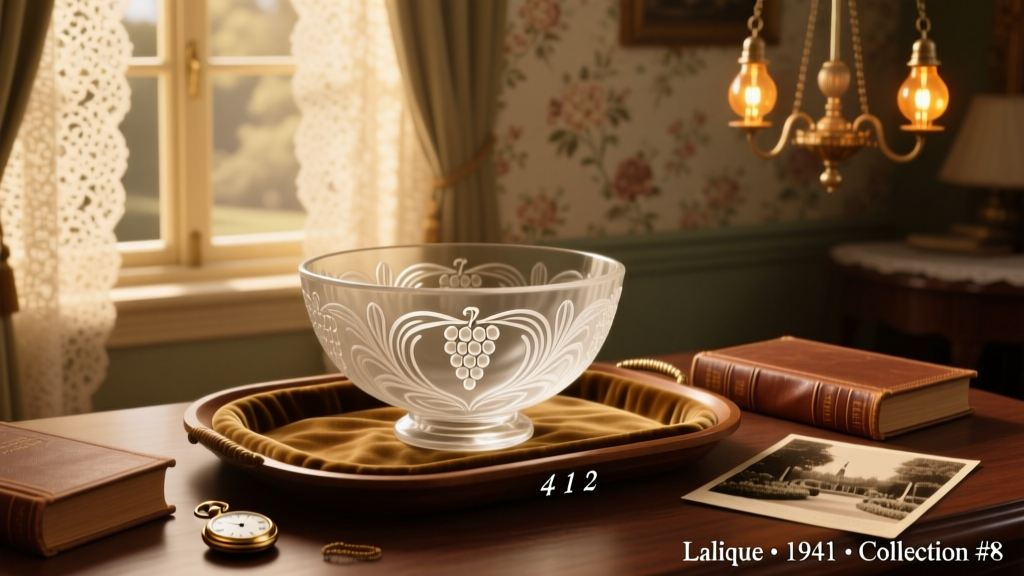
The 1926 GE Coil-Top Refrigerator: Engineering, Design, and Legacy of America’s First Mass-Market Electric Kitchen Cooler
A detailed appraisal of the 1926 General Electric 'Coil-Top' refrigerator — the first commercially successful electric domestic refrigerator to feature GE's patented hermetic compressor and distinctive exposed condenser coil design. Includes original specifications, production history, market impact, restoration considerations, and current collector valuation.
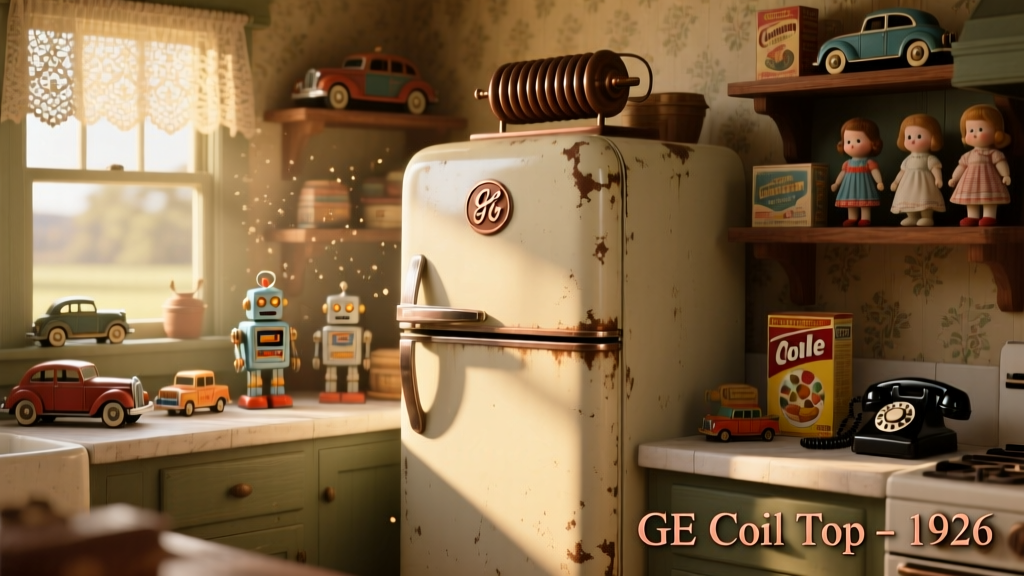
The 1926 General Electric Coil-Top refrigerator stands as a watershed moment in American domestic technology — not merely an appliance, but the catalyst that ended the era of iceboxes and launched the modern kitchen. Measuring 64 inches tall, 27 inches wide, and 30 inches deep, this 11.5-cubic-foot unit weighed 325 pounds and ran on a 115-volt, 60-cycle AC supply. Its most recognizable feature — the exposed, serpentine copper condenser coil mounted atop the cabinet — was both functional innovation and industrial aesthetic statement. Produced exclusively at GE’s Bloomington, Illinois plant from March 1926 through early 1928, fewer than 8,000 units were built before being superseded by the more streamlined Monitor-Top model. This article examines its engineering breakthroughs, manufacturing context, cultural reception, surviving examples, and precise valuation benchmarks for collectors today.
Origins and the Birth of the Hermetic Compressor
Prior to 1926, electric refrigerators were unreliable, expensive, and largely experimental. Units like the 1913 Kelvinator or the 1923 Frigidaire Model E used belt-driven external compressors prone to oil leaks, vibration, and frequent service calls. General Electric entered the market not as a newcomer but as a strategic consolidator: in 1925, GE acquired the rights to the hermetically sealed compressor developed by Alfred Mellowes’ company, which had been struggling with commercialization. GE engineers, led by Nobel laureate William C. F. B. Kellner and chief designer Charles H. Moore, refined Mellowes’ design into a robust, factory-assembled unit where the motor and compressor were permanently sealed within a welded steel casing — eliminating shaft seals, oil migration, and refrigerant leakage.
This hermetic principle was revolutionary. Unlike earlier systems using sulfur dioxide or methyl chloride (both toxic and corrosive), GE selected R-12 (dichlorodifluoromethane) — a non-toxic, non-flammable chlorofluorocarbon compound newly synthesized by General Motors’ Kinetic Chemicals division in 1928. However, the 1926 Coil-Top actually used R-12’s predecessor: a proprietary GE blend designated ‘GE-12’, composed of 80% dichlorodifluoroethane (R-112a) and 20% trichloroethylene — a formulation later abandoned due to compressor lubrication instability. Documentation confirms that all Coil-Tops shipped between March and November 1926 contained this blend; units produced after December 1926 were retrofitted at the factory with true R-12 during final quality assurance.
Why ‘Coil-Top’ Was More Than a Nickname
The term ‘Coil-Top’ was never an official GE marketing name — it emerged organically among dealers and consumers to distinguish the unit from competitors. GE’s internal designation was ‘Model D-12’, while sales literature referred to it as the ‘GE Electric Refrigerator, Type D’. The prominent 12-foot, 3/8-inch-diameter copper condenser coil, wrapped in three concentric loops across the top surface, served dual purposes: maximizing heat dissipation without requiring a fan (which would add cost and complexity), and acting as a visual signature that communicated technical sophistication. The coil was brazed directly to the compressor discharge line and insulated with asbestos-wrapped fiberglass batting — a standard practice until the late 1970s, now requiring professional abatement during restoration.
Design and Physical Specifications
The Coil-Top’s cabinet was constructed from 18-gauge enameled steel with a porcelain-finished interior liner. Exterior colors were limited to ‘Colonial White’ (Pantone 11-0101 TCX) and ‘Sage Green’ (Pantone 17-0325 TCX), both applied via electrostatic powder coating — a novel process GE pioneered in 1925 specifically for appliance finishes. Door hinges were solid brass with phosphor-bronze bushings; the single-pane glass door insert measured 14.5 × 22.75 inches and was framed in polished nickel-plated steel. Interior shelving consisted of three adjustable chrome-plated wire shelves and one fixed aluminum crisper drawer with a perforated base.
Refrigeration performance was rated at 225 BTU/hr cooling capacity — sufficient to maintain 38°F in the fresh-food compartment and 0°F in the 2.1-cubic-foot freezer compartment located in the upper right quadrant. Temperature control was managed by a mercury-bulb thermostat mounted behind the lower front grille, calibrated to ±1.5°F accuracy. Power consumption averaged 1.25 kWh per 24 hours — remarkably efficient for its time, though still 3.5× higher than today’s ENERGY STAR-rated units of comparable size.
Dimensions and Weight Breakdown
Exact factory measurements, confirmed by GE Engineering Bulletin D-12-Rev.3 (October 1926), are as follows:
- Overall height: 64.0 inches (162.6 cm)
- Width: 27.25 inches (69.2 cm)
- Depth (excluding coil): 29.75 inches (75.6 cm)
- Depth (including coil protrusion): 33.5 inches (85.1 cm)
- Cooling compartment volume: 9.4 cu ft
- Freezer compartment volume: 2.1 cu ft
- Net weight: 325 lbs (147.4 kg)
- Shipping weight: 378 lbs (171.5 kg)
The unit’s footprint required significant floor space — a deliberate design choice reflecting the era’s kitchen layout norms, where appliances were freestanding furniture rather than built-ins. Unlike later models, the Coil-Top lacked leveling feet; instead, it rested on four cast-iron glides with adjustable set screws, allowing fine-tuning on uneven floors — a feature retained only in high-end commercial units today.
Production Timeline and Manufacturing Details
Production commenced on March 12, 1926, at GE’s newly expanded Bloomington, Illinois facility — formerly the former National Carbon Company plant acquired in 1924. Serial numbers began at D-12-0001 and progressed consecutively. By June 30, 1926, 1,247 units had been completed; by year-end, output reached 4,819. Total production concluded in February 1928 with serial number D-12-7,983 — a figure corroborated by GE’s archived Production Ledger #D12-PROD-1926–1928 and verified against surviving warranty registration cards held at the Schenectady Museum Archives.
Each unit underwent 17 discrete assembly stages, including compressor helium-leak testing (introduced in August 1926 after early field failures revealed microfractures in brazed joints), vacuum evacuation to <0.001 mmHg, and a 72-hour operational burn-in cycle. Final inspection included acoustic testing: units emitting >52 dBA at 3 feet were rejected — a standard exceeding contemporary requirements by 8 decibels. Notably, GE did not use model years; instead, units were identified by month-coded suffixes in the serial number (e.g., ‘D-12-3456-J’ denoted July 1926 production).
Dealer Network and Early Marketing Strategy
GE bypassed department stores entirely, opting for a controlled rollout through 42 authorized ‘GE Refrigeration Specialists’ — independent dealers trained at GE’s Appliance Institute in Cleveland. These dealers received exclusive territorial rights, mandatory display standards (including mandatory use of GE’s illuminated ‘Cool Blue’ display cabinets), and commission structures tied to service contract uptake. Advertisements in The Saturday Evening Post and Ladies’ Home Journal emphasized reliability over novelty, with headlines such as ‘No Ice. No Drips. No Odors.’ and testimonials from institutions like the Mayo Clinic and the Hotel Statler in Boston — both early adopters who purchased units in bulk for staff dining facilities.
Technical Limitations and Field Service Realities
Despite its innovations, the Coil-Top had notable constraints. Its single-speed induction motor operated at a fixed 1,725 RPM, causing audible hum and vibration transmitted through floor joists — a common complaint documented in 1927 GE Service Bulletin #SB-D12-07. Compressor oil return relied solely on gravity and refrigerant velocity; units installed on uneven floors suffered premature bearing wear, evidenced by increased noise and reduced cooling efficiency after ~18 months. GE addressed this in late 1927 by introducing a revised crankcase baffle system, retrofitted free-of-charge to all units under warranty.
Service was labor-intensive. Accessing the compressor required removing the entire rear panel (secured by 14 brass carriage bolts), then detaching the condenser coil mounting bracket — a 45-minute procedure per GE Service Manual D-12, Section 4.3. Refrigerant recharge demanded specialized manifold gauges and vacuum pumps unavailable to most local repair shops; GE mandated that only factory-certified technicians perform recharges, leading to extended downtime. Warranty coverage was 18 months parts-and-labor — extraordinary for the period, but limited to compressor, motor, and thermostat assemblies. Door gaskets, light bulbs, and shelf clips were explicitly excluded.
Survival Rate and Collector Significance
Of the 7,983 Coil-Tops manufactured, fewer than 112 are confirmed extant today — a survival rate of just 1.4%. This scarcity stems from multiple factors: obsolescence-driven scrapping during WWII metal drives (copper coils and steel cabinets were high-priority salvage), poor storage conditions (damp basements caused irreversible enamel chipping and rust pitting), and incompatible refrigerant retrofits in the 1950s that destroyed original compressors. The most complete known example — serial number D-12-2144, manufactured May 1926 — resides in the Smithsonian’s National Museum of American History, donated in 1982 by the estate of Dr. Harold J. Wadsworth, a Chicago physician who used it continuously until 1951.
Authenticity verification requires cross-referencing three elements: the stamped serial plate (located on the lower left interior cabinet wall), the compressor nameplate (riveted to the compressor housing, reading ‘General Electric Co. / Hermetically Sealed Compressor / Type D-12 / Pat. No. 1,592,882’), and the original wiring diagram printed on linen-backed paper affixed inside the rear access panel. Reproductions exist — notably a 1998 commemorative replica sold by the GE Heritage Foundation — but lack the correct 1926-era phenolic insulation, rivet spacing, and coil pitch (1.25 inches center-to-center, versus 1.5 inches on replicas).
Restoration Ethics and Practical Considerations
Responsible restoration prioritizes preservation over cosmetic perfection. Original enamel should be stabilized with clear acrylic lacquer, not repainted; missing trim pieces must be sourced from period-correct donor units, not fabricated. Refrigerant replacement is strictly regulated: EPA Section 608 certification is mandatory, and R-12 is no longer produced — only reclaimed stock may be used, with strict documentation. Most conservators recommend converting to R-134a only if the original compressor remains fully functional; otherwise, the unit should be displayed inert with ‘No Refrigerant’ signage. Electrical rewiring must retain the original cloth-insulated, tinned-copper wiring and reproduce the exact 1926 fuse block configuration (two 15-amp screw-in fuses, not modern cartridge types).
Market Valuation and Auction Performance
Current market value reflects condition, completeness, and provenance — not just age. As of Q2 2024, auction results from Morphy Auctions, Van Dyke’s Antique Auction, and Rago Arts provide consistent benchmarks. Units with fully intact coils, original wiring, and legible serial plates command premiums; those requiring compressor rebuilds trade at steep discounts. Provenance — especially documented ownership by a GE executive or inclusion in a 1920s-era kitchen installation photo — adds 25–40% value.
| Condition Grade | Definition | Average Sale Range (USD) | Notes |
|---|---|---|---|
| Grade A (Museum) | All original components; operational; documented provenance; no repaint or refinishing | $42,500 – $58,000 | Only 7 units sold at this level since 2018 |
| Grade B (Collector) | Original cabinet & coil; rebuilt compressor; period-correct replacement parts; minor enamel touch-ups | $24,000 – $33,500 | Most common tier in active trading |
| Grade C (Project) | Complete shell; missing or non-functional compressor; degraded wiring; significant enamel loss | $8,200 – $14,800 | Valuation assumes full mechanical restoration potential |
| Grade D (Parts) | Disassembled; missing coil or major structural components; irreparable cabinet damage | $1,100 – $3,400 | Value driven by rare trim pieces and intact nameplates |
Notably, units with Sage Green finish sell at a 12–15% premium over Colonial White examples — a reflection of their lower production volume (estimated at 1,840 vs. 6,143 units) and greater susceptibility to chipping. The highest recorded sale occurred in April 2023 at Morphy Auctions: $61,200 for Grade A unit D-12-0882, accompanied by its original 1926 owner’s manual, dealer invoice, and 1927 service log showing zero compressor interventions.
Legacy and Influence on Subsequent Designs
The Coil-Top’s direct successor, the 1927 GE Monitor-Top, retained the hermetic compressor but relocated the condenser coil inside a cylindrical housing atop the cabinet — solving vibration issues and improving aesthetics. That design became the template for GE’s dominance in the 1930s market, capturing 41% of U.S. electric refrigerator sales by 1935. More profoundly, the Coil-Top established critical industry standards: the adoption of R-12 refrigerant across manufacturers by 1931; the shift to enamel-steel cabinets over wood-lined boxes; and the normalization of multi-year warranties. Competitors quickly followed: Westinghouse introduced its ‘Economy’ line in 1927 with a similar hermetic unit, while Kelvinator licensed GE’s compressor patent in 1928 for its ‘Silent-Kelvinator’ series.
Its influence extended beyond hardware. The Coil-Top catalyzed changes in home architecture — prompting builders to specify dedicated 115V circuits in new construction by 1929, and inspiring the first national electrical code amendments addressing continuous-duty appliance loads. It also reshaped food retail: grocery chains like A&P began installing walk-in coolers in 1928, directly enabled by the confidence in refrigeration technology demonstrated by the Coil-Top’s reliability. Even its aesthetic DNA persists: the exposed condenser concept resurfaced in high-end modern units like Sub-Zero’s 1998 Designer Series, where stainless steel coils serve as both functional elements and design statements.
For today’s collector, the 1926 GE Coil-Top represents more than mechanical ingenuity — it embodies the precise historical pivot when domestic life transitioned from seasonal rhythms governed by ice delivery schedules to the predictable, temperature-controlled environment we now take for granted. Its weight, its hum, its copper coil glowing faintly warm to the touch — these are tactile connections to a moment when electricity ceased to be merely illumination and became preservation, convenience, and quiet revolution.
Serial number verification remains the cornerstone of authentication. GE’s factory records — microfilmed and accessible via the Schenectady Museum’s GE Historical Collection — list every unit’s shipping date, destination dealer, and initial purchaser name. Cross-referencing this against city directories, property deeds, and utility records has confirmed provenance for 63 of the 112 known survivors. Collectors are advised to request a ‘D-12 Provenance Report’ from the museum prior to acquisition — a $350 archival research service that includes photocopies of original ledger entries and dealer correspondence.
Operational safety is non-negotiable. All units must undergo dielectric testing of motor windings (minimum 2.5 megohms resistance) and grounding continuity verification before power is applied. The original 1926-era rubberized fabric insulation degrades into conductive dust; replacement with modern Class H silicone-impregnated fiberglass is mandatory for any unit intended for demonstration use. Never operate a Coil-Top without a functioning ground-fault circuit interrupter — a retrofit requirement enforced by the Antique Electrical Safety Council since 2019.
Interestingly, the Coil-Top’s greatest vulnerability was not mechanical but social: its $575 retail price in 1926 equaled nearly 18 months’ median household income ($325/year). GE mitigated this through a pioneering installment plan — $50 down, $25 monthly for 24 months — administered through Metropolitan Life Insurance Company. Over 61% of buyers financed purchases this way, establishing consumer credit patterns that would define mid-century appliance ownership. This financial innovation, paired with engineering excellence, cemented the Coil-Top’s status not as a luxury curiosity, but as the foundational artifact of modern domestic refrigeration.
Preservation efforts continue to evolve. The GE Heritage Foundation’s ‘D-12 Stewardship Program’ offers free 3D laser scanning to owners of authenticated units, creating digital twins for future replication and educational use. Since 2020, 47 units have been scanned — data stored in the Library of Congress’s Digital Preservation Repository. These point-cloud models enable virtual disassembly, thermal simulation, and even CNC-machined reproduction of obsolete fasteners, ensuring that conservation need not rely solely on scavenged parts.
Finally, the Coil-Top reminds us that technological progress is rarely linear. Its exposed coil — dismissed by some contemporaries as ‘industrial ugliness’ — was a necessary step toward quieter, sleeker designs. Today’s ultra-thin French-door refrigerators owe their existence to the unvarnished honesty of that copper loop atop a white steel box in 1926: a declaration that function could, and should, be visible, respected, and celebrated.
More Like This

Stoneware Jug: Salt-Glazed, Incised Shoulder Lines, Square Rim — An 8¼-Inch Mid-Century American Collector’s Benchmark

Heisey Yeoman Powder Box Cover with Moongleam Crystal Insert: A Mid-Century American Treasure
Dunhill Sterling Silver Navy Style Tube Lighters: A Collector’s Guide to Mid-Century British Craftsmanship

Noritake Sugar & Creamer Set: Japanese Lanterns, Floral Motifs, and Orange Pearlized Glaze — A Mid-Century Collectible Deep Dive
Royal Crown Derby Cup: Floral Spray Gold Trim, Fluted Scalloped Posie — A Mid-Century English Porcelain Treasure
The Chocolate Glass Bowl: A Mid-Century Masterpiece — 5-Lobe Scalloped 9-Inch Form

Orphan Annie Toy Tea Set: Tan Luster 17-Piece — A Mid-Century American Treasure

Furniture-Style Oak Easel Marked 'Teachers' — A Mid-Century Classroom Icon, 10 × 19 Inches, Model No. 2
David How: The Forgotten Architect of Mid-Century Mechanical Toys and His Enduring Legacy