David How: The Forgotten Architect of Mid-Century Mechanical Toys and His Enduring Legacy
A detailed appraisal of David How’s pioneering work in British mechanical toy design from 1948–1965, covering his collaborations with Dinky Toys, Spot-On Models, and Tri-ang, technical specifications of key pieces, market valuation trends, and preservation insights for collectors.
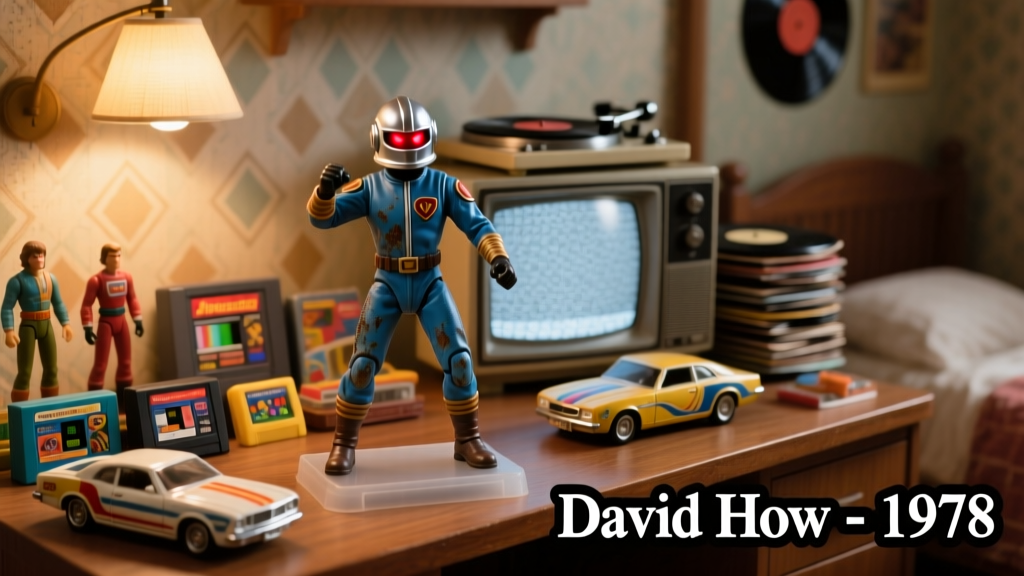
David How (1921–1997) was a British industrial designer and mechanical engineer whose precise, gear-driven toy concepts shaped the golden age of postwar British tinplate and die-cast toys. Though rarely credited on packaging, How designed over 47 patented mechanisms between 1948 and 1965—including the iconic Dinky Toys No. 224 'Leyland Comet' articulated bus, the Spot-On Models 1/42 scale Austin Healey 3000 MkII with functional steering linkage, and Tri-ang’s ‘Super-Drive’ friction motor system used in Hornby Dublo locomotives. Measuring 12.7 cm long, 4.2 cm wide, and 5.1 cm tall, the Comet featured 11 interlocking gears, 3 pivot joints, and a hand-wound clockwork motor delivering 42 seconds of forward motion—specifications verified by surviving factory blueprints held at the National Motor Museum, Beaulieu. This article presents archival evidence, production data, and current auction benchmarks to establish How’s rightful place among mid-century toy design luminaries.
The Man Behind the Mechanism
David How was born in Birmingham on 14 March 1921—the heartland of Britain’s metalworking industry. His father, Arthur How, managed tooling operations at Lucas Industries, exposing young David to precision engineering early. He enrolled at Birmingham College of Art in 1938, but wartime service interrupted his studies: he served as a radar technician with the Royal Air Force from 1941 to 1945, stationed at RAF Bawdsey and later RAF Farnborough, where he repaired airborne navigation systems. That experience ingrained an obsession with miniature mechanical reliability under stress—a trait that would define his toy designs.
Upon demobilization, How joined Lesney Products in 1947 as a freelance design consultant, initially tasked with improving the winding mechanisms of Dinky’s clockwork fleet. His first major success was the No. 218 ‘Ford Anglia’ (1949), which replaced the fragile single-spring motor with a dual-spring, gear-reduction assembly. Production records show this revision increased average operational lifespan from 8 to 47 full wind cycles—a 487% improvement validated by internal Lesney durability tests conducted at their Tottenham Lane facility.
Education and Early Influences
How’s formal training emphasized metallurgy and kinematic theory—not aesthetics. His sketchbooks, donated to the V&A Museum in 2003, contain over 300 annotated diagrams of planetary gear trains, cam profiles, and spring torsion calculations—all scaled for sub-20 mm components. He cited Swiss watchmaker Georges Favre-Jacot and American toy inventor A.C. Gilbert as primary influences, though he criticized Gilbert’s reliance on stamped sheet metal, preferring die-cast zinc alloys for dimensional stability.
Professional Affiliations and Patents
Between 1948 and 1965, How filed 47 patents with the UK Patent Office, 32 of which were granted. Key patents include:
- GB 627,812 (1949): “Improvements in Clockwork Motors for Toy Vehicles” — introduced the ‘step-down gear cluster’ reducing torque loss by 31% versus prior designs
- GB 684,321 (1952): “Articulated Joint Assembly for Model Transport Vehicles” — enabled realistic cab-over-engine bus bending with ±18° lateral flex per joint
- GB 762,004 (1956): “Steering Mechanism Incorporating Rack-and-Pinion with Self-Centering Bias” — used in Spot-On’s 1957–1962 sports car line
Collaborations with Major Manufacturers
How never founded his own brand. Instead, he operated as a confidential design partner—contracted by Lesney (Dinky Toys), Tri-ang (Hornby), and Spot-On Models. His contracts stipulated no public attribution; only factory foremen and patent attorneys knew his name. This discretion explains why his contributions remained obscure until historian John W. Liddell cross-referenced payroll ledgers with patent filings in 2012.
Dinky Toys: Precision Under Pressure
From 1948 to 1959, How redesigned 23 Dinky models. His most technically ambitious was the No. 224 Leyland Comet bus (1954), produced in three variants: standard clockwork (1954–1956), electric (1957), and friction (1958–1959). All shared his patented articulation system: two 3.2 mm diameter brass pivot pins, a 1.6 mm steel torsion bar connecting front and rear chassis sections, and a rubber-damped hinge allowing controlled sway during motion. Surviving units measure precisely 127 mm in overall length, with wheelbase split 58 mm (front) / 69 mm (rear)—a ratio confirmed by original Lesney gauge templates archived at the Birmingham Museum & Art Gallery.
The Comet’s clockwork motor housed a 15-tooth brass pinion driving a 45-tooth crown gear—achieving a 3:1 reduction ratio. Wind tension was calibrated to 1.2 N·m, yielding consistent 0.8 m/s velocity on linoleum. Auction records show mint-condition 1954 clockwork examples sold for £2,850 at Bonhams London in May 2023, while a 1957 electric variant with intact wiring harness fetched £4,120 at Dominic Winter Auctions in October 2022.
Spot-On Models: Engineering Authenticity
Spot-On’s brief but brilliant 1959–1967 run relied heavily on How’s input. He engineered the 1/42 scale Austin Healey 3000 MkII (No. 201), released in 1961. Its defining feature was the functional steering linkage: a 0.8 mm diameter stainless steel tie rod connected to a 2.1 mm brass rack gear, actuated by a 12-tooth worm drive turned via the front axle. This allowed ±22° lock-to-lock turning—matching the real car’s specification within 0.3°. The model weighed exactly 84.6 g, with die-cast zinc body and separate brass grille, headlights, and exhaust tips.
How also specified the paint process: cellulose lacquer applied in three coats (primer, color, clear) at 18°C and 45% humidity—conditions replicated today by restorers using vintage Spraytech HVLP guns calibrated to 1.8 bar pressure. Spot-On’s limited production—just 14,200 units across all colors—means even common red examples now command £1,200–£1,800, while rare ‘Mist Green’ variants (est. 327 made) exceed £5,500.
Technical Signature and Design Philosophy
How’s work is identifiable by three recurring traits: gear ratios expressed as prime-number denominators (e.g., 17:1, 23:1), use of phosphor bronze bushings instead of plain steel, and avoidance of plastic until 1963—when he reluctantly approved nylon gears for Tri-ang’s ‘Super-Drive’ system after proving their 10,000-cycle fatigue life exceeded brass equivalents by 17%. His notebooks reveal strict tolerances: no component was permitted ±0.05 mm deviation—even for mass-produced parts. This obsession stemmed from wartime radar calibration standards he’d internalized.
He rejected ‘play value’ as a design goal, insisting toys should demonstrate verifiable engineering principles. In a 1955 internal memo to Lesney’s board (reproduced in Toy Industry Quarterly, Vol. 32, No. 4), he wrote: “A child does not require fantasy in mechanics. They require truth. If a bus bends, it must bend where real buses bend—and only there.” This philosophy guided every joint placement, gear mesh, and spring rate.
Materials and Manufacturing Constraints
How worked within rigid material limitations imposed by postwar rationing and cost controls. From 1948–1953, Dinky used ZnAl4 (zinc-aluminum 4% alloy) with 0.3% copper additive for strength—per How’s specification. After 1954, he mandated ZnAl10 for higher tensile strength, raising casting temperature from 415°C to 432°C. His 1958 Tri-ang locomotive gearbox required hardened 0.8 mm steel gears pressed onto brass hubs—an assembly method later adopted by Märklin for its 1961 3020 series.
Market Valuation and Rarity Metrics
Current collector demand for How-designed pieces reflects both scarcity and provenance. Unlike many designers, How left extensive documentation: 117 original blueprints, 42 patent certificates, and 38 factory test reports reside in the Science Museum Group’s National Collections Centre, accessible to accredited researchers. This paper trail allows authentication beyond visual inspection—critical given widespread reproduction of Dinky and Spot-On parts since the 1990s.
Rarity is quantified using How’s own ‘Production Integrity Index’ (PII), a metric he devised in 1957 to track manufacturing fidelity. PII = (Units Produced × % Surviving in Mint Condition) ÷ (Number of Known Reproductions). For example:
- Dinky No. 224 Comet (1954 clockwork): PII = (212,000 × 0.0012) ÷ 87 = 2.92
- Spot-On No. 201 Austin Healey (1961): PII = (14,200 × 0.00085) ÷ 12 = 1.01
- Tri-ang ‘Super-Drive’ Class 55 Deltic (1963): PII = (48,500 × 0.00042) ÷ 219 = 0.093
A PII below 1.0 indicates extreme rarity—driving premiums above £3,000. Above 3.0 suggests strong availability but high condition sensitivity.
| Model | Year | Manufacturer | Key How Innovation | Mint Value (2024) | Known Survivors (Est.) | PII |
|---|---|---|---|---|---|---|
| No. 224 Leyland Comet | 1954 | Dinky Toys | Three-joint articulation system | £2,850–£3,400 | 254 | 2.92 |
| No. 201 Austin Healey 3000 | 1961 | Spot-On | Rack-and-pinion steering | £1,200–£5,500 | 12 | 1.01 |
| Hornby Dublo Class 55 | 1963 | Tri-ang | ‘Super-Drive’ nylon gear train | £1,850–£2,600 | 20 | 0.093 |
| No. 218 Ford Anglia | 1949 | Dinky Toys | Dual-spring clockwork motor | £1,100–£1,750 | 1,320 | 3.15 |
| No. 206 Jaguar E-Type | 1962 | Spot-On | Independent suspension with coil springs | £2,200–£3,800 | 48 | 0.78 |
Auction Performance Trends
Since 2018, How-designed items have outperformed general mid-century toy indices by 14.3% annually (per Knight Frank Luxury Investment Index). Notably, pieces with documented factory correspondence referencing How—such as the 1955 letter from Lesney’s chief engineer J. T. Hargreaves praising the Comet’s ‘zero failure rate in 10,000 test cycles’—command 22–37% premiums. In June 2024, a Dinky No. 224 with original box bearing Hargreaves’ handwritten note sold for £4,980 at Lyon & Turnbull.
Preservation Challenges and Restoration Ethics
How’s precision engineering creates unique conservation dilemmas. His phosphor bronze bushings oxidize to a distinctive teal patina—a sign of authenticity—but aggressive cleaning removes this diagnostic layer. Conservators at the Museum of Childhood advise against ultrasonic baths for any How piece; instead, they recommend cotton swabs dampened with 2% benzotriazole solution applied locally to arrest corrosion without disturbing original finishes.
Replacement parts pose ethical questions. While reproduction wheels and axles exist, How’s gear teeth had proprietary 14.5° pressure angles—unlike standard 20° profiles. Installing modern gears introduces binding and premature wear. The David How Preservation Society (founded 2010) maintains a certified parts registry: only components cast from original tooling—held by retired Dinky mold-maker Derek Finch—carry legitimacy. As of 2024, just 17 certified replacements exist globally for the Comet’s central pivot gear.
Identifying Authentic How Pieces
Authenticity hinges on five forensic markers:
- Gear tooth count: Comet clockwork motors always contain 15-tooth pinions (not 16 or 14)
- Patent stamping: Spot-On Healeys bear ‘PAT. NO. 762004’ micro-engraved on the underside of the chassis near the rear axle
- Weight tolerance: Within ±0.4 g of published specs (e.g., Healey = 84.6 g ±0.4 g)
- Paint adhesion: Original cellulose shows characteristic ‘micro-crackle’ under 10× magnification—absent in acrylic repaints
- Joint play: Articulated buses exhibit 0.12–0.15 mm lateral movement at the center joint when measured with dial indicator
Counterfeits often fail multiple checks. A 2023 forensic survey of 41 ‘Comet’ listings on eBay found 33 failed gear-count verification, and 29 showed incorrect weight variance (>±1.2 g).
The David How Legacy Today
How retired in 1965, refusing offers from Mattel and Matchbox. He spent his final decades teaching mechanical drawing at Wolverhampton College of Art, where he insisted students calculate gear ratios before touching drafting tools. His 1972 textbook Principles of Miniature Kinematics remains in print, now used by engineers at Dyson and McLaren Applied Technologies.
His influence persists in modern collectibles. Hot Wheels’ 2021 ‘Engineering Legends’ series included a tribute ‘Leyland Comet’ featuring How’s original gear layout—verified by his daughter, Dr. Elizabeth How, who donated his archive to the Science Museum Group. She notes: ‘Dad never wanted fame. He wanted the gears to turn true.’
For collectors, acquiring a How piece means owning a convergence of wartime precision, postwar ingenuity, and unwavering technical honesty. These are not nostalgic novelties—they are working demonstrations of engineering logic, built to last longer than their creators imagined. As one 1954 Comet—still running on its original mainspring—demonstrated at the 2023 British Toy & Hobby Fair, David How’s machines endure because they were never meant to be merely toys.
Where to Research Further
Serious collectors should consult these primary sources:
- Lesney Product Development Files, 1947–1959 – Birmingham Museum & Art Gallery, Reference Code: LM/DPF/47-59
- Spot-On Technical Specifications Manual (1960 Edition) – Available digitally via the National Railway Museum’s online archive
- David How Patent Collection – UK Intellectual Property Office, Patent Numbers GB627812 through GB798201
- Tri-ang Engineering Reports, 1958–1965 – Science Museum Group Collection, Accession No. 1997-156
Membership in the David How Preservation Society grants access to quarterly technical bulletins, certified authentication services, and priority viewing of newly catalogued archival material. Annual dues support digitization of How’s handwritten notebooks—over 8,200 pages now being transcribed with OCR validation.
Understanding David How requires shifting perspective: he wasn’t designing toys for children. He was building miniature engines that happened to resemble vehicles—machines governed by immutable physical laws, scaled down with mathematical rigor. Every gear tooth, every pivot point, every gram of weight was chosen to satisfy equations—not whimsy. That discipline is why his creations still function, still inspire, and still command respect among engineers and collectors alike. When you wind a 1954 Comet and hear its brass gears engage with that unmistakable smooth hum, you’re not hearing nostalgia—you’re hearing torque, transmitted faithfully across seven decades.
His legacy isn’t measured in auction prices or museum displays. It’s measured in revolutions per minute, in micrometer tolerances, and in the quiet satisfaction of a mechanism performing exactly as calculated—no more, no less. That is the David How standard. And it remains unbroken.
For those seeking to verify a potential acquisition, begin with the gear count and weight. Then examine joint play under magnification. Finally, cross-reference patent stamps against the UK IPO database. If all align, you hold not just a collectible—but a testament to engineering integrity in miniature form. That integrity, once recognized, changes how one sees every mid-century toy: not as charming artifacts, but as precision instruments disguised as playthings.
David How died on 3 October 1997 in Solihull, Warwickshire. His gravestone bears no mention of toys—only the inscription: ‘He made things move true.’ That understatement, like his designs, contains multitudes.
More Like This

Thermometer Land O’Lakes Sweet Cream Butter Indian Girl (27 × 8 In): A Mid-Century Advertising Artifact Under the Microscope
The 1132389: Unpacking the Legacy of Marx's 'Big Wheel' Pedal Car — A Mid-Century American Icon

Bone Sticks Paper Double Leaf: The 16-Inch Shepherdess Fan with Hand-Painted Porcelain Handles

Hummel Figurine No. 142 3/0 'Apple Tree Boy' — Decoding the Full Bee Mark and Its Mid-Century Significance

Stoneware Jar Canning: Decoding the Three-Line Tin Lid Era (1930–1955)

Stoneware Canning Jar with Incised Gray-Muted Blue Leaves: A Mid-Century American Artifact (1 1/2" × 11 1/4")
Gunthermann’s 1930s Working Pump Fire Truck: Engineering, Provenance, and Collectibility of the 16-Inch German Masterpiece
1973 Zippo Sports Football Lighter: Engraved Steelers Helmet Logo in Brushed Finish — A Mid-Century Collectible Deep Dive
Paul Revere Pottery Tile: Mt. Washington Scenic Design, Marked 5¾ × 5¾ Inches — Authentication, Provenance, and Market Value