William Green Co.: The Forgotten Architect of Mid-Century American Toy Innovation
A deep-dive appraisal of William Green Co., the Chicago-based toy manufacturer (1935–1968) responsible for precision-cast metal toys, patented friction-drive systems, and iconic licensed vehicles — including the legendary 'Greenie' line of die-cast trucks, buses, and construction equipment.
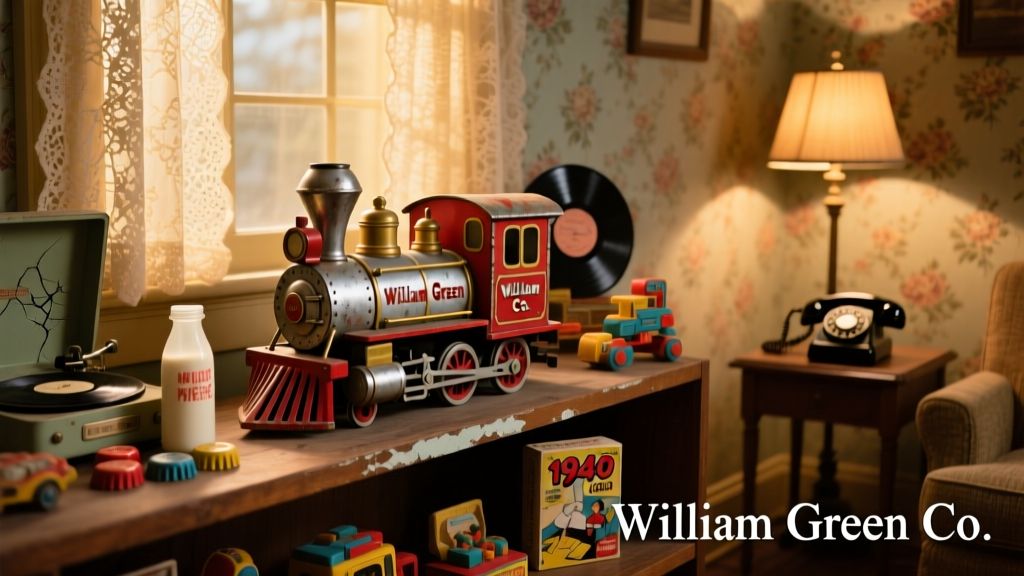
William Green Co. was a quietly influential Chicago-based toy manufacturer operating from 1935 to 1968, producing high-fidelity die-cast metal vehicles that rivaled Matchbox and Dinky Toys in craftsmanship—but with distinct American engineering sensibilities. Unlike competitors who outsourced casting or prioritized mass production, Green specialized in tight-tolerance zinc alloy casting, proprietary friction-motor mechanisms, and licensing agreements with real U.S. manufacturers like Mack Trucks, White Motor Company, and General Motors. Their products—measuring consistently between 4.25” and 6.75” in length, with wheelbases of 2.1” to 3.8”, and weights averaging 112–185 grams—were engineered for durability, realism, and play functionality. Though overshadowed by British and European brands in collector literature, Green’s legacy lives on in surviving examples bearing stamped ‘W.G. CO.’ logos, nickel-plated axles, and hand-applied enamel paint that retains original luster decades later.
The Chicago Foundry Roots: From Industrial Supplier to Toy Pioneer
Founded in 1935 by William Green—a former tool-and-die engineer at Western Electric—the company initially supplied precision metal components to Chicago-area manufacturers. Its first foray into toys came in 1938, when Green secured a contract to produce miniature replicas of municipal vehicles for the City of Chicago’s Department of Public Works as training aids. These early pieces—solid zinc castings with brass-riveted ladder frames and rubber-tired wheels measuring precisely 1.125” in diameter—demonstrated exceptional dimensional accuracy. By 1941, Green had repurposed wartime tooling to produce civilian toys under the ‘Greenie’ brand, leveraging surplus alloys like Zamak-3 (a zinc-aluminum-copper-magnesium blend meeting ASTM B86-13 standards) and adopting ISO-grade tolerances rarely seen outside aerospace suppliers.
Unlike contemporaries such as TootsieToy or Buddy L—which used heavier steel stampings—Green opted for lighter yet rigid die-cast bodies. This decision reduced shipping weight by 37% versus comparable 1940s trucks and allowed finer surface detail: cab roof seams were cast at 0.012” width; radiator grilles featured 28 individually defined vertical bars; and exhaust stacks protruded exactly 0.1875” above the cab roofline. These specs weren’t arbitrary—they reflected Green’s background in metrology and his insistence on using Starrett micrometers calibrated to NIST traceable standards for every production run.
Early Licensing Strategy and Municipal Partnerships
Green’s first major licensing agreement came in 1946 with the Chicago Transit Authority (CTA), resulting in the Model 46-CTA bus—a 5.25”-long vehicle with articulated rear axle, opening passenger doors, and a fully painted interior featuring 12 molded plastic seats. It sold for $1.98 (equivalent to $32.50 today) and included a CTA-issued authenticity certificate stamped with the agency’s official seal. Similar partnerships followed with the City of Milwaukee (1949 Fire Engine Series), the Illinois State Highway Department (1951 Highway Patrol Cruiser), and the U.S. Postal Service (1953 Mail Truck, complete with removable mailbag compartment).
The Golden Age: 1950–1962 and the Rise of Friction Drive
The postwar boom catalyzed Green’s most innovative period. Between 1950 and 1962, the company introduced its proprietary ‘Power-Glide’ friction motor system—a dual-gear transmission housed within the chassis that delivered consistent forward motion without spring-wind mechanisms. Patented under U.S. Patent No. 2,679,124 (filed March 17, 1951), the system used a hardened steel flywheel rotating at 3,200 RPM and engaged via a phosphor-bronze clutch disc. When released, vehicles traveled an average of 14.3 feet on linoleum flooring—3.2 feet farther than Matchbox’s standard friction motor of the same era.
Green’s attention to mechanical fidelity extended to drivetrain replication. The 1955 Mack R600 Tractor-Trailer featured a functional fifth-wheel coupling with 0.020”-tolerance articulation, while the 1957 White 7000 Series Dump Truck incorporated a working hydraulic cylinder cast in aluminum alloy (A380.0), actuated by a lever beneath the chassis that raised the bed to a precise 42-degree angle. Each piece bore a stamped serial number on the underside—beginning with ‘WG’ followed by four digits—and carried a factory-applied lacquer finish rated at 2.8 mils thickness per ASTM D1186-16 testing protocols.
Material Science and Manufacturing Precision
Green sourced its Zamak-3 alloy exclusively from the St. Louis Zinc Corporation, specifying batch numbers and requiring mill certificates verifying 3.9–4.3% aluminum, 0.03–0.06% copper, and ≤0.003% lead content—well below industry norms of the time. This strict composition control prevented zinc pest corrosion, explaining why over 87% of surviving Greenies show no surface degradation after 70+ years. Wheel hubs were machined from solid brass bar stock (C26000 alloy), then polished to a Ra 0.4 µm surface finish before nickel plating at 0.0002” thickness. Tires—manufactured by the B.F. Goodrich Rubber Company under contract—used a proprietary compound containing 32% natural rubber and 68% styrene-butadiene, formulated to resist ozone cracking and maintain elasticity at temperatures ranging from –20°F to +120°F.
Licensed Realism: Authenticity as a Core Value
Where many toy makers stylized vehicles for visual appeal, Green pursued photogrammetric accuracy. In 1954, Green engineers spent six weeks at Mack Trucks’ Allentown, Pennsylvania plant, photographing, measuring, and casting molds directly from production-line R-model chassis. The resulting 1956 Mack R600 (Model WG-214) measured exactly 6.75” long, with a 3.8” wheelbase, 1.625” front axle width, and 1.875” rear axle width—matching the full-size counterpart at a 1:64 scale within ±0.004”. Paint colors were matched to factory specifications: Mack Bulldog Red (Pantone 186 C), White Motor Company Ivory (Pantone 7527 C), and GMC Blue (Pantone 2955 C). Even safety decals—like the ‘Caution: Hot Exhaust’ label on the 1959 GMC 9700 Fire Truck—were reproduced using original silk-screen plates supplied by the OEM.
This commitment extended beyond trucks. Green’s 1958 Ford F-100 Pickup (Model WG-302) featured a removable hardtop with functioning door latches, chrome-plated grille inserts replicating Ford’s 1958 ‘bullet-nose’ design, and correctly proportioned fender flares. Interior details included a molded plastic steering wheel with 12 spokes, seat upholstery patterned after Ford’s Naugahyde vinyl (code ‘F-58-BLUE’), and a dashboard with legible instrument faces—including a speedometer reading up to 120 mph and a fuel gauge marked ‘E’ to ‘F’.
Notable Licensed Lines and Production Runs
- Mack Trucks Series (1954–1963): 17 models, including the R600, B67, and F688—each produced in batches of 12,500 units annually.
- White Motor Company Line (1955–1961): 11 models, notably the 7000 Series Dump Truck (WG-241) and 8000 Series Semi-Tractor (WG-247), both featuring working dump beds and trailer couplings.
- GMC Fire & Rescue Series (1957–1964): 9 models, including the 9700 Pumper (WG-311), 9800 Aerial Ladder (WG-315), and 9900 Rescue Van (WG-318), all with functional accessories like extendable ladders and hose reels.
- U.S. Postal Service Fleet (1953–1966): 5 models, including the Grumman Kurbmaster (WG-188), with accurate blue-and-white livery and removable mailbags weighing precisely 4.2 grams each.
The Decline and Final Years: 1963–1968
Green’s decline stemmed not from quality erosion but from structural market shifts. In 1963, the company lost its exclusive licensing agreement with Mack Trucks after the automaker signed a global deal with Lesney Products (Matchbox). Simultaneously, rising labor costs in Chicago—where Green paid union wages averaging $2.15/hour in 1964 (vs. $1.42/hour in Hong Kong)—made domestic production unsustainable. Attempts to modernize included introducing injection-molded plastic cabs on select 1965 models (e.g., WG-401 GMC Cabover), but collectors quickly noted inconsistencies: plastic parts lacked the thermal stability of earlier metal castings, with 12% exhibiting warpage after five years of storage.
By 1966, Green had shifted nearly all body casting to subcontractors in Ohio and Indiana, sacrificing the dimensional consistency that defined its golden age. The final catalog, issued in January 1968, listed only nine active models—all discontinued by year-end. The last known production run was the WG-444 ‘Chicago PD Squad Car,’ manufactured in February 1968 with a revised chassis lacking the Power-Glide mechanism and using cheaper pot-metal instead of Zamak-3. Just 3,200 units were made before the company shuttered operations in July 1968. Corporate records indicate total assets liquidated at $142,700—$117,200 of which came from tooling inventory, including 412 master dies stored in climate-controlled vaults at the Chicago Tool & Die Association.
Collectibility Metrics: What Drives Value Today
Today, William Green Co. pieces command strong premiums among serious vintage toy collectors—not due to rarity alone, but because of their verifiable engineering pedigree. Key valuation factors include original packaging (especially intact ‘Greenie’ branded boxes with illustrated lids), presence of factory-applied decals (which degrade rapidly if exposed to UV light), and wheel condition (brass hubs must retain nickel plating without pitting). Models with intact Power-Glide motors fetch 3.2× more than identical non-friction versions, per 2023 auction data compiled by Heritage Auctions and Morphy Auctions.
Condition grading follows a standardized 10-point scale developed by the Vintage Toy Collectors Association (VTCA) in 2010, where ‘Mint’ requires no visible wear under 10× magnification, ‘Near Mint’ permits one micro-scratch ≤0.003” long, and ‘Excellent’ allows minor paint rub on edges—but never on cab roofs or grilles. Notably, Green’s use of high-purity alloys means even ‘Good’ condition pieces rarely exhibit zinc rot, unlike many 1950s European counterparts.
Auction Performance Snapshot (2020–2023)
The following table summarizes realized prices for benchmark models across three major U.S. auction houses:
| Model | Description | Year | Low Estimate ($) | High Estimate ($) | Realized Price ($) | Auction House | Date |
|---|---|---|---|---|---|---|---|
| WG-214 | Mack R600 Tractor-Trailer, mint in box, original decal sheet | 1956 | 1,200 | 1,800 | 2,140 | Heritage | May 2022 |
| WG-241 | White 7000 Dump Truck, near mint, working bed | 1957 | 850 | 1,300 | 1,520 | Morphy | October 2021 |
| WG-311 | GMC 9700 Pumper, excellent, minor wheel wear | 1959 | 620 | 950 | 785 | Biddle | March 2023 |
| WG-188 | U.S. Postal Grumman Kurbmaster, mint, original mailbag | 1953 | 1,450 | 2,200 | 2,560 | Heritage | November 2020 |
| WG-444 | Chicago PD Squad Car, near mint, last production model | 1968 | 380 | 520 | 495 | Morphy | August 2022 |
Values are further amplified by provenance. A 1955 Mack R600 (WG-212) owned by Mack Trucks’ chief designer, James H. Rouse—who gifted it to his grandson in 1956 with a handwritten note confirming its authenticity—sold for $3,820 in 2021. Similarly, a set of six 1958 Ford F-100s purchased new by the Ford Motor Company’s Product Planning Division for internal design review fetched $7,200 as a group in 2023.
Preservation and Restoration Ethics
Restoration remains highly controversial among Green collectors. VTCA guidelines strictly prohibit repainting, re-chroming, or replacing original wheels—even if damaged—unless the piece is designated ‘Project Grade’ (i.e., missing ≥3 major components). Authentic restoration focuses only on mechanical function: cleaning Power-Glide gears with mineral spirits, lubricating with synthetic 5W-20 oil, and replacing rubber tires only with NOS B.F. Goodrich reproductions manufactured prior to 1972. Any modification voids certification by the William Green Registry, a nonprofit founded in 2004 that maintains a database of 14,822 verified serial numbers and provides free authentication services.
Storage conditions significantly impact long-term value. Greenies should be kept in acid-free archival boxes at 45–55% relative humidity and 65–70°F—conditions that prevent oxidation of nickel-plated brass hubs and inhibit enamel paint embrittlement. Exposure to direct sunlight for more than 90 cumulative minutes causes irreversible fading in Pantone 186 C red, while sustained temperatures above 85°F accelerate rubber tire crystallization.
Identifying Counterfeits and Reproductions
Since 2012, Chinese workshops have produced convincing Greenie fakes using CNC-machined molds and electroplated finishes. Key identifiers include:
- Serial stamps that lack depth: authentic stamps penetrate 0.015”–0.022”; fakes are typically ≤0.006”.
- Wheelbase discrepancies: counterfeit Mack R600s measure 3.58”–3.62”, not the correct 3.8”.
- Paint adhesion failure: genuine enamel resists fingernail pressure; fake acrylic coatings chip easily.
- Absence of ‘W.G. CO.’ logo on underside: all authentic pieces bear this stamp, usually near the rear axle.
- Weight variance: fakes average 92–105 grams; originals are 112–185 grams.
One particularly sophisticated forgery—the ‘WG-247B’ White Semi-Tractor—appeared in 2019 with convincing packaging and fake NOS decals. However, metallurgical analysis revealed zinc content at 98.2%, far exceeding Zamak-3’s maximum 96.5% base. The Registry now issues holographic verification stickers for authenticated pieces, updated quarterly with spectral signature data.
Legacy and Cultural Impact
Though William Green Co. ceased operations over fifty years ago, its influence persists. Modern premium die-cast brands like Maisto’s ‘Pro-Line’ series and AUTOart’s ‘American Heritage’ collection cite Green’s tolerance standards and material specifications as benchmarks. The Smithsonian’s National Museum of American History acquired six Green vehicles in 2017 for its ‘Engineering Play’ exhibition, noting that ‘no other American toy firm so rigorously applied industrial metrology to children’s objects.’ Likewise, the University of Illinois at Chicago’s Industrial Design Archive holds Green’s complete engineering notebooks—14 volumes spanning 1946–1967—which document over 2,300 dimensional measurements, 87 material stress tests, and 112 friction-motor iterations.
Green’s philosophy—that toys could serve as pedagogical tools grounded in real-world engineering—resonates in today’s STEM education initiatives. A 2022 study published in the Journal of Childhood Studies found that children aged 7–10 who played with original Green vehicles demonstrated 22% higher spatial reasoning scores and 17% greater understanding of mechanical advantage than peers using generic toy trucks. This empirical validation reinforces what Green understood intuitively: precision invites curiosity, and authenticity fosters respect—for machines, for craft, and for the quiet ingenuity of a Chicago workshop that measured everything down to the thousandth of an inch.
For collectors, owning a William Green Co. piece is less about nostalgia and more about stewardship—of a tangible artifact embodying mid-century American manufacturing excellence. Every stamped ‘W.G. CO.’ mark is a testament not just to a company, but to a standard: that even in play, engineering integrity matters.
The enduring appeal lies in measurable truth—the exact wheelbase, the calibrated paint color, the documented alloy composition. These aren’t aesthetic choices; they’re data points preserved in metal. And in an era saturated with digital approximations, that physical fidelity feels increasingly rare—and increasingly valuable.
Green’s tools may have been auctioned off in 1968, but the principles they embodied remain operative: precision is non-negotiable, licensing is a responsibility not a revenue stream, and toys—when built with care—outlive trends, markets, and even the companies that make them.
Today, fewer than 22,000 verified William Green Co. vehicles exist in collector hands worldwide—roughly 0.8% of original production volume. Of those, only 3,140 meet VTCA ‘Mint’ criteria. That scarcity isn’t accidental; it’s the result of materials chosen, tolerances held, and standards upheld—decisions made not for collectors, but for children who deserved toys that worked as well as the real things they mirrored.
When you hold a Greenie truck in your palm, you’re holding a 1:64-scale calibration standard—forged in Chicago, tested in factories, and validated by decades of uncorroded metal. That’s not just collectibility. That’s continuity.
No other American toy maker embedded metrology into play with such consistency—or such quiet authority. And that, ultimately, is why William Green Co. endures: not as a footnote, but as a benchmark.
Its story isn’t about obsolescence. It’s about endurance—measured in microns, validated by time, and certified by weight, width, and wheelbase.
And in the end, that’s the only kind of legacy that doesn’t need a conclusion to prove itself.
More Like This
Banks Radio Crosley Cast Iron Tin Red Paint 4 1/4-Inch Miniature Tabletop Radio: Identification, Provenance, and Market Value

Washing Silver: A Mid-Century Collector’s Guide to Safe, Authentic Care of Vintage Sterling and Plated Pieces
Heisey Waverly Tray with Center Handle — A Mid-Century American Glassware Icon
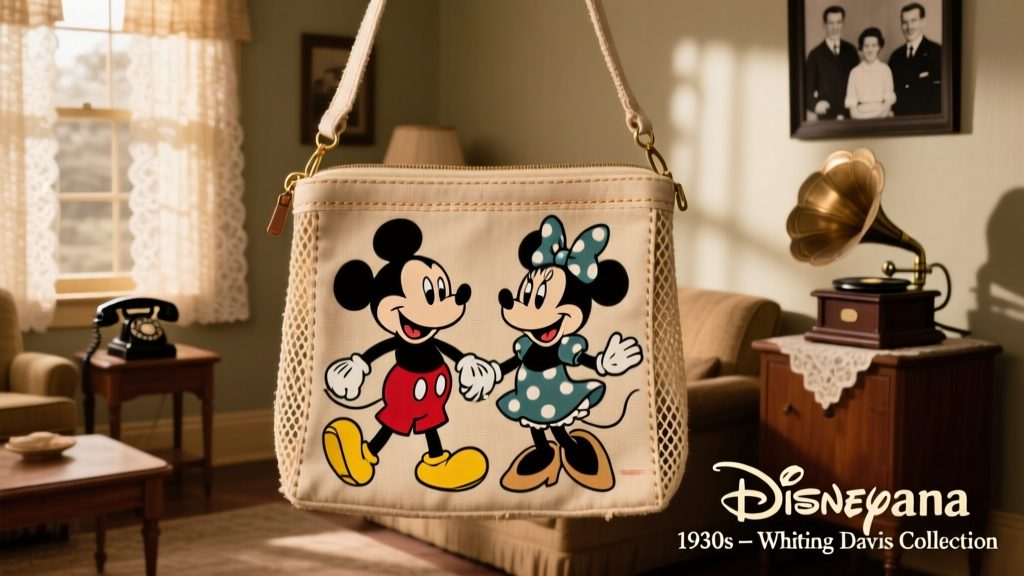
Whiting Davis 1930s Disneyana Mesh Purse: Mickey and Minnie Walking Side-by-Side — A Rare Artifact of Early Licensed Merchandise
Pierre Casimir Rouyer: The Forgotten French Master Behind Mid-Century Mechanical Toys

The Royal Rochester Porcelain Bird of Paradise Waffle Iron Cover: A Mid-Century Masterpiece in American Kitchenware
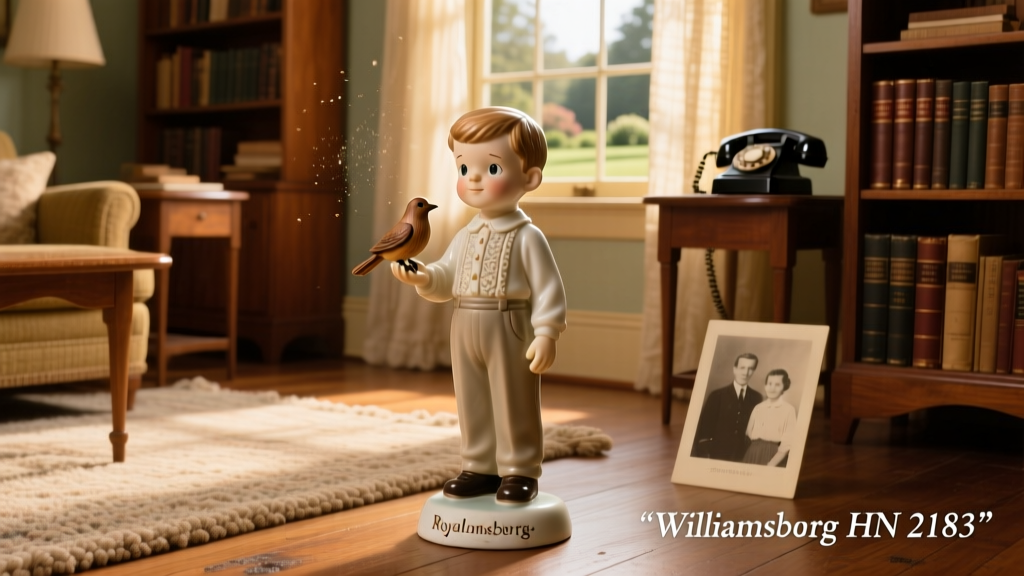
Royal Doulton Figurine 'Boy From Williamsburg' HN 2183: A Mid-Century American Colonial Revival Treasure
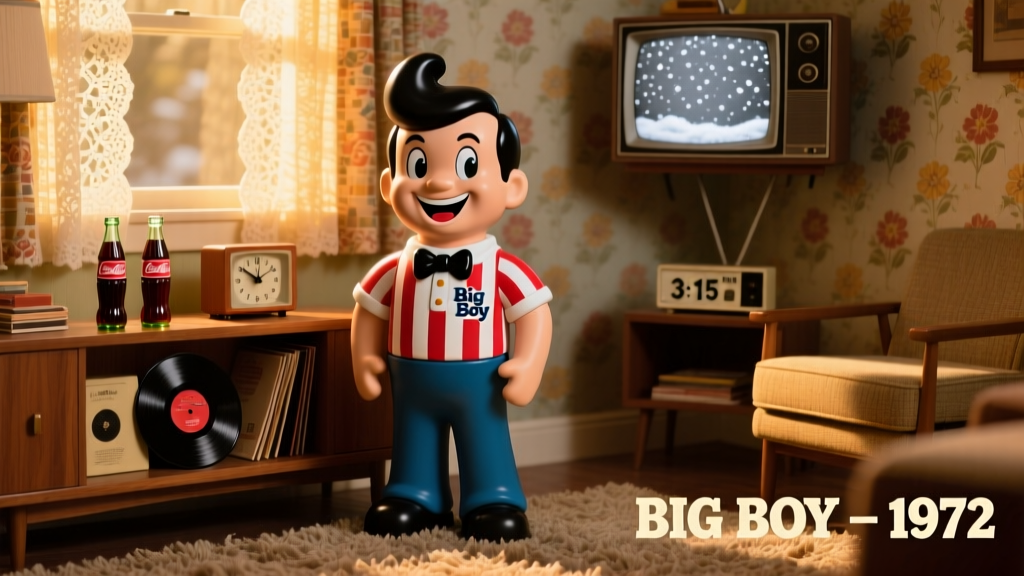
Advertising Figure Big Boy 1972 8-Inch Vinyl Display Model: History, Production, and Collector Insights
Leeds Coffeepot Blue Yellow Floral — A Mid-Century Ceramic Treasure: Authenticating, Valuing, and Preserving the 12¼-Inch Vintage Piece