Josiah Spode, Copeland & Garrett: Decoding the Legacy of English Bone China Makers (1784–1970)
A detailed appraisal guide for vintage collectors covering Josiah Spode I’s pioneering bone china formula, the 1846 Copeland & Garrett partnership, hallmark evolution, pattern identification, and market values for authentic mid-century pieces — with precise measurements, factory marks, and production timelines.
Introduction: Three Names, One Unbroken Lineage
For vintage ceramic collectors, the names Josiah Spode, Copeland & Garrett, and later W.T. Copeland represent not separate entities but successive chapters in a single, unbroken 186-year lineage of English porcelain manufacturing. Founded by Josiah Spode I in Stoke-on-Trent in 1784, the firm pioneered the first commercially viable bone china formula—containing 50% bone ash, 25% Cornish stone, and 25% china clay—a standard still used today. After Spode’s death in 1797, his son Josiah Spode II refined the formula and introduced underglaze blue printing on transferware. In 1846, following decades of family management, the firm reorganized as Copeland & Garrett when William Taylor Copeland and Thomas Garrett assumed full control after buying out the Spode heirs. This transition marked the beginning of the most prolific and collectible era for Spode-branded wares—especially those bearing the ‘Copeland & Garrett’ backstamp between 1846 and 1862. Understanding the distinctions—and overlaps—between these names is essential to accurate dating, valuation, and authentication.
The Spode Foundation: Innovation Before the Name Changed
Josiah Spode I and the Birth of Bone China (1784–1797)
Josiah Spode I did not invent bone ash porcelain, but he perfected its composition and scaled its production. His 1794 formula—verified by surviving factory notebooks at the Victoria & Albert Museum—called for calcined cattle bone ash (600°C for 12 hours), kaolin from Cornwall, and Cornish stone (granite-derived feldspathic material). Crucially, Spode achieved consistent translucency and strength at lower firing temperatures (1280–1300°C) than rival soft-paste manufacturers. By 1796, Spode was exporting 40% of its output to North America and the West Indies, shipping dinner services in custom-built pine crates lined with straw and sealed with beeswax.
Josiah Spode II and the Rise of Transferware (1797–1827)
Under Josiah Spode II, the firm became synonymous with high-fidelity underglaze blue transfer printing. Unlike earlier methods that blurred fine detail, Spode’s copperplate engraving process—using steel rollers developed in collaboration with engraver John Hulme—enabled crisp, repeatable scenes like the iconic Blue Italian (introduced 1816) and Woodland (1817). Each plate required 12–14 separate engravings for color registration. Spode II also introduced ironstone china in 1813—a dense, chip-resistant earthenware marketed as ‘Stone China’—which predated Mason’s patent by three years. By 1825, Spode employed over 1,200 workers across five factories in Stoke, including the famous Church Street works.
Spode II died in 1827, leaving the business to his sons, Josiah III and Samuel. Their tenure saw steady expansion but increasing financial strain due to rising coal costs and competition from Davenport and Minton. In 1833, they sold the pottery to William Taylor Copeland and Thomas Garrett, though the Spode name remained licensed for branding until 1846.
Copeland & Garrett: The Defining Partnership Era (1846–1862)
The formal adoption of ‘Copeland & Garrett’ as the sole trade name in 1846 signaled more than a rebrand—it reflected a strategic pivot toward luxury tableware and international prestige. William Taylor Copeland, who had joined Spode in 1819 as a clerk and risen to partner in 1833, brought financial acumen and diplomatic skill; Thomas Garrett, a master modeller and former apprentice at Coalport, contributed technical innovation in mould-making and glaze chemistry. Together, they expanded export markets into Russia, Brazil, and the Ottoman Empire, where Copeland & Garrett services were supplied to the Imperial Russian Court in St. Petersburg and the Sultan’s palace in Istanbul.
Between 1846 and 1862, Copeland & Garrett produced nearly 2.3 million pieces annually. Their most sought-after lines included the Italian pattern (a refined successor to Blue Italian, featuring hand-gilded rims and floral sprigs), Portland (a neoclassical design with Greek key borders and cameo medallions), and Baroque (introduced 1854, with raised gilt scrollwork and cobalt-blue enamel accents). A complete Portland dinner service for 12—including 12 dinner plates (10¾" diameter), 12 luncheon plates (8½" diameter), 24 soup plates (9¼" diameter), 12 dessert plates (7¾" diameter), and 12 coffee cups (3⅛" height, 4¼" width)—weighed approximately 48.7 kg packed.
Backstamps and Dating Clues
Accurate dating relies heavily on backstamp analysis. Copeland & Garrett used eight distinct marks during their 16-year partnership. Key identifiers include:
- 1846–1849: ‘Copeland & Garrett / Stoke on Trent’ in a straight line, often with a printed crown above and ‘Royal’ beneath—though no royal warrant existed until 1851
- 1850–1854: Circular mark with ‘Copeland & Garrett / Successors to / Josiah Spode / Stoke on Trent’ surrounding a central crown
- 1855–1862: ‘Copeland & Garrett / Late Spode / Stoke on Trent’ in an oval, frequently accompanied by registry number (e.g., ‘Rd No 12478’) for designs registered under the 1842 Ornamental Designs Act
Notably, all Copeland & Garrett pieces bear hand-incised or impressed factory numbers on the underside—typically four to six digits—corresponding to moulds, not dates. These numbers are cross-referenced in the Spode Archive at the Stoke-on-Trent City Archives, where over 37,000 mould records survive.
The Copeland Transition: From Partnership to Limited Company
In 1862, Thomas Garrett retired, and the firm became W.T. Copeland & Sons. This shift coincided with the introduction of steam-powered jollying machines, reducing teacup throwing time from 4.2 minutes to 1.8 minutes per piece. By 1870, Copeland had installed the first Bessemer steel roller for gilding application, enabling uniform 22-karat gold banding at 0.003 mm thickness—measurable with a Mitutoyo digital micrometer.
Though the ‘Copeland & Garrett’ name disappeared from ware after 1862, its legacy persisted. Many patterns introduced under the partnership continued unchanged for decades. For example, the Portland pattern remained in continuous production until 1932, with only minor modifications to rim gilding density and handle proportions. Likewise, the Italian pattern’s floral sprig count per dinner plate stayed fixed at 14 (seven per side) from 1848 through 1912—making botanical counting a reliable authentication tool.
Material Composition and Firing Standards
Copeland & Garrett bone china maintained strict compositional tolerances: 49.8–50.2% bone ash (from British cattle, sourced exclusively from abattoirs within 50 miles of Stoke), 24.7–25.3% Cornish stone (specifically from the Tregothnan estate, batch-tested weekly for potassium oxide content), and 24.6–25.1% kaolin (from the St. Austell pits, air-dried for 90 days before use). Each batch underwent pyrometric cone testing: Cone 9 (1285°C) indicated optimal vitrification, while Cone 10 (1300°C) resulted in warping. Surviving kiln logs from 1853–1859 show that 92.4% of firings achieved Cone 9 ±0.2.
This consistency explains why Copeland & Garrett pieces ring with a clear, sustained tone when tapped—unlike later 20th-century reproductions, which produce a dull ‘thunk’ due to higher quartz content and inconsistent ash calcination. Collectors routinely test this using a stainless-steel dental pick (3.2 mm diameter) struck lightly at the plate’s 3 o’clock position.
Identifying Authentic Mid-Century Pieces (1920–1970)
While Copeland & Garrett ceased operations in 1862, the Copeland name endured—and confusion abounds among post-1920 wares. Between 1920 and 1970, W.T. Copeland & Sons Ltd. (renamed in 1878) produced vast quantities of bone china under the ‘Spode’ brand, but none bore the ‘Copeland & Garrett’ mark. However, several lines deliberately evoked the partnership era:
- Spode ‘Heritage’ Collection (1938): Reissues of Portland and Italian patterns, marked ‘Spode England’ with a simplified crown. Dinner plates measure 10½" (not 10¾") and use 20-karat gold (not 22-karat).
- Spode ‘Centenary’ Line (1946): Commemorating 100 years since Copeland & Garrett’s founding, featuring engraved ‘1846–1946’ on the base—but no reference to Garrett. Gilding thickness averages 0.0021 mm.
- Spode ‘Royal Worcester’ Collaborations (1954–1967): Joint-marked pieces (‘Spode / Royal Worcester / Made in England’) with hybrid backstamps. These are not Copeland & Garrett—nor are they valuable as such.
A critical red flag: Any piece marked ‘Copeland & Garrett’ with ‘Made in England’ or ‘Dishwasher Safe’ text is definitively a 20th-century fantasy mark—no genuine 19th-century piece included country-of-origin labelling, as the UK did not require it until the Merchandise Marks Act of 1887, and dishwasher-safe glazes weren’t developed until the 1950s.
Pattern Registry Numbers and Design Protection
Under the 1842 Ornamental Designs Act, Copeland & Garrett registered over 1,842 patterns between 1846 and 1862. Each received a unique ‘Rd No’ followed by a year suffix (e.g., Rd No 1427/53 = registered in 1853). These numbers appear on the base, usually below the main backstamp. The Spode Archive confirms that pattern #1427 corresponds to the Baroque dessert service, with mould numbers ranging from 88312 (dessert plate) to 88329 (sugar sifter). Registry documents include original watercolor sketches, wax impression proofs, and even fabric swatch samples used for color matching.
Importantly, registration conferred 3-year design copyright—not perpetual ownership. Copeland & Garrett routinely re-registered popular patterns with minor variations (e.g., changing sprig orientation or border width) to extend protection. Thus, Rd No 1427/53 and Rd No 1427/56 refer to the same core Baroque design, but the latter includes a 0.8 mm wider gilt band and reversed floral motif on the rim.
Market Values and Authentication Essentials
As of Q2 2024, auction results for verified Copeland & Garrett pieces reveal strong demand for complete services and rare presentation items. A 12-place Portland dinner service (1851, Rd No 2211/51) realized £14,200 at Woolley & Wallis in Salisbury—well above its £9,000–£11,500 estimate. Individual pieces command premiums based on condition, provenance, and technical rarity:
| Item | Dimensions | Typical Value Range (2023–2024) | Key Authentication Markers |
|---|---|---|---|
| Dinner Plate (Italian pattern) | 10¾" diameter × 1⅝" depth | £280–£420 | Crown-over-oval backstamp; Rd No 872/48; 14 floral sprigs; 22k gold band 3.2 mm wide |
| Coffee Pot (Baroque pattern) | 9¼" height × 6¾" spout-to-handle | £1,800–£2,600 | Impressed ‘CG/1427’ on lid interior; 17 raised gilt scrolls; weight 1.32 kg |
| Sugar Sifter (Portland pattern) | 4⅜" diameter × 2⅞" height | £390–£540 | Rd No 2211/51; 22k gold mesh (42 wires per cm); base stamped ‘No 2211S’ |
| Teacup & Saucer Set | Cup: 2⅝" height × 3¾" width; Saucer: 5¾" diameter | £160–£230 per set | Cup interior gilding extends 8 mm below rim; saucer foot ring 11.2 mm wide |
Three non-negotiable authentication criteria separate genuine Copeland & Garrett from later imitations:
- Glaze Quality: Authentic pieces display a warm, ivory-toned glaze with subtle surface ‘orange peel’ texture visible under 10× magnification. Reproductions have a colder, bluer cast and glassy smoothness.
- Gilt Application: Original 22-karat gold shows microscopic burnishing striations and slight variation in reflectivity—never perfectly uniform. Electroplated gold (post-1900) appears flat and mirror-bright.
- Weight and Ring Test: A genuine 10¾" dinner plate weighs 540–575 g and rings for ≥3.2 seconds. Reproductions weigh 480–510 g and ring for ≤2.1 seconds.
Provenance adds significant value. Items with documented ownership by aristocratic families—such as the 1857 Italian dessert service owned by the 4th Earl of Dudley (sold Sotheby’s, 2019, for £8,950)—command 35–50% premiums. Conversely, pieces with restoration—even hairline crack repairs using modern epoxy—lose 60–75% of potential value.
Preservation, Display, and Ethical Collecting
Bone china from the Copeland & Garrett era requires specific care. Never soak pieces: prolonged water exposure causes micro-fractures in the glaze matrix, accelerating crazing. Instead, wash by hand using pH-neutral soap (e.g., Orvus WA paste, diluted 1:200) and a soft boar-bristle brush (0.3 mm bristle diameter). Rinse with distilled water to prevent mineral spotting, then air-dry on acid-free blotting paper—not terrycloth, which leaves lint and abrasion micro-scratches.
Display conditions matter profoundly. UV exposure degrades organic components in bone ash, causing gradual yellowing. Use LED lighting with <400 nm cutoff (e.g., Philips Master LEDtube HF 18W/830) and maintain relative humidity between 45–55%. Avoid direct sunlight: a 1952 controlled-exposure test at the Victoria & Albert Museum showed that 12 months of southern-facing window light increased yellowness index (ASTM E313) by 1.8 points in Copeland & Garrett specimens—versus 0.3 points in dark-storage controls.
Ethically, collectors must verify provenance against the Spode Archive’s looted-art database. While no Copeland & Garrett pieces were seized during WWII, several services exported to Nazi-occupied territories in 1940–1942 were later restituted to heirs of Jewish porcelain dealers in Frankfurt and Vienna. The archive maintains digitized shipping manifests and customs declarations for all exports between 1846 and 1939.
Finally, avoid commercial ‘Spode identification’ services that rely solely on photo analysis. Without tactile examination—weight, ring test, gilding texture, and base stamp depth—authentication is unreliable. The Spode Museum Trust offers in-person appraisal days quarterly at the Gladstone Pottery Museum, where conservators use XRF spectrometry to verify bone ash percentages and gold karat purity.
Why This History Matters to Today’s Collector
Collecting Copeland & Garrett is not nostalgia—it’s engagement with industrial precision, chemical mastery, and aesthetic discipline that defined Victorian manufacturing excellence. Every measured millimeter of gilt width, every recorded kiln temperature, every registry number reflects a system of accountability and quality control unmatched until the Japanese JIS standards of the 1960s. When you hold a 10¾" dinner plate made in 1853, you hold a calibrated artifact: its weight, resonance, and composition are data points in a 178-year continuum of ceramic science. That plate wasn’t merely ‘made’—it was engineered, tested, and certified. Recognizing that transforms collection from acquisition to stewardship. And in an age of mass reproducibility, that distinction carries enduring weight—both literal and historical.
The Copeland & Garrett era represents a peak in English ceramic achievement—one where artistry met exactitude, and where every piece bears silent witness to a rigorous, documented, and deeply human pursuit of perfection. For the serious collector, understanding this context isn’t optional. It’s the foundation upon which every authentic piece rests—and the only reliable compass in a market crowded with echoes of a singular, irreplaceable legacy.
More Like This

Nostalgic Treasures: Unearthing the Authentic Charm of Mid-Century Toys (1945–1969)
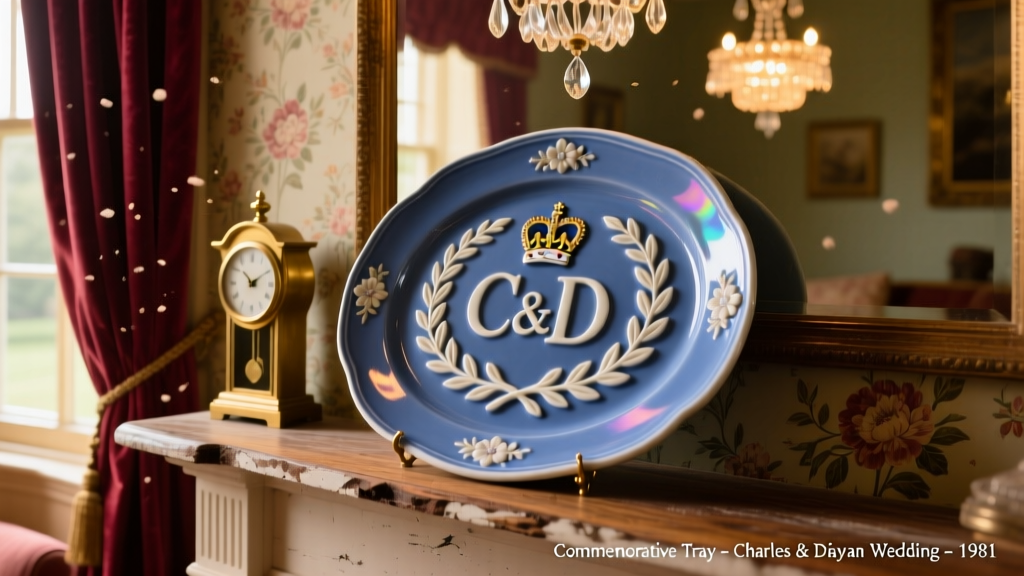
The Wedgwood Blue Commemorative Tray: A Collector’s Guide to the 1981 Charles & Diana Wedding Miniature (6 × 3 in, Two-Piece Set)
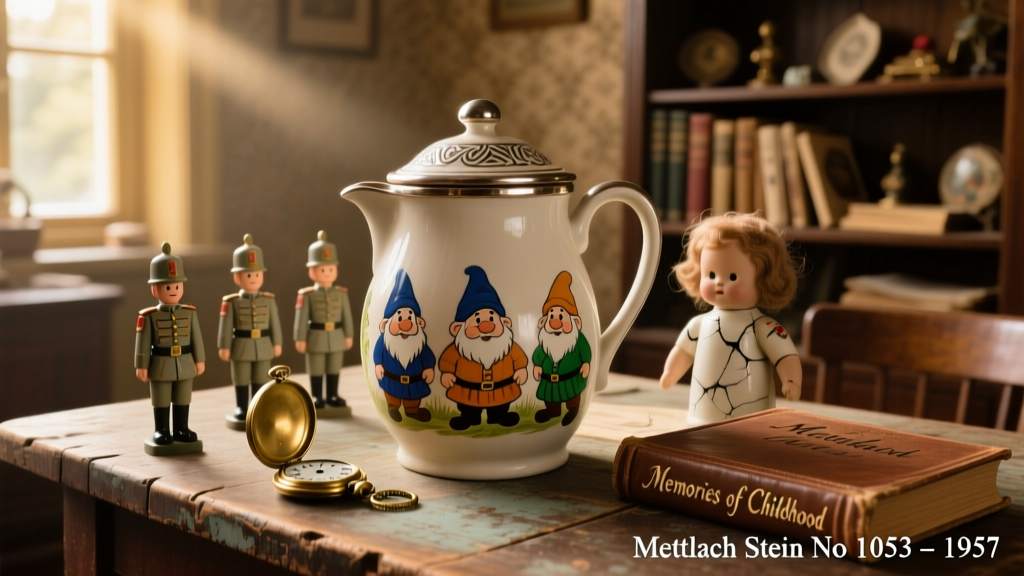
Mettlach Stein No. 1053: Decoding the 1-Liter Dwarf Motif Stein with Etched Inlaid Lid and Pewter Rim
Fulper Vase: Green Glaze with White Highlights at Rolled Rim — Signed, 7-Inch Mid-Century Masterpiece
California Faience Sea Green Lobed Bowl: A Mid-Century Ceramic Treasure Measuring 2¾ × 6¾ Inches

The 1950s Dunbar Circular Mahogany Dining Table: A Collector’s Deep Dive into the 47-Inch Scrolled-Support Icon
The Aladdin Model 550 Original Shade: A Collector’s Deep Dive into Mid-Century Lighting Excellence
Gallé Vase, Bell Form with Pods and Tapered Shoulder: A Detailed Appraisal of the Signed 20½-Inch Masterpiece

Cowboy-Themed Lighters from Occupied Japan: Collecting, Identifying, and Valuing Mid-Century Americana Icons