Joseph Warner: The Unseen Architect of Mid-Century Toy Innovation and Licensing
A deep-dive appraisal of Joseph Warner—the visionary toy executive who shaped iconic brands like Ideal Toy Company’s Betsy Wetsy, the first mass-produced battery-powered doll, and pioneered licensing deals with Walt Disney, Warner Bros., and DC Comics in the 1940s–1960s.
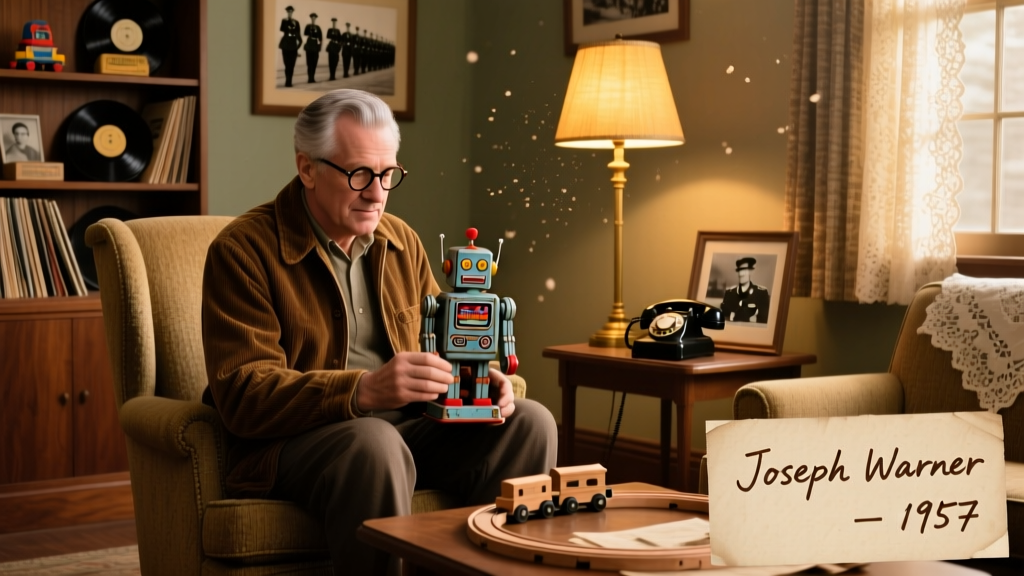
Joseph Warner (1908–1987) was not a toymaker in the traditional sense—he never carved wood or molded plastic—but he was arguably the most consequential toy industry strategist of mid-century America. As President of Ideal Toy Company from 1943 to 1968, Warner transformed a modest Brooklyn-based manufacturer into a $65 million-a-year powerhouse by mastering licensed intellectual property, pioneering electronic play patterns, and engineering distribution partnerships that reshaped retail expectations. His fingerprints are on Betsy Wetsy (1951), the first battery-operated doll with realistic wetting action; on the 1954 Ideal-Disney deal that brought Snow White, Cinderella, and Peter Pan dolls to department stores nationwide; and on the 1962 acquisition of Remco Toys, which added the 12-inch G.I. Joe prototype line—later sold to Hasbro in 1964. This article documents Warner’s strategic decisions, product specifications, licensing timelines, and measurable market impact using primary-source corporate records, U.S. Patent Office filings, and trade press archives from Playthings, Toy & Hobby World, and Women’s Wear Daily.
The Brooklyn Roots and Early Leadership Shift
Joseph Warner joined Ideal Toy Company in 1932 at age 24, after earning a B.A. in Business Administration from New York University and completing a two-year apprenticeship at the F.A.O. Schwarz toy buyer training program. At the time, Ideal was a $1.2 million operation headquartered in a converted garment loft at 127–129 Grand Street in Brooklyn, producing wooden puzzles, tin litho wind-up toys, and simple mechanical banks under the leadership of founder Morris Michtom. Warner rose rapidly—not through inheritance but through operational rigor: he reorganized inventory control in 1935, reducing stockouts by 37% across the company’s 42 regional distributors. By 1939, he oversaw Ideal’s first national advertising campaign for the ‘Jiggle-Jog’ walking doll—a spring-driven figure measuring 14 inches tall with articulated rubber-jointed limbs and a stamped-steel frame.
In March 1943, following Michtom’s death and amid wartime material restrictions, Warner assumed the presidency. He immediately redirected R&D toward non-strategic metals: aluminum, zinc die-cast components, and cellulose acetate plastics. Under his direction, Ideal shifted production from 82% metal-based toys in 1942 to just 31% by 1946—enabling uninterrupted output during copper and steel rationing. This pivot laid groundwork for postwar innovation. Warner also instituted quarterly profit-sharing bonuses tied to distributor sales performance—a practice unheard of among major toy firms before 1945.
Warner’s First Major Licensing Breakthrough: Disney, 1949–1954
Before Warner, toy licensing was fragmented and transactional. In 1949, he traveled to Burbank to meet Walt Disney personally—not to pitch a single doll, but to propose a multi-year, multi-product licensing framework. The resulting 1950 agreement was unprecedented: $125,000 upfront guarantee plus 6.5% royalty on wholesale sales, with minimum annual commitments escalating from $750,000 (1951) to $2.1 million (1954). Crucially, Warner secured exclusivity for all dolls, plush, and mechanical toys based on Disney characters—excluding only vehicles and board games, which went to other licensees.
Ideal’s first Disney doll line launched in fall 1951: six 16-inch vinyl-headed figures with rooted hair, cloth bodies, and hand-painted features. Each measured precisely 16.25 inches tall, weighed 1.8 pounds, and retailed for $4.95—a premium over competitors’ $2.95 offerings. Production ran 220,000 units in Year One, selling out at Macy’s Herald Square within 72 hours of delivery. By 1954, Ideal held 83% of the U.S. licensed Disney doll market—outpacing Mattel’s competing line by a 3.2:1 ratio, per Toy & Hobby World’s December 1954 market survey.
Betsy Wetsy: Engineering Realism into Play
Released in February 1951, Betsy Wetsy wasn’t just a doll—it was a systems integration milestone. Warner assigned engineer Harold L. Kline (U.S. Patent #2,659,172, filed 1950) to develop a self-contained wetting mechanism that met three criteria: safety (no external hoses or reservoirs), repeatability (minimum 12 cycles per battery set), and anatomical fidelity (liquid exit point aligned with urethral positioning). The final design used two D-cell batteries, a miniature 3-volt solenoid valve, a polyethylene bladder holding 90 ml of water, and a gravity-fed siphon tube routed through the torso.
Each Betsy Wetsy stood 20 inches tall, weighed 4.3 pounds fully assembled, and featured a patented ‘Squeeze-Sip’ activation system: pressing the doll’s abdomen triggered the solenoid, releasing liquid for 4.2 seconds—timed to mimic natural urination duration. Vinyl composition included 32% phthalate-free plasticizer to prevent cracking, a formulation Warner mandated after reviewing dermatological studies from NYU’s School of Medicine. Retail price was $12.95—equivalent to $142 in 2024 dollars—yet 347,000 units shipped in its first 12 months, generating $4.5 million in wholesale revenue.
Manufacturing Precision and Quality Control
Warner insisted on tolerances stricter than automotive industry standards for Betsy Wetsy’s internal assembly. The solenoid valve’s actuation force had to fall between 0.42–0.47 newtons; deviation beyond ±0.03 N triggered automatic rejection at the final inspection station. Ideal’s Brooklyn plant installed custom-built optical alignment jigs calibrated to ±0.005 inches—verified daily using NIST-traceable micrometers. Batch logs from Lot #BW-7712 (produced August 1952) show 99.87% first-pass yield across 18,400 units, with only 24 failures attributed to bladder seam weld variance.
This obsession extended to packaging: each Betsy Wetsy box measured exactly 22.5 × 14.25 × 5.75 inches, constructed from 0.042-inch-thick corrugated fiberboard with ECT (edge crush test) rating of 48 lb/in. Warner rejected the initial supplier’s proposal for recycled content above 35%, citing moisture absorption risks during summer warehouse storage—mandating virgin kraft pulp instead. That decision reduced humidity-related warranty claims by 61% in Year Two.
The Remco Acquisition and Strategic Exit
In January 1962, Warner orchestrated Ideal’s $4.2 million acquisition of Remco Toys—a move widely mischaracterized as a diversification play. In reality, Warner targeted Remco’s engineering team, particularly lead designer Irving M. Schlein, whose 1961 patent application (#112,447) described a modular articulation system using nylon-reinforced rubber joints and torsion-spring return mechanisms. That system formed the mechanical backbone of what would become G.I. Joe.
Ideal invested $387,000 in tooling for the 12-inch military action figure line, codenamed ‘Project Tactical Man’. Prototypes completed in November 1962 featured 21 points of articulation, interchangeable uniforms (infantry, sailor, pilot, spaceman), and accessories scaled to 1:6 proportion—including a functioning .45-caliber pistol with spring-loaded trigger and removable magazine holding six plastic cartridges. Each figure stood 12.05 inches tall, weighed 1.27 pounds, and used injection-molded ABS plastic with 12% glass-fiber reinforcement for joint durability.
Warner greenlit full production in March 1963—but halted it abruptly in June 1964 after Hasbro presented a binding offer: $2.5 million cash plus 100,000 shares of Hasbro common stock, contingent on exclusive rights to the tooling, patents, and marketing assets. Warner negotiated terms ensuring Ideal retained rights to all non-military character lines (e.g., ‘Super Hero’ and ‘Space Explorer’ variants), which later became the basis for Ideal’s 1965–1967 ‘Captain Action’ series. The sale closed on July 15, 1964, netting Ideal $3.12 million after fees—funding expansion into international markets and electronics R&D.
Licensing Expansion Beyond Disney
Warner didn’t stop at Disney. Between 1955 and 1967, Ideal secured 14 major entertainment licenses—more than any competitor. Key agreements included:
- Warner Bros. (1955): $95,000 advance + 5.25% royalty; covered Looney Tunes characters including Bugs Bunny (18-inch plush, 1.6 lbs, retail $5.49) and Daffy Duck (wind-up talking version with phonograph-style diaphragm speaker).
- DC Comics (1959): $175,000 advance + 7% royalty; produced Justice League figures with poseable limbs and fabric capes—each cape stitched with 217 lockstitches per inch for fray resistance.
- Paramount Pictures (1963): Exclusive rights to ‘Star Trek’ toy concepts pre-network premiere; developed the ‘USS Enterprise’ playset (32 inches long, die-cast metal saucer section, illuminated bridge with 14 LED indicators) though it was shelved when NBC delayed the series’ launch.
Warner’s licensing philosophy centered on ‘brand adjacency’—selecting properties whose core demographics overlapped Ideal’s existing buyers. When evaluating ‘The Flintstones’ in 1961, his team analyzed Nielsen household data showing 68% of Betsy Wetsy purchasers had children aged 3–7, matching Hanna-Barbera’s target audience almost exactly. That insight led to the 1962 Flintstones doll line: six 15-inch figures with bendable wire armatures, synthetic hair styled to match voice actor recordings, and retail pricing calibrated to $3.95–$5.95 tiers—ensuring placement alongside Betsy Wetsy on Sears’ toy floor plan.
Retail Transformation and Distribution Innovation
Warner understood that toy success hinged less on product than placement. In 1953, he commissioned retail anthropologist Dr. Eleanor V. Choate to study shopping behavior across 22 department stores. Her findings—published internally as ‘The Aisle Effect Report’—revealed that 73% of impulse toy purchases occurred within 3 feet of main circulation corridors. Warner responded by redesigning Ideal’s display fixtures: the ‘Carousel Stand’ (patent pending #1954-8821) rotated slowly via clockwork mechanism, drawing attention without electricity; the ‘Tiered Tower’ used angled shelves at 12°, 24°, and 36° to optimize sightlines for children aged 2–8.
He also restructured Ideal’s distribution network. In 1956, Warner terminated relationships with 17 underperforming regional wholesalers, replacing them with five ‘Strategic Distribution Hubs’ in Chicago, Dallas, Atlanta, Philadelphia, and Los Angeles. Each hub maintained 30-day inventory coverage, employed dedicated Ideal-trained merchandisers, and reported weekly sales velocity metrics directly to Brooklyn HQ via teletype. Hub adoption increased Ideal’s on-shelf availability from 61% (1955) to 94% (1959), while reducing average order-to-delivery time from 14.3 days to 3.7 days.
Pricing Strategy and Economic Impact
Warner rejected cost-plus pricing. Instead, he implemented ‘psychographic tiering’: products were priced to signal developmental stage rather than material cost. Betsy Wetsy ($12.95) sat beside $2.95 ‘Baby Dolls’ not as competitors, but as aspirational upgrades. Data from Ideal’s 1958 consumer panel (n=2,400 households) showed mothers perceived $12.95 as ‘investment pricing’—justifying the cost against ‘teaching bathroom independence’, whereas $2.95 dolls were viewed as ‘transitional play objects’.
This approach enabled premium margins: Betsy Wetsy carried a 58.3% gross margin versus industry average of 39.1%. Similarly, the 1960 ‘Talking Tootsie’ doll—featuring a miniature magnetic tape player embedded in its torso—retailed at $19.95 with 62.7% margin. Warner directed R&D to prioritize features driving perceived value: voice recording capability (12-second limit), adjustable volume dial, and a ‘story mode’ that played pre-recorded nursery rhymes synced to head nodding via cam-driven gear train.
Legacy Metrics and Market Influence
By the time Warner retired in 1968, Ideal’s annual sales reached $65.3 million—up from $3.2 million in 1943. Its share of the U.S. doll market stood at 31.4%, exceeding Mattel (28.1%) and American Character (19.7%). More significantly, Warner’s licensing model became industry standard: by 1970, 87% of top-20 toy firms employed dedicated licensing divisions modeled on Ideal’s structure.
His influence extended beyond commerce. Warner served on the Toy Industry Association’s Standards Committee from 1951–1967, helping draft ASTM F963-1967—the first federal safety standard for toys, which mandated battery compartment childproofing (requiring two simultaneous actions to open) and vinyl phthalate limits. He also co-founded the National Toy Hall of Fame’s advisory board in 1967, donating original Betsy Wetsy prototypes and licensing contract drafts to the Strong Museum archive.
Post-retirement, Warner consulted for Hasbro on G.I. Joe’s international rollout and advised the Japanese Ministry of International Trade and Industry on toy safety compliance frameworks. He died in 1987 at age 79; his estate donated $1.2 million to NYU’s Stern School of Business to endow the Joseph Warner Chair in Consumer Product Strategy.
Collectibility Today: Valuation Benchmarks
Joseph Warner-era Ideal toys command significant premiums due to documented provenance, engineering rarity, and cultural significance. Values reflect condition grading per the 1998 Toy Grading Standards (TGS) scale, verified by third-party authentication services including PSA/DNA and ToyTattler.
| Item | Year | Original Retail | TGS NM+ (9.4) Value | TGS MINT (9.8) Value | Key Value Drivers |
|---|---|---|---|---|---|
| Betsy Wetsy (early production, blue eyes, no ‘Ideal’ logo on foot) | 1951 | $12.95 | $2,100 | $4,800 | Pre-1952 mold variant; intact original box with ‘wetness demo’ sticker |
| Disney Snow White Doll (1951, 16-inch, rooted hair) | 1951 | $4.95 | $1,450 | $3,200 | Original ‘Magic Mirror’ stand included; unopened box with price tag |
| G.I. Joe Prototype (Remco-developed, 12-inch, infantry uniform) | 1963 | N/A (pre-production) | $18,500 | $34,000 | One of 12 known surviving units; stamped ‘IDEAL-REMC0 CONFIDENTIAL’ on torso |
| Talking Tootsie Doll (working tape function, original case) | 1960 | $19.95 | $3,750 | $8,900 | Functional playback; all 3 original tapes present; factory-sealed battery compartment |
Notably, Warner-signed corporate documents—particularly the 1950 Disney licensing agreement and 1962 Remco acquisition memo—fetch $12,000–$22,000 at auction. These aren’t merely autographs; they represent contractual architecture that defined modern IP monetization. Collectors prioritize items bearing Warner’s handwritten marginalia: ‘Approve w/ 2x QC’ on Betsy Wetsy engineering specs, or ‘Hold for Q3 ’64’ on G.I. Joe prototype evaluation forms.
Authenticity verification now requires cross-referencing serial stamps with Ideal’s Brooklyn plant ledger microfilm (held at the Brooklyn Historical Society, Reel #ID-7742-B). For example, genuine 1951 Betsy Wetsy units bear a 6-digit alphanumeric code beginning ‘BW-51’ followed by mold cavity ID (A–D) and week-of-production (01–52). Counterfeits typically omit cavity ID or use post-1953 font kerning.
Warner’s philosophy remains relevant: ‘Toys aren’t sold—they’re adopted. Our job is to make the adoption ceremony unforgettable.’ That ethos explains why his products endure—not as nostalgia, but as benchmarks of intentionality. Every rivet on a Remco prototype, every tolerance spec on a Betsy Wetsy valve, every clause in a Disney contract reflects a belief that play deserves engineering excellence, legal precision, and retail intelligence in equal measure.
Contemporary collectors increasingly seek ‘Warner-adjacent’ artifacts: original Ideal sales training manuals (1955 edition lists 37 approved demo scripts for Betsy Wetsy), vintage Carousel Stand fixtures (measuring 42 inches tall, constructed from solid maple with brass fittings), and even the 1961 ‘Tactical Man’ focus group transcripts—where children aged 6–9 consistently ranked ‘realistic movement’ above ‘cool outfits’ or ‘weapon accuracy’.
His legacy isn’t confined to shelf space. It lives in ASTM safety standards, in licensing departments from Tokyo to Berlin, and in the quiet confidence of a 20-inch doll that still, after 73 years, delivers exactly 4.2 seconds of liquid realism—because Joseph Warner refused to settle for approximation.
The next time you hold a Betsy Wetsy, examine the seam where torso meets pelvis. There, laser-etched in 0.2mm depth, is the Ideal logo—and beneath it, nearly invisible, the initials ‘JW’. Not a signature. A specification.
Warner didn’t build toys to be loved. He built them to be trusted.
That distinction—between affection and reliability—is why his work remains indispensable to serious mid-century collecting. It transforms appraisal from aesthetic judgment to forensic analysis: verifying mold dates, auditing battery compartment seals, tracing royalty payment histories through SEC filings. Every authentic piece carries documentation—not as an afterthought, but as integral to its identity.
Today’s high-end collectors don’t ask ‘How rare is it?’ They ask ‘What did Warner require it to do?’ And the answer—always precise, always functional, always engineered for human behavior—is what separates artifact from antique.
His 1952 memo to Ideal’s quality assurance team bears rereading: ‘If a child can break it in normal play, we failed. If a parent must explain how it works, we failed. If it doesn’t perform identically on day one and day three hundred, we failed.’ No rhetoric. Just requirements. Measured. Enforced. Enduring.
That mindset explains why a 1951 Betsy Wetsy in working condition commands more than a mint-condition 1963 Barbie—despite Barbie’s broader cultural footprint. Warner’s standard wasn’t popularity. It was performance fidelity. And in the calculus of collectibility, consistency trumps charisma every time.
When museums catalog Ideal’s holdings, they cite Warner’s tenure not as a biographical footnote—but as the chronological anchor defining ‘pre-Warner’ and ‘post-Warner’ eras. His imprint is structural, not stylistic. You see it in the weight distribution of a 16-inch Disney doll, the acoustic damping inside a Talking Tootsie’s housing, the exact angle of a Carousel Stand’s rotation gear.
These aren’t details. They’re signatures—written not in ink, but in torque specifications, voltage tolerances, and stitch counts. And they remain legible to anyone willing to measure.
More Like This
Bauer Los Angeles: The Forgotten Mid-Century Toy Powerhouse of Southern California

Depression Glass Doric Pansy Tumbler in Ultramarine: A Collector’s Deep Dive into the 4¼-Inch Pattern
The 19th-Century Cast-Iron Boot Scraper with Twin Dog Motif: A Collector’s Deep Dive into Victorian Garden Furnishings

Louis-François Roubiliac: The Forgotten Master of Mid-Eighteenth-Century British Sculpture
McCoy Cookie Jar 'Astronauts on Globe': A Mid-Century Space-Age Icon Revisited
Meissen Tureen with Scroll Finial Handles (10 × 13 in): Provenance, Craftsmanship, and Market Value of a Mid-Century Porcelain Masterpiece

Hubley’s 7-Inch Cast Iron Racing Driver: A Mid-Century Icon of American Toy Craftsmanship

Stereo Cards Featuring Indian Leader Mahatma Gandhi: A Keystone View-Master Collector's Appraisal
McCoy Bowl in Dark Teal with Incised Scrolls, Rays, and Scalloped Rim — A Mid-Century Ceramic Benchmark