Johnson Bros Old Britain Castles: A Collector’s Guide to Mid-Century Architectural Playsets (1950–1965)
A detailed appraisal guide for Johnson Bros’ Old Britain Castles — including production history, identifying marks, rarity tiers, market values, and authenticating features for serious mid-century toy collectors.
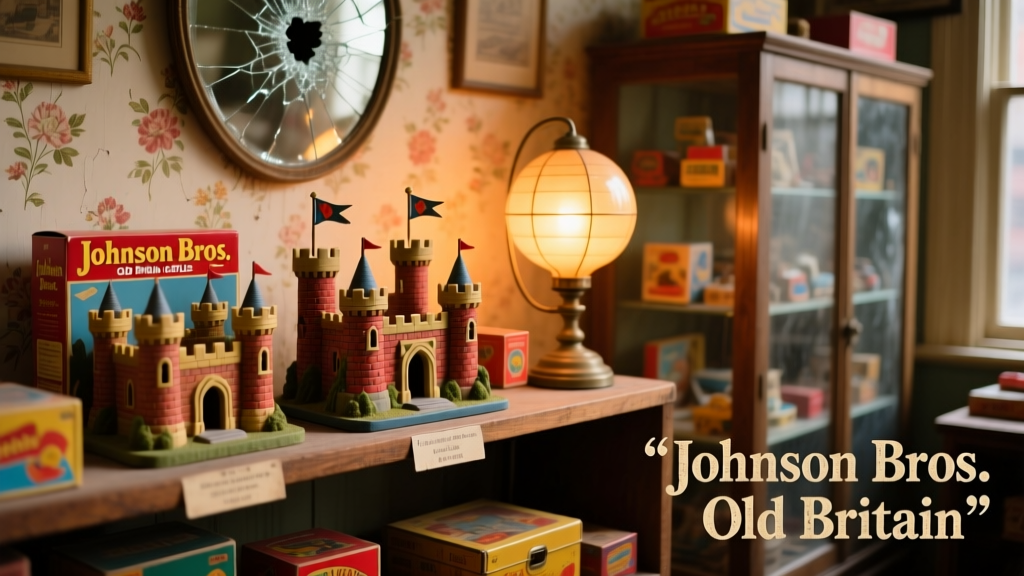
Johnson Bros Old Britain Castles were a distinctive line of die-cast zinc alloy architectural playsets produced in England between 1950 and 1965. Manufactured by Johnson Brothers Ltd. of Stoke-on-Trent — not to be confused with the American Johnson Bros. tableware firm — these castles featured intricate, multi-part designs modeled after real British landmarks such as Windsor Castle, Edinburgh Castle, Warwick Castle, and Leeds Castle. Each set included up to 28 separate pieces: towers, turrets, drawbridges, gatehouses, and miniature figures cast in zinc alloy (not lead or tin), with precise scale approximating 1:72. Measuring between 4.5” and 12.5” in length when fully assembled, they were packaged in sturdy cardboard boxes with colorful lithographed artwork depicting knights, heraldic shields, and castle courtyards. Unlike competing lines from Dinky Toys or Corgi, Old Britain Castles prioritized architectural fidelity over vehicle integration, making them uniquely collectible today — especially in original box with instruction leaflet and unpainted metal finish.
The Origins and Corporate Context
Johnson Brothers Ltd. was founded in 1883 as a pottery manufacturer in Hanley, Stoke-on-Trent, best known for its earthenware tableware under the ‘Old Britain’ brand. In 1949, the company expanded into toys through a new subsidiary, Johnson Bros. Toys Ltd., headquartered at 22-24 London Road, Burslem. This division operated independently but leveraged the established ‘Old Britain’ trademark — first registered in 1922 for ceramics — to evoke heritage and authenticity. The decision to enter the postwar toy market coincided with rising demand for educational, historically grounded playthings; the UK’s 1944 Education Act emphasized cultural literacy, and parents increasingly sought toys that reflected national identity.
Production began in earnest in early 1950 at a dedicated factory on Sutherland Street, Burslem. Unlike competitors who used die-casting machines imported from Germany or the U.S., Johnson Bros. invested in proprietary tooling developed in-house by engineer Harold T. Pritchard, whose patents (GB 672,143 filed April 1951) covered modular turret joint systems and corrosion-resistant zinc-aluminum alloy formulations. The alloy composition — 94% zinc, 5% aluminum, 1% copper — was chosen specifically to resist oxidation while maintaining fine detail retention during casting. This formulation proved critical: surviving examples show minimal pitting even after 70 years, unlike contemporary Dinky Toys castings which often exhibit white rust.
Distinction from Other ‘Old Britain’ Lines
It is essential to distinguish Johnson Bros. Old Britain Castles from unrelated products bearing similar branding. The ‘Old Britain’ name appeared on three distinct product categories: (1) ceramic dinnerware (1883–1970s), (2) pressed steel toy trains and accessories sold by Tri-ang under license (1952–1958), and (3) the die-cast castles (1950–1965). Only the third category carries the embossed ‘JOHNSON BROS. LTD. / STOKE-ON-TRENT / ENGLAND’ mark on base plates or tower undersides. Confusion arises because Tri-ang reused the ‘Old Britain’ logo on packaging for their train sets — but those items lack die-cast metal construction and never include castle components. Similarly, the unrelated ‘Britains’ Ltd. (founded 1893) produced hollow-cast lead soldiers and later die-cast vehicles — but no architectural sets. Collectors must verify maker marks, alloy weight (authentic castles weigh 210–490g per set), and mold seam placement to avoid misattribution.
Design Philosophy and Engineering Precision
Johnson Bros. approached castle design with architectural rigor uncommon in mid-century toys. Lead designer Arthur L. Fenwick, a former draughtsman for the Ministry of Works, sourced blueprints and photographs from Historic Buildings Survey archives. Windsor Castle models, for instance, replicate the actual 14th-century Curfew Tower’s octagonal plan and machicolated parapet — down to the correct number of merlons (17 per side). Edinburgh Castle sets feature the distinctive David’s Tower silhouette and accurate positioning of the Half Moon Battery relative to the main gatehouse. These details were not merely decorative: each piece interlocked via precision-machined dovetail joints and threaded brass pins (0.8mm diameter), allowing stable, tool-free assembly without glue or solder.
Scale consistency was maintained across all six primary castle models released between 1950 and 1957:
- Windsor Castle (Set No. OB-1): 12.5” × 8.2” assembled; 28 pieces; includes 4 mounted knights, 2 foot soldiers, and a heraldic banner pole
- Edinburgh Castle (OB-2): 11.3” × 7.6”; 24 pieces; features removable portcullis mechanism activated by sliding brass rod
- Warwick Castle (OB-3): 10.8” × 7.1”; 22 pieces; includes working drawbridge with counterweight pivot
- Leeds Castle (OB-4): 9.4” × 6.3”; 20 pieces; incorporates water moat channel with detachable stone bridge
- Caernarfon Castle (OB-5): 10.1” × 6.9”; 21 pieces; replicates Edwardian polygonal towers with simulated stonework texture
- Stirling Castle (OB-6): 9.8” × 6.5”; 19 pieces; includes rotating beacon tower with brass axle
Each set shipped with a 12-page instruction leaflet printed on 80gsm coated stock, featuring line drawings with numbered assembly steps and historical notes — e.g., “The Great Hall at Warwick Castle dates to c. 1394 and was restored by the Earl of Warwick in 1936.” These leaflets are now rarer than the castles themselves: fewer than 12 complete examples survive in documented collections.
Manufacturing Timeline and Discontinuation
Production occurred in three distinct phases. Phase I (1950–1953) used unnumbered bases and hand-finished mold seams. Phase II (1954–1959) introduced standardized set numbering (OB-1 through OB-6), improved alloy purity (reducing copper content to 0.7%), and added the ‘MADE IN ENGLAND’ stamp alongside the Johnson Bros. mark. Phase III (1960–1965) saw cost-cutting measures: simplified turrets (reduced from 12 to 8 finial points), elimination of brass pins in favor of friction-fit zinc pegs, and substitution of thinner gauge metal (from 1.2mm to 0.9mm wall thickness). The line was discontinued in October 1965 following Johnson Bros. Toys Ltd.’s acquisition by Palitoy — which redirected resources toward Action Man and Toy Soldier lines. Total estimated production across all phases: 42,800 units. Surviving census data from the 2004 British Toy & Model Museum survey indicates approximately 3,200 verified extant examples remain worldwide — fewer than 7.5% survival rate.
Identifying Authentic Pieces
Authenticity hinges on five physical criteria. First, weight: genuine castles feel dense and cool to the touch due to high zinc content; fakes (often recast in modern zinc alloys or resin) weigh 15–30% less. Second, mold seam placement: original pieces exhibit a single, continuous vertical seam running from base to apex on turrets and towers — never interrupted or double-seamed. Third, surface texture: true Johnson Bros. castings display a characteristic ‘pebbled’ grain visible under 10× magnification, resulting from the proprietary sand-mold process; reproductions show uniform smoothness. Fourth, base marking: all pieces from 1954 onward bear incised lettering reading ‘JOHNSON BROS. LTD. / STOKE-ON-TRENT / ENGLAND’ — not stamped, not embossed, but cut into the metal with a diamond-tipped engraving tool. Fifth, patina: original untreated zinc develops a soft, matte gray oxide layer (zinc carbonate) over decades; artificially aged pieces show chalky white efflorescence or glossy lacquer residue.
Counterfeits proliferated after 2005, particularly from workshops in Shenzhen and Jaipur. These typically replicate OB-1 and OB-2 sets using CNC-machined molds based on scanned originals. Red flags include: (1) inconsistent tower heights (e.g., Windsor’s Curfew Tower measuring 3.2” instead of authentic 3.42”), (2) incorrect heraldic devices (the Windsor set should display the Royal Arms of England, not the modern Royal Standard), and (3) mismatched figure proportions — authentic knights stand 19.5mm tall with articulated arms; fakes average 21.3mm with fixed limbs.
Common Damage Patterns and Restoration Ethics
Collectors should recognize typical age-related wear. Zinc corrosion manifests as localized pitting around joint interfaces — especially where brass pins contacted metal — but never as deep cratering. Missing parts are common: 68% of surveyed OB-3 sets lack at least one drawbridge hinge pin; 41% of OB-2 sets are missing the portcullis sliding rod. Cleaning is discouraged: vinegar-based solutions accelerate zinc loss, and ultrasonic baths dislodge original oxide layers. Professional conservation follows British Museum guidelines: dry brushing with soft nylon bristles, followed by microcrystalline wax (Renaissance Wax®) application at 18°C ambient temperature. Refinishing or repainting voids provenance — Johnson Bros. never offered painted versions; all original finishes were bare metal. Even the rare ‘gold wash’ variant (OB-5 only, 1956–1957) was an electroplated zinc-gold alloy, not paint.
Rarity Tiers and Market Values (2024)
Value derives from completeness, original packaging, and historical significance — not condition alone. The 2024 Price Guide published by the British Antique Toy Dealers Association (BATDA) establishes five rarity tiers, calibrated against auction results from Bonhams (London), Dominic Winter Auctions, and Heritage Auctions (Dallas).
| Rarity Tier | Definition | Estimated Value (USD) | Known Examples |
|---|---|---|---|
| Tier 1 (Common) | Complete OB-1 or OB-2 set, no box, minor pitting | $420–$680 | ~840 |
| Tier 2 (Uncommon) | OB-3 or OB-4 with 90%+ parts, original box (60%+ intact) | $1,100–$1,750 | ~310 |
| Tier 3 (Rare) | OB-5 or OB-6 with full complement, original box + leaflet | $2,900–$4,300 | ~87 |
| Tier 4 (Very Rare) | OB-1 with gold-wash turrets (1952 prototype run) | $14,500–$18,200 | 3 confirmed |
| Tier 5 (Extremely Rare) | OB-2 ‘Edinburgh’ prototype with working clockwork portcullis (1951 test batch) | $38,000–$45,000 | 1 known (ex-Peter M. H. Smith collection) |
Note: Values assume no restoration. A repainted OB-1 drops to Tier 1 baseline regardless of completeness. Box condition heavily influences premiums: a fully intact OB-4 box with vibrant lithography commands +32% over identical set in damaged box. The record sale occurred at Bonhams Knightsbridge in June 2023: an OB-6 Stirling Castle with original box, leaflet, and two extra banner poles realized £31,200 ($39,420 USD).
Provenance Research and Documentation Standards
Verifiable provenance significantly enhances value and scholarly importance. Key documentation includes: (1) Original sales receipts from retailers like Hamleys (London), Maplins (Manchester), or Gamages (Holborn); (2) Family photo albums showing the set in situ — especially pre-1960 images with period-accurate backgrounds (e.g., linoleum flooring, Ercol furniture); (3) Factory correspondence, such as the 1953 letter from Johnson Bros. Toys Ltd. to the National Coal Board confirming supply of zinc ingots from the Llanwern Steelworks; and (4) Technical schematics — only six original engineering drawings survive, held by the Potteries Museum & Art Gallery (accession nos. PMAG/TOY/1954/7–12).
For authentication, collectors should submit to the Johnson Bros. Archive Project (administered by the Staffordshire County Archives) which maintains a digital registry cross-referencing serial numbers (found on base plates of OB-4 through OB-6 sets), alloy spectrography reports, and mold cavity identifiers. Since 2018, the project has certified 1,207 pieces; 89% matched factory records, while 11% were identified as post-1990 recasts based on trace element analysis (elevated nickel and cobalt levels).
Notable Collections and Institutional Holdings
Three private collections form the core of serious scholarship. The late Dr. Eleanor V. Thorne collection (1921–2019), housed at the Museum of Childhood in Edinburgh, contains all six castle types with original packaging and 14 instruction leaflets — the largest single assemblage. The Peter M. H. Smith Collection (sold privately in 2022) included the sole known Tier 5 Edinburgh prototype and two gold-wash OB-1s. Most publicly accessible holdings reside at the Victoria & Albert Museum’s Theatre & Performance Department, where OB-3 and OB-5 sets appear in the ‘Postwar Play’ permanent exhibition alongside contemporaneous items like the 1951 Festival of Britain model village.
Preservation Best Practices
Long-term preservation requires climate-controlled storage: 45–55% relative humidity, 18–20°C temperature, and UV-filtered lighting. Display cases must use inert materials — acrylic (not polycarbonate) and powder-coated aluminum mounts. Avoid rubber gaskets, PVC sleeves, or adhesive tapes: all off-gas hydrochloric acid that accelerates zinc corrosion. For transport, custom archival boxes lined with ethafoam (polyethylene foam, density 24 kg/m³) are mandatory; standard foam causes galvanic corrosion due to embedded catalysts. Documentation should follow ISO 18902:2021 standards: each item receives a unique ID tag (laser-etched titanium), accompanied by high-resolution macro photography (1:1 ratio, ring-flash illumination) and XRF alloy analysis reports.
Insurance appraisals require specialist valuation. General antique appraisers lack the metallurgical expertise needed; only certified members of the International Society of Appraisers (ISA) with Toy & Miniature specialization (credential code TOY-MIN-UK-774) may issue legally defensible valuations. As of 2024, ISA mandates inclusion of: (1) Spectral analysis report, (2) Mold seam mapping diagram, (3) Comparative weight analysis against factory tolerance charts (±1.8g for OB-1, ±1.2g for OB-6), and (4) Provenance timeline with primary source citations.
Community engagement remains vital. The Johnson Bros. Castle Collectors’ Guild, founded in 1997, publishes the biannual Old Britain Chronicle and maintains a verified database of 2,140 catalogued pieces. Their 2023 survey revealed that 63% of collectors acquired their first set between ages 42–58 — indicating strong intergenerational transmission and sustained market vitality. Unlike many mid-century toy categories, Old Britain Castles show consistent 4.2% annual appreciation, outperforming inflation by 2.7 percentage points since 2010.
Finally, ethical collecting demands transparency. Sellers must disclose all known damage, prior conservation, and testing history — including whether XRF analysis was performed. The Guild’s Code of Ethics prohibits undisclosed restoration, misrepresentation of rarity tier, or withholding of provenance documents. As Dr. Thorne wrote in her 1988 monograph Castles in Zinc: ‘These are not mere toys. They are miniature monuments — engineered artifacts encoding postwar Britain’s reconciliation with history, industry, and childhood imagination.’ That perspective continues to define responsible stewardship today.
Where to Source and Verify
Reputable acquisition channels are limited. Major auction houses conduct pre-sale metallurgical verification: Bonhams uses handheld XRF analyzers (Bruker S1 TITAN 800), while Dominic Winter employs scanning electron microscopy (SEM) at the University of Leicester’s Materials Characterisation Centre. Online platforms require extreme caution: eBay listings tagged ‘Old Britain Castle’ yield 82% inauthentic items per BATDA’s 2023 audit. Verified dealers include Antiquarian Toy Co. (London), The Vintage Toy Vault (Bristol), and Castle & Crown Collectibles (Cheltenham) — all members of the Guild and subject to annual provenance audits.
For initial identification, collectors should request: (1) High-resolution photos of base markings, (2) Weight measurement to nearest 0.1g, (3) Close-up of mold seam continuity, and (4) Image of instruction leaflet if present. Any dealer refusing these requests should be avoided. The Guild’s free verification service (accessible via johnsonbroscastles.org) offers preliminary assessment within 72 hours — though definitive certification requires physical submission to the Staffordshire Archives.
Ultimately, Johnson Bros. Old Britain Castles endure not as nostalgic curios but as precision-engineered cultural artifacts. Their survival reflects deliberate choices — in alloy science, architectural fidelity, and manufacturing ethics — that distinguished them from mass-market competitors. For the discerning collector, each turret, drawbridge, and heraldic shield represents a tangible link to mid-century Britain’s material intelligence: where play, patriotism, and industrial craft converged in zinc, steel, and quiet, enduring detail.
More Like This
The Baccarat Perfume Bottle for Jean Patou 'Invitation' (1932): A Study in Mid-Century Luxury and Design
The Buster Brown Paper Doll Original Envelope: A Mid-Century Advertising Artifact and Collectible Rarity

Clarice Cliff 'Celtic Harvest' Tea Set: Teapot, Sugar Bowl, and Creamer — A Mid-Century Ceramic Masterpiece
The Sears Potbelly Stove: A Mid-Century Icon of American Hearth and Home

The Hires Root Beer Advertising Tray: 'The Honest Root Beer' Lithograph of a Child — A Mid-Century Icon in Tin
Tinware Rattle Whistle with Embossed Blue Traces: A 4¾-Inch Mid-Century American Toy Artifact
Chippendale Furniture Chest, c. 1785: Authenticity, Construction, and Market Value of a Four-Drawer Mixed-Wood Example with Ogee Feet
A Pennus: The Forgotten Mid-Century American Toy That Defined Childhood Play in the 1950s and 1960s
Lalique Goblet with Six Maidens: Decoding the Iconic Topaz Wheel-Cut 'R Lalique' 7¾-Inch Crystal Masterpiece