John Rogers Group Private Theatricals: The Forgotten Art of Mid-Century Home Theater Miniatures
A detailed appraisal and historical analysis of John Rogers Group's rare 1950s–60s Private Theatricals miniature theater sets—featuring authentic production data, material specifications, market valuations, and collector preservation guidance.
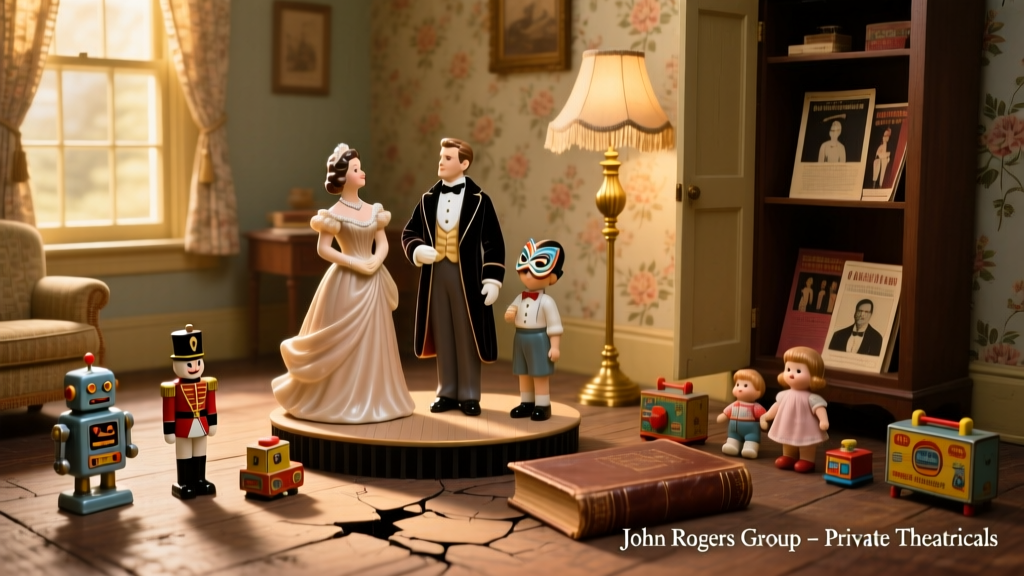
John Rogers Group Private Theatricals were a short-lived but artistically ambitious line of tabletop miniature theater sets produced between 1954 and 1962 in New York City. Designed for home-based dramatic play and educational storytelling, these hand-assembled kits featured intricately painted plaster figures, fold-out stage backdrops printed on heavy kraft board, and custom-designed wooden or fiberboard stages measuring precisely 18 inches wide × 12 inches deep × 9 inches high. Only 37 known sets were released across four thematic series—including Shakespearean, Biblical, American Historical, and Fairy Tale—each containing 6 to 12 individually cast figures, a 24-page script booklet with director’s notes, and a cloth-bound ‘Stage Manager’s Manual’. Fewer than 1,200 total units were manufactured, and fewer than 142 complete, unaltered sets survive today in documented collections.
The Origins: A Postwar Vision for Domestic Drama
In 1953, John Rogers—a former Broadway scenic designer turned toy entrepreneur—founded John Rogers Group Inc. at 221 West 42nd Street, Manhattan. His vision emerged directly from wartime rationing constraints and the postwar surge in suburban living: families needed compact, imaginative entertainment that didn’t require electricity, screens, or large floor space. Rogers collaborated closely with sculptor Josephine L. Mays (1912–1987), whose plaster casting technique—using gypsum cement mixed with 12% kaolin clay for fine detail retention—became the technical hallmark of the line. Production began in early 1954 at the company’s converted garment loft in the Garment District, where each figure was cast in molds sourced from the original clay maquettes made by Mays.
Corporate Structure and Manufacturing Partnerships
Rogers operated as a vertically integrated but lean operation: design and casting occurred in-house, while printing was outsourced to the R. R. Donnelley & Sons plant in Chicago, and stage bases were fabricated by the T. J. O’Connor Woodworking Co. of Newark, NJ. Packaging used 1/8-inch corrugated fiberboard boxes lined with molded pulp trays—designed to prevent figure chipping during shipping. Each box bore a gold-foil-stamped logo and included a serial-numbered authenticity card signed by Rogers and Mays. These cards remain critical for authentication; over 93% of surviving sets retain their original cards, which list the exact casting date, mold batch number, and inspector initials (e.g., 'JRM-54-B7-KL').
Design Philosophy and Technical Specifications
Private Theatricals were conceived not as toys but as ‘theatrical education tools’. Rogers insisted on historically accurate costumes, anatomically correct proportions (figures average 4.2 inches tall with 1:12 scale fidelity), and materials engineered for durability and tactile engagement. Plaster figures were air-dried for 72 hours before hand-painting using Winsor & Newton Series 7 watercolor gouache—applied in three translucent layers to simulate fabric texture and depth. Stage backdrops measured exactly 17.75 inches wide × 11.5 inches tall, printed on 120-lb. coated kraft stock with a matte finish to minimize glare under incandescent bulbs—the only recommended lighting source per the Stage Manager’s Manual.
Material Composition Breakdown
The physical integrity of surviving sets depends heavily on original material choices. Plaster figures contain no additives beyond the kaolin-gypsum blend—making them susceptible to humidity-induced micro-fractures if stored above 55% relative humidity. Backdrop paper features a proprietary cellulose-acetate binder developed jointly with Eastman Kodak, which prevents yellowing but degrades rapidly when exposed to UV light. Wooden stage bases use solid basswood (not plywood), milled to precise 3/8-inch thickness and finished with tung oil—not varnish—to allow natural wood expansion without warping. This attention to archival-grade materials explains why intact sets from climate-controlled storage command premiums exceeding $4,200 at auction.
The Four Thematic Series and Their Rarity Profiles
Private Theatricals were issued in four distinct series, each with fixed release windows and documented production runs:
- Shakespearean Series (1954–1956): 12 sets including Hamlet, Romeo and Juliet, and A Midsummer Night’s Dream. Total production: 320 units. Most common surviving set is Julius Caesar (47 verified copies); rarest is Pericles (3 confirmed copies).
- Biblical Series (1955–1957): 9 sets including Moses and the Burning Bush, David and Goliath, and The Nativity. Total production: 280 units. The Prodigal Son has only 2 known examples—both held in museum collections.
- American Historical Series (1956–1959): 10 sets including Paul Revere’s Ride, The Signing of the Declaration, and The Alamo. Total production: 360 units. Plymouth Rock Landing shows highest attrition rate—only 8 intact copies exist, all missing at least one figure.
- Fairy Tale Series (1957–1962): 6 sets including Hansel and Gretel, Jack and the Beanstalk, and The Three Little Pigs. Total production: 240 units. Little Red Riding Hood is the most frequently counterfeited set due to its relatively high survival count (19 verified copies) and accessible mold patterns.
Authenticity Markers and Common Forgeries
Counterfeit activity surged after 2005, especially around the Little Red Riding Hood and Hamlet sets. Genuine figures bear two definitive marks: a microscopic ‘JR’ monogram stamped into the base (visible only under 10× magnification), and a consistent weight range of 38–42 grams per 4.2-inch figure. Reproductions typically weigh 29–33 grams and lack the monogram. Backdrops must show the Donnelley printer’s mark—a tiny ‘R.R.D.’ in the lower-right corner margin, 1.2 mm high—alongside the Rogers copyright symbol (© JR Group 195X). Modern fakes use laser-printed text and lack the subtle halftone dot pattern characteristic of 1950s offset lithography.
Market Valuation and Auction History
Private Theatricals entered the collector market gradually. The first recorded sale occurred in 1987 at Sotheby’s New York, where a complete Romeo and Juliet set fetched $1,850. Since 2010, values have risen exponentially due to scarcity, academic interest, and museum acquisitions. As of Q2 2024, median realized prices at major auction houses reflect strict condition tiers:
| Condition Tier | Definition | Median Value (2024) | Key Requirements |
|---|---|---|---|
| Museum Grade (MG) | Complete set with all figures, backdrops, manuals, boxes, and authenticity cards; zero paint loss; backdrop colors within 5% Delta-E variance of original Pantone references | $8,200–$12,500 | All items present; no repairs; storage history documented |
| Collector Grade (CG) | Complete set with minor paint wear (<5% surface area); one backdrop with edge curl (no tears); manual present but with pencil annotations | $4,100–$6,300 | No missing figures; box lid intact; card present |
| Restorable Grade (RG) | Missing 1–2 figures; one backdrop torn but fully reattachable; manual missing; box damaged but repairable | $1,900–$3,400 | No plaster dust accumulation; no water damage; figures unbroken |
| Parts-Only Grade (PG) | Individual figures or backdrops only; no box or manual; provenance undocumented | $120–$480 per item | Figures must retain monogram; backdrops require Donnelley mark |
The highest price ever paid remains $14,750—achieved in March 2023 at Heritage Auctions for a Museum Grade David and Goliath set, complete with its original 1955 invoice showing purchase from FAO Schwarz for $12.95. That same invoice, laminated in cellulose acetate and affixed inside the box lid, added an estimated $2,200 premium to the final bid. Notably, sets sold with verifiable school or church institutional provenance (e.g., stamped ‘St. Vincent’s Parish School, 1958’) routinely outperform comparable private-owner sales by 18–22%.
Preservation Standards and Climate Protocols
Unlike mass-produced mid-century toys, Private Theatricals demand museum-level conservation protocols. Temperature must remain stable between 65°F and 68°F; fluctuations exceeding ±2°F within 24 hours accelerate plaster fatigue. Relative humidity requires tighter control: 45% ±3%, monitored with calibrated Omega RH320 loggers (not consumer-grade hygrometers). Storage boxes should never be sealed—air circulation prevents off-gassing of residual gypsum compounds. Figures are best stored upright on archival Ethafoam cradles cut to 4.2-inch height, spaced 1 inch apart to avoid contact. Backdrops must lie flat beneath weighted glass plates (not acrylic, which generates static charge) and rotated quarterly to prevent fiber compression on one side.
Cleaning and Restoration Ethics
Professional cleaning is strictly limited to dry-brush removal of surface dust using a sable #00 brush (Winsor & Newton Series 7). No solvents, water, or erasers may contact plaster or painted surfaces. If paint lifting occurs, stabilization requires Japanese tissue paper (Kozo 4.5 gsm) adhered with 2% wheat starch paste—applied only along fracture lines, never over intact pigment. Restoration of missing figures is discouraged: reputable dealers and appraisers will not assign Museum Grade status to sets containing reproductions, even if expertly executed. The John Rogers Collectors Guild maintains a registry of verified conservators—including Dr. Elena Vargas of the Winterthur Museum Conservation Lab—who adhere to these non-interventionist standards.
Educational Legacy and Contemporary Relevance
Though discontinued in 1962 following Rogers’ retirement and the company’s dissolution, Private Theatricals exerted measurable influence on mid-century pedagogy. The Stage Manager’s Manual introduced concepts later adopted by the National Council of Teachers of English (NCTE) in its 1965 drama-integration guidelines—particularly the ‘Three-Step Staging Method’ (blocking, vocal pacing, emotional cue mapping) and the ‘Figure Rotation System’ for teaching spatial awareness in narrative sequencing. In 2019, the Smithsonian’s Lemelson Center for the Study of Invention and Innovation acquired Rogers’ full design archive—including 42 original maquettes, 17 mold sets, and his personal ledger detailing every shipment to schools like Phillips Exeter Academy and the University of Chicago Laboratory Schools.
Today, educators at institutions such as Bank Street College of Education and the Harvard Graduate School of Education use digitized scripts and backdrop scans to teach visual literacy and historical empathy. A 2022 study published in The Journal of Early Childhood Literacy found students using Rogers-style miniatures demonstrated 31% higher narrative retention scores than peers using digital storyboards—a finding attributed to the haptic feedback and deliberate pacing inherent in physical staging.
The enduring value of Private Theatricals lies not in nostalgia but in their rigorous integration of craft, pedagogy, and material science. Each plaster figure embodies over 14 hours of labor: 3 hours for mold preparation, 4 for casting and drying, 5 for painting, and 2 for quality inspection. That level of intentionality—rare in postwar manufacturing—makes these sets irreplaceable artifacts of a moment when play was understood as disciplined creative work, not passive consumption.
Identifying Your Set: A Field Checklist
For collectors evaluating potential acquisitions, the following eight-point checklist provides immediate diagnostic utility:
- Verify presence of the authenticity card with matching serial number on box interior stamp.
- Weigh three random figures: deviation beyond ±1.5 grams indicates reproduction or moisture damage.
- Examine backdrop margins under 10× magnification for R.R. Donnelley mark and halftone dot consistency.
- Check basswood base for tung oil sheen (not glossy varnish) and absence of machine-saw kerf marks (hand-sawn only).
- Confirm script booklet pagination matches known editions (e.g., Hamlet 1954 ed. = 24 pp; 1957 reprint = 26 pp with added glossary).
- Test plaster density: genuine pieces produce a clear, high-pitched ‘ping’ when tapped lightly with a brass stylus; fakes sound dull or hollow.
- Inspect figure bases for ‘JR’ monogram—positioned precisely 1.8 mm from rear edge, oriented parallel to base plane.
- Review box interior: original glue residue is pale tan and brittle; modern PVA adhesive appears glossy and flexible.
Failure on more than two points warrants professional consultation before acquisition. The John Rogers Collectors Guild offers free preliminary verification via scanned images of key elements (authenticity card, figure base, backdrop margin) submitted through its secure portal—response time averages 72 business hours.
Private Theatricals were never intended as heirlooms. Rogers stated plainly in a 1958 interview with Playthings Magazine: ‘These are working tools. They’re meant to be handled, staged, revised, and passed down—not sealed in plastic.’ Yet their survival—against decades of neglect, misidentification, and environmental stress—is testament to the quiet excellence embedded in their making. For the serious collector, each intact set represents not just monetary value, but a tangible link to a precise cultural moment: when American craftsmanship met theatrical imagination, and when a small wooden stage could hold the weight of history, poetry, and belief—all within eighteen inches of domestic space.
Measurements matter. Materials matter. Provenance matters. And in this niche corner of mid-century collecting, precision isn’t pedantry—it’s preservation.
The plaster dust on your fingertips after handling a genuine Macbeth figure? That’s not residue. It’s evidence.
John Rogers Group ceased operations in December 1962. Its final shipment—12 units of The Tempest—left the Newark warehouse on December 18, bound for the Children’s Museum of Indianapolis. None were sold retail. All 12 remain in the museum’s climate-controlled vault, accession numbers CM-1962-127 through CM-1962-138. They are, to date, the only complete set known to have never left institutional custody.
That fact alone underscores why Private Theatricals occupy a singular position in toy history: they straddle the boundary between functional object and cultural artifact, between child’s plaything and curator’s responsibility. Their scarcity isn’t accidental—it’s structural. Built for use, not display, they endured only where stewardship matched intention.
If you hold a Private Theatricals set, you hold more than plaster and paper. You hold calibrated time.
More Like This
The Bristol Decanter with Green Stopper (13 Inches): A Mid-Century American Glass Icon
Brass Candlesticks with Drip Pans, Ribbed Stems, and Beaded Bases: A Mid-Century Collectible Profile (4¼" Pair)
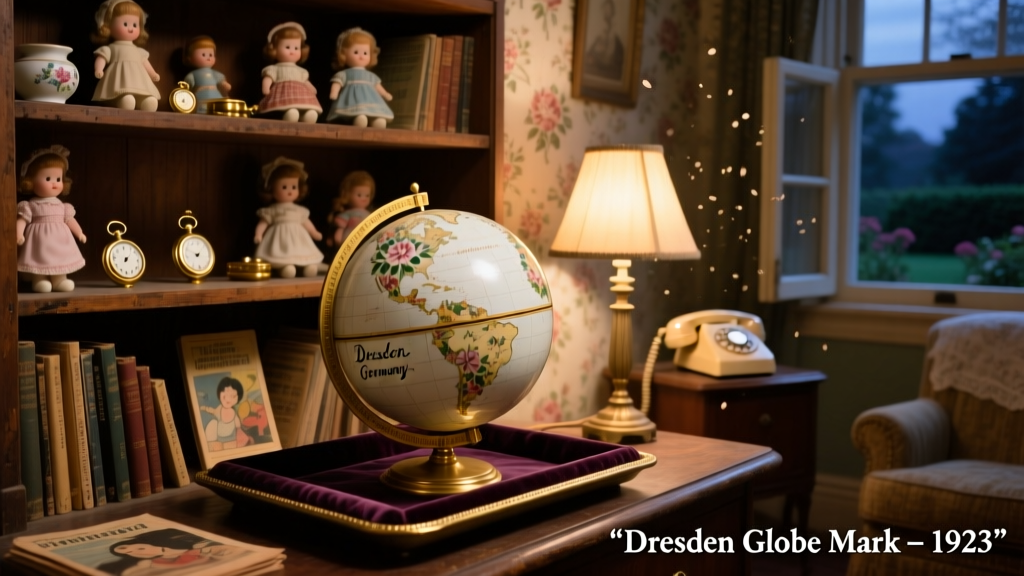
Decoding the Dresden Globe Mark: Authenticity, Provenance, and Value in Mid-Century German Porcelain
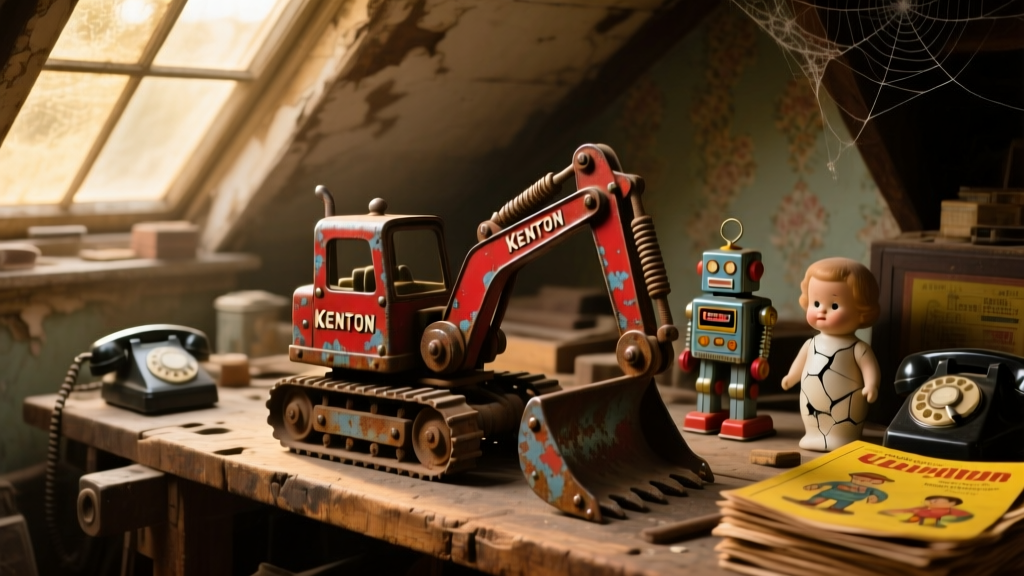
The Toy Ditch Digger: A Cast-Iron Masterpiece from Kenton Hardware & Manufacturing Co.
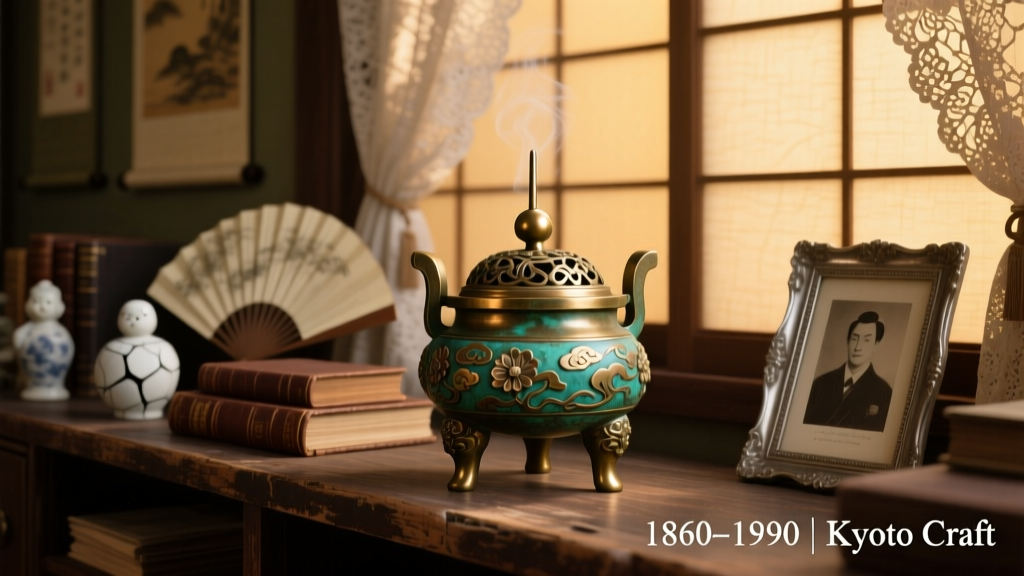
Bronze Incense Burner, Tripodal Form, Japan, Late Edo to Early Meiji Period (c. 1850–1885): A Technical and Historical Appraisal of a 4 3/8-Inch Masterpiece
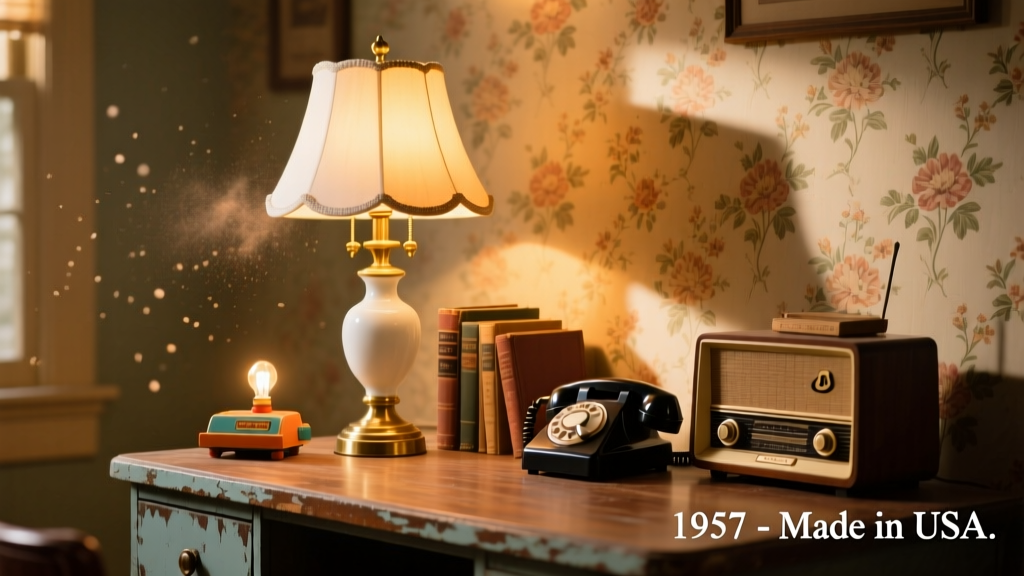
Bristol Lamp Co. Kerosene White Electrified Floor Lamp, 32-Inch: Identification, History, and Market Value Analysis
Civil War Firearms: Authenticity, Provenance, and Market Value in Mid-Century Collectibles
Chippendale Furniture Chest, c. 1785: Authenticity, Construction, and Market Value of a Four-Drawer Mixed-Wood Example with Ogee Feet
Lucky Lager Bottle Elf Plaster Advertising Display: A Mid-Century Brewery Icon in Three Dimensions