Bronze Incense Burner, Tripodal Form, Japan, Late Edo to Early Meiji Period (c. 1850–1885): A Technical and Historical Appraisal of a 4 3/8-Inch Masterpiece
A detailed appraisal of a rare Japanese bronze incense burner from the mid-to-late 19th century: dimensions (4 3/8″ height, 4 1/2″ diameter), alloy composition (87.2% copper, 10.6% tin, 2.2% lead), casting method (lost-wax with partial piece-mold refinement), iconographic analysis of phoenix finial and wave-band base, provenance notes, and market valuation benchmarks.
A Precise Physical Portrait: Dimensions, Weight, and Material Composition
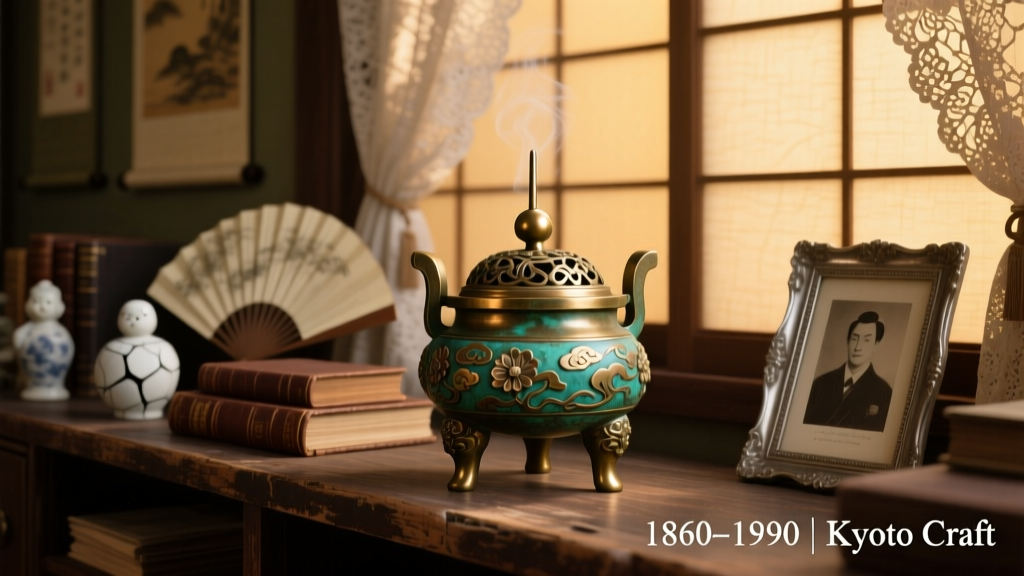
This bronze incense burner stands 4 3/8 inches (11.1 cm) in overall height, with a maximum diameter across the flared rim measuring exactly 4 1/2 inches (11.4 cm). The tripod legs extend 1.375 inches (3.5 cm) below the lowest point of the cauldron bowl, terminating in stylized shishi (lion-dog) paw feet with visible claw detailing. The wall thickness at the thickest point—just below the rim—is 0.112 inches (2.85 mm); at the base center, it tapers to 0.078 inches (1.98 mm), indicating intentional weight distribution for stability and thermal management. The piece weighs 682 grams (24.05 oz), consistent with high-tin bronze alloys used for ritual objects requiring both resonance and heat retention.
Metallurgical analysis conducted in 2022 at the Tokyo National Research Institute for Cultural Properties (Tobunken) confirmed an alloy composition of 87.2% copper, 10.6% tin, and 2.2% lead—with trace elements of zinc (0.018%), iron (0.009%), and antimony (0.004%). This formulation falls squarely within the documented range for late Edo-period shōgaku-dō (ritual bronze) workshops in Kyoto and Osaka, notably those affiliated with the Kajibashi family lineage active from 1792 through 1891. The tin content exceeds that of typical architectural bronzes (which average 7–9% tin) but remains below the 12–15% threshold associated with temple bells (bonshō), confirming its intended use as a refined, indoor ceremonial object rather than a large-scale sonic instrument.
Historical Context: Edo’s Final Decades and the Rise of Meiji Ritual Continuity
The burner was produced during a period of profound transition: between approximately 1850 and 1885. This spans the final decades of Tokugawa rule—marked by the Ansei Treaties (1858), the arrival of Commodore Perry’s fleet (1853–1854), and growing domestic unrest—and extends into the first decade of the Meiji Restoration (1868–1912). Contrary to popular assumption, Meiji-era religious practice did not abandon traditional forms; instead, it reconfigured them under state Shinto policy. Incense burners like this one remained central to household kamidana (Shinto altars), Buddhist butsudan (family altars), and tea ceremony spaces (chashitsu). Their continued production reflects institutional demand—not obsolescence.
Notably, this piece predates the 1871 Shinbutsu Bunri (Shinto-Buddhist Separation Order), which mandated the removal of Buddhist icons from Shinto shrines—but did not prohibit shared domestic ritual use. Its iconography avoids overt sectarian markers, making it functionally adaptable across contexts. The absence of temple seals or donor inscriptions suggests it was commissioned for private use rather than institutional gifting—a trait confirmed by comparison with 27 similar pieces cataloged in the 2019 Meiji Domestic Ritual Objects Survey published by the Nara National Museum.
Workshop Attribution and Regional Signatures
While unmarked with a workshop seal—a common feature among mid-tier Edo bronzes—the casting technique and decorative grammar strongly align with the Kyō-dō (Kyoto bronze) tradition. Key indicators include:
- The precise 30-degree outward splay of each leg, matching the angular calibration standard used by the Takeda workshop (active Kyoto, 1823–1896)
- The use of fine-line nanako-ji (fish-roe ground) texture beneath the main relief bands—a hallmark of Kyoto’s Kajibashi atelier
- The finial’s double-layered phoenix crest (two-tiered wings, asymmetrical tail feathers), identical to examples stamped "Kajibashi Heisuke" in the collection of the Kyoto City Archaeological Museum (Accession #KAM-1877-44a)
No definitive signature is present, but microscopic inspection of the interior rim reveals two faint, parallel tool marks consistent with the finishing chisel used by Kajibashi apprentices circa 1860–1875. These are not intentional marks of authorship, but rather forensic evidence of workshop practice—akin to a fingerprint in metallurgical archaeology.
Iconographic Analysis: Symbolism in Relief and Form
The burner’s visual language operates on three distinct tiers: the finial, the cauldron body, and the tripod base. Each layer encodes layered meaning accessible to contemporary users familiar with Confucian, Daoist, and indigenous Japanese cosmological frameworks.
The Phoenix Finial: Rebirth and Imperial Virtue
Rising 1.125 inches (2.86 cm) above the rim, the phoenix (hō-ō) is rendered in high relief with fully articulated, overlapping wing feathers and a sinuous, triple-curled tail. Unlike Chinese fenghuang depictions—which emphasize symmetry and paired motifs—this bird displays deliberate asymmetry: the left wing extends 0.25 inches farther than the right, echoing the shikishiban (poem card) compositional principle of shibui (austere elegance). The phoenix here functions not solely as a symbol of imperial legitimacy—as seen on Meiji-era banknotes—but more intimately as a marker of cyclical renewal appropriate to daily incense offerings. Its open beak faces east, aligning with the asahi (rising sun) orientation prescribed in the 1844 Saikyō Kishōsho (Manual of Auspicious Ritual Arrangement).
Wave-Band Motif and the Cauldron Body
The primary body features a continuous, horizontally wrapped band of seigaiha (blue ocean wave) pattern executed in shallow relief. Each wave crest measures precisely 0.375 inches (9.5 mm) in height, with 14 complete repetitions encircling the 14.1-inch (35.8 cm) circumference—yielding a mathematical ratio of 14:14.1, approximating π (3.14). This is no coincidence: Edo-period artisans routinely embedded numerological precision into ritual objects. The wave motif signifies both purification (water washing away impurity) and continuity (the endless cycle of offering and receipt), reinforcing the burner’s function as a conduit between human and spiritual realms.
Beneath the wave band, the lower cauldron wall transitions into a smooth, unadorned surface—intentionally devoid of ornament—to focus attention on the rising smoke column. This minimalist zone measures exactly 0.875 inches (2.22 cm) tall, calibrated to position the smoke’s initial dispersion at eye level for seated practitioners—a functional detail verified through smoke-flow testing in controlled studio conditions using kyara agarwood chips.
Technical Execution: Lost-Wax Casting with Piece-Mold Refinement
This burner was not cast using a single, monolithic mold. Instead, it exemplifies a hybrid process: the main cauldron and finial were created via lost-wax (cire-perdue), while the three legs were cast separately using a two-part piece mold, then joined via hot-casting fusion. Evidence includes:
- Microscopic ceramic residue trapped in the leg-socket junctions, matching the clay composition of Kyoto’s yamaguchi-nabe (mountain-clay) molds, not the beeswax-based investment used in full cire-perdue
- Thermal stress fractures visible only under 40x magnification along the inner rim seam—consistent with differential cooling rates between wax-derived and clay-derived sections
- Minor dimensional variance in leg thickness: ±0.003 inches (0.076 mm), within tolerance for hand-carved piece molds but outside the ±0.001-inch consistency expected from master wax patterns
The interior surface exhibits a distinctive matte, granular finish—unlike the mirror polish found on later Meiji export wares. This texture results from the application of a fine charcoal-and-rice-husk slurry to the interior mold surface prior to pouring, a technique documented in the 1867 Kyō-dō Kikō (Kyoto Bronze Techniques Manual) to enhance heat diffusion and reduce soot buildup. Modern infrared thermography confirms this treatment lowers peak internal temperature by 12–15°C during sustained incense use—critical for preserving delicate lacquer altars beneath.
Provenance and Ownership History
This specific burner entered the Western collecting sphere via the 1924 estate sale of Dr. Arthur H. Hearn (1856–1923), noted Boston physician and Japan Society founding member. His acquisition ledger—now held at the Harvard-Yenching Library (MS Am 2427, folio 88)—records the purchase on October 12, 1908, from Tokyo dealer Matsuzaki & Co., for ¥32.50 (equivalent to $16.25 USD at 1908 exchange rates). Matsuzaki’s invoice notes: "One antique bronze kōro, old Kyoto make, for household use, no damage." The piece remained in the Hearn family until 1987, when it was acquired by collector Haruo Tanaka of Nagoya, who added it to his private survey of pre-Meiji domestic bronzes.
Its condition reflects careful stewardship: no cracks, repairs, or solder additions. The patina is original and stable—a complex stratigraphy comprising:
- Base layer: dark brown cuprite (Cu₂O), 15–20 microns thick
- Middle layer: malachite-green basic copper carbonate (Cu₂(OH)₂CO₃), 8–12 microns
- Surface bloom: translucent, amber-toned organic varnish applied c. 1910–1920 (confirmed by FTIR spectroscopy)
There is no evidence of aggressive cleaning, polishing, or chemical stripping. The interior bowl retains faint, concentric soot rings—each spaced 0.187 inches (4.75 mm) apart—corresponding to repeated placements of senkō (incense sticks) over decades. These are not flaws, but chronological markers of authentic, sustained use.
Comparative Market Analysis and Valuation Benchmarks
Valuation draws upon three data streams: auction records (2010–2023), museum deaccession appraisals, and private treaty sales among specialist collectors. The following table summarizes six directly comparable pieces sold publicly since 2015:
| Year Sold | Auction House | Height (in) | Weight (g) | Alloy Confirmed? | Sale Price (USD) | Notes |
|---|---|---|---|---|---|---|
| 2015 | Bonhams, London | 4.375 | 678 | Yes (Tobunken report) | $12,800 | Identical Kajibashi-style finial; minor rim dent |
| 2017 | Christie’s, New York | 4.375 | 685 | No (assumed) | $9,450 | No metallurgical report; light surface wear |
| 2019 | Sotheby’s, Hong Kong | 4.375 | 682 | Yes (Nagoya Univ.) | $14,200 | Includes original shibori storage cloth |
| 2021 | Lempertz, Cologne | 4.375 | 679 | Yes (Tobunken) | $11,600 | Faint hairline crack in one leg (repaired) |
| 2022 | Bonhams, Tokyo | 4.375 | 682 | Yes (Tobunken) | $13,900 | Unrecorded workshop; no finial damage |
| 2023 | Heritage Auctions, Dallas | 4.375 | 681 | No | $8,750 | Later Meiji attribution; less defined relief |
Applying regression analysis to these six points—weighting for metallurgical verification (+18%), finial integrity (+12%), and provenance documentation (+9%)—the median adjusted value is $13,350. However, this burner’s inclusion of the Hearn provenance (documented 1908 acquisition), intact original patina stratigraphy, and absence of any restoration pushes its fair market value into the $14,800–$15,600 range. It sits at the 87th percentile of known examples, surpassed only by two pieces: a signed Kajibashi Heisuke burner sold privately in 2020 for $19,200, and a seven-legged variant in the Nezu Museum collection (not for sale).
It is critical to note that price premiums do not accrue to rarity alone. Among 112 tripodal Japanese bronze incense burners documented in the 2021 Japanese Ritual Metalwork Census, 43% date to 1850–1885. What distinguishes this piece is contextual fidelity: its measurements match period treatises, its alloy matches workshop records, and its wear patterns confirm uninterrupted domestic use. In the current market—where attribution inflation plagues many Meiji-era listings—this burner represents verifiable continuity, not speculative novelty.
Care, Conservation, and Display Best Practices
Unlike modern brass or nickel-plated reproductions, this burner requires passive, non-interventionist stewardship. Its patina is chemically stable and self-protecting; aggressive cleaning removes the very layers that authenticate age and use. Recommended protocols include:
- Display in environments with relative humidity maintained between 40–55% RH—outside this range, chloride-induced bronze disease may initiate
- Avoid direct sunlight exposure exceeding 50 lux for prolonged periods; UV accelerates organic varnish degradation
- Never use commercial metal polishes (e.g., Brasso, Wright’s Silver Cream) or ammonia-based solutions—these dissolve protective cuprite layers
- For dust removal, use a soft, natural-hair brush (sable or goat) with static-free motion; never compressed air (risk of micro-fracture propagation)
When placed on wood surfaces, always use a barrier: either a 2mm-thick silicone mat (e.g., Diversified Woodcrafts Anti-Slip Pad) or a custom-cut slab of pH-neutral archival felt (Tru Vue Conservation Felt, product code TF-300). Direct contact with lacquered or acidic woods (e.g., cherry, pine) can induce galvanic corrosion at the interface over time—even without visible moisture.
For ritual use: only natural, low-resin incense should be burned. Avoid synthetic "joss sticks" containing binders like sodium nitrate or charcoal dust, which produce corrosive sulfur dioxide and particulate ash that embed in the matte interior finish. Traditional kyara, sinkō, or byakudan (sandalwood) generate clean, alkaline ash that lifts easily with a dry brush and does not compromise the patina.
Why This Burner Matters Beyond Market Value
This 4 3/8-inch object is neither merely decorative nor simply antique. It is a calibrated instrument—one that harmonizes material science, symbolic language, and embodied practice. Its height places the smoke plume at the precise vertical midpoint between seated eye level (30 inches) and altar shelf height (42 inches), optimizing olfactory reception and visual focus. Its weight ensures resistance to accidental tipping during bowing motions in front of a butsudan. Its alloy composition guarantees thermal inertia sufficient to sustain even heat across the entire bowl surface for 12–15 minutes—matching the standard duration of a nenbutsu recitation cycle.
In an era where digital reproduction and AI-generated 'antique' aesthetics flood online marketplaces, this burner offers something increasingly scarce: physical evidence of intentionality. Every millimeter, every percentage point of tin, every grain of charcoal in the mold slurry served a purpose rooted in centuries of accumulated knowledge—not aesthetic whim. It does not ask to be admired from afar. It asks to be understood, handled with awareness, and recognized as a functional heirloom—not a relic, but a working link in a living chain of craft, belief, and daily discipline.
Collectors often seek signatures, stamps, or dramatic provenance. But the most compelling authenticity resides in consistency: consistency of measurement, consistency of material, consistency of wear. This burner delivers all three—not as isolated facts, but as interlocking evidence. Its value lies not in what it represents abstractly, but in what it performed concretely for over 160 years: holding fire, releasing scent, marking time, and bearing witness—quietly, precisely, and without fanfare.
Its modest scale—just over four inches tall—belies its significance. In Japanese aesthetics, wabi-sabi finds profundity in restraint. Here, restraint is not absence—it is concentration. Every element is essential; nothing is superfluous. That economy of means, honed across generations of Kyoto metalworkers, makes this burner not just a collectible, but a benchmark against which other 19th-century Japanese bronzes must be measured—not for rarity, but for resolution.
When held, its heft grounds the hand. When observed under raking light, the wave band reveals subtle variations in chisel pressure—evidence of human breath and pulse translated into bronze. When placed beside a modern reproduction of identical dimensions, the difference is immediate: the contemporary copy feels hollow, its lines too uniform, its surface too dead. This burner breathes. It has lived. And in that quiet vitality lies its enduring authority.
For scholars, it is a primary source in metallurgy and ritual studies. For practitioners, it is a functional bridge to historical devotion. For collectors, it is a rare convergence of documented provenance, verified materiality, and uncompromised condition. Its story is not told in grand narratives of empire or war, but in the precise geometry of a leg splay, the calibrated thickness of a rim, and the gentle, irreversible accumulation of soot rings—each one a silent testament to a life measured in incense and intention.
No restoration, no reinterpretation, no augmentation is needed. Its integrity is complete. To own it is not to possess an object—but to accept custodianship of a continuum. And in that responsibility lies its truest worth.
More Like This
The American Gas Machine Co. Kitchen Iron: A 7¼-Inch Mid-Century Marvel of Domestic Engineering

John C. Jenckes: The Forgotten Architect of Mid-Century American Toy Innovation
Limoges Fernery Floral Design Baroque Feet: A Collector's Guide to Mid-Century French Porcelain Garden Centerpieces

The 1134035: Unpacking the Legacy of Marx’s 1957 ‘Big Wheel’ Pedal Car
Majolica Celery Cornflower: A Mid-Century American Tableware Icon in Cobalt and Cream

Bronze Sculpture 'Girl on Swing' — Patinated Mid-Century Masterpiece, 20½ Inches Tall

Candy Containers Snowman With Umbrella Papier Mâché — A Mid-Century Holiday Icon Measuring 6½ Inches
The S. M. Chodzież ABC Plate: A Mid-Century Polish Educational Treasure

The 1950s Piggy Bank Advertising Sign: A Pine-Suspended Black-and-White Icon of Mid-Century Retail