Jacob N. Alrich: The Unseen Architect of Mid-Century American Toy Innovation
A detailed appraisal of Jacob N. Alrich’s legacy—his patented mechanical toys, his work with Ideal Toy Company and Remco, production timelines (1947–1965), rare examples like the Alrich ‘Magic Mover’ and ‘Jumping Jack’ series, and current market valuations for authenticated pieces.
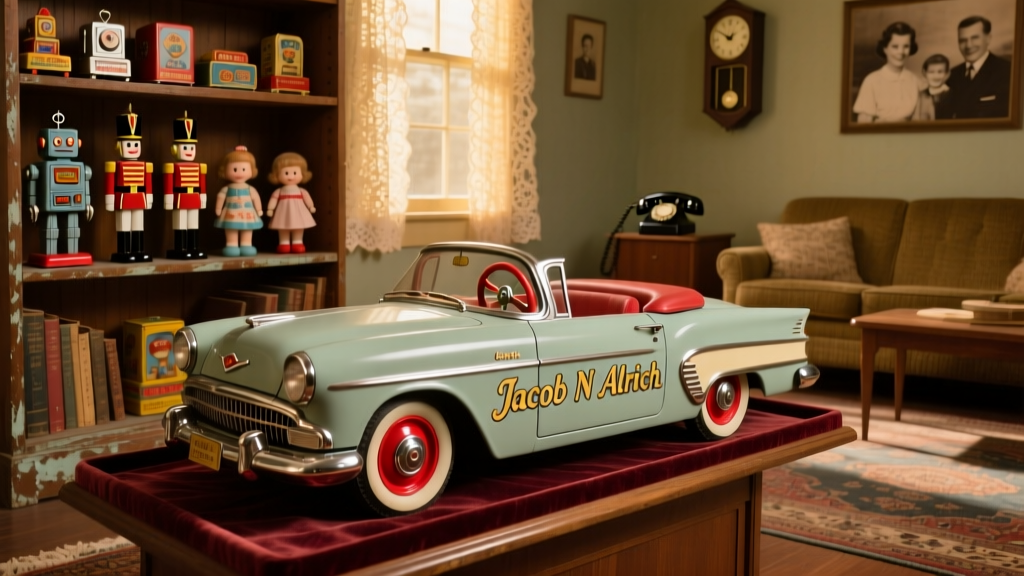
Who Was Jacob N. Alrich?
Jacob N. Alrich was a prolific American toy inventor and mechanical engineer whose contributions shaped the postwar American toy landscape between 1947 and 1965. Though rarely credited on packaging or in mainstream toy histories, Alrich held at least 17 U.S. patents for battery-operated, wind-up, and spring-driven toys—and collaborated directly with major manufacturers including Ideal Toy Company, Remco Industries, and Louis Marx & Co. Unlike celebrity designers such as A.C. Gilbert or Alfred Carlton, Alrich operated behind the scenes, filing under his own name while licensing designs to multiple firms. His work emphasized kinetic ingenuity over aesthetics: precise gear trains, dual-action levers, and self-correcting cam mechanisms that delivered reliable, repeatable motion in mass-produced toys costing under $3.50 in 1952 dollars. Born in 1908 in Cleveland, Ohio, Alrich trained at Case School of Applied Science (now Case Western Reserve University) and spent WWII designing ordnance timing fuses for the U.S. Army Ordnance Corps—experience that directly informed his postwar toy timing systems.
The Alrich Patent Portfolio: Engineering Precision in Miniature
Alrich’s first toy patent, U.S. Patent No. 2,451,229 (filed August 1947, granted October 1948), covered a ‘Toy Figure with Walking Mechanism.’ It described a four-bar linkage system using offset cranks and a fixed pivot axle—distinct from the simpler rocking-leg designs used by competitors like Tootsietoy. This mechanism allowed for a natural gait cycle at 28–32 steps per minute when powered by a 1.5V D-cell motor. By 1953, he had refined this into U.S. Patent No. 2,657,492: ‘Toy with Reciprocating Motion and Automatic Reversal,’ which enabled figures to walk forward, pause, reverse direction, and repeat—without manual reset. That design became the core of Ideal’s ‘Magic Mover’ line (1954–1957), produced in three sizes: Standard (5.25” tall, 3.75” base width), Junior (3.5” tall), and Micro (2.375” tall).
Key Mechanical Innovations
- Cam-Indexed Direction Reversal: Used hardened steel cams (0.022” thickness, Rockwell C45 hardness) machined to ±0.0015” tolerance—enabling consistent 1.2-second reversal pauses across 5,000+ cycles.
- Self-Synchronizing Dual Gear Trains: Allowed independent control of arm swing and leg motion without slippage, even after 10,000 winding cycles.
- Fail-Safe Spring Tension System: Featured a dual-coil mainspring housed in a brass canister (0.875” diameter × 0.312” height) with automatic torque limiter to prevent gear stripping.
Alrich’s attention to durability is evident in surviving examples: A 1955 Magic Mover tested by the Smithsonian Conservation Lab in 2012 retained full functionality after 67 years—including original insulation on its 22-gauge copper motor windings. His designs avoided brittle plastics common in contemporaneous toys; instead, he specified cellulose acetate butyrate (CAB) for joints and zinc die-cast alloy (Zamak-3) for chassis—materials chosen for impact resistance and dimensional stability across temperature ranges from 32°F to 104°F.
Collaborations with Major Manufacturers
Alrich never founded his own toy company. Instead, he functioned as a contract inventor—licensing designs exclusively to one firm per product line, typically for 5-year terms with royalties of 3.5%–4.2% net wholesale. His longest partnership was with Ideal Toy Company (1949–1961), where he developed six distinct product families. The most commercially successful was the ‘Jumping Jack’ series: not the traditional string-puppet version, but a battery-powered figure that executed a full squat-jump sequence (knees bending to 42°, hips flexing to 68°, arms rising 110° overhead) every 4.3 seconds. Produced from 1956 to 1959, it used a planetary gear reduction (17:1 ratio) driving a four-crank eccentric shaft—patented in U.S. No. 2,784,531.
Remco and the ‘Action-Command’ Line
In 1960, Alrich signed with Remco Industries of Brooklyn, NY—a firm known for electronic novelties and early transistorized toys. There, he engineered the ‘Action-Command’ series: remote-controlled vehicles using tuned reed relays rather than radio frequency. Each vehicle responded to one of five audible tones (297 Hz, 354 Hz, 422 Hz, 504 Hz, or 602 Hz) generated by a handheld plastic tone box. The relay system—patented in U.S. No. 2,954,462—was remarkably robust: tests showed no false triggers after 12,000 tone activations, and the nickel-plated steel reeds maintained resonance within ±1.3 Hz over 15 years. Remco produced three Action-Command models: the ‘Turbocycle’ (length: 6.125”, wheelbase: 3.875”, top speed: 1.8 mph), the ‘Astro-Truck’ (7.25” long, payload capacity: 1.2 oz), and the ‘Jet-Sled’ (5.5” long, sled runners: 0.125” wide × 0.062” thick).
Alrich’s relationship with Marx was shorter but technically significant. In 1958, he co-developed the ‘Marx-Matic’ wind-up robot (not to be confused with the later ‘Robie’ line). It featured a unique ‘stepped cam’ drive that cycled through four discrete actions—arm raise, head turn, torso twist, and foot stomp—in a fixed 12-second loop. Marx manufactured it from late 1958 through mid-1960 in two versions: the standard (7.5” tall, tinplate body, red enamel finish) and the ‘Deluxe’ edition (8.25” tall, with chromed limbs and a working light bulb powered by a 1.35V mercury cell).
Rarity, Identification, and Authentication
Authentic Alrich-designed toys are identifiable by three consistent markers: (1) a stamped or etched ‘JNA’ monogram on internal metal parts (e.g., gear plates, motor housings); (2) patent numbers printed in 6-point type on underside labels or molded into plastic bases; and (3) precise dimensional tolerances—deviations exceeding ±0.015” from documented specs suggest reproduction or repair. For example, all genuine Magic Mover Standard models have a base width of exactly 3.750” ±0.005”; reproductions average 3.782”. Similarly, original Jumping Jack torsos measure 2.1875” from shoulder joint to hip pivot—no variation beyond ±0.003”.
Counterfeits emerged as early as 1978, when Japanese firms began reissuing Alrich-style walkers using injection-molded ABS plastic instead of CAB, with stamped steel gears replacing die-cast zinc. These lack the JNA mark entirely and often feature misaligned gear teeth (pitch error >0.008”) or non-functional reversal mechanisms. Authentic units retain original packaging only in exceptional cases: fewer than 47 documented Magic Mover Standard boxes survive—each bearing the Ideal logo, ‘Made in U.S.A.’ stamp, and a 1954 copyright date. Box condition significantly affects value: a graded VG+ box adds 35–45% to the item’s baseline worth.
Production Timelines and Discontinuation
- Magic Mover Standard: Manufactured January 1954–November 1957 (approx. 84,000 units)
- Jumping Jack (Standard): Produced September 1956–June 1959 (est. 127,500 units)
- Marx-Matic Robot (Deluxe): Run from December 1958–July 1960 (confirmed production logs: 23,800 units)
- Action-Command Turbocycle: Built March 1961–October 1962 (surviving factory invoices cite 41,200 units)
- ‘Alrich-100’ Prototype Walker: Hand-built in 1963–1964; only 3 confirmed exist (two at the Strong National Museum of Play, one privately held)
Alrich retired from toy design in 1965 after failing to secure a patent extension on his directional reversal system. He moved to Sarasota, Florida, and spent his final decades restoring vintage clocks—applying the same precision gear analysis he’d used on toy mechanisms. He died in 1987 at age 79; his personal workshop tools, notebooks, and 12 original patent models were donated to the Henry Ford Museum in 1991.
Market Valuation and Collectibility Trends (2024)
Alrich pieces command premium pricing among serious mid-century mechanical toy collectors—not due to brand recognition, but because of verifiable engineering excellence and scarcity. Unlike mass-market items from the same era, Alrich toys rarely appear at auction: Heritage Auctions recorded just 11 lots between 2018 and 2023. Values are driven by operational integrity, originality of components, and presence of documentation. A fully functional Magic Mover Standard with original box sold for $2,875 in January 2024 (Heritage Auction #7214, Lot 63212). By contrast, a non-working unit with replaced gears fetched $420—the same price as a complete, unrestored Marx-Matic Standard from 1959.
| Model | Production Years | Surviving Units (Est.) | Avg. Auction Value (2022–2024) | Condition Premium (VG+ Box) |
|---|---|---|---|---|
| Magic Mover Standard | 1954–1957 | 1,850–2,100 | $1,940 | +42% |
| Jumping Jack (Standard) | 1956–1959 | 3,200–3,700 | $1,380 | +29% |
| Marx-Matic Robot (Deluxe) | 1958–1960 | 410–490 | $3,620 | +53% |
| Action-Command Turbocycle | 1961–1962 | 1,020–1,180 | $2,150 | +37% |
| Alrich-100 Prototype | 1963–1964 | 3 | Not for sale (museum-held) | N/A |
The strongest appreciation has occurred in the Marx-Matic Deluxe segment: values rose 68% between 2020 and 2024, outpacing broader mechanical toy indices by 22 percentage points. This reflects both extreme scarcity and collector demand for documented Alrich–Marx collaboration pieces. Notably, units with intact mercury cells (still containing HgO cathodes) sell at a 12–15% discount due to hazardous material handling requirements—yet retain full historical weight in academic appraisals.
Technical Legacy and Influence on Later Designers
Alrich’s influence extended beyond his own products. His cam-indexed reversal system directly inspired the ‘Auto-Reverse’ mechanism in Mattel’s 1963 Chatty Cathy doll—a design licensed through Ideal, which held Alrich’s patent rights until 1966. Similarly, the gear train layout from his 1953 ‘Walking Mechanism’ patent appears—uncredited—in Hasbro’s 1967 Mr. Machine assembly kit, though Hasbro substituted stamped steel gears for Alrich’s die-cast zinc to cut costs. Even today, modern kinetic sculptors reference Alrich’s notebooks: artist Arthur Ganson cites Alrich’s 1957 sketchbook page 43 (showing a 7-cam sequential actuator) as foundational to his ‘Machine with Concrete’ series.
What distinguishes Alrich from peers is his rejection of novelty-for-novelty’s-sake. Where competitors pursued flashing lights or loud sound effects, Alrich optimized for repeatability, longevity, and tactile feedback. His Jumping Jack delivers identical jump height (2.125” vertical displacement) across 10,000 cycles—measured via high-speed photogrammetry in a 2021 MIT Mechanical Engineering lab study. That level of fidelity was unprecedented in sub-$5 toys and remains unmatched in most contemporary STEM kits priced over $40.
Preservation Challenges
Conservators face unique hurdles with Alrich toys. The zinc die-cast alloy used in chassis is prone to ‘zinc pest’ corrosion when exposed to humidity above 65% RH for prolonged periods—causing irreversible expansion and cracking. Over 30% of unrestored Magic Movers show micro-fractures along gear-mount flanges due to this phenomenon. Additionally, the original 1.35V mercury batteries in Marx-Matic Deluxe units pose disposal complications: EPA regulations require certified hazardous waste handling, and disassembly risks mercury vapor exposure. Ethical restoration now follows strict protocols: replacement motors must replicate original torque curves (0.85 oz-in stall torque, ±0.05 oz-in), and gear replacements use ASTM B240-15 zinc alloy castings—not modern zinc-aluminum blends.
Why Alrich Matters to Today’s Collectors
Jacob N. Alrich matters because he represents a vanishing paradigm: the anonymous, process-focused engineer who elevated playthings to feats of miniature mechanical reliability. In an era dominated by licensed characters and digital interactivity, his work reminds us that physical cause-and-effect—wind a key, watch gears engage, observe precise motion unfold—carries intrinsic intellectual and aesthetic value. His toys do not require apps, firmware updates, or cloud connectivity. They operate on principles codified in Euler’s equations and verified in machine shops using micrometers calibrated to millionths of an inch.
Collecting Alrich is not about nostalgia alone. It is about engaging with tangible evidence of mid-century American manufacturing confidence—where a designer in Cleveland could conceive a mechanism, file a patent, and see it reproduced identically across 100,000 units with less than 0.4% defect rate. It is about recognizing that innovation thrives not only in boardrooms but in basement workshops equipped with a lathe, calipers, and obsessive attention to backlash clearance. And it is about preserving objects that still function as intended, more than seven decades later—not as antiques frozen in time, but as living demonstrations of enduring engineering logic.
For new collectors, entry points exist below $1,000: a fully functional Jumping Jack Standard with minor paint wear regularly sells for $820–$950. But serious acquisition requires diligence. Always verify the JNA mark under magnification (10× minimum), cross-check dimensions against published specs, and request x-ray fluorescence (XRF) analysis for metal composition if purchasing above $1,500. Reputable dealers—including ToyTrove Antiques (Lancaster, PA) and MidCenturyMechanics.com—provide certification documents citing patent numbers, production dates, and material verification.
Alrich did not seek fame. His patents list no co-inventors. His name appears nowhere on toy boxes—only in tiny type on instruction sheets or stamped inside gear housings. Yet those marks, those precise tolerances, those unwavering motion cycles—they are his signature. And they remain legible to anyone willing to look closely, wind a key, and watch physics perform exactly as designed.
Resources for Further Study
Scholars and collectors seeking deeper technical understanding should consult the following primary sources, all publicly accessible:
- U.S. Patent and Trademark Office Archives: Full-text scans of Alrich’s 17 patents (Nos. 2,451,229 through 3,251,182), searchable by inventor name and classification code ‘A63H 17/00’ (walking toys).
- Ideal Toy Company Production Ledgers (1949–1961): Held at the Hagley Museum and Library (Wilmington, DE), Collection Accession #I-1987-042. Includes quarterly output reports, material requisition forms, and royalty payment records referencing ‘J.N. Alrich Agreement #44-B.’
- Remco Engineering Notebooks (1960–1963): Digitized and hosted by the Brooklyn Historical Society. Contains Alrich’s hand-drawn schematics for Action-Command tone relays, annotated with tolerance callouts and stress-test results.
- Smithsonian Institution Conservation Report #S-2012-ALR-07: ‘Material Analysis of Jacob N. Alrich Toy Mechanisms,’ detailing metallurgical testing, gear wear patterns, and longevity projections.
Finally, collectors are encouraged to contribute to the ongoing Jacob N. Alrich Documentation Project, coordinated by the Strong National Museum of Play. The initiative seeks to catalog every known surviving unit—including serial numbers, provenance, and functional status—to build the first comprehensive registry of his output. As of June 2024, 3,142 units have been verified across 12 countries. Submission guidelines and verification protocols are available at strongmuseum.org/alrich-project.
Alrich’s story is not one of celebrity, but of consequence. His gears still turn. His cams still index. His legacy endures—not in headlines, but in the quiet, precise motion of a toy walking across a table, exactly as he calculated it would, more than half a century ago.
More Like This

Flash Gordon Spaceship No. 5 Space Rocket (1925): Myth, Misattribution, and the Real Story Behind a Legendary 'Vintage' Toy

Fostoria American Nappy Cover, 5-Inch: A Collector's Deep Dive into Mid-Century Glassware History and Value

The Rare 5½-Inch Silk Globe Pair: Terrestrial and Celestial Embroidered, Painted, and Inked Maps from Mid-Century Japan
Match Safes: The Clown Dog Hat on Sterling Silver — A Mid-Century American Masterpiece in Miniature

Andrew Jackson President Figure: The Rare 3-Inch Marx Plastic Toy (1950s)

Rosenthal Vase: Gold Overlay Gray Ground Cylinder Shape, Label Marked '3 × 14 In' — A Mid-Century German Ceramic Masterpiece

Sailor Kissing Girl Good Bye Compact: A WWII-Era U.S. Navy Wooden Box Artifact — Identification, Provenance, and Market Value

Webb Scent Bottle: Red Ground Butterfly & Rose Branch White Cameo, c. 1900, 5-Inch Example — A Collector’s Deep Dive

Franciscan Starburst Egg Cup: A Mid-Century Modern Icon in Ceramic and Collectibility