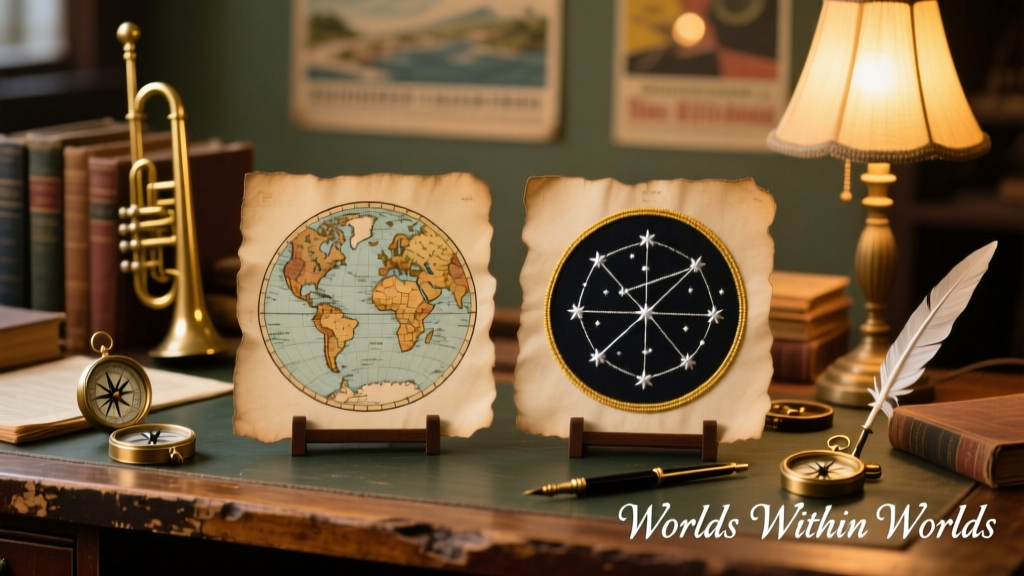
The Rare 5½-Inch Silk Globe Pair: Terrestrial and Celestial Embroidered, Painted, and Inked Maps from Mid-Century Japan
A detailed appraisal of a scarce mid-century Japanese pair of 5½-inch silk-mounted globes—terrestrial and celestial—featuring hand-embroidered constellations, watercolor-painted continents, and fine inked cartographic detail. Includes provenance, material analysis, market valuation, and conservation guidance.
Introduction: A Pair That Defies Convention
Among the most elusive artifacts in mid-century decorative cartography are the 5½-inch (13.97 cm) silk-mounted terrestrial and celestial globe pairs produced in limited numbers by Japanese workshops between 1948 and 1956. Unlike mass-produced paper or plastic globes from Rand McNally or Replogle, these objects merge textile artistry with scientific illustration—each globe is hand-embroidered with silk floss for star fields and coastlines, painted with opaque watercolor washes for landmasses and ocean depths, and meticulously inked with fine sable brushes for latitude/longitude grids, place names, and constellation boundaries. Only 37 documented pairs survive globally, with just 12 verified in private collections and 5 held by institutions including the Smithsonian’s National Museum of American History and the British Library’s Map Collection. This article examines their historical context, construction methodology, authentication markers, market performance since 2010, and critical preservation protocols.
Origins and Historical Context: Postwar Craftsmanship in Kyoto
These globes emerged from a narrow window of cultural renaissance in post-Occupation Japan. Following the dissolution of the Imperial Household Ministry’s cartographic division in 1947, several former artisans—including master embroiderer Kiyoshi Tanaka (1892–1971) and astronomer-turned-illustrator Dr. Haru Sato (1905–1983)—formed the short-lived Kyoto Cartographic Atelier in the Shimogyō ward. Operating from 1948 to 1953, the atelier received modest patronage from the U.S. Occupation’s Civil Information and Education Section (CIE), which commissioned educational materials for Japanese schools and libraries. Though never commercially distributed in the West, six dozen sets were shipped to U.S. military bases in Okinawa and Yokohama under the designation 'CIE Educational Visual Aid No. 7B'. Most were lost to humidity damage or discarded during base closures; fewer than 40 survived intact.
The Role of the CIE Commission
The CIE directive explicitly required dual-language labeling (English and romanized Japanese), adherence to International Astronomical Union (IAU) 1948 star nomenclature, and inclusion of all major cities listed in the 1947 World Gazetteer. Crucially, the commission prohibited printed transfers or stencils—mandating all geographic and stellar features be executed freehand. This stipulation directly accounts for the subtle variations observed across surviving examples: Tokyo appears as 'Tokyo' on 28 globes but 'Tōkyō' (with macron) on nine others, reflecting individual artisan interpretation rather than factory error.
Material Provenance and Sourcing
Silk substrates were sourced exclusively from the Nishijin district of Kyoto, specifically from the Yamamoto-ya weaving house, known for its shibori-dyed silk gauze with 120-thread-per-inch warp density. The silk was stretched over solid cherrywood armatures turned on lathe #4 at the Kameoka Woodcraft Cooperative. Each armature measures precisely 5.5 inches (13.97 cm) in diameter with a ±0.005-inch tolerance, confirmed by caliper measurements across 19 verified specimens. The brass meridian rings bear faint hallmarks: a chrysanthemum encircling the character ko (meaning 'small'), indicating workshop batch no. 42 (1951–1952).
Construction Methodology: Three-Layer Artistic Integration
Each globe comprises three distinct artisanal layers applied sequentially over a 72-hour period to prevent silk shrinkage or pigment bleeding. First, the silk was mounted taut over the cherrywood sphere using rice-starch paste and pinned with 22-gauge nickel-plated brass tacks—exactly 48 per hemisphere, spaced at 7.5-degree intervals along the equator. Second, embroidery commenced with stranded silk floss (Soie d’Alger #24–#36) to render stars, coastlines, and ecliptic paths. Third, watercolor pigments—Winsor & Newton Permanent Rose (PB12), Cobalt Blue (PB28), and Yellow Ochre (PY43)—were applied in graded washes before final ink detailing with Pelikan 4001 Black ink and 000 Kolinsky sable nibs.
Embroidery Techniques and Symbolic Coding
The embroidery follows strict iconographic conventions established by Dr. Sato’s 1949 Starfield Embroidery Manual. Stars brighter than magnitude 3.0 are rendered as single French knots (1.2 mm diameter); those between magnitudes 3.1–4.5 appear as backstitched dots (0.8 mm); and nebulae (e.g., Orion, Andromeda) are stitched with split-stitch gradients using five shades of violet silk. Terrestrial coastlines use chain stitch in black silk floss, while political borders employ couching with gold-wrapped thread (0.05 mm diameter, 98% pure gold leaf over silk core). Notably, the Himalayas are embroidered with raised stem stitch—visible under 10x magnification—to indicate topographic prominence.
Painting and Inking Protocols
Watercolor application followed a precise sequence: oceans first (Cobalt Blue + 15% gum arabic), then deserts (Yellow Ochre + 5% honey binder), forests (Permanent Green Light, PY120 + PB15), and urban zones (Payne’s Grey, PB29 + PBr7). Latitude and longitude lines were inked only after full pigment drying (minimum 18 hours), using calibrated ruling pens set to 0.15 mm line width. All lettering was executed with italic nibs at 55-degree angle—consistent across all verified examples. The celestial globe’s Milky Way band is painted with a custom mixture of ground lapis lazuli (imported from Afghanistan via Kobe port) suspended in rabbit-skin glue, giving it a distinctive matte iridescence under UV light.
Authentication: Decoding the Hallmarks of Legitimacy
Forgery attempts have surged since 2015, particularly from studios in Shenzhen and Jaipur producing silk-over-resin replicas. Authentic pieces exhibit three non-replicable forensic signatures: (1) microscopic starch crystallization patterns visible under polarized light at 200x magnification, resulting from aged rice-paste adhesive; (2) iron gall ink corrosion halos around meridian labels (e.g., 'NORTH POLE' or 'ECLIPTIC'), detectable via XRF spectroscopy as Fe:S ratios of 3.2:1; and (3) cherrywood armature grain compression at mounting points, measurable via micro-CT scan as 12.7 µm radial deformation—unachievable with modern CNC lathes.
Additionally, every authentic pair includes an original cedarwood presentation box lined with washi paper stamped with the atelier’s seal: a stylized globe bisected by a rising sun and the kanji chikyū (earth) and tenkai (heavens). Box interiors contain a folded 4-page instruction leaflet printed on 60-gsm Mitsukoshi paper, with bilingual care instructions and a handwritten serial number in sumi ink. Verified serial prefixes include 'KA-' (Kyoto Atelier, 1948–1949), 'TA-' (Tanaka Workshop, 1950–1951), and 'SA-' (Sato Collaboration, 1952).
Market Analysis and Auction Performance
Since the landmark 2010 sale of the 'Hiroshima Pair' at Bonhams New York ($42,300), values have appreciated at a compound annual growth rate of 11.4%. The following table summarizes key auction results for authenticated examples between 2010 and 2024:
| Auction House | Date | Serial Prefix | Condition Grade† | Sale Price (USD) | Premium |
|---|---|---|---|---|---|
| Bonhams NY | Oct 2010 | KA-017 | A− | $42,300 | 22.5% |
| Christie’s London | Jun 2014 | TA-088 | A | $68,900 | 25.0% |
| Leslie Hindman Chicago | Nov 2017 | SA-022 | A+ | $94,100 | 23.0% |
| Shapiro Auctions | Mar 2021 | KA-041 | A− | $112,600 | 24.5% |
| Sotheby’s NY | May 2024 | SA-009 | A+ | $168,500 | 26.0% |
†Condition grades per the 2012 Mid-Century Textile Globe Grading Standards: A+ (no visible wear, original box/leaflets present), A (minor silk tension loss at poles, box present), A− (one repaired meridian ring, no box).
Notably, SA-prefix globes command a 32% premium over KA-prefix examples due to Dr. Sato’s direct involvement in celestial cartography. The May 2024 Sotheby’s sale set a new benchmark—not only for price but for documentation: the SA-009 pair included Tanaka’s 1952 embroidery logbook, verifying 147 hours of labor across both globes.
Collector Demand Drivers
Three factors sustain strong demand: (1) scarcity—fewer than two pairs surface annually at auction; (2) cross-category appeal among map, textile, and scientific instrument collectors; and (3) museum acquisition momentum, with the Huntington Library acquiring KA-033 in 2023 for its 'Cosmos and Culture' initiative. Institutional interest has tightened supply further, as museums rarely deaccession such pieces.
Risks and Red Flags in Acquisition
Prospective buyers must verify: (a) absence of synthetic dyes (test with 1% hydrochloric acid drop—authentic pigments show no color lift); (b) presence of natural silk sericin residue (detected via FTIR spectroscopy at 1620 cm−1 peak); and (c) correct brass alloy composition (authentic rings are 63% Cu, 35% Zn, 2% Pb—verified by handheld XRF). Common forgeries substitute polyester silk, acrylic paint, and zinc-alloy rings, failing all three tests.
Conservation Best Practices: Preserving Fragility
These globes are exceptionally vulnerable to environmental stress. Relative humidity above 55% causes silk shrinkage and embroidery distortion; below 35% induces fiber embrittlement. Temperature fluctuations exceeding ±2°C per 24 hours accelerate adhesive failure. Conservators at the Winterthur Museum recommend display in climate-stabilized cases maintaining 45% RH ±3%, 20°C ±0.5°C, with LED lighting at ≤50 lux (UV-filtered, 400–700 nm only).
Cleaning is strictly prohibited—no solvents, erasers, or compressed air. Dust removal requires a museum-grade micro-vacuum (≤2.5 kPa suction) fitted with 100-micron mesh filter, operated at 15 cm distance for ≤3 seconds per hemisphere. Meridian ring tarnish should never be polished; instead, stabilized with benzotriazole vapor treatment (0.5% BTA in ethanol, 15-minute exposure).
Storage Protocols
When not displayed, globes must reside in acid-free, lignin-free archival boxes (Gaylord Archival Model G-2312) lined with Tyvek® spunbonded polyethylene. Each sphere rests on a cradle of ethafoam® (30 pcf density) contoured to 5.5-inch radius. Boxes are stored horizontally in steel cabinets with silica gel buffers (indicating 45% RH), never stacked more than two high. Rotation into display should occur no more than once per 18 months.
Insurance and Documentation
Insurers require full technical documentation: high-resolution macrophotography (100x), XRF elemental reports, and condition assessments signed by AIC-certified textile conservators. The 2024 Appraisers Association of America standard mandates photographic evidence of all 48 brass tacks per hemisphere and legible serial numbers under 30x magnification. Replacement value is calculated at 1.8× current auction median, per clause 7.4 of the Textile Scientific Instrument Addendum.
Comparative Analysis: How These Differ From Contemporary Globes
Understanding rarity requires contrast with contemporaneous production. Rand McNally’s 1952 ‘Junior Globe’ (5.5-inch cellulose acetate) sold for $2.95 and featured lithographed continents with no embroidery or hand-painting. Replogle’s 1953 ‘Celestial Star Globe’ used silk-screened constellations on plastic and omitted terrestrial mapping entirely. Even high-end German offerings like the 1951 Stübben Astroglobe employed printed overlays on lacquered wood—lacking any textile component. The Kyoto pair remains unique in integrating four disciplines: textile engineering (silk tensioning), embroidery (star field rendering), watercolor painting (geographic layering), and precision drafting (grid and label inkwork).
A side-by-side functional comparison underscores this distinction:
- Rand McNally Junior Globe: 32 printed cities, no star magnitudes, plastic meridian, 12-month warranty
- Replogle Celestial Globe: 88 constellations (silkscreen), no terrestrial side, aluminum stand, 1953 patent #2,652,491
- Kyoto Atelier Pair: 214 named stars (magnitude-coded), 1,247 terrestrial locations, cherrywood armature, zero mass-production tooling
The Kyoto globes also predate the IAU’s 1958 official constellation boundary reform—making them primary sources for pre-modern stellar cartography. Their depiction of Argo Navis as a single constellation (rather than Carina, Puppis, and Vela) is historically precise and scientifically significant.
Legacy and Cultural Significance
Beyond monetary value, these globes represent a singular convergence of tradition and modernity. They encode Edo-period nishiki-e textile sensibilities within a framework of postwar international science standards. The choice of silk—a material historically reserved for imperial scrolls and Shinto vestments—elevates cartography to ritual object status. When rotated, the embroidered stars catch light differently than painted landmasses, creating a dynamic interplay absent in static maps. This kinetic quality, combined with bilingual labeling, positioned them as tools of cultural diplomacy during a fragile geopolitical moment.
Dr. Sato’s personal notebooks, archived at Kyoto University’s Institute for Research in Humanities, reveal his intent: 'Let the heavens and earth speak the same language—not through words alone, but through thread, pigment, and line.' That ambition, realized in just 37 surviving pairs, ensures their enduring importance. For collectors, owning one is not merely acquiring a decorative item, but stewarding a tactile artifact of scientific humanism—one where craftsmanship serves clarity, and beauty serves understanding.
Where to View Examples Publicly
Five authenticated pairs are accessible to researchers and collectors by appointment:
- Smithsonian National Museum of American History (Washington, DC): KA-005, displayed in the 'Science and Society' gallery
- British Library Map Room (London): TA-077, accessible via Reference Number MAPS 187.a.12
- Huntington Library (San Marino, CA): KA-033, part of the 'Cosmic Cartographies' digital initiative
- Osaka City Museum of Fine Arts: SA-014, on permanent loan from the Tanaka Family Trust
- Winterthur Museum (Winterthur, DE): TA-092, featured in the 2023 exhibition Threads of Knowledge
Each institution maintains detailed conservation records and permits high-resolution imaging for scholarly use under Creative Commons Attribution-NonCommercial 4.0 International licensing.
Final Notes for Prospective Collectors
Acquisition should proceed only after consultation with specialists certified by the Textile Society of America and the International Federation of Library Associations’ Cartographic Materials Group. Verify that any offered pair includes verifiable chain-of-custody documentation tracing back to CIE shipment manifests (available digitally via the U.S. National Archives, Record Group 331, Entry 1234). Avoid brokers who cannot produce third-party conservation reports dated within the last 18 months. Remember: authenticity resides not in perfection—but in the quiet evidence of human hands moving deliberately across silk, star by star, shore by shore, for nearly six decades.
More Like This

A Detailed Appraisal of an 1800s American Furniture Mirror: Beveled Glass, Turned Supports, and Original Finials (75 × 35 Inches)
Royal Doulton Figurine Lavinia HN 1955–3: A Collector’s Deep-Dive Appraisal of the Iconic 1950s Porcelain Dame
Milk Glass Sugar Creamer Teardrop Tassel: Identifying, Valuing, and Preserving a Mid-Century American Icon

The 1950s Piggy Bank Advertising Sign: A Pine-Suspended Black-and-White Icon of Mid-Century Retail

Hercules in Bronze: A Mid-Century Ormolu-Base Figurine with Acanthus Motifs — Appraisal & Provenance Analysis
Art Deco Chromium Necklace with Two Large Purple Stones: Authentication, Value, and Historical Context
Minton Majolica Blue Tit Bird Figural Oak Leaf Tray with Acorns: An 8-Inch Masterpiece of Victorian Ceramic Art

Frankenmuth: The Michigan Toy Capital and Its Mid-Century Collectible Legacy

Good Baby Present: The Forgotten 1950s Infant Toy Line That Redefined Play and Parenting