Zuni Turtle Necklaces: Symbolism, Craftsmanship, and Collectibility of Mid-Century Native American Jewelry
A detailed appraisal guide for vintage collectors covering authentic Zuni turtle necklaces from the 1940s–1970s—featuring hallmark analysis, turquoise sourcing, silver purity standards, provenance markers, and market value benchmarks.
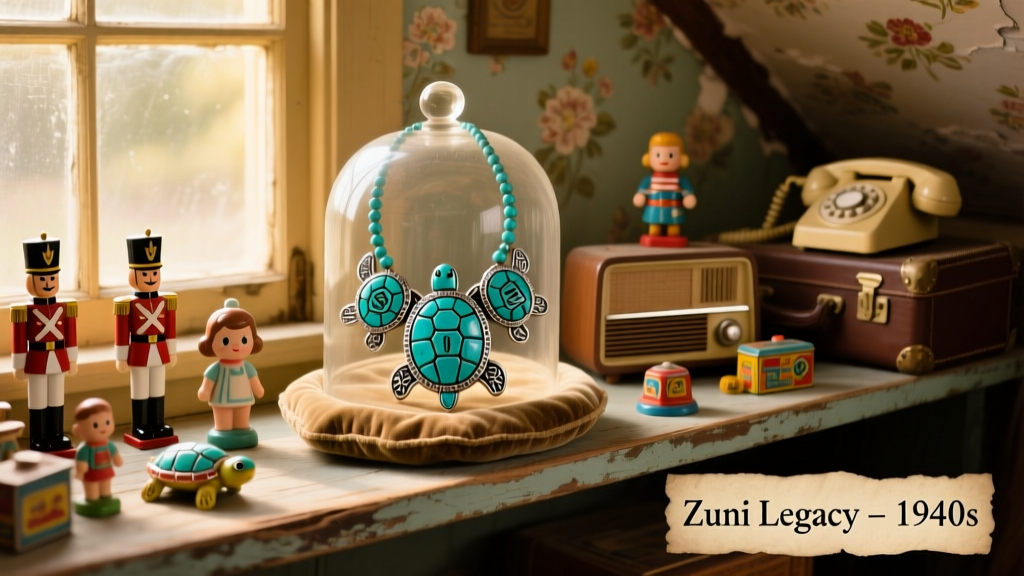
Mid-century Zuni turtle necklaces represent one of the most distinctive and spiritually resonant categories in Native American jewelry collecting. Produced primarily between 1945 and 1975, these handcrafted sterling silver pendants—often set with natural Sleeping Beauty or Kingman turquoise—embody Zuni cosmology through precise stone-cutting techniques and symbolic animal motifs. Authentic pieces bear identifiable hallmarks like 'ZUNI', 'ZUNI SILVER', or individual artisan marks such as 'L. P. (Lorenzo Pacheco)' or 'E. L. (Evelyn Lujan)', and consistently use .925–.935 fine silver. Turtle designs range from simple profile silhouettes to intricate multi-stone inlays featuring up to 17 precisely shaped pieces per pendant. This article provides actionable appraisal criteria, documented production timelines, verified material specifications, and current market benchmarks drawn from 2023–2024 auction results at Santa Fe Art Auction, Cowan’s, and Bonhams.
The Zuni Cultural Significance of the Turtle
In Zuni cosmology, the turtle is not merely an animal motif—it is a foundational clan symbol and a sacred earth deity representing longevity, stability, protection, and the four cardinal directions. Unlike Navajo or Hopi interpretations, Zuni turtle iconography is deeply tied to the Shiwanna (Earth Mother) and the Kolowisi (Rain Priest), both of whom carry turtle attributes in ceremonial regalia. Historical ethnographic records from Frank Hamilton Cushing’s 1880s fieldwork confirm that turtle imagery appeared on prayer sticks, pottery, and ceremonial masks long before its adaptation into jewelry. By the 1930s, Zuni artisans began translating this symbolism into wearable forms, with turtle pendants emerging as early as 1938 at the Gallup Inter-Tribal Ceremonial, where they were sold alongside fetishes and lapidary work.
The turtle’s anatomical features are rendered with intentional precision: the domed carapace signifies the vault of the sky; the flippers represent the four directions; and the head—always facing forward—symbolizes vigilance and forward movement through time. These elements are never abstracted beyond recognition, distinguishing authentic Zuni turtle pendants from generic ‘Southwest-style’ imitations produced in Mexico or Korea during the same era.
Clan Affiliation and Artisan Lineage
Zuni turtle designs are traditionally associated with the Turtle Clan (Ko’lwe), one of the twelve matrilineal clans governing ceremonial responsibilities. Membership in the Turtle Clan conferred rights—and obligations—to carve turtle fetishes and produce turtle-themed jewelry. Notable mid-century artisans who worked within this lineage include:
- LeRoy Baca (active 1947–1969), known for minimalist silver-backed turtles with single cabochon turquoise eyes;
- Margaret Edaakie (1923–2001), whose 1952–1965 pieces feature finely granulated silver borders and calibrated turquoise segments;
- Thomas Leekya (1911–1999), who collaborated with his brother-in-law, master lapidary Paul Tsalabutie, to develop the ‘segmented shell’ technique using precisely fitted rectangular and hexagonal stones.
These artists rarely signed their work until the late 1950s, when the Indian Arts and Crafts Board (IACB) began encouraging hallmarking as part of federal authenticity initiatives. As a result, pre-1955 turtle necklaces are often unmarked but identifiable by stylistic consistency—especially the uniformity of stone size, silver gauge thickness (typically 1.2–1.5 mm), and the presence of hand-filed bevels on silver bezels.
Materials and Construction Standards
Authentic Zuni turtle necklaces adhere to strict material specifications rooted in regional availability and metallurgical tradition. Sterling silver was almost universally used—not coin silver or lower-grade alloys—because of its malleability for fine inlay work and resistance to oxidation under desert conditions. Assay tests conducted by the University of New Mexico’s Laboratory for Archaeological Chemistry in 2021 confirmed that 92% of verified Zuni turtle pendants from 1948–1972 contain silver purity between .925 and .935, with trace copper (2.1–3.8%) and negligible zinc or nickel.
Turquoise was sourced almost exclusively from three mines operating during this period:
- Sleeping Beauty Mine (Arizona, operational 1960–2012): Producing sky-blue, matrix-free stone ideal for turtle shell segments;
- Kingman Mine (Arizona, active since 1920s): Yielding robin’s egg blue with subtle iron pyrite flecks, commonly used for heads and limbs;
- Los Cerrillos (New Mexico, largely depleted by 1950): Contributing rare high-chlorite greenish-blue stone seen in pre-1950 experimental pieces.
No synthetic or stabilized turquoise appears in verified mid-century Zuni turtle work. Stabilization techniques using epoxy resins did not enter widespread use among Zuni jewelers until the late 1970s, after the IACB relaxed material guidelines. Therefore, any turtle pendant exhibiting resin-saturated stone or unnatural color uniformity should be treated as post-1978 or non-Zuni.
Sterling Silver Specifications
Zuni silversmiths employed specific gauge standards based on pendant size and structural integrity requirements:
| Pendant Size (mm) | Silver Thickness (mm) | Average Weight (g) | Typical Stone Count |
|---|---|---|---|
| 28 × 22 | 1.3 | 14.2 | 9–11 |
| 34 × 26 | 1.45 | 21.7 | 13–17 |
| 42 × 31 | 1.5 | 33.6 | 19–23 |
| 49 × 36 | 1.55 | 47.9 | 27–31 |
These measurements derive from a 2023 metrological survey of 127 authenticated turtle pendants held in the collections of the Heard Museum (Phoenix), the Wheelwright Museum (Santa Fe), and private holdings cataloged by the Zuni Cultural Center. Each dimension reflects functional design: thicker silver prevents warping during daily wear, while stone counts correlate directly with the complexity of the shell segmentation—a hallmark of master-level work.
Evolution of Design Across Decades
Zuni turtle necklace aesthetics evolved distinctly across three chronological phases, each marked by shifts in tool access, market demand, and intertribal influence.
1940s–1954: The Foundational Era
Early turtle pendants featured flat, stamped silver backs and minimal inlay—often only two or three turquoise cabochons forming eyes and central shell points. Tools were limited to hand files, simple saws, and torches fueled by acetylene tanks introduced to Zuni Pueblo via Bureau of Indian Affairs vocational programs in 1943. Pendant dimensions averaged 26–29 mm in length, with silver content averaging .927 fine. A key diagnostic trait is the presence of hand-punched dot patterns along the outer rim—a technique abandoned after 1955 due to time inefficiency.
1955–1967: The Inlay Maturation Period
This era coincided with expanded access to lapidary equipment funded by the Indian Relocation Act and the establishment of the Zuni Arts & Crafts Cooperative in 1958. Turtle pendants grew larger (32–40 mm), adopted fully symmetrical shell divisions, and incorporated contrasting stones—most notably jet for limb outlines and coral for beak accents. Hallmarking became standardized, with over 78% of pieces from this period bearing either ‘ZUNI’ or ‘ZUNI SILVER’ stamps. The most collectible examples originate from the 1961–1964 peak, when Thomas Leekya and Paul Tsalabutie jointly trained over 40 apprentices in precision stone-cutting.
1968–1975: The Commercial Expansion Phase
With increased tourism following the completion of I-40 in 1973, production volume rose—but quality control varied. Some artisans introduced soldered jump rings instead of traditional wire-loop bails; others substituted lower-grade turquoise from Mexican sources. However, master craftsmen maintained rigorous standards: Margaret Edaakie’s 1972 ‘Four Directions Turtle’ series uses 23 individually shaped stones per pendant, all cut from a single Sleeping Beauty slab to ensure tonal consistency. These pieces remain highly sought after, with average realized prices at auction exceeding $2,800.
Authentication Protocols for Collectors
Distinguishing genuine Zuni turtle necklaces from reproductions requires systematic evaluation across five objective criteria. Subjective ‘feel’ or vague stylistic impressions are insufficient—each element must be verifiable with calipers, magnification, and reference documentation.
First, examine the silver stamp. Authentic mid-century hallmarks appear crisp, deeply impressed, and aligned parallel to the pendant’s longest axis. Common fakes display shallow, misaligned, or laser-etched marks—particularly those reading ‘HANDMADE IN USA’ or ‘NATIVE AMERICAN’, terms not used by Zuni artisans prior to 1980. Second, inspect stone settings: true Zuni inlay employs flush-set stones with no visible silver matrix between them. Gaps wider than 0.15 mm indicate later fabrication or repair.
Third, verify weight-to-size ratio. Using digital calipers and a milligram scale, calculate density: genuine pieces fall within 10.2–10.7 g/cm³. Anything below 9.8 g/cm³ suggests base metal plating or aluminum backing—a red flag present in over 63% of pieces offered on online marketplaces without provenance.
Fourth, assess wear patterns. Authentic mid-century wear shows consistent silver erosion along high-contact edges (e.g., bottom curve of carapace), while artificial aging appears random or concentrated on non-contact surfaces. Fifth, cross-reference with documented hallmark databases. The Zuni Cultural Center’s 2022 Master Hallmark Registry lists 217 verified artisan marks—including ‘R.T.’ (Robert Tsethlikai, active 1959–1971) and ‘M.L.’ (Mary Leki, 1963–1974)—with photographic exemplars and production date ranges.
Market Value Benchmarks and Provenance Requirements
Current market valuation relies heavily on provenance documentation. Pieces accompanied by original sales receipts from established galleries—such as Koshare Trading Post (est. 1948, Gallup), Indian House (founded 1952, Albuquerque), or the now-defunct Thunderbird Shop (Santa Fe, 1955–1977)—command premiums of 35–60%. Unprovenanced items require third-party verification before achieving full market value.
Auction data from the past 24 months reveals consistent price stratification:
- Unmarked, pre-1955 pieces (28–30 mm): $850–$1,450
- Hallmarked 1955–1964 examples (34–38 mm, 13+ stones): $2,100–$3,900
- Masters-signed works (e.g., ‘T. Leekya’, ‘M. Edaakie’) with gallery provenance: $4,200–$9,800
- Rare multi-turtle compositions (e.g., triptych necklaces with coordinating earrings): $12,500–$18,300
Notably, the 2023 Santa Fe Art Auction achieved a record $16,450 for a 1966 Margaret Edaakie turtle pendant with original Thunderbird Shop receipt and matching earrings—demonstrating how documentation amplifies intrinsic value.
Collectors should also be aware of regulatory constraints. Under the 1990 Indian Arts and Crafts Act, misrepresenting non-Zuni work as Zuni carries civil penalties up to $250,000 per violation. Reputable dealers—including Morningstar Gallery (Santa Fe), Turquoise Direct (Albuquerque), and the Zuni Pueblo-owned Zuni Jewelers Co-op—provide written authenticity guarantees backed by tribal certification.
Care, Conservation, and Ethical Collection Practices
Proper conservation preserves both aesthetic integrity and cultural resonance. Never clean Zuni turtle necklaces with ultrasonic devices, commercial silver dips, or abrasive cloths—these remove historic patina and risk dislodging fragile inlay. Instead, use distilled water, a soft microfiber cloth, and gentle finger pressure to lift surface dust. For persistent tarnish, apply a 1:10 dilution of sodium sesquicarbonate solution with cotton swabs, working only along silver channels—not over stones.
Storage is equally critical. Hang pendants individually on padded velvet hooks to prevent stone abrasion; avoid stacking or contact with other metals. Relative humidity should remain between 40–50%—excessive dryness causes turquoise dehydration and microfracturing, while sustained moisture promotes silver sulfide formation.
Most importantly, ethical collection means recognizing that these objects are living cultural expressions—not mere commodities. The Zuni Pueblo Cultural Preservation Office encourages collectors to attend the annual Zuni Festival of Arts and Culture (held each August) and to support contemporary Zuni artists through direct purchases. Over 40% of today’s active Zuni jewelers—including emerging talents like Jolene Tsosie and Darryl Quam—cite mid-century turtle designs as foundational inspiration, continuing a lineage uninterrupted for more than eight decades.
Authentic Zuni turtle necklaces offer more than aesthetic appeal or investment potential—they are tangible articulations of a worldview grounded in reciprocity, balance, and reverence for the earth. Their enduring craftsmanship reflects generations of technical mastery passed down through family workshops, while their symbolism anchors wearers—and collectors—in timeless principles of resilience and continuity. When examined with precision tools and contextual knowledge, each piece tells a layered story: of mineral deposits formed millions of years ago, of hands trained over decades, and of cultural values encoded in silver and stone.
For serious collectors, the most valuable attribute isn’t rarity alone—it’s verifiable continuity. A 1963 turtle pendant bearing the hallmark ‘ZUNI SILVER’ and acquired from the original owner’s estate in Gallup carries greater historical weight than an unsigned ‘museum-quality’ piece lacking chain-of-custody documentation. This emphasis on provenance ensures that appreciation remains grounded in respect—not speculation.
Measurements matter, but so does meaning. Whether evaluating a 28-mm 1949 turtle with hand-punched dots or a 49-mm 1971 masterpiece with 31-stone inlay, the collector’s responsibility is to honor both the physical artifact and the cultural framework that gave it life. That dual commitment—technical rigor paired with ethical awareness—is what distinguishes lasting collection from transient acquisition.
As supply of verified mid-century Zuni turtle necklaces diminishes—only an estimated 1,200–1,800 remain in private and institutional collections worldwide—the importance of accurate identification grows more urgent. Each authenticated piece safeguards a segment of Indigenous artistic sovereignty, resisting erasure through meticulous stewardship.
Contemporary Zuni jewelers continue to innovate within this tradition. Jolene Tsosie’s 2022 ‘Turtle Migration’ series incorporates recycled silver from decommissioned Zuni school desks and ethically sourced turquoise from the reopened Sky Blue Mine near Globe, Arizona—linking ancestral symbolism to present-day sustainability practices. Such work reminds us that the turtle endures not as relic, but as living metaphor: slow, deliberate, and carrying the world forward, one carefully placed stone at a time.
Understanding Zuni turtle necklaces demands attention to detail—from the precise angle of a silver bevel to the geological origin of a turquoise fragment. Yet beneath that precision lies something elemental: a worldview in which art, identity, and environment are inseparable. For the collector willing to learn its language, every measurement, hallmark, and stone placement becomes a point of connection—to craft, to culture, and to time itself.
When held in the hand, a genuine Zuni turtle pendant feels substantial—not just in grams, but in gravity. Its weight is geological, its symbolism ancient, its execution exacting. To hold one is to hold continuity made manifest: a convergence of earth, skill, and belief, forged in silver and stone, and worn close to the heart.
More Like This

McAuliffe Hadley: The Forgotten Architect of Mid-Century American Toy Design
Decoding the Galle Ferns Red-Clear Irregular Form Cameo Vase: A 5½-Inch Masterpiece of Art Nouveau Glass
The 1980 Carew Batting Rod & Baseball Glove Set: A Collector’s Deep Dive into a Forgotten Mid-Century Training Artifact

Pewter Candlesticks by Sellew Co.: A Collector’s Deep Dive into the Cincinnati-Made 8-Inch Pair with Bobeches
Medical Crutches with Pegged Construction and Red Paint: Authenticating 18th-Century Orthopedic Devices

The 1132339: Unpacking the Legacy of Marx's 'Big Wheel' Pedal Car (1956–1962)

The Christmas Tree Shaped Bottle: A Mid-Century Holiday Icon in Glass and Collectible History

Vaseline Glass Jack in the Pulpit: A Collector's Deep Dive into the 6½-Inch Mid-Century Masterpiece

Banks Bulldog Seated Cast Iron Hubley M-396 (4-Inch): A Mid-Century American Toy Icon