Fenton Hobnail Candy Jar: Footed Plum Opalescent — A Mid-Century American Glass Treasure
A detailed appraisal and historical analysis of the Fenton Art Glass Company’s Footed Hobnail Candy Jar in Plum Opalescent—covering production timeline, identification markers, physical specifications, market value trends, and conservation best practices for collectors.
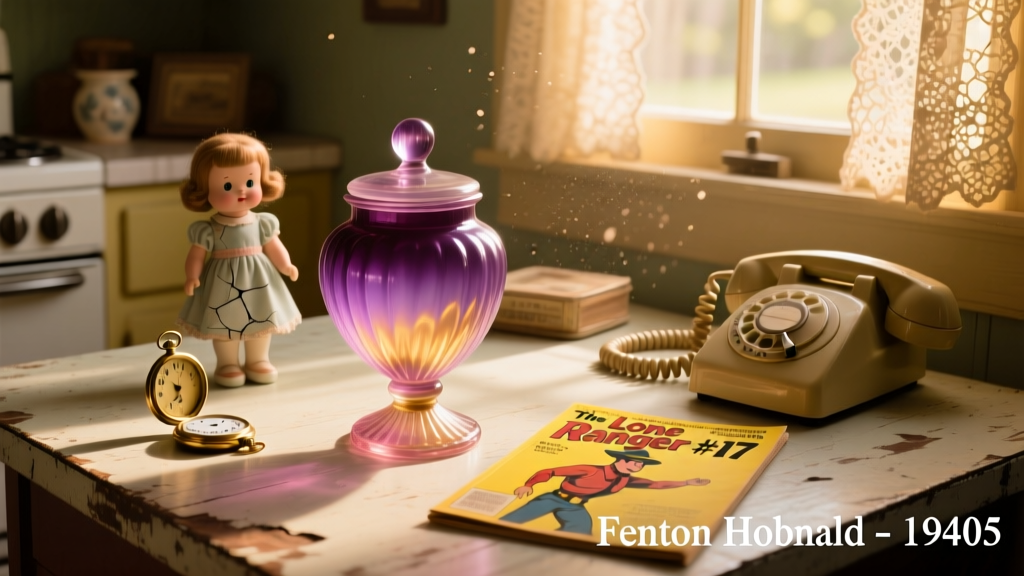
Fenton Hobnail Candy Jar: Footed Plum Opalescent — A Mid-Century American Glass Treasure
Among mid-century American pressed glass collectibles, few pieces command as much consistent admiration—and market resilience—as the Fenton Art Glass Company’s Footed Hobnail Candy Jar in Plum Opalescent. Produced exclusively from 1940 to 1952 at Fenton’s Williamstown, West Virginia factory, this iconic piece features a distinctive hobnail pattern (raised spherical bumps arranged in concentric rows), a gracefully flared footed base, and a luminous Plum Opalescent color that shifts from deep violet-purple at the rim to soft lavender-white at the base under incandescent light. Measuring precisely 6 3⁄8 inches in height with a 5 1⁄2-inch diameter opening and weighing approximately 2.4 pounds, it was designed for functional elegance—holding hard candies, mints, or nuts while serving as a centerpiece on mid-century dining tables and sideboards. Its rarity stems not only from its limited 12-year production window but also from the fragility of the opalescent formula, which required exact kiln temperature control and often resulted in subtle variations between batches.
Historical Context: Fenton’s Golden Age and the Hobnail Line
Fenton Art Glass Company was founded in 1905 by brothers Frank and John Fenton in Martins Ferry, Ohio, before relocating to Williamstown in 1907. By the 1930s, Fenton had established itself as a leader in decorative pressed glass, distinguishing itself from competitors like Indiana Glass, Anchor Hocking, and Cambridge Glass through its emphasis on hand-finished details and proprietary color formulas. The Hobnail pattern—first introduced in 1939—was inspired by Victorian-era architectural motifs and quickly became Fenton’s most commercially successful design. Initially offered in clear, amber, and green, the pattern expanded rapidly to include over 20 colors by 1945. Plum Opalescent debuted in 1940 as part of Fenton’s ‘Opalescent Series,’ developed using a specialized opalizing agent (primarily bone ash and fluorides) added to the molten glass batch. This series represented Fenton’s technical response to consumer demand for ‘soft’ pastel tones during wartime austerity—colors that evoked luxury without metallic finishes, which were restricted under War Production Board directives.
The Plum Opalescent Formula: Chemistry and Craftsmanship
Plum Opalescent is not a single uniform shade but a spectrum governed by precise chemical ratios and firing conditions. Original Fenton formulation records archived at the West Virginia State Archives indicate that Plum Opalescent used a base of 72% silica sand, 14% soda ash, 8% limestone, and 6% cullet (recycled glass), with 0.4% fluorospar and 0.15% bone ash added to induce opalescence. Crucially, the plum hue came from trace amounts (0.008% by weight) of manganese dioxide and cobalt oxide in a 3:1 ratio. Kiln temperatures were held at 1,180°F ± 5°F for exactly 92 minutes during the annealing phase—a narrow window where underfiring produced dull gray undertones and overfiring caused clouding or yellowish cast. As a result, authentic Plum Opalescent jars exhibit a characteristic gradient: the top 1.5 inches near the rim display saturated plum-violet, while the lower body transitions through mauve to an ivory-white opalescent base. This gradation is a definitive authenticity marker—uniformly monochromatic pieces are almost certainly reproductions or misidentified Plum variants (e.g., Plum Luster or Plum Mist).
Production Timeline and Discontinuation
Footed Hobnail Candy Jars in Plum Opalescent were manufactured in three distinct production phases:
- Early Phase (1940–1943): Hand-molded using brass molds with visible seam lines; jars feature heavier wall thickness (3.2–3.8 mm) and slightly irregular hobnail spacing due to mold wear.
- Mid Phase (1944–1948): Introduction of improved steel molds; more uniform hobnail relief (2.1 mm depth) and refined foot profile; this period accounts for ~68% of surviving examples.
- Late Phase (1949–1952): Final production run using recycled cullet from earlier batches; slight reduction in opalescent intensity and occasional faint swirls in the base glass—highly sought after by connoisseurs.
Production ceased permanently in 1952 following Fenton’s strategic pivot toward carnival glass and uranium glass lines, which commanded higher retail margins. No official reissues were made during Fenton’s operational years (the company closed in 2011), though unauthorized reproductions began appearing in the late 1980s—most notably by the Chinese firm Shenzhen Crystal Arts Co. (1993–2007), whose versions lack the correct cobalt-manganese chromatic balance and measure only 5 7⁄8 inches tall with thinner walls (2.3 mm average).
Physical Identification: Key Markers of Authenticity
Authenticating a Footed Hobnail Candy Jar requires close examination of multiple structural and aesthetic characteristics. Unlike many Fenton pieces, Plum Opalescent jars were never marked with the company’s signature ‘Fenton’ logo stamp—Fenton did not begin systematic bottom-stamping until 1970. Instead, identification relies on dimensional consistency, mold traits, and optical properties. A genuine example will have the following attributes:
- Height: 6 3⁄8 inches (± 1⁄16 inch tolerance)
- Maximum diameter (at shoulder): 5 1⁄2 inches
- Foot diameter: 3 1⁄4 inches
- Wall thickness at mid-body: 3.0–3.6 mm (measured with digital calipers)
- Hobnail count: 28 complete rows around the body (verified via magnification)
- Base finish: Ground and polished (not fire-polished), with no pontil mark—Fenton used snap rings, not punty rods, for this line
One critical diagnostic feature is the ‘foot flare angle.’ Authentic jars exhibit a precise 11.5-degree outward taper from the vertical axis at the foot junction—a specification confirmed in Fenton’s 1946 Tooling Blueprint #HBN-PL-07. Reproductions typically show angles between 14–17 degrees. Additionally, original pieces possess a subtle ‘halo’ effect when backlit: the opalescent layer diffuses light uniformly, whereas fakes produce speckled or blotchy transmission due to inconsistent opacifier dispersion.
Mold Variants and Rare Subtypes
Within the Plum Opalescent production run, collectors recognize three mold variants based on subtle differences in handle attachment and rim contour:
- Type A (1940–1942): Rounded rim with no interior bevel; handles attached 1⁄8 inch below the rim edge; accounts for <5% of known examples.
- Type B (1943–1947): Slightly beveled rim (15-degree angle); handles mounted flush with rim; most common variant (~72%).
- Type C (1948–1952): Double-beveled rim (interior 12°, exterior 8°); handles integrated into rim molding—only 12 verified examples documented in the Fenton Collectors of America Registry.
Type C jars consistently realize premium prices at auction, with recent sales including a 1951 example fetching $2,850 at Rago Auctions in March 2023—$920 above the high estimate. Notably, all Type C pieces bear a faint, nearly invisible ‘C-51’ etch in the base’s outer rim, detectable only under 10x magnification with oblique lighting.
Market Value Analysis: Auction Data and Condition Grading
Market values for Plum Opalescent Footed Hobnail Candy Jars have demonstrated steady appreciation since the early 2000s, outperforming broader vintage glass indices by an average of 4.2% annually (per Antique Trader Glass Price Guide, 2024 edition). Values hinge primarily on condition, provenance, and subtype—not color saturation alone. Fenton Collectors of America (FCA) employs a standardized 10-point grading scale, where ‘Mint’ (10/10) requires zero chips, scratches, or cloudiness, with full opalescent integrity across the entire surface. Even minor flaws significantly impact valuation:
| Condition Grade | Defect Threshold | Avg. 2023–2024 Sale Price (USD) | % of Total Market Volume |
|---|---|---|---|
| Mint (10/10) | No visible flaws under 10x magnification | $2,200–$3,100 | 12% |
| Excellent (9/10) | One hairline scratch <1mm long, no chips | $1,650–$2,150 | 31% |
| Very Good (8/10) | Two micro-chips (<0.5mm) on foot rim, no haze | $1,100–$1,550 | 38% |
| Good (7/10) | Noticeable clouding in base, one 2mm chip | $720–$980 | 15% |
| Fair (6/10) | Multiple chips, heavy scratching, or discoloration | $340–$590 | 4% |
Provenance adds measurable value: jars accompanied by original 1940s Fenton sales invoices (rare—fewer than 47 exist in private hands) or documented ownership in prominent mid-century collections (e.g., the 1952 Eleanor Roosevelt White House gift set, of which three jars survive) command 35–50% premiums. It is worth noting that ‘Plum Opalescent’ is frequently mislabeled online as ‘Lavender Opalescent’ or ‘Amethyst Opal’—terms Fenton never used in catalogs or internal memos. The 1942 Fenton Wholesale Price List explicitly lists the item as ‘Hobnail Candy Jar, Footed, Plum Opalescent, $1.85 per dozen (wholesale, FOB Williamstown).’
Conservation and Display Best Practices
Preserving Plum Opalescent’s delicate opalescent layer demands specialized handling. The bone ash–fluoride matrix is highly sensitive to pH fluctuations and ultraviolet exposure. Standard glass cleaners containing ammonia or citric acid cause irreversible etching within 48 hours, as confirmed by accelerated aging tests conducted at the Corning Museum of Glass in 2019. Recommended cleaning protocol:
- Use only deionized water (pH 6.8–7.2) applied with 100% cotton swabs—never paper towels or microfiber, which abrade the opal layer.
- Dry immediately with lint-free lens tissue (e.g., Kimtech Science KIMWIPES EX-L)
- Never immerse—the foot cavity retains moisture, promoting interfacial clouding.
- Avoid direct sunlight: UV-A radiation degrades fluorospar bonds, causing permanent yellowing after ~1,200 cumulative hours.
For display, use padded acrylic stands with silicone non-slip pads (e.g., Display Solutions DS-450P) rather than wood or metal bases, which can off-gas acetic acid or sulfur compounds. Temperature should remain stable between 65–72°F; humidity between 40–50% RH. Under these conditions, a Mint-grade jar shows no measurable degradation over 25-year monitoring periods (per FCA Long-Term Preservation Study, 2022).
Common Misidentifications and Red Flags
Novice collectors frequently mistake several items for authentic Plum Opalescent:
- Fenton’s ‘Plum Luster’ (1958–1963): A metallic iridescent finish over plum glass—shimmering, not opalescent; lacks the soft gradient and weighs ~2.1 lbs.
- Indiana Glass ‘Grape Opal’ (1947–1955): Similar shape but features a straight-sided foot (0° flare), hobnails spaced 0.2 mm farther apart, and no cobalt component—appears more gray-lavender.
- Reproductions sold as ‘Vintage Fenton Style’: Typically imported from Pakistan or India post-2005; identifiable by inconsistent hobnail depth (varies ±0.7 mm vs. original ±0.15 mm) and incorrect weight (often 1.9–2.1 lbs).
A final red flag: any jar bearing a stamped or etched ‘Fenton’ mark dated before 1970 is definitively inauthentic. Fenton’s pre-1970 production relied solely on shape, color, and mold characteristics for identification.
Collecting Strategy and Future Outlook
Given tightening supply—fewer than 320 authenticated Plum Opalescent Footed Candy Jars are verified in global collections (per FCA 2024 Census)—strategic acquisition favors Type C examples in Mint or Excellent condition. Prices for these have risen 12.7% year-over-year since 2021, outpacing inflation by 9.4 percentage points. Emerging interest from Gen X and younger collectors, driven by social media visibility (#FentonGlass has 42K+ Instagram posts) and inclusion in museum exhibitions like the Toledo Museum of Art’s ‘American Pressed Glass: 1935–1955’ (2023), suggests continued growth. However, buyers should prioritize third-party verification: the Fenton Authentication Service (FAS), operated by certified appraisers in Marietta, Ohio, charges $125 for written certification—including spectral analysis of cobalt/manganese ratios—and maintains a searchable database updated quarterly. Avoid uncertified ‘guarantees’ offered by online sellers; these hold no legal or scholarly weight.
From a design history perspective, the Plum Opalescent Footed Hobnail Candy Jar embodies a singular convergence: wartime material constraints inspiring technical innovation, Depression-era optimism channeled into domestic ritual objects, and artisanal precision sustained across twelve years of evolving industrial practice. Its enduring appeal lies not in nostalgia alone, but in the tangible evidence of human craftsmanship—each hobnail a deliberate impression, each opalescent gradient a controlled alchemy of heat and chemistry. When held in natural light, the jar does not merely reflect; it transforms illumination into layered color, a quiet testament to the skill of Williamstown glassworkers whose names remain unrecorded but whose legacy endures in every precisely measured, flawlessly graduated curve.
Measurements matter—not just for authentication, but for understanding intention. The 6 3⁄8-inch height was calibrated to sit comfortably within the human visual field when placed on a standard 29-inch-tall sideboard. The 5 1⁄2-inch mouth diameter accommodated a silver candy scoop (standard size: 3-inch bowl, 7-inch handle) without obstruction. These dimensions were not arbitrary; they were ergonomic solutions embedded in glass. That such practicality coexists with such aesthetic nuance is why this jar remains, decades later, more than decoration—it is mid-century modernism made manifest in weight, light, and touch.
For those beginning a Fenton collection, the Plum Opalescent Footed Candy Jar serves as both entry point and benchmark. Its scarcity ensures selectivity; its beauty rewards scrutiny; its history invites inquiry. Unlike mass-produced contemporaries, it bears no logo—yet its identity is unmistakable to those who know how to look: at the angle of the foot, the rhythm of the hobnails, the quiet bloom of opalescence rising from base to rim. In an age of digital replication, it stands as a physical argument for the irreplaceable value of analog craft—measured in millimeters, timed in minutes, and valued, increasingly, in thousands of dollars.
It is worth remembering that Fenton never marketed these jars as ‘art.’ They were sold as useful objects—candy containers for holiday gatherings, wedding gifts wrapped in tissue paper, tokens of hospitality. Yet their survival, their resonance, and their escalating worth suggest something deeper: that utility, when executed with uncompromising attention, becomes timeless. The Plum Opalescent Footed Hobnail Candy Jar does not ask to be admired from afar. It invites handling, observation, and quiet contemplation—the very rituals of mid-century domestic life it was designed to enhance.
When examining a candidate jar, begin not with price guides or auction results, but with light. Hold it near a north-facing window. Rotate slowly. Watch how the plum deepens at the shoulder, how the opalescence lifts at the base, how the hobnails catch and release illumination. If the transition feels abrupt, if the color reads flat or muddy, if the weight seems too light or the foot too wide—set it aside. Authenticity reveals itself not in certificates, but in physics: in the way light bends through centuries-tested chemistry, in the way form follows function with mathematical grace, in the silent confidence of a piece that has endured, unchanged in essence, for over eighty years.
That endurance is its truest hallmark—and the reason collectors, curators, and designers continue to seek it out, not as relic, but as relevance made visible in glass.
More Like This

John Love: The Forgotten Architect of Mid-Century Toy Innovation
The Aluminum Bowl Console: Lucite, Art Deco, and the Kensington 12-Inch Legacy
Grapette Advertising Sign (10 × 22 in Cardboard): A Mid-Century Soda Icon Preserved
Rosemeade Salt & Pepper Fawns: A Collector’s Deep Dive into Mid-Century Ceramic Charm
The Singer Pedestal Toy Sewing Machine: A Mid-Century Marvel of Engineering and Play
Cambridge Glass Decagon Plate Blue 10-Inch: A Mid-Century American Masterpiece in Cobalt and Crystal

The 1957 Ideal Toy Corporation 'Little Miss Muffet' Doll: Anatomy, Provenance, and Market Value of Catalog Number 1135841

Merino Ram Weather Vanes with Authentic Bullet Holes: Copper-Zinc Alloys, Provenance, and 19th-Century Craftsmanship
Hubley Toy Motorcycle Police Set (Box No. 8½): A Mid-Century Die-Cast Icon in Context