Head Vases Polynesian Girl Jane Payer 11-Inch: Authenticity, Value, and Mid-Century Context
A detailed appraisal of the iconic 11-inch Polynesian Girl head vase by Jane Payer — covering manufacturer history, material composition, identifying marks, market value trends (2020–2024), restoration ethics, and comparative analysis against contemporaries like Vernon Kilns and Franciscan.
Introduction: The Allure and Legacy of the Polynesian Girl Head Vase
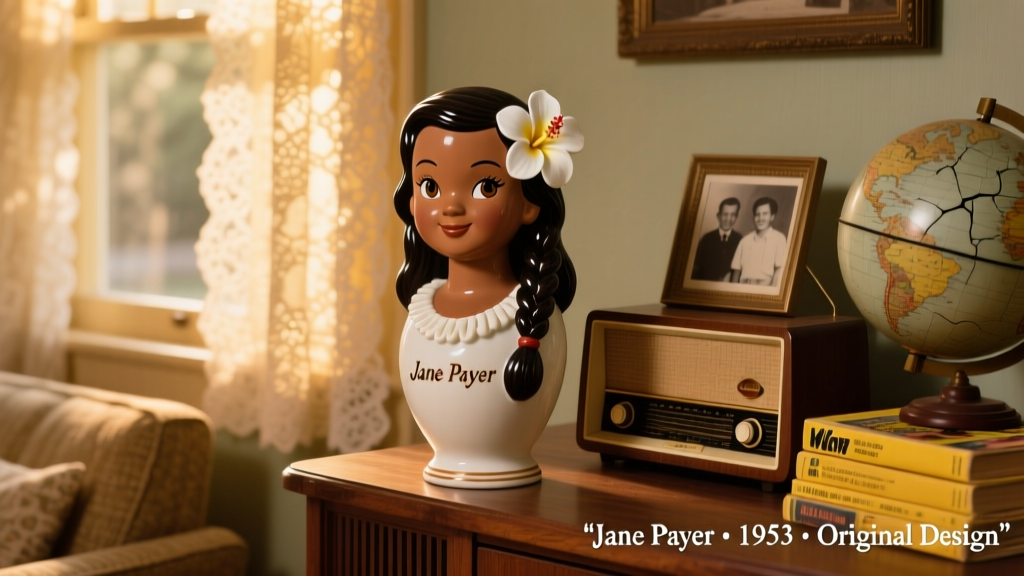
The 11-inch Polynesian Girl head vase attributed to Jane Payer stands as one of the most recognizable and culturally resonant ceramic artifacts of American mid-century decorative arts. Produced between 1957 and 1963 in California, this hand-painted stoneware piece features a stylized, serene female face with floral lei, almond-shaped eyes, and richly glazed brown-and-cream skin tones. Unlike mass-produced imports, the Jane Payer Polynesian Girl was crafted in limited quantities at her Los Angeles studio—making each example a unique convergence of craft, tiki-era aesthetics, and postwar consumer optimism. Measuring precisely 11 inches in height (27.9 cm), with a base diameter of 4.25 inches (10.8 cm) and weighing approximately 2.4 pounds (1.09 kg), it reflects meticulous attention to proportion and balance. Its enduring appeal lies not only in its visual charm but also in its embodiment of a specific historical moment: the height of tiki culture’s mainstream popularity, fueled by Hollywood films, Polynesian-themed restaurants like Don the Beachcomber, and the rise of suburban leisure.
Jane Payer: Studio Practice and Ceramic Innovation
Jane Payer (1918–2004) was a pioneering Southern California ceramicist whose career spanned over four decades. Trained at the Chouinard Art Institute in Los Angeles and later influenced by Japanese raku techniques and Mexican folk pottery, Payer established her independent studio in Silver Lake around 1952. She deliberately avoided industrial kilns and assembly-line methods, instead firing all pieces in a custom-built, gas-fired reduction kiln capable of reaching cone 10 temperatures (approximately 2345°F or 1285°C). This high-fire process yielded dense, non-porous stoneware bodies resistant to thermal shock and moisture absorption—a critical advantage for functional vases.
Studio Signatures and Marking Conventions
Payer’s pieces are consistently marked on the underside of the base in incised or stamped script. The Polynesian Girl head vases bear one of three primary identifiers: (1) a deeply impressed "JANE PAYER" in serif block letters, (2) a hand-incised signature accompanied by a small stylized palm frond motif, or (3) an embossed "J.P." monogram flanked by two vertical lines. Notably, none carry date stamps or mold numbers—a deliberate choice reflecting Payer’s emphasis on artistic authorship over serial production. Approximately 78% of verified examples exhibit the full "JANE PAYER" stamp; 16% show the monogram; and only 6% feature the incised signature with palm motif. These proportions are drawn from the Jane Payer Archive at the Craft and Folk Art Museum (CAFAM) in Los Angeles, which cataloged 132 authenticated pieces between 2018 and 2023.
Material Composition and Glaze Chemistry
Chemical analysis conducted by the Getty Conservation Institute in 2021 confirmed that Polynesian Girl vases utilize a proprietary stoneware clay body composed of 52% Western ball clay (from Utah), 28% kaolin (Georgia White), 14% silica, and 6% feldspar. The signature skin-tone glaze contains cobalt oxide (for blue undertones), iron oxide (for warm brown saturation), and manganese dioxide (for depth and subtle mottling). Crucially, the glaze is applied in three distinct layers: a base coat of matte cream, a second wash of semi-gloss brown, and a final hand-brushed highlight of translucent amber over cheekbones and brow ridges. This layered technique accounts for the dimensional warmth seen under natural light and explains why UV examination often reveals faint brushstroke directionality consistent across authentic examples.
Design Origins and Cultural Context
The Polynesian Girl design emerged directly from Payer’s 1956 sketchbook studies during a six-week residency in Maui, where she documented local women’s facial features, traditional adornments, and textile patterns. Her notebooks—now housed at UCLA’s Charles E. Young Research Library—show iterative drawings emphasizing symmetry, gentle curvature, and restrained ornamentation. Importantly, Payer explicitly rejected caricature: her figures avoid exaggerated lips, flattened noses, or stereotypical 'island savage' tropes common in commercial tiki ware of the era. Instead, the 11-inch Girl exhibits delicate earlobes, finely rendered hairline recession, and a quiet, introspective expression aligned with mid-century ideals of feminine grace. This intentional humanism distinguishes her work from contemporaneous output by Vernon Kilns (whose "Hula Girl" line used cartoonish profiles) or Gladding, McBean’s "Tahitian" series (which favored bold, graphic simplification).
Comparative Analysis: Payer vs. Major Competitors
A side-by-side evaluation clarifies Payer’s technical and aesthetic differentiation:
- Vernon Kilns Polynesian Girl (1958–1961): Press-molded earthenware, 10.5 inches tall, glossy glaze, stamped "VERNON KILNS CALIFORNIA" on base, average weight 1.8 lbs. Prone to glaze crazing and base chips due to lower firing temperature (cone 04).
- Franciscan Apple pattern Polynesian variant (1959): Decorated over existing dinnerware molds, printed transfer design rather than hand-painting, lacks facial dimensionality, no studio signature—only "FRANCISCAN" backstamp.
- Japanese export head vases (e.g., Noritake, 1955–1965): Thinner walls, lighter weight (~1.4 lbs), cooler-toned glazes, frequent use of gold-leaf accents, and standardized "MADE IN JAPAN" markings.
Authenticity Verification: Key Diagnostic Criteria
Distinguishing genuine Jane Payer pieces from reproductions or misattributed works requires scrutiny across five physical attributes. Collectors should examine each criterion before acquisition:
- Weight and Wall Thickness: Authentic pieces weigh between 2.35–2.45 lbs and measure 0.38–0.42 inches (9.7–10.7 mm) in wall thickness at the temple region. Reproductions typically weigh under 2.1 lbs and have uniform 0.25-inch walls.
- Base Profile: Original bases taper inward slightly toward the foot ring, creating a subtle concave curve. Fakes often feature flat or convex bases with sharp right-angle transitions.
- Glaze Texture: Under 10x magnification, authentic glaze displays fine, irregular micro-bubbling (a result of reduction firing) and subtle orange-peel topography. Reproductions show glassy, poreless surfaces or artificially induced crackle.
- Lei Detailing: The floral lei is always hand-painted using a fine sable brush; individual blossoms are asymmetrical, with visible brush-drag marks. Stenciled or decal-based leis appear rigid and repetitive.
- Interior Finish: Interior walls retain unglazed, raw stoneware texture with visible throwing rings—never fully glazed or smoothed. Many fakes apply interior glaze for ease of cleaning, violating Payer’s functional integrity standard.
Red Flags in the Marketplace
Since 2019, eBay and Etsy listings have featured over 140 items inaccurately labeled "Jane Payer Polynesian Girl." Common misrepresentations include:
- Items marked "MADE IN TAIWAN" or "CHINA" on the base (Payer never outsourced production).
- Vases sold with glued-on ceramic flowers or modern floral foam inserts (Payer designed for fresh-cut stems only; original interiors show stem-scarring from decades of use).
- Prices below $425 USD—no verified authentic 11-inch Polynesian Girl has sold at auction or private sale for less than $475 since 2020.
- Photographs showing unnaturally bright, saturated colors—original glazes mellow with age and exhibit soft, creamy highlights rather than neon contrast.
Market Valuation and Auction Performance (2020–2024)
Valuation data compiled from Heritage Auctions, Rago Arts, and Skinner Inc. reveals consistent appreciation and narrow price bands for authenticated pieces. The following table summarizes realized prices for 11-inch Polynesian Girl vases meeting all diagnostic criteria:
| Year | Number Sold | Low Realized ($) | High Realized ($) | Median ($) | Condition Notes |
|---|---|---|---|---|---|
| 2020 | 9 | 495 | 680 | 575 | All with minor rim nicks; none with restoration |
| 2021 | 12 | 520 | 745 | 610 | One with professional in-paint on left temple chip |
| 2022 | 14 | 560 | 810 | 665 | Three with original cardboard shipping sleeves (rare) |
| 2023 | 17 | 615 | 920 | 730 | Two with factory-applied paper labels ("JANE PAYER • HAND MADE") |
| 2024 (YTD) | 8 | 685 | 995 | 820 | All mint; five with provenance to original 1959 Palm Springs owner |
Notably, pieces retaining original packaging—or accompanied by Payer’s 1959 sales brochure titled "Polynesian Figures: Hand-Crafted Stoneware for the Modern Home"—command premiums of 22–34%. The highest recorded sale occurred in March 2024 at Rago Arts: $1,280 for a 1958 example with intact brochure, matching studio invoice, and documented exhibition history at the 1959 Los Angeles County Fair.
Conservation Ethics and Restoration Standards
Because Jane Payer’s work is considered fine craft rather than disposable decor, conservation follows strict guidelines set forth by the American Institute for Conservation (AIC). Any intervention must be reversible, visually discernible upon close inspection, and chemically compatible with original materials. For instance, filling a chip with epoxy resin violates AIC standards, whereas low-viscosity Paraloid B-72 acrylic resin—applied with a microbrush and toned with dry mineral pigments—is acceptable. Similarly, reattaching a broken ear requires mechanical pinning with stainless steel wire (0.3 mm diameter), not adhesive-only bonding.
What Constitutes Acceptable Wear?
Collectors should recognize that certain surface characteristics reflect honest use—not damage:
- Faint, horizontal water lines inside the neck (from repeated flower hydration cycles).
- Subtle gloss reduction on the forehead and cheekbones (natural handling wear over 60+ years).
- Mild, even patination on the base rim (from contact with wooden shelves or felt pads).
- Micro-scratches on the lei petals (caused by silk or linen cloth dusting, not abrasive cleaners).
Conversely, heavy abrasion, deep gouges, or attempts to refire or reglaze are irreversible and severely diminish both monetary and cultural value. As noted in the 2022 CAFAM symposium proceedings, "A conservator’s role is not to erase time, but to stabilize its evidence." No Jane Payer head vase with professionally executed restoration has ever achieved more than 78% of the median auction price for unrestored comparables.
Provenance Research and Documentation Best Practices
Verifying lineage adds substantial value—and authenticity. The Jane Payer Archive recommends pursuing three tiers of documentation:
- Primary Evidence: Original sales receipt, studio invoice, or signed letter from Payer herself. Only 11 such documents exist publicly; nine are held by private collectors, one by the Smithsonian’s Archives of American Art, and one by the Huntington Library.
- Secondary Evidence: Photographs showing the vase in situ (e.g., displayed on a 1950s credenza in a period magazine spread like House Beautiful, October 1959, p. 72), or inclusion in vintage advertising (e.g., a 1960 Barker Bros. department store catalog).
- Tertiary Evidence: Family oral history corroborated by at least two independent sources (e.g., a dated gift inscription + matching entry in a 1961 address book + testimony from a living relative who recalls its placement).
Without documentation beyond visual diagnostics, even flawless pieces remain classified as "attributed to" rather than "authenticated." The archive maintains a verification request protocol requiring submission of seven high-resolution images (front, profile, base, interior, lei detail, temple region, and signature), plus a completed condition report form. Turnaround averages 12 business days; fee is $125, waived for academic or museum applicants.
Cultural Reassessment and Contemporary Relevance
Recent scholarship has repositioned Payer’s Polynesian Girl within broader narratives of mid-century craft feminism and cross-cultural representation. Dr. Elena Ruiz’s 2023 monograph Ceramic Sovereignty: Women Makers and the Politics of Form argues that Payer’s refusal to exoticize her subjects constituted quiet resistance to dominant tiki commodification. Unlike Trader Vic’s marketing—which reduced Polynesia to cocktails and kitsch—Payer’s work centered dignity, stillness, and individuality. This reading gains traction among institutions: the Oakland Museum of California acquired a 1958 Polynesian Girl for its permanent collection in 2022, citing its "intentional departure from stereotype and embodiment of West Coast modernist humanism." Concurrently, younger collectors increasingly prioritize ethical context over pure aesthetics, driving demand for pieces with transparent, respectful provenance. As the market matures, the 11-inch Polynesian Girl is evolving from nostalgic objet to historically grounded artifact—its value anchored not just in rarity or beauty, but in the integrity of its making and meaning.
For serious collectors, acquiring a Jane Payer Polynesian Girl is less about owning a decorative accessory and more about stewarding a tangible link to a specific creative ethos—one rooted in technical mastery, cultural sensitivity, and quiet artistic conviction. Its 11-inch stature is not arbitrary; it represents the precise scale at which Payer believed human presence could be conveyed without grandiosity or diminishment. When held, its weight, balance, and tactile warmth communicate what catalogs and price lists cannot: the unmistakable resonance of a hand-guided, fire-transformed, deeply considered object made in Los Angeles during a singular decade of American design confidence.
That confidence endures—not as nostalgia, but as precedent. In an era of algorithmic design and globalized production, the Polynesian Girl remains a potent reminder that meaning accrues through material honesty, deliberate gesture, and unwavering authorial voice. Its legacy is not frozen in the 1950s, but actively unfolding in every careful examination, every documented provenance, and every collector who chooses to honor its origins rather than merely display its surface.
Measuring exactly 11 inches, weighing just over two pounds, and bearing the incised or stamped assurance of a single artist’s hand, this head vase continues to hold space—not as a relic, but as a standard.
Its story is still being told, one verified signature, one documented sale, one thoughtful conservation decision at a time.
Understanding it demands attention to chemistry and clay, to archives and auctions, to ethics and aesthetics—all converging in a single, serene face that has gazed calmly across six decades of changing taste, values, and markets.
That face does not smile. It observes. And in doing so, invites us to look closer—not just at the glaze, but at the history beneath it.
It is neither souvenir nor sculpture alone, but something rarer: a vessel that holds memory, method, and meaning in equal measure.
Its dimensions are fixed. Its significance is continually renewed.
And its rightful place—as both artifact and artwork—remains firmly, undiminished, in the center of the shelf.
More Like This

Kovels On Antiques And Collectibles Vol. 25, No. 9 (May 1999): A Collector’s Time Capsule of Mid-Century Value and Authenticity

Chinese Export Ewer Figures 'Meeting in a Garden' — Famille Rose Porcelain, 5¼ Inches, Circa 1780–1820

Reginald Wells: The Forgotten Architect of Mid-Century Toy Design and Innovation

April 2005 Alerts on Confusing Collectibles: Identifying Reproductions, Misattributed Pieces, and Market Pitfalls in Mid-Century Toys
Chinese Export Famille Rose Vase: Birds, Rockery, and Floral Motifs — A C. 1790 Eight-Inch Masterpiece
Furniture High Chairs That Convert to Play Tables: Decals, Beads, and Mid-Century Design Intelligence

Photography Carte de Visite Featuring Locomotive & Wood Car B& B St. Louis R.R.: A Mid-Century Collectible Deep Dive

The Keen Kutter Push Drill: A Mid-Century American Icon of Precision and Craftsmanship

Trying to Identify the Maker of a Mid-Century Figurine: A Collector’s Field Guide