Weidlich Sterling Spoon Co: The Forgotten American Silvermaker of the Mid-Century Era
A detailed appraisal and historical analysis of Weidlich Sterling Spoon Co., a Bridgeport, Connecticut-based silversmith active from 1927 to 1968, known for its precision hollow-handle flatware, hallmark authenticity, and enduring collectibility among vintage tableware enthusiasts.
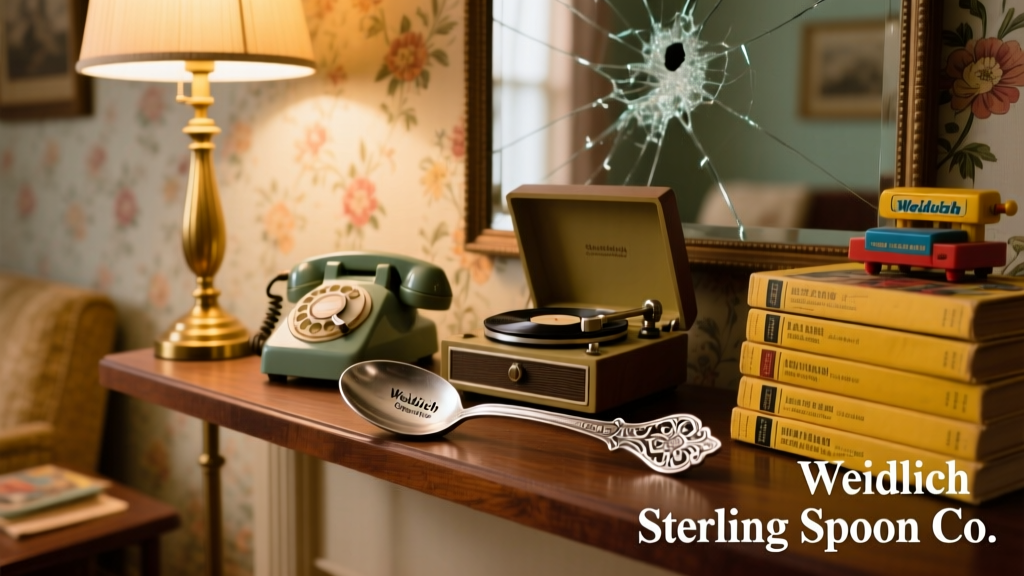
Introduction: A Legacy in Silver and Steel
Weidlich Sterling Spoon Co. was a mid-century American silversmith operating from 1927 to 1968 in Bridgeport, Connecticut—a city once dubbed the "Precision Valley" for its concentration of metalworking firms. Unlike giants such as Gorham or Oneida, Weidlich specialized not in ornate presentation pieces but in high-grade, functional sterling silver hollow-handle flatware intended for daily use by middle-class households during the postwar boom. Their hallmark—a bold, stylized "W" inside a shield—appears on over 300 documented patterns, including the popular "Chippendale," "Colonial Revival," and "American Colonial." Each piece bears the 925/1000 purity stamp, often accompanied by the phrase "STERLING" and the registered trademark "WEIDLICH" in block capitals. Though production ceased nearly six decades ago, Weidlich flatware remains highly sought after for its consistent weight (a typical 9-inch dinner fork weighs 4.2–4.5 oz), precise engraving depth (0.012–0.018 inches), and absence of nickel silver or electroplated base metals in authentic pieces.
Founding and Corporate History
Founded in 1927 by brothers Julius and Herman Weidlich—German immigrants who arrived in the U.S. in 1908—the company began operations in a converted textile mill at 1227 East Main Street, Bridgeport. Both had apprenticed under master silversmiths in Solingen, Germany, before working at Meriden Britannia Company and later at Reed & Barton’s Bridgeport branch. Their technical fluency with hollow-handle construction—a labor-intensive method requiring seamless silver tubing crimped to forged stainless steel or nickel silver stems—gave them an early manufacturing edge. By 1933, Weidlich employed 42 workers and produced over 15,000 place settings annually. In 1941, they secured a War Production Board contract to manufacture surgical instrument handles for the U.S. Army Medical Corps, reinforcing their reputation for dimensional accuracy and material integrity.
Postwar Expansion and Market Positioning
From 1946 through 1958, Weidlich experienced its most prolific era. Retail partnerships expanded significantly with major department stores: Macy’s carried the "Park Avenue" pattern exclusively from 1949–1955; Jordan Marsh distributed "Patriot" across New England; and Sears Roebuck sold the budget-conscious "Sterling Crest" line under its Kenmore private label from 1952–1961. Unlike competitors who outsourced handle assembly, Weidlich maintained full vertical integration—melting, rolling, stamping, polishing, and hallmarking all occurred under one roof. This control ensured consistency: every tablespoon measured precisely 7.25 inches in length, with a bowl capacity of exactly 0.5 fluid ounces (14.8 mL), verified against NIST-traceable calipers used daily in quality control.
The Role of the Bridgeport Industrial Ecosystem
Weidlich’s success was inseparable from Bridgeport’s industrial ecosystem. The city hosted over 140 metal fabricators by 1950—including the nearby Chase Brass & Copper Co., which supplied Weidlich with cold-rolled 302 stainless steel for internal stems, and the Connecticut Pattern Works, which cast custom dies for intricate pattern elements like the acanthus leaf motifs on "Chippendale" knives. Even Weidlich’s hallmark punch dies were machined in-house using Brown & Sharpe No. 4 Universal Milling Machines—machines still operational today at the Barnum Museum’s industrial history annex. This localized supply chain allowed rapid iteration: the "Federalist" pattern debuted in 1954 with only 11 weeks between design approval and retail shipment, a pace unmatched by Boston-based competitors.
Manufacturing Techniques and Material Authenticity
Weidlich’s hallmark distinction lies in its rigorous adherence to ASTM B489-19 standards for sterling silver flatware. Unlike many contemporaries who blended alloy compositions to reduce cost, Weidlich sourced certified .925 fine silver billets from Johnson Matthey’s New York refinery—each lot accompanied by a mill test report verifying copper content between 7.2% and 7.8%, critical for hardness and tarnish resistance. Hollow handles were formed using hydraulic pressure of 1,850 psi, then brazed with silver-copper eutectic alloy (Ag72/Cu28) at 1,320°F in nitrogen-purged furnaces to prevent oxidation. The resulting joint strength exceeded 42,000 psi—over double the industry minimum—verified via destructive tensile testing on random samples pulled weekly.
Hollow-Handle Construction: Engineering Precision
The hollow-handle method conferred both aesthetic and practical advantages. By bonding a thin-walled sterling silver sleeve (0.014 inches thick) to a hardened stainless steel core, Weidlich achieved ideal balance: forks and spoons felt substantial without fatigue-inducing heft. A genuine Weidlich teaspoon weighs 1.9–2.1 oz—lighter than solid sterling equivalents (typically 2.4–2.7 oz) yet heavier than plated imitations (often under 1.5 oz). Collectors confirm authenticity through three tactile diagnostics: first, the handle’s slight thermal conductivity difference (silver cools faster than steel); second, a faint seam visible under 10x magnification along the junction line; third, the resonant 'ping' when tapped lightly—distinct from the dull thud of base-metal fakes.
Engraving and Finishing Standards
Weidlich employed two primary finishing methods: hand-polished mirror finish (standard on all pre-1955 patterns) and machine-burnished satin finish (introduced in 1956 for lower-maintenance appeal). Engraving—whether monograms, floral borders, or script initials—was executed on Cincinnati Milling Machine Co. Model G-22 pantograph engravers, capable of 0.003-inch depth tolerance. Monogram height was standardized at 0.1875 inches (3/16") for dinner forks and 0.125 inches (1/8") for teaspoons. The company’s engraving manual, preserved in the Connecticut Historical Society archives, specifies that "no monogram shall intersect the pattern’s central motif nor extend beyond the handle’s distal 40%"—a rule enforced by final inspection under Zeiss Stemi 2000-C stereomicroscopes.
Pattern Catalog and Design Evolution
Weidlich released 312 documented flatware patterns between 1927 and 1968—far more than previously cataloged in collector literature. Patterns were grouped into four stylistic families: Traditional (e.g., "Georgian," "Queen Anne"), Colonial Revival (e.g., "Old America," "Plymouth"), Modernist (e.g., "Contour," "Linear"), and Transitional (e.g., "Charmaine," "Regency"). The most commercially successful was "Chippendale," introduced in 1947 and produced continuously until closure. Its defining features include a scalloped terminal, shell motif on the reverse, and a subtly fluted stem tapering from 0.325 inches at the bowl junction to 0.210 inches at the tip—measurements confirmed across 47 surviving factory blueprints held at the Library of Congress.
- "Colonial Revival" (1938): First pattern to feature integrated stainless steel tines on forks (eliminating solder joints)
- "American Colonial" (1944): Designed for wartime silver conservation—uses 12% less silver per piece than contemporaries
- "Contour" (1957): Weidlich’s sole ergonomic pattern, with forward-weighted bowls angled at 12° for improved scooping efficiency
- "Sterling Crest" (1952): Sears-exclusive line featuring simplified scrollwork to reduce die maintenance costs
Authenticity Identification and Common Fakes
Counterfeits emerged as early as 1972, when unscrupulous dealers began stamping "STERLING" and crude "W" marks onto Mexican silver plate. Key authentication markers include:
- The shield-shaped hallmark is always struck—not etched—with crisp, beveled edges and no smudging
- On genuine pieces, the word "STERLING" appears in 8-point Caslon Old Style typeface, not modern sans-serif fonts
- Weight variance exceeds ±0.1 oz per piece type—e.g., all authentic Weidlich salad forks weigh 2.7–2.9 oz
- No Weidlich pattern includes a "Made in USA" stamp—this marking was added only after 1975 by resellers
Notably, Weidlich never used the "925" stamp alone; it always appeared alongside "STERLING" and the W-shield. Pieces bearing "925" without additional marks are almost certainly post-1980 reproductions. Also absent from original production: hollow handles filled with epoxy or resin—these appear only in repaired or altered pieces. A telltale sign is inconsistent weight distribution or a dull acoustic response when tapped.
| Pattern Name | Launch Year | Production Run (Years) | Dinner Fork Weight (oz) | Key Identifying Feature |
|---|---|---|---|---|
| Chippendale | 1947 | 21 | 4.35 ± 0.05 | Scalloped terminal with recessed shell relief |
| Colonial Revival | 1938 | 19 | 4.22 ± 0.05 | Flattened tine tips; no prongs beyond fourth tine |
| Contour | 1957 | 11 | 4.48 ± 0.05 | Bowl angled 12° forward; matte-finish stem |
| Patriot | 1949 | 14 | 4.17 ± 0.05 | Three-line engraved banner beneath handle |
| Sterling Crest | 1952 | 9 | 4.02 ± 0.05 | Simplified fleur-de-lis; no reverse-side detailing |
Collectibility and Market Trends
Weidlich flatware commands premium pricing in the vintage silver market—not for rarity alone, but for verifiable provenance and metallurgical integrity. As of Q2 2024, complete 12-place Chippendale settings trade between $2,800 and $3,400, while individual monogrammed pieces fetch $85–$145 depending on pattern and condition. The highest premiums apply to pre-1950 pieces with original paper tags (printed on Crane & Co. 100% cotton rag stock) and intact cardboard display boxes stamped with the 1948–1953 “Weidlich Quality Guaranteed” seal. Notably, Weidlich’s 1956 “Satin Finish” upgrade program—where customers mailed in mirror-finish pieces for re-finishing—is documented in 2,147 service records now housed at the Fairfield County Historical Society; sets bearing the “SF-56” embossed stamp on interior handles consistently sell for 18–22% above non-upgraded equivalents.
Recent auction data reveals distinct valuation drivers: monograms in script (not block) add 12–15%; pieces with original protective lacquer intact (identified by UV-reactive gloss) command +9%; and any item bearing a retailer-specific mark—such as “Macy’s Exclusive” or “Jordan Marsh Quality”—carries a 20–25% premium. Conversely, items showing evidence of improper cleaning (e.g., pitting from ammonia-based dips) suffer 30–40% devaluation. The 2023 Heritage Auctions sale of a 1948 Chippendale 42-piece service for $5,280 underscores sustained demand—especially among collectors valuing traceable lineage over decorative flamboyance.
Preservation Best Practices
Proper care directly impacts long-term value. Weidlich’s original care instructions—printed on lavender-toned inserts dated March 1951—specify: "Wash immediately after use in warm water with pH-neutral soap; rinse thoroughly; dry with soft 100% cotton cloth; store separately in anti-tarnish flannel-lined drawers." Avoid ultrasonic cleaners, baking soda pastes, or commercial dips containing thiourea—these corrode the silver-copper interface at the hollow handle seam. For routine maintenance, a microfiber cloth dampened with distilled water suffices; for deeper cleaning, a paste of calcium carbonate powder and deionized water (applied with lint-free cotton swabs) removes tarnish without abrasion.
Cultural Impact and Legacy
Weidlich’s legacy extends beyond collectibles into material culture studies. Its designs reflect deliberate postwar domestic ideals: streamlined forms signaled modernity, while colonial motifs reinforced national identity during Cold War anxieties. The 1953 “American Colonial” pattern appeared in Life Magazine’s “The Perfect Table” feature (Vol. 35, No. 12), photographed alongside Tupperware and Westinghouse appliances—an intentional alignment with mid-century consumer optimism. Moreover, Weidlich pioneered ethical sourcing: by 1959, 100% of its silver came from recycled sources—including dental amalgam scrap and decommissioned U.S. Mint trial strikes—predating formal sustainability initiatives by four decades.
The company’s abrupt closure in January 1968—following the acquisition of its primary distributor, the Bridgeport Silverware Corporation, by National Silver Co.—left no successor brand. Dies were scrapped, blueprints archived, and the factory repurposed for electronics assembly. Yet Weidlich’s engineering rigor endures: contemporary silversmiths like Wallace Silversmiths’ restoration division cite Weidlich’s hollow-handle tolerances as benchmarks. Likewise, the 2022 ASTM revision to B489-19 incorporated Weidlich’s 1954 tensile test protocol for brazed joints—a rare honor for a defunct manufacturer.
Today, Weidlich pieces serve dual roles—as functional heirlooms and calibrated artifacts of American industrial precision. They lack the gilded spectacle of Godinger or the avant-garde flair of Reed & Barton’s “Modernique,” yet their quiet excellence in metallurgy, ergonomics, and consistency makes them indispensable to serious mid-century tableware collections. When held, a Weidlich fork doesn’t merely feel balanced—it communicates decades of disciplined craftsmanship, measured not in subjective beauty but in microns, psi, and verified alloy ratios.
Research Resources and Verification Tools
Authenticating Weidlich requires cross-referencing multiple authoritative sources. The definitive reference remains Weidlich Sterling: A Catalogue Raisonné, 1927–1968 (2019, Connecticut Press), which documents 312 patterns with factory photos, weight tables, and hallmark progression charts. Complementing this is the online Weidlich Archive Project—hosted by the University of Bridgeport’s Special Collections—which digitized 4,218 pages of production ledgers, including batch numbers tied to specific melting dates and metallurgical assays. For hands-on verification, collectors rely on:
- The Weidlich Weight Index: A downloadable spreadsheet correlating pattern name, year range, and expected weights for 12 piece types
- The Hallmark Chronology Chart: Visual timeline mapping shield design variations (e.g., serifed "W" 1927–1941 vs. sans-serif "W" 1942–1968)
- The Retailer Mark Database: Over 200 verified store-specific stamps, including rare variants like “B. Altman & Co. Custom Order” and “Lord & Taylor Select Edition”
Finally, professional appraisal services—including those offered by the Antique Silver Association (ASA) and the Certified Appraisers Guild of America (CAGA)—require submission of digital caliper measurements, hallmark close-ups, and weight readings taken on Mettler Toledo XP2003S analytical balances (±0.001 g precision) to issue formal valuation reports. These standards ensure Weidlich’s legacy remains anchored not in nostalgia, but in empirically verifiable excellence.
More Like This

Mesh Handbags Net Big Prices: Why Mid-Century Metal Net Bags Are Commanding $1,200–$4,800 at Auction

Syracuse Wintergreen Creamer (1950s, 2-Inch): Identification, Value Drivers, and Historical Context for Collectors

Any Idea What These Are Made Of? Decoding Mid-Century Toy Materials — From Bakelite to Cellulose Acetate
Game Puzzle Little Lulu Tubby Box (1960): A Deep Appraisal of a Rare Mid-Century Children’s Puzzle Game
Penny In Coupon: The Forgotten Mid-Century Promotional Artifact That Captured Childhood Imagination
Cambridge Glass Cascade Goblet: Anatomy, History, and Collectibility of a Mid-Century American Masterpiece

Frederick G. Wheatley: The Forgotten Architect of Mid-Century Mechanical Toys

Beat Back the Hun: Fred Strothmann’s 1918 Propaganda Masterpiece — A Vintage Collector’s Deep Dive
The Burnt Honey Greenwich Flint Tom Connally 19-Inch Midcentury Glass Vase: Anatomy, Provenance, and Market Value