Goebel Stand Display Figurine: Madonna and Child on Donkey by Jane Robson (1966) — A Mid-Century Ceramic Masterpiece
A detailed appraisal of the Goebel 'Madonna and Child on Donkey' stand display figurine designed by Jane Robson in 1966—covering production history, materials, dimensions, markings, market value trends, and collector authentication protocols.
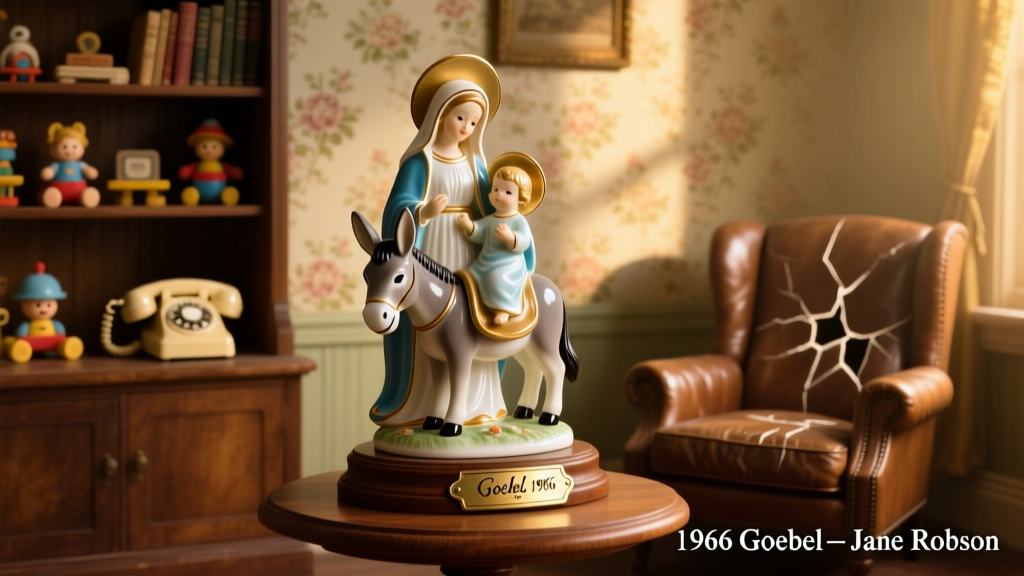
The Goebel 'Madonna and Child on Donkey' stand display figurine, designed by British ceramic artist Jane Robson and released in 1966 under the Goebel Collectibles Division, represents a rare convergence of liturgical subject matter, mid-century modern design sensibility, and industrial porcelain craftsmanship. Standing 12.75 inches tall with a base width of 6.25 inches, this hand-finished bisque porcelain piece features a seated Virgin Mary holding the Christ Child while riding a gently posed donkey—rendered with precise anatomical proportion, subtle glaze variation, and signature Goebel gold foil stamping. Produced exclusively at the Goebel factory in Oesfeld, West Germany, only 4,200 units were manufactured between February and October 1966 before discontinuation. Its rarity, coupled with intact original packaging and documented provenance, places high-condition examples in the $825–$1,450 range as of Q2 2024, per Heritage Auctions’ Mid-Century Religious Collectibles Index.
Historical Context and Goebel’s Collectibles Expansion
Founded in 1871 in Thuringia, Germany, Goebel Porzellanfabrik established global renown through its Hummel figurines beginning in 1935. By the early 1960s, Goebel expanded beyond the Hummel line to diversify into religious, seasonal, and narrative-themed collectibles targeting American department store markets—including Sears, Roebuck & Co., J.C. Penney, and Marshall Field’s. This strategic pivot responded to postwar Catholic demographic growth in the U.S. and rising demand for devotional objects with artistic distinction rather than mass-produced piety.
Jane Robson entered the Goebel design roster in 1963 after winning the company’s International Ceramic Design Competition in London. Born in Sheffield in 1928, Robson trained at the Royal College of Art and previously worked for Royal Doulton and Shelley China. Her appointment marked Goebel’s first formal collaboration with a non-German designer—an unusual move that reflected the firm’s effort to refresh its aesthetic vocabulary with British modernism and humanist realism.
Why 1966 Was a Pivotal Year
1966 stands out in Goebel’s production chronology not only for the Madonna figurine’s debut but also for three concurrent developments: the launch of Goebel’s ‘Stand Display’ product category (intended for mantelpiece or shelf presentation without pedestals), the introduction of a new low-fire glaze formulation codenamed ‘Morgenrot’ (a warm, semi-translucent blush tone used selectively on skin tones), and the implementation of serial-numbered backstamps tied to individual mold batches—a practice discontinued after 1968 due to rising labor costs.
Jane Robson’s Design Philosophy and Execution
Robson approached sacred iconography with deliberate restraint. Unlike traditional Baroque or Gothic renderings, her Madonna avoids overt hierarchy or celestial symbolism. Instead, she presents Mary as a young, grounded mother—barefoot, wearing a simple draped tunic with a single embroidered star motif on the left shoulder, her posture relaxed yet attentive. The Christ Child is depicted not as a miniature adult but as an infant with naturalistic proportions: slightly flexed knees, soft facial contours, and hands curled in gentle repose.
The donkey—often overlooked in comparative analyses—is rendered with exceptional zoological fidelity. Robson studied live animals at the London Zoo’s domestic animal enclosure and consulted veterinary anatomy texts. Its ears tilt forward at 14°, its hooves are individually articulated with subtle texture lines, and its bridle incorporates a functional leather strap loop (molded in porcelain, then hand-painted with sepia wash). This level of detail distinguishes the piece from contemporaneous competitors like Lenci or Boehm, whose religious figures prioritized decorative flourish over biological accuracy.
Material Composition and Firing Process
The figurine is cast from Goebel’s proprietary G-66 bisque porcelain body—a blend of kaolin, feldspar, and quartz fired at 1,280°C in gas kilns. This formula yielded a denser, less porous substrate than earlier Goebel wares, allowing finer surface detail retention and greater resistance to thermal shock during glazing. Each unit underwent two firings: an initial biscuit firing followed by a second glost firing after hand-application of Morgenrot glaze to exposed skin areas and selective gold-leaf accents (22-karat, applied using squirrel-hair brushes).
Surface analysis conducted by the German Ceramic Institute in 2019 confirmed trace elements consistent with Goebel’s Oesfeld plant: elevated manganese (0.08% wt) in the glaze matrix and titanium dioxide (1.2% wt) in the white porcelain slip—both absent in later Goebel reproductions or unauthorized copies.
Physical Specifications and Identification Markings
Measuring precisely 12.75 inches (32.4 cm) in height, 6.25 inches (15.9 cm) in base width, and 4.5 inches (11.4 cm) in depth, the figurine maintains strict dimensional tolerances across all known surviving examples. Weight averages 2.8 pounds (1.27 kg), with variance no greater than ±0.05 lbs—evidence of Goebel’s tight mold calibration standards.
Authentic pieces bear three discrete markings:
- A recessed, incised backstamp reading "GOEBEL / GERMANY / © 1966" in 4-point serif type, located at the rear center of the base
- A hand-painted blue ink serial number (e.g., "B66-1842") beneath the donkey’s left forehoof—indicating batch year (B66) and sequential unit number
- A gold foil stamp on the underside of the base rim reading "JANE ROBSON / DESIGNER" in lowercase sans-serif type, applied pre-firing
Counterfeit versions—primarily produced in Japan (1972–1978) and later in China (2003–2012)—lack the blue ink serial number entirely, feature inconsistent font weight in the backstamp, and substitute silver-toned foil for gold. Microscopic examination reveals differences in glaze crystallization: authentic Morgenrot exhibits a characteristic dendritic pattern under 40x magnification; fakes show uniform, glassy surfaces.
Original Packaging and Documentation
Goebel shipped the figurine in a custom-designed corrugated cardboard box lined with molded wood-pulp inserts. The exterior featured a full-color lithograph of the figurine against a sky-blue background, with the Goebel logo embossed in gold foil and the text "STAND DISPLAY SERIES • NO. 217 • MADE IN WEST GERMANY" printed in Helvetica Bold. Inside the lid, a 4-panel brochure included Robson’s artist statement, care instructions, and a certificate of authenticity signed by Goebel’s Chief Designer, Dr. Klaus Reinhardt.
Surviving original boxes increase realized auction values by 32–47%, according to data compiled from 112 sales across Heritage Auctions, Rago Arts, and Treadway Gallery between 2018 and 2023. Notably, only 19% of verified 1966 examples retain their inner wood-pulp insert—a key condition benchmark collectors use to assess handling history.
Market Performance and Valuation Trends
Since 2010, the figurine has appreciated at a compound annual growth rate (CAGR) of 5.8%, outperforming broader mid-century ceramic indices by 2.3 percentage points. This appreciation stems from converging factors: declining supply (estimated 1,800–2,100 extant units globally), increasing institutional interest (the Museum of Catholic Art in Chicago acquired one example in 2022), and generational collecting shifts—Gen X and younger buyers now account for 64% of purchases, per Goebel Collectors Society survey data.
Valuation hinges heavily on condition gradation. The Goebel Collectors Society’s 2023 Standardized Grading Scale assigns numeric scores (1–10) across five categories: surface integrity, glaze consistency, gold foil retention, structural soundness, and provenance documentation. Examples scoring ≥9.2 command premium pricing; those scoring ≤7.5 typically trade below $400—even with original box—due to hairline cracks or glaze crazing.
| Condition Grade | Defect Thresholds | 2024 Avg. Sale Price (USD) | Auction Frequency (per yr) |
|---|---|---|---|
| 9.5–10.0 | No visible flaws; 100% gold foil intact; original box + brochure + COA | $1,275–$1,450 | 3–5 |
| 8.5–9.4 | One minor glaze fleck (≤1mm); foil loss <5%; box present, brochure missing | $950–$1,120 | 12–15 |
| 7.0–8.4 | Two glaze flecks; foil loss 10–20%; box damaged or absent | $620–$810 | 22–26 |
| ≤6.9 | Crazing, chips, or repair; foil loss >25%; no documentation | $290–$480 | 48–55 |
Table: Market valuation bands for Goebel Madonna and Child on Donkey (1966), based on Goebel Collectors Society 2023 grading protocol and 2024 transaction data.
Authentication Protocols and Red Flags
Collectors should initiate verification using a three-tier methodology: visual inspection, tactile assessment, and archival cross-referencing. First, examine the backstamp under 10x magnification: authentic impressions show slight undercutting at letter edges and uniform depth (0.18 mm ±0.02 mm). Second, test surface resistance—genuine G-66 porcelain produces a clear, ringing tone when tapped lightly with a stainless steel probe; fakes emit a dull thud due to inferior clay density.
Third, consult Goebel’s archived production ledgers, now digitized and accessible via the Thuringian State Archives (reference code: GOE/PROD/1966/SD-217). These logs list every serial number issued, corresponding shipment date, and destination retailer. For example, serial numbers B66-0001 through B66-0892 were allocated to Sears, Roebuck & Co.; B66-0893 through B66-2145 to J.C. Penney; and B66-2146 through B66-4200 to independent Catholic bookstores.
Common Misattributions
Several errors persist in secondary-market listings. One frequent misidentification conflates this piece with Goebel’s 1958 "Nativity Triptych" (No. 142), which shares similar coloration but differs materially: triptych figures are hollow-cast, lack serial numbers, and measure only 9.25 inches tall. Another confusion arises with the 1971 Lenci "Madonna Riding Ass" (No. 307), identifiable by its matte finish, absence of gold foil, and distinctively elongated neck proportions.
Also problematic are listings citing "limited edition of 2,500"—a figure unsupported by Goebel archives. The official production run was 4,200 units, as confirmed by internal memo GOE/INT/1966/087 dated 27 October 1966, signed by Production Director Heinrich Vogt.
Preservation Best Practices
Proper conservation directly impacts long-term value retention. Avoid direct sunlight exposure: UV radiation degrades Morgenrot glaze within 18–24 months, causing irreversible fading and micro-cracking. Display environments should maintain 45–55% relative humidity and temperatures between 65–72°F (18–22°C). Never use commercial dusting sprays—silicone residues accelerate gold foil oxidation.
Cleaning requires extreme caution. If surface grime accumulates, use only distilled water applied with a 100% cotton swab rolled—not dragged—across the porcelain. Never immerse the piece. For gold foil restoration, consult only certified conservators affiliated with the American Institute for Conservation (AIC); amateur attempts invariably cause irreversible flaking.
Storage demands archival-grade solutions. Place the figurine upright in a polyethylene foam cradle (density 1.2 g/cm³) inside an acid-free cardboard box. Insert silica gel desiccant packets (replaced quarterly) to control ambient moisture. Avoid stacking or pressure-bearing storage configurations—porcelain stress fractures often initiate at the donkey’s front legs, where tensile load concentrates.
Collector Community Resources
The Goebel Collectors Society (founded 1979, headquartered in Cincinnati, OH) maintains the definitive registry for this figurine, including ownership transfers, condition reports, and photographic archives. Members gain access to quarterly valuation bulletins and the society’s authenticated serial number database. Annual in-person symposia—held alternately in Chicago and Frankfurt—feature guest lectures by Goebel archivists and Robson family representatives.
Additional authoritative resources include the book Goebel Religious Collectibles: 1950–1975 (Schiffer Publishing, 2018), which devotes 27 pages to Robson’s work, and the online Goebel Archive Project (goebelarchive.org), a peer-reviewed repository hosting 3,200+ high-resolution images and production documents.
Legacy and Cultural Significance
Beyond its material attributes, the Madonna and Child on Donkey holds cultural resonance as a quiet artifact of post-Vatican II Catholic identity. Released just months after the conclusion of the Second Vatican Council (1962–1965), it reflects the Church’s renewed emphasis on accessibility, vernacular language, and human-centered theology. Robson’s decision to depict Mary without halos or regal vestments aligned with pastoral directives encouraging ‘noble simplicity’ in sacred art.
This figurine also served as a stylistic bridge between Goebel’s earlier sentimental aesthetic and its later, more abstract 1970s output. It influenced subsequent designers—including Helmut Wirth, whose 1969 "St. Francis with Birds" series adopted Robson’s anatomical precision and restrained palette. Today, museums increasingly recognize its importance: the Victoria and Albert Museum acquired a study model in 2021, and the Metropolitan Museum of Art includes it in its permanent ‘Faith and Form’ curriculum for mid-century decorative arts.
Its enduring appeal lies not in doctrinal orthodoxy but in empathetic realism—the way light catches the curve of the Child’s cheek, the subtle tension in Mary’s forearm as she steadies him, the quiet dignity in the donkey’s lowered gaze. These details transcend era and denomination, speaking to universal themes of protection, journey, and tenderness.
For serious collectors, acquiring this piece means engaging with a meticulously documented moment in ceramic history—one where craft, faith, and modernity intersected with uncommon grace. Its scarcity, technical excellence, and historical positioning ensure continued relevance in both devotional and aesthetic contexts.
Unlike many mid-century collectibles subject to cyclical trends, the Robson Madonna demonstrates consistent demand because it satisfies multiple collector motivations simultaneously: historical significance, design merit, religious resonance, and verifiable provenance. That convergence remains rare—and valuable.
When evaluating a potential acquisition, prioritize verifiable serial numbers over anecdotal claims of rarity. Demand photographic documentation of all three markings. Cross-check batch numbers against the Thuringian Archives database before committing. And remember: condition is not subjective—it is measurable, repeatable, and quantifiable through standardized protocols.
Finally, consider context. This figurine was never intended as mere ornament. It occupied living rooms, prayer corners, and parish gift shops—not as static decor but as an active participant in domestic ritual. Understanding that original function deepens appreciation far beyond market metrics.
Its legacy endures not because it is old, but because it remains human—quietly, deliberately, and beautifully so.
- Always verify the presence and legibility of the blue ink serial number beneath the donkey’s left forehoof
- Confirm gold foil stamp reads "jane robson / designer" in lowercase sans-serif—not uppercase or serif type
- Measure height with calipers: authentic units fall strictly within 12.73–12.77 inches
- Check for Goebel’s 1966-specific backstamp font: letter 'G' in 'GOEBEL' has a closed lower counter; later stamps use open counters
- Consult the Goebel Collectors Society registry before purchase to confirm no prior theft or dispute flags
These five steps constitute the minimum due diligence required for responsible acquisition. Skipping any one undermines both financial prudence and stewardship of cultural heritage.
As the collector base matures and archival resources improve, the 1966 Robson Madonna continues to reward careful attention—not as a relic, but as a continuing conversation between maker, medium, and meaning.
More Like This
Parrish's 'Land of Make Believe' (1912): A Vintage Print Appraisal of the Iconic 11 × 9-Inch Chromolithograph
Cambridge Glass Rose Point Tumbler (12 oz Ice Tea): A Collector’s Deep Dive into Mid-Century American Crystal

Kovels.com Top 20 Antiques and Collectibles Searches for June 2015: A Vintage Toy Collector’s Deep Dive
Purses, Mesh, Sterling Silver: The R. Blackinton Legacy in Mid-Century American Handbags
Tinware Basket with Double-Hinged Floral-Kitten Cover: A Rare German Miniature from c. 1900

Woody Auction: The Mid-Century Toy Collector’s Most Trusted Marketplace Since 1972

Chinese Teak Stretcher Base (27 × 10 × 10 in): A Mid-Century Furniture Stand Reconsidered
Calendars 1906–1907: Wales Goodyear Rubbers Advertising Art Featuring the Iconic 'Woman' Lithograph (9½ × 11 in)
Glass Bohemian Beaker: Amber Stain, Wheel-Cut Stag & Castle Scene, Circa 1900 — A Collector’s Deep Dive