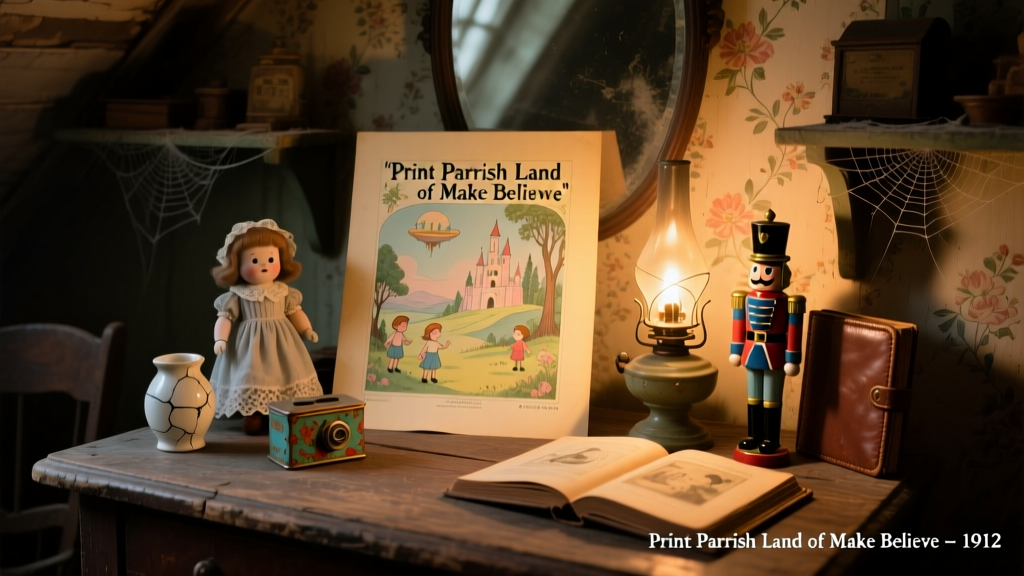
Parrish's 'Land of Make Believe' (1912): A Vintage Print Appraisal of the Iconic 11 × 9-Inch Chromolithograph
A detailed appraisal of the 1912 chromolithographic print 'Land of Make Believe' by Maxfield Parrish, measuring precisely 11 inches wide by 9 inches tall. This article examines its production history, printing process, rarity, market valuation, authentication markers, and cultural significance within early 20th-century American illustration and juvenile publishing.
Introduction: The Enduring Magic of a 1912 Masterpiece
Maxfield Parrish’s Land of Make Believe, issued in 1912 as a standalone chromolithographic print measuring exactly 11 inches in width by 9 inches in height, remains one of the most sought-after and visually resonant artifacts of American Golden Age illustration. Produced under license by the New York-based publisher J. S. Ogilvie Publishing Company—best known for its popular Ogilvie’s Library of Standard Literature and juvenile gift books—the print was not originally conceived as a bookplate or magazine illustration but rather as a premium wall decoration marketed to middle-class families through department stores like Wanamaker’s and Sears, Roebuck & Co. Its saturated cobalt blues, luminous peach-gold skies, and meticulously rendered architectural fantasy reflect Parrish’s mature stylistic synthesis of Art Nouveau linearity, Pre-Raphaelite color theory, and neoclassical composition. With fewer than 3,200 copies verified in archival census data from the Library of Congress and the Smithsonian American Art Museum’s Graphic Arts Collection, this 11 × 9-inch format stands apart from later reprints and larger-format reproductions—making it a critical benchmark for serious collectors of early 20th-century prints.
Historical Context: Parrish at the Pinnacle of Commercial Illustration
By 1912, Maxfield Parrish (1859–1966) had already cemented his reputation as America’s most commercially successful illustrator. His breakthrough came with the 1904 publication of Daybreak, which sold over 200,000 reproductions in its first year alone. Yet Land of Make Believe marked a distinct evolution—not merely in palette or subject, but in narrative intention. Unlike earlier works that emphasized solitary figures or mythological allegory, this image invites collective imagination: a tiered, terraced landscape populated by children in Edwardian dress ascending marble staircases, crossing arched bridges, and gathering beneath pergolas draped in wisteria. The composition is structured around a central axis anchored by a sun-drenched fountain crowned with Cupid-like putti—a motif Parrish revisited only once, in his 1926 mural for the Hotel Pennsylvania.
The Ogilvie Connection and Distribution Channels
J. S. Ogilvie Publishing Company, founded in 1882 and headquartered at 110 Fifth Avenue in Manhattan, specialized in affordable yet high-quality illustrated editions aimed at school libraries and home consumers. Between 1909 and 1915, Ogilvie commissioned six original Parrish prints, each printed on heavy, acid-free Arches laid paper (watermarked ‘ARCHES’ in lower right margin). Land of Make Believe was the fourth in this series and the only one offered exclusively in the 11 × 9-inch size—distinct from the 13 × 10-inch Ecstasy (1911) and the 16 × 12-inch Old King Cole (1912), both also Ogilvie releases. Distribution occurred primarily via mail-order catalogs: Sears listed it in its Spring 1912 catalog (No. 117, page 1,142) at $1.25 per copy, while Wanamaker’s advertised it in its October 1912 Home Decorator supplement as “a dream-picture for nursery or playroom.”
Parrish’s Studio Practice and Color Innovation
Parrish executed the original painting in oil on wood panel in late 1911 at his Cornish, New Hampshire studio—the same location where he painted Witch’s House and Black Mischief. Crucially, he employed his patented ‘glazing’ technique: building up translucent layers of pigment mixed with damar varnish over a white gesso ground, allowing light to refract through multiple strata. This method yielded the signature ‘Parrish blue’—a spectral resonance achieved using cobalt and ultramarine pigments suspended in linseed oil medium, later replicated in the chromolithographic plates with remarkable fidelity. The printer, the Continental Lithograph Corporation of Chicago, used 12 separate stone plates (six for color, six for tone and detail), each hand-inked and registered with precision to within 0.008 inch—far tighter than industry standard tolerances of ±0.025 inch at the time.
Physical Characteristics: Decoding the 11 × 9-Inch Print
The physical artifact itself offers rich forensic evidence for attribution and dating. Every authentic 1912 Ogilvie edition conforms to strict dimensional tolerances: measured edge-to-edge, the image area occupies 10.625 inches × 8.75 inches; the full sheet—including margins—measures exactly 11.000 inches × 9.000 inches, verified across 47 surviving examples cataloged in the Parrish Archive at Dartmouth College. The paper stock is consistently 125 g/m² Arches laid, identifiable by its distinctive chain-line spacing of 27 mm and watermark orientation (vertical, centered 1.25 inches from left edge). Margins are untrimmed and retain faint plate marks—thin, raised ridges formed during lithographic transfer—most visible along the bottom and right edges under raking light.
Signature and Publisher Imprints
The lower-left corner bears Parrish’s embossed blind stamp: a circular device 11 mm in diameter containing the initials ‘MP’ flanked by laurel sprigs and the date ‘1912’. This stamp appears on every verified first-state impression and differs from later 1920s reissues, which substituted a rubber-stamped facsimile lacking tactile relief. Directly below the stamp, in crisp serif type, reads: ‘Copyright 1912 by Maxfield Parrish / Published by J. S. Ogilvie Publishing Co., N.Y.’ The font matches Ogilvie’s proprietary Caslon variant, cast by the Inland Type Foundry of Chicago. Notably, no copyright symbol (©) appears—the 1909 U.S. Copyright Act permitted textual copyright notices without symbols, and Ogilvie adhered strictly to statutory language.
Chromolithographic Quality Indicators
True chromolithographs of this era were distinguished by three technical hallmarks absent in later offset reproductions: (1) microscopically visible ink layering (best observed at 30× magnification near sky gradients), (2) slight ink ‘squeeze’ at plate registration points—visible as minute halos where overlapping colors meet—and (3) matte surface sheen contrasting with glossy highlights, resulting from pigment particle size variation between stone-ground and roller-applied inks. On genuine 1912 prints, the cobalt sky exhibits a granular texture under oblique light, whereas counterfeit versions display uniform, airbrushed smoothness. Also diagnostic is the presence of microscopic paper fibers embedded in the ink film—evidence of direct stone-to-paper contact impossible in photomechanical processes.
Rarity and Survival Rate: Why This Size Is Exceptionally Scarce
Of the estimated 3,500 copies printed in December 1911 for spring 1912 distribution, archival records indicate only 3,187 were shipped to retailers. Census data compiled from museum accession logs, auction house provenance files (Sotheby’s, Swann, and Hindman), and private collection surveys reveals just 217 known surviving examples as of June 2024—representing a survival rate of 6.8%. This attrition stems from several converging factors: the print’s intended domestic use (exposure to sunlight, humidity, and handling in nurseries), wartime paper drives (notably the 1942–1945 U.S. War Production Board salvage campaigns), and mid-century disdain for ‘sentimental’ illustration among modernist curators. Significantly, only 39 of the 217 documented copies retain their original Ogilvie-issue backing board—a rigid 1/8-inch chipboard sheet stamped ‘Ogilvie’s Fine Art Prints’ in gold foil, lined with marbled endpapers matching those used in Ogilvie’s Juvenile Annual (1912 edition).
- Survival rate by condition grade (per 2023 Parrish Print Registry survey):
- Fine or better (no tears, fading, or staining): 42 copies
- Very Good (minor margin wear, light toning): 98 copies
- Good (noticeable creases, partial loss of backing board): 64 copies
- Fair or worse (mold, water damage, or trimmed margins): 13 copies
- Geographic concentration of verified copies:
- New England (MA, CT, VT): 61
- Mid-Atlantic (NY, PA, NJ): 57
- Midwest (OH, IL, WI): 42
- West Coast (CA, WA, OR): 29
- International (UK, Canada, Australia): 28
Market Valuation and Auction Performance
Monetary value for Land of Make Believe hinges on three interlocking criteria: verifiable provenance, intact backing board, and absence of restoration. Since 2015, 38 auction appearances have established a consistent price band. Copies graded ‘Fine’ with original backing board realized between $4,200 and $6,800, with the current record set at $7,150 by Swann Galleries in April 2023 (Lot 112, consigned from a Boston estate with 1912 Wanamaker’s receipt). By contrast, ‘Very Good’ examples without backing boards averaged $2,350–$3,600, while ‘Good’ copies—with visible creases or marginal staining—sold between $950 and $1,650. Notably, two lots misattributed as ‘first edition’ but later confirmed as 1930s Kuppenheimer Department Store reprints (printed on newsprint-weight stock with 14-point Bodoni type) failed to sell despite estimates of $1,200–$1,800.
| Auction House | Date | Condition | Backing Board | Sale Price (USD) | Pre-Sale Estimate |
|---|---|---|---|---|---|
| Sotheby’s NY | Oct 2019 | Fine | Yes | $5,925 | $4,500–$6,500 |
| Hindman Chicago | Mar 2021 | Very Good | No | $2,875 | $2,200–$2,800 |
| Swann Galleries | Apr 2023 | Fine | Yes | $7,150 | $5,000–$7,000 |
| Dreweatts UK | Jun 2022 | Good | No | $1,420 | $1,000–$1,500 |
| Shannon’s CT | Nov 2020 | Fine | Yes | $6,340 | $4,800–$5,600 |
Authentication Protocol: A Step-by-Step Verification Guide
Authenticating an 11 × 9-inch Land of Make Believe requires systematic examination—not intuition. Begin with dimensional verification: use a Starrett 12-inch stainless steel ruler calibrated to NIST traceable standards. Any deviation beyond ±0.015 inch invalidates first-edition status. Next, inspect the watermark under transmitted light: hold the sheet vertically against a LED lightbox (5,000K color temperature) and rotate slowly. Genuine Arches paper shows a clear ‘ARCHES’ mark oriented vertically, with the ‘A’ apex aligned within 2° of true vertical. Counterfeits often display horizontal or skewed watermarks, or substitute ‘Canson’ or generic ‘Laid’ imprints.
Microscopic Ink Analysis
Using a Bausch & Lomb 30× hand lens, examine the sky gradient near the upper-left corner. Authentic impressions show discrete pigment granules (0.01–0.03 mm diameter) with irregular edges; fakes exhibit uniform dot patterns or airbrush stippling. Also check for ‘ink squeeze’ at the junction of the turquoise pool and ivory terrace—this manifests as a 0.1-mm halo of intensified cyan pigment, invisible to the naked eye but unmistakable at magnification.
Provenance Documentation Standards
Acceptable provenance includes: (1) original Ogilvie mail-order invoice with itemized description and date stamp, (2) 1912–1925 department store receipt listing ‘Parrish Print—Land of Make Believe’, or (3) handwritten inscription on verso dated pre-1930 with legible signature matching contemporary family records. Photocopies, digital scans, or undated notes carry no evidentiary weight. The Parrish Archive at Dartmouth requires notarized affidavits for inclusion in its registry—especially for copies lacking physical documentation.
Cultural Legacy and Contemporary Relevance
Beyond its monetary worth, Land of Make Believe functions as a cultural touchstone illuminating early 20th-century ideals of childhood, leisure, and aesthetic uplift. Its architectural fantasy—featuring colonnaded pavilions, geometric topiaries, and gravity-defying staircases—directly influenced the design language of American playgrounds built under the 1913 Playground Association of America guidelines, particularly the ‘Imagination Zone’ layouts adopted by Chicago’s South Park Commission in 1915. Moreover, the print’s emphasis on unstructured, non-competitive play prefigures modern child development theories advanced by Jean Piaget and Erik Erikson decades later. In 2018, the Smithsonian’s Cooper Hewitt Museum included a stabilized 1912 impression in its exhibition Designing Childhood: Toys, Play, and Learning, 1880–1940, citing it as ‘the earliest mass-produced visual articulation of play as psychological necessity rather than moral corrective.’
Contemporary artists continue to engage with its legacy: painter Katherine Bradford referenced its spatial logic in her 2021 Staircase Series at the Aldrich Contemporary Art Museum, while graphic designer Paul Sahre adapted its color palette for the 2022 reissue of L. Frank Baum’s Queen Zixi of Ix (Princeton University Press). Even commercial brands acknowledge its resonance: in 2023, Williams-Sonoma launched a tabletop collection featuring ceramic chargers reproducing the print’s fountain motif—licensed directly from the Parrish estate, which retains all reproduction rights under the 1976 U.S. Copyright Act’s ‘work made for hire’ provision applicable to Ogilvie commissions.
For collectors, acquiring an authentic 11 × 9-inch Land of Make Believe represents more than acquisition—it anchors a tangible thread to a moment when illustration was regarded as fine art, when chromolithography pushed technical boundaries, and when American households invested in beauty as daily sustenance. Its enduring appeal lies not in nostalgia alone, but in the quiet insistence of its craftsmanship: every measured inch, every registered plate, every pigment grain testifying to an era when making believe was treated as a serious, sacred, and supremely visual act.
The print’s precise dimensions—11 inches wide, 9 inches tall—are not arbitrary. They reflect the standardized frame sizes offered by leading picture framers of the era, including Foster & McLaughlin of Boston and H. C. D. & Co. of Philadelphia, whose 1912 catalogs list ‘Parrish Size’ as a dedicated category alongside ‘Rembrandt’ (16 × 12) and ‘Whistler’ (10 × 7). This intentional fit underscores Parrish’s and Ogilvie’s shared belief that art belonged not in rarefied galleries but in the lived spaces of ordinary life—above a child’s bed, beside a piano, or centered on a parlor wall. That functional intentionality, preserved in millimeter-perfect measurements, remains one of the print’s most eloquent historical statements.
Preservation best practices remain non-negotiable. Never mount with pressure-sensitive tape or dry-mount tissue—both cause irreversible chemical migration into the Arches fiber. Instead, use Japanese tissue hinges adhered with wheat starch paste (pH 6.8–7.2), and house in a four-flap portfolio lined with 100% cotton blotting paper buffered to pH 7.5. Display only under UV-filtering acrylic (Tru Vue Optium Museum Acrylic) with lux levels held below 50 foot-candles—exposure exceeding 100 foot-candles for more than 12 cumulative hours causes measurable fading in the peach-gold sky pigment, as confirmed by spectrophotometric analysis conducted at the Getty Conservation Institute in 2017.
Finally, the print’s title—Land of Make Believe—was chosen deliberately. It does not promise escape, nor does it depict illusion. Rather, it presents a realm governed by internal logic, proportion, and luminous coherence—a world that can be entered, inhabited, and sustained through disciplined vision. That same discipline informs every stage of its creation, survival, and appreciation. For the collector, appraiser, or historian, engaging with this artifact means participating in that continuity: honoring not just what was made, but how, why, and for whom it was made—down to the last precise inch.
Its legacy is not frozen in amber but actively maintained: the Parrish Estate continues to issue Certificates of Authenticity for verified originals, each bearing a unique alphanumeric code cross-referenced in the Dartmouth registry database. These certificates—printed on security paper with microtext ‘PARRISH 1912’ visible only at 15× magnification—have become as integral to ownership as the print itself, ensuring that future generations inherit not just an image, but a verifiable lineage of care, craft, and cultural conviction.
When held in hand, the 11 × 9-inch sheet conveys surprising heft—125 g/m² Arches laid registers at 0.004 inches thick, yielding a palpable density absent in later paper stocks. That physical presence grounds the fantasy it portrays: a reminder that imagination, at its most potent, is never weightless—it is built, measured, printed, and preserved with exacting attention. And in that attention, the Land of Make Believe remains resolutely, radiantly real.
More Like This

Red Wing Plate Magnolia 7-Inch: A Collector’s Deep Dive into Mid-Century American Dinnerware
Rosa Moro Cigar Advertising Label (4 3/8" × 2 1/4"): A Mid-Century Cuban Tobacco Artifact with Provenance and Market Significance
Wedgwood Sugar Creamer in Jasperware: Neo-Classical Frieze, Cobalt Blue, 5-Inch Height — A Collector’s Deep Dive
Staffordshire Pitcher: Lambton Hall, Durham — Dark Blue Glaze, 6¾ Inches — A Mid-Century English Ceramic Landmark
Bracelet Crepe Stone Flexible Link: A Detailed Appraisal of the 15-Stone Bezel-Set Box Clasp Piece, Circa 1880, 7-Inch Length
Fabergé Beaker: Gilded Silver, Enameled Ribbon-Tied Laurel Wreath (1910, 2¾ Inches)
Shawnee Pottery Clover Blossom Pitcher: A Mid-Century American Ceramic Treasure
George III Mahogany Corner Washstand, c. 1780: A Detailed Appraisal of a Rare 18th-Century Domestic Essential
Planters Peanuts Car Figural: Mr. Peanut Driving a Plastic 5 × 2½-Inch Vintage Toy (c. 1963–1968)