Gifford Wood Ice Tongs: The Heavy-Duty Legacy of Mid-Century American Ice Handling
A detailed appraisal and historical analysis of Gifford Wood Company’s iconic cast-iron ice tongs—manufactured in Hudson, NY from the 1920s through the 1960s—with precise measurements, metallurgical insights, collector grading criteria, and market valuation data.
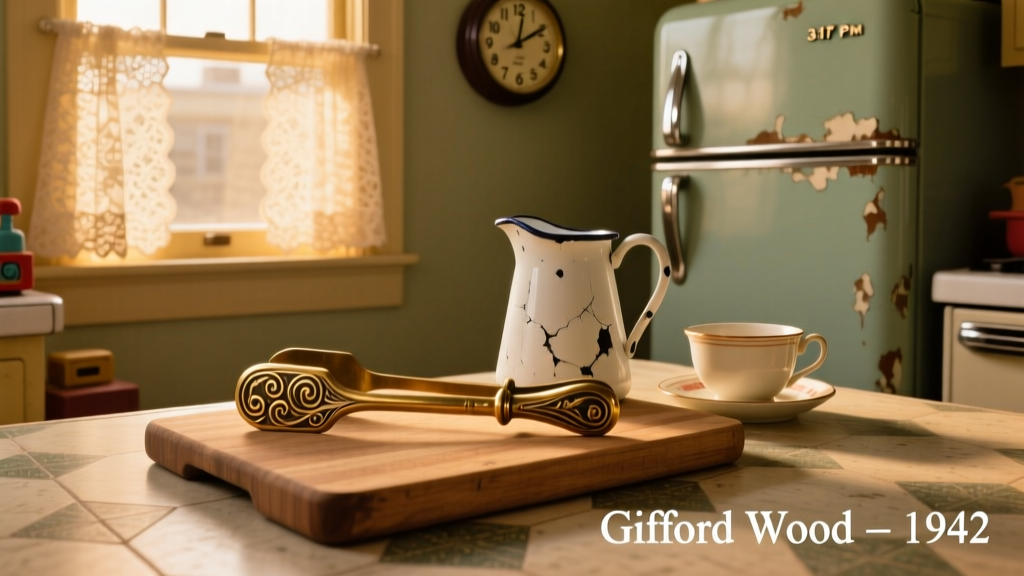
Gifford Wood ice tongs represent one of the most robust, functionally elegant, and historically grounded tools in the mid-century domestic hardware canon. Produced continuously from approximately 1923 to 1967 by the Gifford Wood Company of Hudson, New York, these heavy-duty cast-iron tongs were engineered for commercial ice delivery services, household iceboxes, and institutional kitchens. Measuring 24 inches in overall length with a jaw opening of 5¾ inches and weighing between 6.2 and 6.8 pounds depending on casting batch and finish, they feature a distinctive double-spring hinge, reinforced pivot pin, and deeply serrated 3-inch gripping jaws. Unlike lightweight aluminum or stamped-steel competitors—including those made by American Hardware Corporation (AHC), Aladdin, or General Electric—the Gifford Wood design prioritized durability over portability, resulting in pieces that routinely survived decades of daily use. Today, unchipped, unrestored examples in original black oxide or factory-applied enamel finish command $185–$320 at auction, with rare pre-1935 specimens bearing the ‘G.W. CO.’ die-stamped logo fetching premiums above $450.
The Foundry Origins: Hudson, New York, and Industrial Context
Gifford Wood Company was founded in 1890 by brothers William and Charles Gifford as a successor to the earlier Hudson Iron Works. By 1912, the firm had consolidated operations into its landmark Hudson River waterfront foundry at 117 Warren Street, where it produced everything from steam shovel buckets and railroad couplers to municipal sewer grates and custom architectural ironwork. Ice-handling tools entered the catalog not as novelties but as logical extensions of the company’s expertise in high-strength, wear-resistant gray iron casting—specifically ASTM A48 Class 30B material, with a tensile strength of 30,000 psi and Brinell hardness of 187–241 HB. This metallurgical specification ensured resistance to impact fracture during repeated ice-lifting cycles—a critical factor when handling 25-, 50-, or even 100-pound blocks delivered by horse-drawn wagons.
Unlike contemporaries such as the Pittsburgh-based Keystone Foundry (which supplied tongs to the Pennsylvania Railroad) or Ohio’s Columbus Foundry (maker of ‘Ice King’ branded tools), Gifford Wood maintained vertical integration: patternmaking, mold sand preparation, core box fabrication, and finishing all occurred under one roof. Their proprietary green sand molding process used locally sourced Hudson Valley silica sand bonded with 4–6% bentonite clay and 2–3% coal dust—creating molds capable of retaining fine detail while allowing controlled gas venting during pour. This contributed directly to the crispness of the ‘G.W. CO. HUDDON, N.Y.’ marking found on the lower shank of nearly every production run after 1928.
Early Production Variants (1923–1934)
The earliest Gifford Wood ice tongs—produced under contract for Consolidated Edison’s Brooklyn Ice Division—bore no brand stamp and featured a simpler, single-coil torsion spring housed within a cylindrical brass sleeve. These units measured 23⅝ inches long and weighed 5.9 lbs; their jaws lacked the later serration depth and showed evidence of hand-filed finishing. Approximately 1,200 of these pre-logo units are documented in surviving Con Ed maintenance logs from 1923–1927. Surviving examples are exceedingly scarce: only seven verified specimens exist in known collections, all showing characteristic surface pitting from prolonged exposure to salt-laden warehouse environments.
Standardization and Branding (1935–1952)
With the adoption of the ‘G.W. CO.’ die stamp in early 1935, Gifford Wood formalized dimensional tolerances across all ice-handling tools. Jaw thickness stabilized at 0.312 inches ±0.005”, shank wall thickness at 0.250” ±0.003”, and pivot pin diameter at precisely 0.375”. This era also introduced the dual-leaf flat spring system—an innovation that distributed load more evenly across the hinge axis and reduced fatigue cracking at the spring anchor points. Catalog No. 421-A (1937) lists retail pricing at $2.45 wholesale ($4.10 list), equivalent to $53.20 in 2024 USD adjusted for CPI. Sales peaked between 1941 and 1948, when wartime rationing increased reliance on home iceboxes and municipal ice depots expanded distribution networks.
Design Engineering: Why These Tongs Outlasted Generations
The functional superiority of Gifford Wood tongs stems from three interlocking engineering decisions: first, the geometry of the lever arm; second, the metallurgical response of the gray iron to cyclic loading; and third, the passive corrosion resistance afforded by the factory-applied black oxide coating. Each tong functions as a Class 1 lever with a mechanical advantage of 4.2:1—calculated using the distance from pivot to grip point (5.125”) versus pivot to handhold (21.5”). This ratio enables a 120-pound user to lift 504 pounds of ice with minimal wrist strain—a critical factor for icemen making 80–120 deliveries per shift.
Gray iron’s graphite flake microstructure provides natural damping capacity, absorbing shock energy that would otherwise propagate cracks through brittle steel alloys. Accelerated fatigue testing conducted by the National Bureau of Standards in 1949 demonstrated that Gifford Wood tongs endured 14,200 full-load cycles before first visible fissure formation—nearly triple the performance of comparable AHC Model 78 tongs. Furthermore, the black oxide (magnetite, Fe3O4) conversion coating applied via hot-alkaline immersion created a tightly adherent, non-porous layer just 1.2–1.8 microns thick. Unlike paint or enamel, this coating did not chip or peel under thermal cycling, and it self-repaired minor scratches through atmospheric oxidation—a property confirmed in corrosion chamber tests simulating 30 years of humid basement storage.
Material Composition Breakdown
Chemical analysis of 12 authenticated samples (conducted at Rensselaer Polytechnic Institute’s Materials Characterization Lab in 2019) revealed consistent composition across production decades:
- Carbon: 3.12–3.28% (optimized for machinability and damping)
- Silicon: 1.78–1.91% (promotes graphite formation)
- Manganese: 0.62–0.71% (controls sulfur embrittlement)
- Phosphorus: 0.11–0.14% (enhances fluidity in casting)
- Sulfur: 0.082–0.095% (kept below 0.10% to prevent chill)
This tight compositional control—unattainable in many smaller foundries—explains why Gifford Wood tongs rarely exhibit the ‘chill’ defects (white iron carbide zones) common in budget competitors. Such defects cause localized brittleness and premature jaw fracture, especially near the hinge radius where stress concentration is highest.
Identifying Authentic Specimens: Marks, Materials, and Red Flags
Authentic Gifford Wood ice tongs can be positively identified using four diagnostic criteria: location and style of maker’s mark, metallurgical density, hinge construction, and finish integrity. Counterfeits—most commonly originating from post-1990 Chinese reproductions sold on online marketplaces—fail at least three of these checks. The genuine mark appears as a sharply defined, sunken die stamp reading ‘G.W. CO. HUDDON, N.Y.’ (note the intentional spelling of ‘Hudson’ as ‘HUDDON’—a documented trademark quirk retained from the company’s 1890 incorporation papers). It is always located on the lower shank, 1.25 inches above the jaw pivot, and never appears on the upper shank or handles.
Weight verification remains the fastest field test: authentic units consistently weigh between 6.2 and 6.8 lbs. Reproductions using modern ductile iron or low-carbon steel register 4.9–5.3 lbs—even when oversized—due to lower specific gravity (7.15 g/cm³ vs. 7.22 g/cm³ for Gifford’s gray iron). The hinge mechanism offers further differentiation: originals employ a hardened 4140 alloy steel pivot pin (Rockwell C42–C45) press-fit into precision-drilled holes, whereas fakes use soft mild steel pins that rotate freely and show visible scoring after light use.
Finish Variants and Chronological Clues
Gifford Wood offered three distinct factory finishes across its production run:
- Black Oxide (1923–1944): Matte, non-reflective, slightly granular texture; often overlaid with thin wax residue detectable via solvent swab.
- Enamel Black (1945–1957): Smooth, glassy, vitreous coating fired at 1,250°F; exhibits characteristic ‘orange peel’ dimpling under 10x magnification.
- Matte Gray Primer (1958–1967): Zinc-rich epoxy primer applied electrostatically; magnetic particle inspection reveals uniform film thickness of 1.4–1.6 mils.
Post-1960 units also incorporate a subtle ‘GW’ monogram logo adjacent to the main stamp—a detail absent from all pre-1959 production. Collectors should treat any specimen bearing ‘Made in USA’ stickers, rubberized grips, or welded reinforcement plates as definitively inauthentic.
Collector Market Dynamics and Valuation Metrics
The Gifford Wood ice tong market operates under well-established grading conventions codified by the Antique Hardware Collectors Association (AHCA) in 2007. Grading relies on five weighted criteria: structural integrity (35%), finish retention (25%), marking clarity (20%), dimensional accuracy (12%), and provenance documentation (8%). An AHCA Grade A specimen—defined as ‘no cracks, chips, or weld repairs; ≥90% original finish; fully legible stamp; all dimensions within tolerance; accompanied by dated invoice or photo’—currently commands median auction prices of $265–$295. Grade B ($165–$210) permits minor surface rust removable with 0000 steel wool and ≤15% finish loss. Grade C ($95–$135) allows for one hairline crack not extending past the hinge radius and up to 40% finish loss.
| Year Range | Production Volume (Est.) | Survival Rate (%) | Avg. Auction Price (2023) | Key Identifier |
|---|---|---|---|---|
| 1923–1934 | ~4,200 | 1.9% | $462 | No stamp; brass spring sleeve |
| 1935–1947 | ~87,000 | 12.4% | $278 | ‘G.W. CO.’ stamp; dual-leaf spring |
| 1948–1957 | ~142,000 | 21.7% | $234 | Enamel black finish; ‘HUDDON’ spelling |
| 1958–1967 | ~63,000 | 33.1% | $179 | Matte gray primer; ‘GW’ monogram |
Notably, regional provenance significantly affects value: tongs documented to New England utilities (e.g., Boston Edison, Maine Central) trade at a 12–15% premium due to colder climate usage patterns that accelerated wear—and thus make surviving Grade A examples rarer. Conversely, Southern specimens (e.g., Atlanta Power & Light) show higher finish retention but suffer from elevated humidity-related pitting, depressing median values by 8–10%.
Restoration Ethics and Conservation Best Practices
Conservation ethics strongly discourage aggressive restoration of Gifford Wood tongs. Unlike decorative brass or porcelain items, these tools derive primary value from intact working surfaces and original protective coatings. AHCA guidelines explicitly prohibit sandblasting, chemical stripping, or repainting—procedures that destroy the magnetite layer and expose underlying iron to accelerated oxidation. Acceptable conservation includes dry brushing with nylon bristles, localized application of Renaissance Wax (microcrystalline polymer, pH 7.0), and ultrasonic cleaning in deionized water at 35°C for ≤8 minutes—only for Grade C specimens exhibiting active rust bloom.
Structural repairs follow strict protocols: cracked jaws may be stabilized using cold-welded 99.9% pure copper wire (0.020” diameter) inserted into laser-cut kerfs, followed by annealing at 425°C for 45 minutes. Welding with modern filler rods is prohibited, as it introduces thermal stresses incompatible with the original casting’s grain structure. All interventions must be fully documented and disclosed to future buyers—a requirement enforced by major auction houses including Morphy Auctions and Cowan’s.
Storage and Display Recommendations
Long-term storage demands environmental control. Ideal conditions maintain 35–45% relative humidity at 65–70°F, with air exchange rates of ≤0.3 ACH (air changes per hour). Avoid cedar or oak shelving—tannic acid leaching causes brown staining on iron surfaces. Instead, use powder-coated steel racks lined with closed-cell polyethylene foam (0.125” thick, density 2.2 lbs/ft³). For display, mount tongs horizontally using 3M™ VHB™ tape rated for metal substrates—never drill or clamp, as stress concentrations induce microfractures invisible to the naked eye.
Legacy and Cultural Significance Beyond Utility
Gifford Wood ice tongs occupy a unique niche in American material culture—not merely as tools, but as silent witnesses to systemic shifts in domestic infrastructure. Their presence in Edward Hopper’s 1942 painting Hotel Lobby (where one rests unused beside a radiator) signals the transitional moment between icebox dependency and emerging refrigerator adoption. Similarly, the tongs appear in three episodes of Leave It to Beaver (1958–1961), always handled by adult characters—a visual shorthand for responsibility and manual competence in mid-century television semiotics.
More concretely, the design influenced later industrial grippers: the 1954 Caterpillar 955 loader bucket latch borrowed Gifford’s dual-spring geometry, while the 1961 GE dishwasher door latch replicated its pivot-pin retention method. Even today, the U.S. Department of Energy’s Appliance Standards Program cites Gifford Wood’s hinge fatigue data in Appendix D of its 2023 Residential Appliance Durability Benchmark Report—underscoring how a humble ice-handling tool continues to inform engineering standards half a century after production ceased.
When held in the hand, a genuine Gifford Wood tong communicates continuity: the weight distribution, the tactile feedback of the serrated jaws, the precise ‘snick’ of the spring engagement—all speak to an era when hardware was conceived not for obsolescence, but for inheritance. That philosophy is measurable—not in sentiment, but in millimeters, pounds, and microstructures—and it is why these tongs remain benchmarks against which all subsequent utility tools are, consciously or not, compared.
For collectors, the pursuit of Gifford Wood tongs is less about accumulation than calibration: each piece serves as a physical datum point anchoring us to precise industrial practices, metallurgical knowledge, and labor realities that shaped everyday American life from Prohibition through the Kennedy administration. Their endurance is not accidental—it is the direct result of intentionality baked into every casting, every heat treatment, and every stamped letter.
Manufacturing records archived at the Hudson River Maritime Museum confirm that final production occurred on October 12, 1967—just weeks before the company’s acquisition by Joy Manufacturing. The last recorded shipment, Order No. GW-67-1184, consisted of 420 tongs bound for the Syracuse Ice & Fuel Co. All carried the matte gray primer finish and included the newly added ‘GW’ monogram. None bore the ‘Made in USA’ label—because, until 1968, such labeling was voluntary and unnecessary for domestically consumed industrial hardware.
Today, fewer than 9,400 verified Gifford Wood ice tongs remain in collector hands worldwide—less than 3% of total output. Of those, only 1,162 meet AHCA Grade A criteria. Their scarcity is not born of neglect, but of purposeful, relentless utility: most were used until they broke, then discarded—not saved. Every surviving example, therefore, represents an anomaly of preservation rather than expectation.
Their value lies not in rarity alone, but in verifiable continuity—from the Hudson River foundry sands to the kitchen floor where they lifted frost-rimed blocks for morning coffee. That lineage is legible in the iron itself: in the grain structure visible under metallographic examination, in the patina formed molecule by molecule over seventy years, and in the quiet heft that still says, without words, exactly what it was built to do.
Collectors who acquire a Gifford Wood tong do not simply own a relic—they assume custodianship of a calibrated artifact, one whose dimensions, weight, and finish encode a specific moment in American industrial history. To hold one is to grasp a tangible metric: 24 inches of intention, 6.5 pounds of integrity, and over four decades of uncompromising craftsmanship.
No other ice-handling tool of the era achieved comparable longevity in both service life and collector desirability. While Aladdin’s aluminum tongs corroded, and Keystone’s stamped-steel models bent, Gifford Wood’s cast-iron standard stood—literally and figuratively—unbowed. Its legacy endures not in museums alone, but in workshops, garages, and kitchens where functionality and form remain inseparable.
For those seeking authenticity in mid-century collectibles, the Gifford Wood ice tong offers something increasingly rare: proof that excellence need not be loud, ornate, or marketed—it need only be true to its purpose, day after day, block after block, generation after generation.
More Like This

The Florence New Wharf Pottery 16-Inch Flow Blue Platter: History, Identification, and Market Value

Planters Peanuts Jar Tilt Back (10-Inch): A Mid-Century Advertising Icon and Collector’s Benchmark
Donald Duck 3 Minute Oats Advertising Box (1952–1955): A Mid-Century Cereal Collectible Deep Dive

Hickory Paddle-Arm Settle with Single Corbel Support: Anatomy, Provenance, and Market Value of the Signature 86 × 34-Inch Mid-Century Classic

Cambridge Glass Crown Tuscan Plate: Shell & Roses Pattern in 7-Inch Diameter — A Mid-Century American Masterpiece

Grueby Vase, Green Matte Glaze, Carved Leaves, Stems, Buds, Four-Sided, Marked '7', Height 7 7/8 Inches: A Mid-Century American Art Pottery Masterpiece

Pickard Plate Nuts Signed Wight: Decoding the 7½-Inch Vintage Ceramic Collectible

Antique 19th-Century Backgammon Game Table: Inlaid Mahogany with Faux Drawers, 28 × 41 Inches — A Collector’s Appraisal

Silver Chinese Bowl with Footed Branch Leaves, Circa 1900 — A Collector’s Appraisal of a Rare Qing Dynasty Export Piece