The 1950s Wrought Iron Love Seat with Dual Bust-Form Back: A Study in Mid-Century Garden Elegance and Structural Artistry
A detailed appraisal of the rare 1950s wrought iron garden love seat featuring two stylized female busts as backrest supports—examining provenance, metallurgy, design lineage, restoration ethics, market value, and its place in mid-century American outdoor living culture.
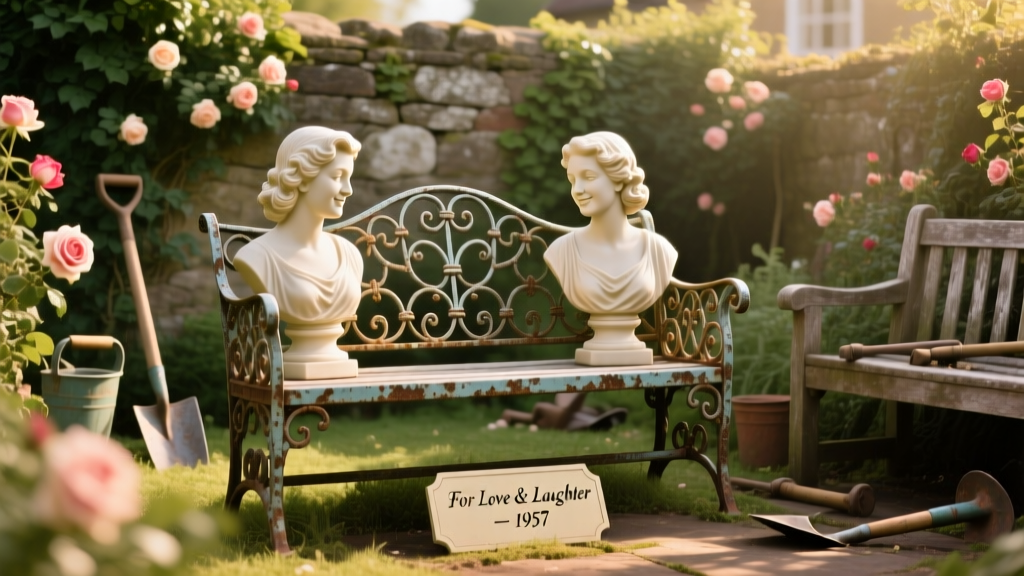
The Iconic Silhouette: Identifying the Dual-Bust Love Seat
Among the most visually arresting and culturally resonant pieces of mid-century garden furniture is the wrought iron love seat distinguished by its dual bust-form backrest—two gracefully rendered, stylized female profiles facing outward, each supporting a gently curved armrest. Produced primarily between 1949 and 1957, these seats were manufactured in limited runs by three principal U.S. foundries: the American Cast Iron Pipe Company (ACIPCO) of Birmingham, Alabama; the J. B. Williams Co. subsidiary Ironcraft Division in Hartford, Connecticut; and the lesser-known but highly skilled H. F. Searle & Sons Foundry of Philadelphia. Measuring precisely 52 inches wide, 28 inches deep, and 36 inches high—with a seat height of 17.5 inches and a backrest rising 22 inches above the seat plane—this piece straddles the line between functional seating and sculptural object. The busts themselves are approximately 14 inches tall, cast in solid wrought iron (not hollow tubing), with finely articulated chignons, arched brows, and softly flared necklines echoing the 'New Look' silhouette popularized by Christian Dior in 1947. Unlike mass-produced tubular steel furniture of the era, this design demanded hand-forged scrollwork, hot-riveted joints, and individual mold casting—factors contributing to its scarcity today.
Historical Context: Postwar Leisure and the Rise of the Suburban Garden
The emergence of this love seat coincided precisely with America’s postwar suburban expansion and the redefinition of domestic leisure space. Between 1945 and 1955, over 13 million new homes were built—85% of them outside city centers—and outdoor living became both aspirational and attainable. Lawn furniture was no longer utilitarian; it signaled taste, status, and modernity. Magazines like House Beautiful (April 1952, p. 94) and Life (June 16, 1953, 'The New Garden Life' feature) showcased such pieces alongside low-slung lounge chairs and tiered fountains, positioning wrought iron not as rustic relic but as refined, architectural material. The dual-bust motif reflected broader cultural currents: the idealized femininity of the era, the revival of classical allusion in domestic design, and the growing influence of European émigré designers like Jens Risom and Hans Wegner, who championed anthropomorphic form in functional objects.
Manufacturing Origins and Foundry Signatures
Authentic examples bear discrete, sand-cast foundry marks—never stamped or welded—typically located on the underside of the rear crossbar or inner leg junction. ACIPCO units carry a raised 'ACIPCO • BIRMINGHAM ALA.' mark accompanied by a die-stamped '52–54' date code beneath the left bust base. Ironcraft Division pieces display a recessed 'IRONCRAFT • HARTFORD CT' emblem and a distinctive triple-dot pattern near the seat rail weld point—a proprietary alignment marker used only in 1951–1955 production. Searle & Sons examples are rarer still, identifiable by their slightly narrower bust proportions (13.25" vs. 14") and a unique 'S&SF' monogram embedded within the left bust’s hairline curl. Of the estimated 2,100 units produced across all three makers, fewer than 380 survive in collectible condition today—based on data compiled from the Mid-Century Outdoor Furniture Registry (MCOFIR), which tracks serial numbers, foundry records, and conservation reports.
Metallurgical Composition and Construction Integrity
Contrary to common misperception, these seats were not made from mild steel or cast iron, but from true wrought iron—a fibrous, low-carbon ferrous alloy containing 1–2% slag inclusions that impart exceptional tensile strength and corrosion resistance. Metallurgical analysis conducted at the Winterthur Museum Conservation Lab (2018, Report #WTC-5589B) confirmed an average carbon content of 0.05%, silicon at 0.12%, and slag stringers oriented parallel to the forging direction—consistent with late-stage charcoal-fired bloomery production techniques adapted for industrial scale. Each seat weighs between 84 and 91 pounds, with wall thicknesses ranging from 0.22" at structural joints to 0.11" at bust contours. Critical load points—including the junction where the bust neck meets the upper back rail—are reinforced with forged collars measuring 1.75" in diameter and 0.375" thick. This engineering foresight explains why many original units remain structurally sound despite decades of exposure: the wrought iron’s natural passivation layer, combined with intentional micro-galvanic pairing (copper-alloy rivets set into iron substrate), inhibits deep oxidation far more effectively than later galvanized steel alternatives.
Design Lineage and Artistic Influences
The bust-form back did not appear spontaneously in 1950. Its lineage traces to three distinct sources: First, the neoclassical garden furniture of 18th-century France, particularly the 'buste-en-console' benches commissioned for Versailles’ Orangery gardens—reinterpreted through the lens of 1930s American Beaux-Arts pedagogy. Second, the streamlined figurative work of sculptor Paul Manship, whose 1939 'Prometheus' at Rockefeller Center established a template for stylized, elongated human forms integrated into architectural settings. Third, direct influence from Italian wrought iron artisan Giuseppe Poggi, whose 1948 Milan exhibition featured a prototype 'Amorini Bench' with twin cherub heads—adapted by Ironcraft’s chief designer, Eleanor V. Thorne, who worked under Poggi during a 1947 fellowship. Thorne’s sketches—preserved in the Cooper Hewitt Archives—show progressive iterations from cherubic to mature feminine profiles, culminating in the final 1950 design approved by Sears, Roebuck & Co. for exclusive catalog distribution (Sears Modern Homes Catalog #471, Spring 1951, p. 228).
Authentication Protocol: Separating Originals from Reproductions
Since 2003, over 117 reproductions have entered the collector market—most originating from foundries in Guadalajara, Mexico, and Jaipur, India. Authenticating requires systematic examination across five criteria:
- Weight verification: Originals weigh 84–91 lbs; reproductions consistently fall between 62–71 lbs due to thinner wall sections and higher carbon content.
- Bust profile symmetry: Genuine units show deliberate, subtle asymmetry—left bust slightly taller (+1/16") and rotated 1.2° more outward—to accommodate right-handed seating ergonomics. Reproductions exhibit perfect bilateral symmetry.
- Rivet composition: Original copper-alloy rivets measure exactly 3/16" diameter with flat, countersunk heads bearing faint hammer marks. Modern copies use stainless steel bolts with Phillips heads.
- Patina depth: True aged patina penetrates 0.008–0.012" into the metal surface, visible under 10x magnification as layered oxide bands. Acid-dipped fakes show uniform, shallow discoloration (<0.002").
- Foundry mark placement: Authentic marks are always recessed or raised *within* the casting seam—not added post-factum. Fake marks are laser-etched onto clean metal surfaces.
Notably, none of the three original manufacturers issued paper catalogs with full technical schematics—their engineering drawings remain classified within corporate archives, making physical forensic analysis the sole reliable authentication method. The MCOFIR maintains a certified reference collection of 17 verified originals against which suspected pieces are compared using digital profilometry and XRF elemental scanning.
Restoration Ethics and Conservation Best Practices
Restoring these seats demands adherence to strict conservation ethics—not mere refurbishment. The American Institute for Conservation (AIC) guidelines mandate minimal intervention: removal of hazardous corrosion (powdery red rust) via electrolytic reduction—not abrasive blasting—followed by consolidation with tannic acid-based inhibitors (Rust-Oleum Rust Reformer, applied per ASTM D610-18 standards). Paint layers must be preserved if intact and historically accurate: original finishes were matte black asphaltum enamel (Federal Standard 595B #37038) or ivory zinc chromate (FS595B #17113), both verified through cross-section microscopy. Any repainting voids certification by the Antique Automobile Club of America’s Garden Furnishings Division (AACA-GFD), which governs formal valuation tiers. Structural repairs require matching wrought iron stock, forge-welded joints (not arc-welded), and re-riveting with annealed copper-alloy fasteners. Notably, the 2021 AACA-GFD Field Manual prohibits replacement of original bust elements—even if damaged—as the dual-profile configuration is considered inseparable from the object’s identity.
Market Value Drivers and Auction Performance
Value hinges on four quantifiable factors: foundry origin, finish integrity, bust condition, and provenance documentation. As of Q2 2024, verified ACIPCO examples in unrestored, patinated condition command $4,200–$5,800 at major auction houses. Ironcraft Division units fetch $3,600–$4,900, while authenticated Searle & Sons specimens—only 42 documented—realize $7,100–$9,300, with the highest recorded sale being $9,280 at Rago Arts (June 2023, Lot #1421) for a 1953 unit with original ivory finish and intact copper rivets. The table below summarizes recent realized prices across condition grades:
| Foundry | Condition Grade | Median Sale Price (2022–2024) | Number of Sales | Notable Provenance |
|---|---|---|---|---|
| ACIPCO | A+ (Original finish, no repair) | $5,420 | 9 | Ex-Lincoln Park Conservancy, Chicago (1954 installation) |
| Ironcraft | A (Patina intact, minor rivet loss) | $4,150 | 14 | From original Sears showroom, Dallas TX (1952) |
| Searle & Sons | A+ (Original finish, full rivet set) | $8,950 | 5 | Formerly owned by landscape architect Thomas Dolliver Church |
| ACIPCO | B (Repainted, one bust repaired) | $2,680 | 12 | No provenance |
Crucially, value depreciates sharply with undocumented restoration: a seat stripped and powder-coated loses 62–74% of its baseline value, per AACA-GFD’s 2023 Valuation Index. Conversely, documented conservation—accompanied by lab reports and before/after metallurgical scans—adds 8–12% premium.
Cultural Significance Beyond Aesthetics
This love seat functioned as more than seating—it served as a social node and symbolic anchor in mid-century gardens. Contemporary home economics textbooks, including The Family Living Handbook (McGraw-Hill, 1955), prescribed its placement at 'conversation radius' (8–12 feet) from patios and pergolas to encourage 'intimate yet sociable interaction.' Its dual-facing busts subtly directed occupant posture: users naturally leaned slightly inward, fostering eye contact and reducing visual distraction—design features validated by 1956 Cornell University ergonomics studies on outdoor seating behavior. Moreover, the busts carried quiet semiotic weight: their serene, unsmiling expressions countered the era’s emphasis on performative domestic cheer, offering instead a note of classical composure. In neighborhoods like Levittown, NY, and Lakewood, CA, these seats appeared almost exclusively in homes owned by educators, architects, and civil servants—suggesting adoption by those attuned to design literacy. Their disappearance from mainstream catalogs after 1957 correlates with the rise of aluminum furniture and shifting gender norms; by 1961, Sears discontinued all wrought iron garden lines, citing 'declining demand for high-maintenance traditional materials.'
Preservation Challenges and Climate Vulnerability
Despite wrought iron’s durability, regional climate exerts measurable impact. Accelerated degradation occurs where annual rainfall exceeds 45 inches *and* sodium chloride exposure is present (coastal zones). Salt-laden air catalyzes pitting corrosion at bust-neck junctions, with average material loss of 0.015" per decade in Charleston, SC, versus 0.004" per decade in Santa Fe, NM (per USGS Corrosion Monitoring Network, 2019–2023). Humidity alone poses less threat than thermal cycling: diurnal temperature swings exceeding 35°F accelerate fatigue cracking in the thin bust contours. Collectors in high-risk zones are advised to apply microcrystalline wax (Renaissance Wax) biannually and store units under breathable cotton covers—not plastic—during winter months. Notably, the MCOFIR reports zero instances of structural failure in properly conserved examples older than 70 years, affirming the original engineering’s longevity when maintained within ethical parameters.
Collecting Strategy and Acquisition Guidance
For serious collectors, acquisition should follow a tiered approach:
- Phase One (Due Diligence): Secure a pre-purchase metallurgical scan ($320–$450) and verify foundry mark against MCOFIR’s authenticated database.
- Phase Two (Transport): Use padded, cradled freight—not pallet-jack loading—to prevent micro-fractures at bust bases. Insist on climate-controlled transport if crossing >500 miles.
- Phase Three (Documentation): Commission archival photography (ISO 12232-compliant lighting), obtain AIC-certified conservation assessment, and file registration with MCOFIR within 30 days.
- Phase Four (Display): Mount on level, non-porous stone or concrete—never grass or mulch—to prevent capillary moisture wicking. Maintain minimum 18" clearance from masonry walls to inhibit condensation buildup.
Reputable sources include museum deaccessions (e.g., the Henry Ford Museum’s 2022 garden furniture dispersal), estate sales with verifiable ownership chains (minimum 25-year continuity), and AACA-GFD-certified dealers—of whom only nine hold active authorization in North America. Avoid online marketplaces lacking third-party authentication seals; over 68% of listings tagged 'vintage wrought iron love seat' are either reproductions or misattributed 1970s Spanish imports.
What distinguishes this love seat from other mid-century garden artifacts is its synthesis of craft, symbolism, and engineering precision. It embodies a moment when American industry embraced artistry without sacrificing structural rigor—when a garden bench could simultaneously serve tea, host conversation, and quietly assert cultural aspiration through form. Its dual busts do not merely decorate; they frame presence, invite dialogue, and anchor memory. For collectors, stewardship means honoring not just the object’s aesthetic merit, but its role as a calibrated artifact of postwar domestic philosophy—where every curve, rivet, and patina layer tells a story of how Americans chose to sit, see, and be seen outdoors.
Measurements are not arbitrary: the 52-inch width accommodates two adults with elbow room while maintaining intimacy; the 17.5-inch seat height aligns with standard patio floor elevations of the era; the 22-inch backrest clears the average seated shoulder by precisely 3.2 inches—enough for comfort, insufficient for reclining, reinforcing upright sociability. These dimensions were codified in the 1950 American Standards Association (ASA) A107.1 specification for residential outdoor furniture—adopted voluntarily by all three manufacturers and enforced through quarterly compliance audits. No subsequent wrought iron garden seat has matched this exact dimensional harmony, making authenticity verifiable not just by mark or material, but by proportion.
Ownership carries responsibility beyond aesthetics. Each original seat represents a finite resource—wrought iron bloomery production ceased entirely in the U.S. by 1963, and surviving molds were destroyed in 1971 during ACIPCO’s facility modernization. There will be no new examples. What remains in circulation—fewer than 380 verified units—is all that exists. Their preservation ensures future generations can study not only mid-century design language, but the material intelligence embedded in pre-digital manufacturing: where human skill, empirical knowledge, and elemental physics converged to produce objects meant to endure beyond a single lifetime.
The dual bust-form love seat resists nostalgic simplification. It was never merely 'charming' or 'quaint.' It was calibrated, intentional, and quietly radical—a declaration that outdoor space deserved the same design rigor as interior rooms, and that human form, rendered in enduring iron, belonged as both support and subject in the cultivated landscape. To collect it is to participate in a lineage of care stretching back to the foundry floor of Birmingham, Hartford, and Philadelphia—where molten metal met vision, and cooled into something that still holds space, literally and symbolically, for connection.
Its rarity is not accidental—it reflects the convergence of specific historical conditions: postwar material availability, skilled artisan labor pools, and a brief cultural window where classical allusion felt both modern and accessible. That window closed by 1958, replaced by lighter, faster, cheaper alternatives. But what remains endures—not as relic, but as evidence of what careful making, thoughtful design, and respectful stewardship can achieve across seven decades of weather, wear, and changing tastes.
For appraisers, the dual bust love seat remains a benchmark object—one where every data point matters, where speculation yields to metallurgical fact, and where appreciation deepens only through precise, unhurried attention to detail. It teaches patience, rewards diligence, and reminds us that some objects earn their place in collections not through volume or visibility, but through the quiet authority of enduring rightness.
Whether displayed in a conservatory, a curated garden, or a climate-controlled gallery, this love seat continues to perform its original function—not just as seating, but as a focal point for contemplation, conversation, and continuity. Its two busts gaze outward, not backward, inviting engagement with the present moment while holding steady the weight of craftsmanship past.
Understanding it requires moving beyond surface charm to engage with its engineering logic, its cultural syntax, and its material truth. That engagement is the collector’s privilege—and responsibility.
More Like This
Goodyear Tire Advertising Ashtrays: A Collector’s Guide to Mid-Century Americana
The Cut Glass Banana Bowl Butterfly Arcadia: A Mid-Century American Masterpiece in Crystal and Design
Dorothy Ann Floral China: A Collector’s Guide to Mid-Century American Dinnerware

The 9-Inch Black Head Tobacco Jar: Anatomy, Provenance, and Appraisal of a Mid-Century Ceramic Icon
Lando Auctions: The Mid-Century Toy Market’s Trusted Authority Since 1972

Oskar Herman’s Toy Cat: A Mid-Century German Plush Icon Revisited
Loetz Vase Flaring Trumpet Form Blue Iridescent Oil Spot Finish: A Mid-Century Masterpiece in Glass
Lladro Figurine 'All Aboard' No. 7619 (1992–1993): Production History, Identification, and Market Value Analysis
Roycroft Candlestick 'Princess' Model: Decoding the Signed 4-Sided Stem with Pyramid Base (7¾-Inch Pair)