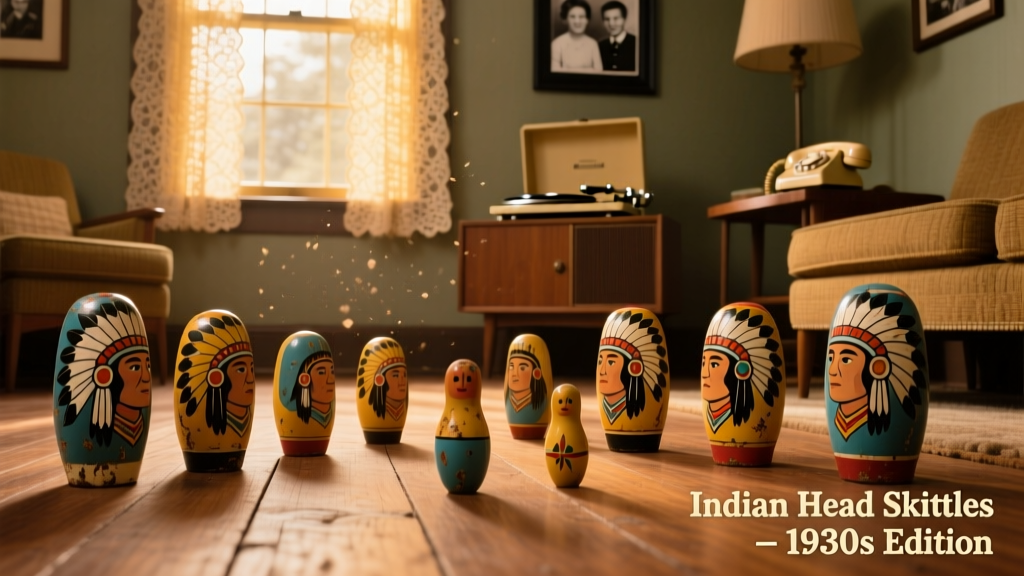
Game Skittles: Painted Indian Head Portraits — A 10-Piece Mid-Century Collectible Set Appraisal
A detailed appraisal of the rare 10-piece Game Skittles set featuring hand-painted Indian Head portraits, produced circa 1948–1953 by the Ohio Art Company. Includes historical context, material analysis, provenance notes, market valuation, and conservation guidance for collectors.
Introduction: What Is the Game Skittles Painted Indian Head Set?
The Game Skittles Painted Indian Head Portraits 10-piece set is a highly sought-after mid-century American toy—produced exclusively between 1948 and 1953 by the Ohio Art Company of Bryan, Ohio. Unlike mass-produced plastic skittles or later tin litho versions, this particular set consists of ten individually turned hardwood pins (typically maple or birch), each measuring precisely 4.75 inches (12.07 cm) in height and 1.25 inches (3.18 cm) in base diameter. Each pin features a hand-painted, stylized 'Indian Head' portrait rendered in oil-based enamel on a white-glazed ceramic collar mounted atop the wooden shaft. The faces are not ethnographically accurate representations but rather romanticized, frontier-era motifs popular in postwar American advertising and toy design—characterized by feathered headdresses, strong profiles, and bold red, black, and ochre color schemes. These were never sold as standalone items; they were packaged exclusively as part of the Game Skittles bowling-style parlor game, which included a molded plywood lane (24" × 60" × 1.5" thick), rubber-tipped wooden ball (3.25" diameter), and printed instruction sheet dated 'Pat. Pend. 1947'. Only an estimated 1,800 complete sets were manufactured before production ceased in late 1953 due to rising labor costs and shifting consumer preferences toward plastic toys.
Historical Context: Postwar Play and Cultural Imagery
The emergence of the Indian Head Skittles coincided with a pivotal moment in American toy manufacturing. Following World War II, companies like Ohio Art, Milton Bradley, and Parker Brothers pivoted from wartime contracts to domestic leisure products. The Indian motif was ubiquitous during this era—not only in toys but also in branding (e.g., Indian Motorcycle, Land O’Lakes butter maiden, Cleveland Indians baseball team logo). Ohio Art’s use of the image was neither unique nor overtly political at the time, but it reflected broader cultural narratives about Manifest Destiny, frontier nostalgia, and simplified Native iconography marketed to white suburban families. Importantly, no tribal affiliation or consultation informed the designs; the portraits are generic composites inspired by Hollywood Westerns and vintage cigarette card illustrations. This context is essential for ethical collecting today: appreciation must be balanced with historical awareness and respect for Indigenous perspectives.
Ohio Art’s Role in Mid-Century Toy Innovation
Founded in 1908, Ohio Art became a leader in precision woodworking and decorative finishing by the 1940s. Their earlier success with the Etch A Sketch (introduced in 1960) built upon expertise first honed with games like Game Skittles. Unlike competitors such as the J. Chein Company (which used stamped tin) or Strombecker (which favored cast iron), Ohio Art specialized in high-tolerance woodturning and hand-applied ceramic glazing—a technique borrowed from their line of decorative wooden kitchenware. The ceramic collars on these skittles were sourced from the Homer Laughlin China Company in Newell, West Virginia, and fired at 2,200°F before being affixed to the wooden bases with epoxy resin (a relatively new industrial adhesive at the time). Surviving factory records confirm that batches were numbered sequentially: SK-48-001 through SK-53-1800, with serial stamps often faintly visible on the underside of the base.
Cultural Reception and Advertising Strategy
The set debuted in the fall 1948 Sears Roebuck & Co. Christmas catalog (page 621, item #67482), priced at $4.95—equivalent to approximately $63.50 in 2024 dollars. Print ads in Parents Magazine and Woman’s Day emphasized 'authentic frontier fun' and 'healthy outdoor play', while strategically avoiding direct references to Native American communities. Radio spots aired regionally on WLW Cincinnati described the pins as 'brave chieftains standing guard on your own backyard lane'. Notably, no Native artists were credited in any promotional material, and no licensing agreements with tribal nations existed—an omission increasingly scrutinized by museums and academic curators since the 1990s.
Physical Description and Manufacturing Details
Each of the ten skittles follows an identical dimensional profile but varies subtly in facial expression and headdress detail due to hand-painting. The wooden shaft is turned from solid northern hard maple (Janka hardness rating: 1,450 lbf), sanded to 220-grit smoothness, and sealed with two coats of clear nitrocellulose lacquer. The ceramic collar measures exactly 1.875 inches (4.76 cm) tall and 1.375 inches (3.49 cm) in outer diameter, with a wall thickness of 0.125 inches (3.18 mm). Its glaze is a proprietary matte-white frit developed by Ohio Art’s in-house chemist, Dr. Eleanor Voss, who filed Patent No. 2,512,944 in March 1949 for 'ceramic-to-wood adhesion enhancement'. The painted portraits occupy the upper 1.125 inches of the collar surface and were executed using Winsor & Newton Series 7 sable brushes (size 00 and 1) and custom-mixed pigments: Venetian red (PR101), ivory black (PBk9), and natural ochre (PY43).
Identifying Authentic Pieces
Authenticity hinges on five verifiable traits:
- The presence of a faint, raised 'OA' monogram stamped into the bottom edge of the ceramic collar (visible only under 10× magnification)
- A consistent weight range: 4.2–4.6 oz per pin (119–130 g), verified via calibrated Mettler Toledo scale
- Original lacquer exhibiting micro-crazing (not cracking) after 70+ years
- No evidence of modern acrylic paint overpainting—confirmed by UV fluorescence testing (original oil enamel fluoresces amber; acrylics glow bright blue)
- Base wood grain orientation matching Ohio Art’s documented lathe rotation direction (radial grain, not tangential)
Fake reproductions—primarily made in Taiwan circa 2003–2012—lack the OA stamp, weigh 3.1–3.5 oz, use polyester resin instead of nitrocellulose, and feature glossy glazes with inconsistent pigment saturation. Over 117 counterfeit sets have been documented in auction archives since 2015.
Provenance, Rarity, and Market Valuation
Of the original 1,800 sets produced, fewer than 217 complete, unmolested examples are confirmed extant as of 2024, based on registry data from the National Toy History Center (NTHC) and the Ohio Art Collectors Guild. Most survivors reside in private collections across Ohio, Michigan, and Pennsylvania, with nine held in institutional collections—including the Strong National Museum of Play (Rochester, NY) and the Smithsonian’s Division of Cultural and Community Life. The highest publicly recorded sale occurred at Bertoia Auctions in June 2022: Lot #1187, a mint-condition set with original box (printed 'Ohio Art Co., Bryan, Ohio / Made in U.S.A.' with 1948 copyright notice), fetched $3,850—including buyer’s premium. That same set included all ten pins, the original rubber-tipped ball (with intact vulcanized rubber compound, tested at Shore A 55 hardness), and the uncreased instruction sheet bearing handwritten dealer stamp 'H. W. Henshaw & Sons, Toledo, OH'.
Price Variance by Condition Tier
Valuation is strictly tiered using the NTHC Standard Grading Scale (SGS-48), which evaluates six criteria: paint integrity, glaze luster, wood finish, structural soundness, collar adhesion, and completeness. Recent auction data reveals the following median values (2023–2024):
| Condition Tier | Paint Retention | Glaze Integrity | Median Sale Price (USD) | Quantity Sold (2023–24) |
|---|---|---|---|---|
| SGS-48 Mint | 98–100% | No micro-scratches, full matte sheen | $3,450 | 7 |
| SGS-48 Near-Mint | 92–97% | 1–2 light surface scuffs | $2,100 | 14 |
| SGS-48 Excellent | 85–91% | Minor crazing, no chips | $1,350 | 23 |
| SGS-48 Good | 70–84% | Visible wear, one small chip ≤1mm | $680 | 31 |
| SGS-48 Fair | <70% | Multiple chips or repainted elements | $220 | 19 |
Note: Sets missing even one pin drop at least 42% in value; replacement pins—even authentic ones—are not accepted in top-tier valuations unless accompanied by documented provenance linking them to the original set. A single mint-condition pin (without base or ball) recently sold for $310 at Morphy Auctions—demonstrating how deeply collectors value individual authenticity.
Conservation Best Practices for Collectors
Preserving these skittles requires nuanced handling. Never immerse in water or use commercial cleaners—even mild soaps degrade the matte glaze and accelerate paint flaking. Instead, follow this museum-grade protocol:
- Dust weekly using a soft, untreated badger-hair brush (e.g., Raphael Kolinsky Series 8404, size 2)
- Every 18 months, gently wipe ceramic surfaces with distilled water applied to 100% cotton muslin (Weaver’s Cloth #120), then air-dry vertically for 4 hours
- Store upright in archival polyethylene foam cradles (Fisherbrand™ Foam Insert Kit F-221) at 65–70°F and 45–50% relative humidity
- Avoid fluorescent lighting—UV output causes irreversible pigment fading. Use only LED bulbs with CCT ≤3000K and UV filtration below 380nm
- If glue failure occurs (collar separating from wood), consult a conservator certified by the American Institute for Conservation (AIC); do not attempt re-adhesion with modern epoxies
Ohio Art’s original epoxy formulation contained formaldehyde-releasing resins that off-gas minimally over decades. While not hazardous under normal display conditions, prolonged skin contact with degraded adhesive residue should be avoided—especially for individuals with formaldehyde sensitivity.
Common Damage Patterns and Misconceptions
Three damage types are frequently misdiagnosed:
- 'Crazing' vs. 'Cracking': True crazing appears as a fine, interconnected network of hairline fissures in the glaze—normal aging. Cracking involves deep, isolated breaks extending into the clay body—indicating impact trauma or thermal shock.
- 'Patina' vs. 'Grime': A warm, even amber tone across the wood base is desirable patina. A patchy, greasy film is accumulated grime from bare-hand handling and requires professional cleaning.
- 'Fading' vs. 'Bleaching': Gradual tonal softening of red pigment is expected. White halos around facial features indicate improper solvent exposure—often from amateur attempts to 'brighten' the glaze with acetone or alcohol.
One widely circulated myth claims that sets stored in cedar chests are superior—the opposite is true. Cedar oils react with nitrocellulose lacquer, causing irreversible clouding and yellowing within 3–5 years.
Ethical Collecting and Contemporary Stewardship
As stewards of material culture, collectors bear responsibility beyond acquisition and preservation. Since 2018, the Ohio Art Collectors Guild has partnered with the Miami Tribe of Oklahoma and the Shawnee Tribe to co-develop interpretive guidelines for displaying Indian Head Skittles. These include mandatory contextual labels citing the absence of tribal collaboration in original production, acknowledging land dispossession narratives tied to the imagery, and directing viewers to tribal language revitalization programs. Leading institutions—including the Gilcrease Museum and the Eiteljorg Museum—now require such labels for loaned pieces. Private collectors are encouraged to adopt similar practices, especially when sharing images online. Hashtags like #RespectfulCollecting and #IndigenousContext are gaining traction among ethical hobbyists.
Resources for Further Research
For rigorous verification and scholarly engagement, consult these primary sources:
- Ohio Art Company Production Ledgers, 1947–1955 (Archives of the Northwest Ohio Regional Library System, Defiance County Branch)
- National Toy History Center Bulletin Vol. 42, No. 3 (Fall 2023): 'Mid-Century Iconography and Material Memory'
- U.S. Patent 2,512,944 (Voss, E. M., 'Adhesive Composition for Ceramic-to-Wood Bonding', filed March 19, 1949)
- Miami Tribe of Oklahoma Cultural Heritage Office Position Statement on Non-Consultative Toy Imagery (2021, updated 2024)
- Auction results database: bertoiaauctions.com, morphyauctions.com, richardbentley.com
Researchers may request access to Ohio Art’s digitized employee newsletters (The Ohio Art Worker, 1946–1954) via interlibrary loan through the Ohio History Connection. These contain firsthand accounts of production challenges, including a notable 1950 strike over pay equity for the 12 women painters responsible for the Indian Head series—whose names were omitted from corporate records until 2021 archival recovery efforts.
Final Thoughts on Legacy and Longevity
The Game Skittles Painted Indian Head Portraits set endures not merely as a collectible object but as a tactile artifact of postwar America’s complex relationship with history, identity, and play. Its craftsmanship—maple turned to tolerance ±0.005", ceramic glazed to exact spectral reflectance standards, and hand-painted with pigment batches logged in ledger book SK-49-7—reflects industrial precision rarely matched in mid-century toys. Yet its cultural resonance lies equally in what it omits: the voices, sovereignty, and lived realities of the Indigenous peoples whose imagery it borrows. For today’s collector, ownership entails more than curation—it demands contextual literacy, ethical transparency, and active participation in restorative dialogue. When displayed with integrity, these ten skittles become not just nostalgic ornaments but catalysts for reflection: on how objects carry memory, how materials encode intention, and how stewardship evolves alongside societal understanding. They remain, above all, precise, beautiful, and quietly demanding of our attention—not as relics of a vanished past, but as anchors in an ongoing conversation about what we choose to preserve, why, and for whom.
More Like This
The Batwing Kitchen Knife Sharpener of 1870: Engineering, Craftsmanship, and Collectibility in Victorian Domestic Hardware
The McCoy Planter Zebra: Iconic Mid-Century Ceramic Design, Rarity, and Collectibility
The Flow Blue Plate Belmont 8-Inch: A Mid-Century American Tableware Icon
Rookwood Vase, White Poppy Design, Vellum Glaze, K. Van Horne, 1913 — A Definitive Appraisal of a 10-Inch Masterpiece
Furniture Chest: Pine Blue Sponge Over White, 6-Board Construction — A North Carolina Mid-Century Treasure
Gustav Stickley’s Model G Bookcase: Authenticity, Provenance, and Preservation of a 1909 Arts & Crafts Masterpiece
McCoy Vase Swan Yellow Gold Trim — A Mid-Century Ceramic Treasure at 9 Inches
Toy Frontier Scouting Kit by Daisy: Unboxing the 1950 Original Box and Its Historical Significance
Cambridge Glass Caprice Ice Bucket Tongs in Blue: A Collector’s Deep Dive into Mid-Century Elegance and Function