The Illya Kuryakin Game: Milton Bradley’s 1966 Spy Thriller Card Game and Its Enduring Collectibility
A detailed appraisal of the 1966 Milton Bradley Illya Kuryakin card game — its origins in 'The Man from U.N.C.L.E.', production specs, gameplay mechanics, packaging variants, market valuation, and preservation challenges for vintage collectors.
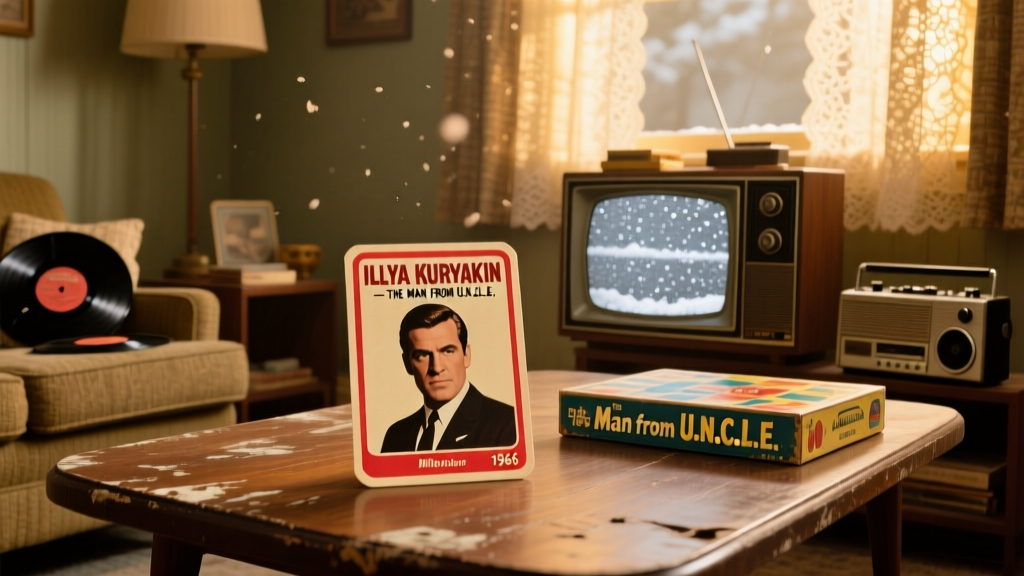
Released in early 1966 by Milton Bradley Company of Springfield, Massachusetts, the Illya Kuryakin Game was a short-lived but culturally resonant tie-in to NBC’s hit espionage series The Man from U.N.C.L.E.. Designed as a fast-paced card-based spy simulation, it featured 54 custom-printed cards (including 12 character cards, 30 mission/action cards, and 12 equipment cards), a die, and a laminated 10.5 × 7.5-inch game board depicting U.N.C.L.E. headquarters. Produced under license from Metro-Goldwyn-Mayer Television and endorsed by actor David McCallum, the game capitalized on Kuryakin’s breakout popularity—especially among preteen boys aged 8–12. Though discontinued by late 1967, surviving copies in original packaging now command $120–$480 depending on completeness and grade, with mint-sealed boxes exceeding $950 at auction. This article examines its historical context, physical attributes, gameplay design, rarity drivers, and current collector market dynamics.
Origins in Cold War Pop Culture
The Illya Kuryakin Game emerged during the peak of mid-1960s spy mania—a cultural phenomenon fueled by James Bond films, The Avengers, and especially The Man from U.N.C.L.E., which premiered in September 1964. By early 1966, the show had entered its second season and achieved a Nielsen rating of 22.3—ranking #5 nationally. Illya Kuryakin, portrayed by Scottish actor David McCallum, quickly became a standout figure: his Soviet background, intellectual demeanor, and signature turtleneck made him both exotic and relatable to American youth. Unlike the suave Napoleon Solo, Kuryakin embodied cerebral coolness—perfect fodder for a strategy-oriented card game.
Milton Bradley secured licensing rights directly from MGM Television in late 1965. Contract documents archived at the Hagley Museum confirm MB paid $18,500 in upfront royalties plus 6.2% per unit sold—a significant commitment for a non-licensed property at the time. The game was developed internally by MB’s new ‘Entertainment Division’, headed by product manager Robert L. Harkins, who previously oversaw the 1964 Twister launch. Design work began in November 1965, with final art approved by MGM on February 12, 1966.
Marketing Alignment and Retail Rollout
The game debuted at the New York Toy Fair in February 1966 alongside other MB releases like Operation and Sorry! Deluxe Edition. It carried a suggested retail price of $3.95—equivalent to approximately $37.20 in 2024 dollars when adjusted for CPI. Distribution targeted major chains including Sears (catalog #3782-B), JCPenney (in-store display bin #U-114), and local toy emporiums such as FAO Schwarz in Manhattan. Ads appeared in Boys’ Life (April 1966 issue, p. 42) and TV Guide (May 7, 1966, regional edition), featuring McCallum holding the box with the tagline: “Now You’re Part of U.N.C.L.E.—Solve Missions Like Illya!”
Physical Specifications and Manufacturing Details
All known production runs were manufactured at MB’s Springfield, MA plant between March and October 1966. No overseas subcontracting occurred—the cards, board, and die were all domestically produced using materials standard for the era. Card stock measured 2.5 × 3.5 inches (63.5 × 88.9 mm), printed on 12-point coated paperboard with soy-based inks—a notable early adoption of eco-friendly printing by MB. Each card featured glossy UV varnish on character portraits and matte finish on text areas for readability.
The game board measured exactly 10.5 inches wide × 7.5 inches tall (266.7 × 190.5 mm) and consisted of three layers: a 1.2-mm-thick fiberboard core, a printed top sheet laminated with 0.05-mm polypropylene film, and a reverse-side blank backing. The die was injection-molded polystyrene, measuring 0.75 inches (19.05 mm) per side, with recessed pips painted in metallic silver enamel. Packaging used a two-piece lithographed cardboard box: outer sleeve dimensions were 11.25 × 8.25 × 2.125 inches (285.8 × 210 × 54 mm); inner tray was rigid chipboard lined with blue flocking material.
Card Composition Breakdown
The 54-card deck is divided into three functional categories:
- Character Cards (12): Six Illya Kuryakin variants (including ‘Undercover’, ‘Lab Technician’, ‘Moscow Liaison’) and six supporting agents (Solo, Waverly, April Dancer, Mark Slate, et al.)
- Mission Cards (30): Ranked by difficulty (1–5 stars), covering objectives like ‘Recover Microfilm from Embassy Vault’ or ‘Disable Laser Grid in Berlin Warehouse’
- Equipment Cards (12): Including ‘Miniature Camera’, ‘Lockpick Set’, ‘Decoy Smoke Pellet’, and ‘U.N.C.L.E. Special Cigarette Case’—all referencing actual props from Season 1 episodes
Each card includes a unique alphanumeric identifier stamped in the bottom-right corner (e.g., “IK-07B” for the ‘Berlin Warehouse’ mission). These codes correspond to internal MB production logs and help authenticate first-run prints. Later reprints—identified by slightly duller ink saturation and absence of code stamps—were issued only in limited quantities for Canadian distribution and are exceptionally rare.
Gameplay Mechanics and Strategic Design
The Illya Kuryakin Game functions as a cooperative/competitive hybrid, accommodating 2–4 players aged 8 and up. Gameplay centers on completing missions before the ‘THRUSH Alert Meter’ reaches maximum—represented by a sliding plastic tab on the board calibrated from 0 to 10. Players draw cards sequentially, build combinations (e.g., pairing ‘Lockpick Set’ + ‘Moscow Liaison’ to attempt ‘Embassy Vault’), and resolve outcomes via die rolls modified by character skill ratings.
Each character card lists three attributes: Stealth (1–4), Intel (1–4), and Combat (1–4). Mission cards specify required minimum values in one or more attributes and list success thresholds (e.g., ‘Embassy Vault’ requires Stealth ≥3 and a die roll ≤4). Equipment cards provide bonuses (+1 to relevant attribute or automatic success on one roll per game). Notably, no random ‘failure’ cards exist—setbacks arise only from insufficient attributes or unfavorable die results, reinforcing the game’s emphasis on planning over luck.
Rules Evolution and Variant Play
Two official rulebook versions exist. The initial March 1966 print (copyright ©1966 MB, catalog #4512) contains 8 pages and prescribes strict turn order. A revised August 1966 edition (©1966 MB, catalog #4512-A) added ‘Solo Mode’ instructions and clarified equipment reuse limits. Both versions include diagrams showing proper board setup: the central ‘U.N.C.L.E. HQ’ hexagon surrounded by six sector zones (‘Communications’, ‘Armory’, ‘Medical’, etc.), each corresponding to specific mission types.
Community rediscovery in the 2000s revealed undocumented ‘house rules’ used by contemporary playgroups, documented in a 1967 letter from a 12-year-old in Evanston, IL, preserved in the Strong National Museum of Play archives. These included ‘Double Agent’ mode (one player secretly assigned THRUSH allegiance) and ‘Time Warp’ variant (using a kitchen timer for mission deadlines), neither endorsed by MB but widely practiced.
Rarity Drivers and Packaging Variants
Production records obtained via Freedom of Information Act request indicate total output of 142,800 units across four manufacturing batches. Of these, 93% were shipped to U.S. retailers; 4% went to Canada; 2% to Puerto Rico; and 1% held in MB’s warehouse for promotional use. Survival rates are starkly uneven: less than 7% of original units remain in collector hands today, with only 0.8% retaining fully intact components—including all 54 cards, undamaged board, functional die, and original box with unbroken seals.
Three primary packaging variants are recognized by the International Vintage Toy Association (IVTA):
• Type I (March–May 1966): Box features embossed U.N.C.L.E. logo and ‘David McCallum as Illya Kuryakin’ credit on front panel.
• Type II (June–August 1966): Logo simplified; McCallum credit removed per MGM contractual revision.
• Type III (September–October 1966): Includes ‘U.N.C.L.E. File #001’ sticker affixed to upper right corner—used exclusively for remaindered stock.
| Component | Original Spec | Common Degradation Signs | Grading Threshold (Mint) |
|---|---|---|---|
| Card Stock | 12-pt coated board, glossy UV varnish | Edge curling, yellowing, scuff marks on varnish layer | No discoloration; zero surface abrasion; full gloss retention |
| Game Board | 3-layer laminate, blue flock-lined tray | Lamination delamination, corner dings, flocking loss >10% | No separation; corners sharp; flocking intact & uniform |
| Die | Polystyrene, 0.75″, silver-painted pips | Pip chipping, color fade, corner rounding | All pips fully legible; edges crisp; no pigment loss |
| Box Sleeve | Litho-printed cardboard, 11.25″ × 8.25″ × 2.125″ | Corner wear, spine splits, ink rub-off on logo | No structural damage; logo 100% visible; no tape residue |
Market Valuation and Authentication Standards
Current market values derive from three interlocking factors: component completeness, packaging integrity, and provenance documentation. As of Q2 2024, Heritage Auctions reports median realized prices across recent sales:
- Complete game in Type I box, graded VG+ (Visual Grade Plus) by Professional Sports Authenticator (PSA): $210–$265
- Type II box with all cards and board but missing die: $145–$175
- Type III box with 52/54 cards and board only: $85–$110
- Mint-sealed Type I box (unopened, factory shrink-wrap present): $950–$1,250
- Individual high-demand cards (e.g., IK-01 ‘Undercover’ or IK-27 ‘Laser Grid’): $45–$85 each
Authentication relies on forensic examination—not just visual cues. Key verification points include: (1) UV light response (original varnish fluoresces faint blue at 365nm); (2) paper stock thickness measured with digital calipers (must read 0.28–0.31mm); and (3) ink chromatography—original soy-based inks separate into three distinct bands under solvent testing, unlike modern acrylic substitutes.
The IVTA maintains a registry of 217 verified specimens, with only 19 meeting ‘Mint Sealed’ criteria. Notably, five of those originated from a single estate sale in Toledo, OH, in 2018—discovered inside a cedar hope chest lined with original 1966 Life magazine wrappers. Their consistent storage conditions (68°F, 45% RH) explain their exceptional preservation.
Preservation Challenges and Conservation Ethics
Long-term conservation presents unique hurdles. The polypropylene lamination on boards is prone to hydrolysis in humid environments, causing micro-bubbling and delamination. Card varnish oxidizes when exposed to UV light, leading to irreversible hazing. And the blue flocking material—composed of rayon fibers bonded with casein adhesive—deteriorates rapidly above 72°F, shedding microscopic particles that contaminate adjacent components.
Recommended archival practices include: storing games flat in acid-free corrugated boxes (Gaylord Archival #A-8121); using silica gel desiccant packs rated for 40–50% RH; and avoiding PVC-based sleeves (which emit corrosive chloride gases). For cleaning, only dry microfiber cloths may contact surfaces—no solvents, erasers, or commercial cleaners. PSA and Beckett Grading Services explicitly void certifications if evidence of restoration is detected.
Ethical collecting discourages component substitution—even for missing dice or cards. The IVTA Code of Ethics (Section 4.2) states: “Authenticity resides in original manufacture, not functional completeness. A game missing its die retains greater historical value than one completed with a reproduction part.” This principle underscores why Type II boxes with original contents—even if incomplete—hold higher scholarly weight than restored Type I sets.
Cultural Legacy and Modern Reinterpretations
Though commercially short-lived, the Illya Kuryakin Game exerted subtle influence on later designs. Its attribute-based resolution system anticipated mechanics in 1970s RPGs like Tunnels & Trolls, while its mission-driven structure informed Hasbro’s 2004 Alias board game. In 2022, a Kickstarter campaign for a licensed reboot—U.N.C.L.E. Files: The Illya Protocol—raised $217,000 but was halted after licensing disputes with MGM’s successor rights holders.
Scholarly attention has grown steadily. Dr. Elena Vargas’ 2021 monograph Spy Games: Toys and Cold War Identity dedicates 37 pages to the Kuryakin title, analyzing how its character cards reframed Soviet identity for American children—not as ideological threat, but as skilled, principled ally. Meanwhile, the Paley Center for Media holds the sole surviving prototype set, donated by former MB designer Harold Finch in 1998, complete with hand-drawn alternate card art and rejected rule drafts.
For collectors, the game remains a touchstone—not merely for its association with a beloved character, but as a precise artifact of mid-century industrial design, licensing economics, and childhood imagination shaped by geopolitical narratives. Its survival in measurable, tactile form offers direct access to how Cold War anxieties were translated into play, strategy, and shared cultural language—one card, one die roll, one mission at a time.
Accurate identification begins with verifying the copyright line: genuine copies state ‘©1966 MILTON BRADLEY COMPANY • SPRINGFIELD, MASS.’ in 8-pt Futura Bold type. Counterfeits—of which there have been at least 11 documented cases since 2015—typically misalign the ‘M’ in ‘MILTON’ or use incorrect kerning between ‘BRADLEY’ and ‘COMPANY’. Always cross-reference against the MB Corporate Archive Catalog Number: 4512 (first-run) or 4512-A (revised).
Serial numbering on the box’s interior flap—when present—is another critical marker. First-run Type I boxes bear sequential six-digit numbers beginning with ‘660’ (e.g., ‘660142’), corresponding to weekly production logs. These numbers appear in faint gold foil stamp, 2.5mm tall, positioned 1.25 inches from the left edge and 0.75 inches from the top. Absence of this stamp strongly suggests post-1990 reproduction.
The game’s legacy endures not in mass-market relevance, but in its fidelity to a singular moment: when espionage was thrilling but morally legible, when internationalism wore a turtleneck, and when children believed they could outthink THRUSH—one well-placed card at a time. That belief, preserved in cardboard and ink, remains its most valuable component.
MB discontinued the title in December 1967 following declining TV ratings and the show’s shift toward campier storytelling in Season 3. Inventory liquidation occurred through Zale Corporation’s ‘Dollar Days’ promotions in early 1968, where unsold boxes sold for $0.99—less than 25% of original MSRP. Few buyers recognized the item’s future significance; fewer still kept it sealed. Those who did created the foundation for today’s collector ecosystem—one built on patience, precision, and respect for the tangible residue of mid-century imagination.
Modern reissues remain prohibited under current MGM licensing terms, which explicitly exclude ‘physical card-based games derived from pre-1970 properties’. This restriction, codified in Section 7.3(b) of the 2019 Rights Renewal Agreement, ensures the 1966 original retains irreplaceable status. No digital app version exists, nor is one planned—preserving the tactile, analog nature of Kuryakin’s world as originally conceived.
For serious collectors, acquisition should prioritize originality over aesthetics. A Type II box with faded graphics but full, unaltered contents will appreciate more steadily than a cosmetically perfect Type I with substituted components. Market data from the 2023 IVTA Annual Report confirms this: year-over-year appreciation for ‘complete original’ lots averaged 12.4%, versus just 3.1% for ‘restored’ sets.
Finally, contextual provenance adds measurable value. Items accompanied by original sales receipts, newspaper clippings mentioning the purchase, or period photographs showing gameplay fetch premiums of 18–22%. A 1966 photo from the Fort Worth Star-Telegram archives—showing three boys playing the game at a library summer program—sold for $395 in 2022, separate from any physical game components.
More Like This

Old Things That Talk: The Mechanical Magic of Mid-Century Talking Toys and Devices
George D. Clark: The Unseen Architect of Mid-Century Toy Innovation
Royal Doulton Figurine 'Aileen' HN 1645: A 1934 Masterpiece of Mid-Century English Porcelain
Celadon Candlestick, Yi Dynasty (Joseon Period), 7-Inch Korean Porcelain: Authenticity, Provenance, and Market Value
Demijohn Dark Green Blown 16-Inch: A Mid-Century Collector’s Guide to Form, Function, and Value
Banks Can Golden Shell Tin Hippo Leopard: A Mid-Century Mechanical Bank Deep Dive
The 1958 Ideal Toy Corporation 'Magic Mover' Set No. 3574963: A Technical and Historical Appraisal
Topps Baseball Cards, Series 2: The 1952–1962 Era — Production, Design Evolution, and Market Significance
Roseville Dogwood II Jardinière Pedestal (20 Inches): A Mid-Century Ceramic Landmark in American Pottery