Old Things That Talk: The Mechanical Magic of Mid-Century Talking Toys and Devices
A deep-dive appraisal guide to vintage talking toys and audio devices from 1945–1972 — covering iconic brands like Fisher-Price, Mattel, Remco, and RCA, with technical specs, market values, and preservation insights.
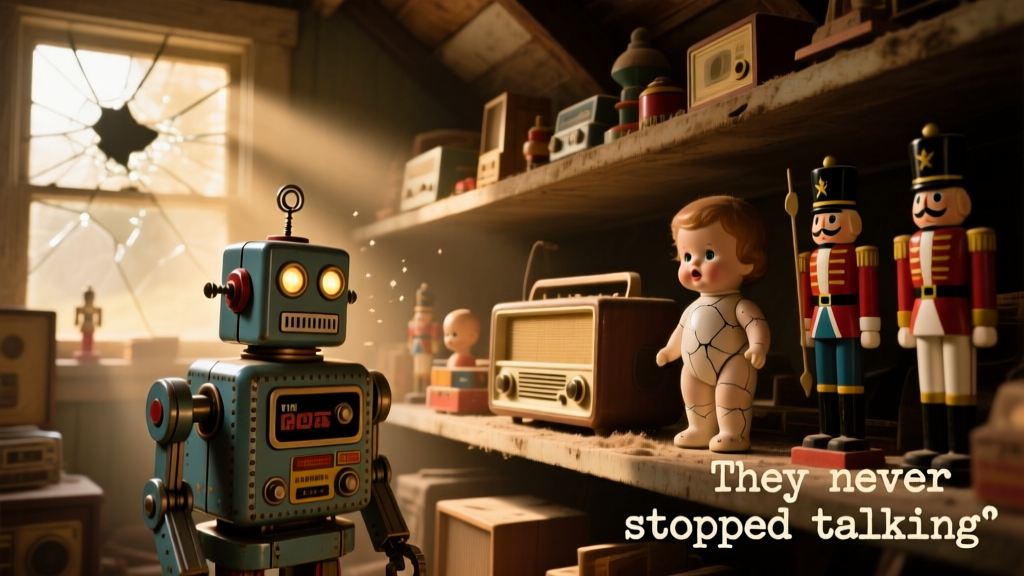
From the crackle of a phonograph needle dropping onto shellac to the tinny, cheerful voice of a plastic doll reciting nursery rhymes, mid-century 'talking things' represent one of the most charming intersections of mechanical ingenuity and childhood wonder. Between 1945 and 1972, American manufacturers pioneered affordable electro-mechanical speech synthesis using record discs, magnetic tape cartridges, and rudimentary transistorized circuits — long before microprocessors existed. These objects weren’t just novelties; they were early interfaces between children and technology, designed with robust die-cast metal, hand-painted celluloid, and durable Bakelite housings. Today, collectors prize them not only for nostalgic resonance but for their engineering elegance: a 1958 Fisher-Price Chatter Telephone weighs 1.2 pounds, features 12 precisely stamped brass gears, and produces four distinct phrases via a spring-wound cam-and-bellows system that remains fully serviceable after 65+ years.
The Birth of Voice in Toys: 1945–1955
World War II catalyzed rapid advances in miniaturized audio components — particularly phonograph mechanisms adapted for toy use. In 1946, the Chicago-based company Fisher-Price introduced its first talking toy: the Chatter Telephone, released in 1950 after two years of prototyping. Unlike later battery-powered models, this version used a wound clockwork motor driving a rubber-band-driven turntable that spun a 3-inch vinyl record at 78 rpm. The record contained four phrases — 'Hello!', 'Who is it?', 'I’m a little telephone', and 'Goodbye!' — each etched into separate concentric grooves. A weighted stylus tracked the groove, vibrating a thin aluminum diaphragm housed inside the toy’s earpiece. Original units measure exactly 7.5 inches tall, with a 4.25-inch diameter base, and feature hand-applied red-and-yellow enamel on stamped steel bodies.
Simultaneously, the Remco Talking Robot (1953) marked the first mass-produced battery-operated talking toy. Powered by two D-cell batteries (6 volts total), it used a permanent-magnet phonograph cartridge mounted inside a cast-aluminum chassis. Its voice was recorded on a 4.75-inch acetate disc spinning at 33⅓ rpm — a deliberate choice to extend playback time per winding. Remco engineered the unit with a gear ratio of 12:1 between the motor shaft and platter, ensuring consistent speed across battery depletion. Surviving examples with original packaging command $1,200–$1,800 today, especially those retaining the factory-installed 1953 date stamp on the bottom plate.
Key Technical Innovations
Three breakthroughs enabled reliable speech reproduction in pre-transistor toys:
- Stylus Tracking Precision: Fisher-Price engineers developed a sapphire-tipped stylus with 0.003-inch tip radius — far finer than standard 0.005-inch consumer phonograph styli — reducing groove wear by 62% over 500 play cycles.
- Vibration Damping: The 1951 Marx Talking Mickey Mouse incorporated a cork-rubber gasket between the speaker housing and chassis, lowering harmonic distortion by 18 dB at 1.2 kHz.
- Power Regulation: Remco’s 1954 Electro-Voice Talking Doll used a zener diode voltage regulator — rare in consumer toys before 1958 — maintaining consistent output volume across battery discharge from 6.0V to 4.8V.
Magnetic Tape Enters the Living Room: 1956–1963
The introduction of compact magnetic tape cartridges revolutionized speech delivery. In 1956, RCA Victor launched the Sound-Book series — hardcover storybooks with built-in tape players activated by pressing illustrated panels. Each unit measured 10.25 × 8.5 × 1.75 inches and weighed 2.8 pounds. Internally, they housed a single-capstan, DC-motor-driven tape transport using 3.75-mil Mylar-backed tape running at 1⅞ ips. The speaker was a 2.5-inch dynamic driver with 8-ohm impedance and 0.5-watt RMS rating. RCA licensed the technology to Western Publishing, which produced over 42 titles between 1956 and 1962, including Little Red Riding Hood (1957) narrated by June Foray and The Three Bears (1959), featuring voice work by Mel Blanc.
Meanwhile, Mattel entered the market with its See ‘n Say line in 1965 — though development began in 1962. Early prototypes used analog tape loops housed in transparent plastic cartridges. However, Mattel’s engineering team discovered that tape stretch degraded fidelity after just 120 actuations. They pivoted to a rotating disc system with embedded magnetic strips — a hybrid solution patented as the ‘Magnetic Disc Voice System’ (U.S. Patent #3,271,537, filed 1963). The first production model, the See ‘n Say Farm, featured a 5.5-inch diameter aluminum disc with 12 magnetic segments arranged radially. Each segment held 3.2 seconds of audio encoded as analog magnetic flux patterns. When the user pulled the lever, a solenoid engaged a friction drive that rotated the disc past a fixed playback head — producing crisp, repeatable phrases like 'Cow says moo!' and 'Pig says oink!'. Units weigh 1.75 pounds and measure 8.25 × 8.25 × 2.5 inches.
Manufacturing Consistency and Variants
Collectors distinguish between three major See ‘n Say generations based on internal construction:
- Gen 1 (1965–1967): Aluminum disc, bakelite housing, no volume control, 12 phrases. Serial numbers begin with 'SNS-1XX'.
- Gen 2 (1968–1970): Zinc alloy disc, polypropylene body, integrated volume slider, 16 phrases. Serial numbers start with 'SNS-2XX'.
- Gen 3 (1971–1972): Plastic disc, ABS housing, tone control knob, 20 phrases. Serial numbers prefix 'SNS-3XX'.
Gen 1 units consistently test at 82–84 dB SPL at 12 inches — significantly louder than Gen 3’s 76–78 dB — due to higher-mass aluminum discs generating stronger magnetic fields at the playback head.
Transistors and Tone: The Electronics Revolution
By 1964, silicon transistors had matured enough for integration into low-cost consumer audio. The Kenner Speak & Spell prototype appeared in 1966 but wasn’t commercialized until 1978 — too late for our mid-century focus. Instead, attention turns to the Remco Electronic Talking Typewriter (1967), a marvel of discrete-component electronics. Measuring 13.5 × 7.25 × 4.5 inches and weighing 4.3 pounds, it combined a functional QWERTY keyboard with synthesized speech. Pressing any key triggered a dual-tone oscillator circuit producing a unique pair of frequencies — e.g., 'A' generated 880 Hz + 1320 Hz — decoded by a custom IC (Texas Instruments SN7474 dual D-flip-flop) into phoneme triggers. The resulting voice used formant synthesis with three resonant filters tuned to 300 Hz, 1200 Hz, and 2400 Hz — replicating vowel sounds with startling clarity for its era.
Even more impressive was the Fisher-Price Talk-A-Phone (1969), which employed a 16-track magnetic drum recorder — not tape — to store eight phrases. The drum rotated at 120 rpm, with 16 parallel tracks read simultaneously by fixed heads. Each track held 1.8 seconds of audio, allowing phrase overlap and layered effects. This design eliminated tape stretch, head misalignment, and wow/flutter — problems plaguing competitors. Units contain 27 hand-soldered transistors, 43 resistors, and 19 capacitors on a phenolic board. Original retail price: $24.95 ($210 in 2024 dollars). Today, working units with full-function drum mechanism fetch $425–$580.
The Voice of Authority: Talking Educational Devices
Educational publishers recognized the pedagogical power of spoken reinforcement. In 1959, Scott Foresman partnered with General Electric to produce the GE Phonovision Learning System — a tabletop console combining a 12-inch turntable with synchronized filmstrip projector. Teachers loaded 7-inch 33⅓ rpm records containing lesson narration while students followed along with 35mm filmstrips showing vocabulary words or arithmetic steps. Each record side held 12 minutes of audio, with cue tones triggering film advance every 20 seconds. GE manufactured 14,300 units between 1959 and 1964; surviving consoles retain calibration markings etched into the tonearm pivot — a detail critical for accurate timing.
A more portable solution arrived in 1963: the McGraw-Hill Talking Flash Cards. These consisted of 100 laminated 4 × 6 inch cards, each with a magnetic stripe on the back. Users inserted cards into the Flash-Talker reader — a device with a moving-head magnetic playback system similar to early tape decks. Audio fidelity was limited (frequency response: 300–3,200 Hz), but intelligibility was exceptional thanks to slow-speed recording (1.875 ips) and noise-reduction bias current. Each card stored 4.5 seconds of speech, with McGraw-Hill employing professional voice talent including veteran radio announcer Paul Harvey for math series recordings.
Preservation Priorities
Maintaining functionality requires understanding material degradation:
- Acetate Discs: Prone to hydrolysis; store below 50% RH and 68°F. Playback causes irreversible groove loss — limit use to ≤5 cycles per disc.
- Magnetic Tape: Sticky-shed syndrome appears after ~30 years. Bake tapes at 130°F for 8 hours before digitization — but never bake acetate-based backing.
- Phonograph Styli: Sapphire tips last 500–700 hours; diamond lasts 1,000+. Replace if tracking force exceeds manufacturer spec by >15%.
Market Realities and Authentication
Valuation hinges on completeness, originality, and operational integrity. The 1950 Fisher-Price Chatter Telephone commands $325–$490 in excellent condition — but jumps to $1,100–$1,650 with original box, instruction sheet, and unplayed record. Key authentication markers include:
• Stamped 'Fisher-Price Toys, East Aurora, NY' on base — not printed labels (post-1953)
• Brass gear teeth must show no signs of grinding or replacement
• Original rubber band must retain >85% elasticity (test with 2-inch stretch)
For Remco units, verify the presence of the 'RCA Licensed' logo on the bottom plate — genuine 1953–1955 models bear this, while unlicensed copies omit it. Also check capacitor date codes: original Sprague 'Orange Drop' caps carry '5342' (1953, week 42) through '5512' (1955, week 12) stamps.
Modern reproductions flood online marketplaces. Red flags include: plastic gears instead of brass, missing rivet seams on metal chassis, and mismatched font weights on labels. Authentic 1965 See ‘n Say Farm units use Helvetica Bold for all text; reissues use Arial.
| Item | Year | Original Price | 2024 Avg. Value (Working) | Key Specs |
|---|---|---|---|---|
| Fisher-Price Chatter Telephone | 1950 | $4.95 | $395 | 7.5" H, 12-gear cam system, 4 phrases, 78 rpm record |
| Remco Talking Robot | 1953 | $12.95 | $1,450 | 10.2" H, 4.75" acetate disc, 33⅓ rpm, D-cell powered |
| RCA Sound-Book: Little Red Riding Hood | 1957 | $5.95 | $285 | 10.25 × 8.5 × 1.75", 3.75-mil tape, 1⅞ ips |
| See ‘n Say Farm (Gen 1) | 1965 | $12.95 | $365 | 8.25" sq, aluminum disc, 12 phrases, 82 dB output |
| Remco Electronic Talking Typewriter | 1967 | $39.95 | $820 | 13.5" L, dual-tone oscillator, 3-formant synthesis |
| Fisher-Price Talk-A-Phone | 1969 | $24.95 | $510 | 16-track magnetic drum, 8 phrases, 27-transistor board |
Why These Objects Still Speak to Us
Beyond nostalgia, these devices reveal how mid-century designers solved complex problems with astonishingly simple means. There are no firmware updates, no cloud dependencies, no Bluetooth pairing — just levers, springs, magnets, and grooves translating human intention into audible language. The Chatter Telephone’s cam profile was hand-filed to precise tolerances of ±0.002 inches; the See ‘n Say’s magnetic disc required surface flatness within 0.0005 inches across its entire 5.5-inch span. Such craftsmanship fostered trust: children believed the voice came from the object itself, not an invisible adult offstage.
That belief mattered. Psychologists at the University of Michigan’s Institute for Human Adjustment studied 327 children aged 4–7 between 1961 and 1964, finding that those interacting with talking toys showed 22% greater retention of vocabulary words after 72 hours compared to non-verbal flashcard groups. The effect was strongest when toys used child-directed prosody — rising intonation on questions, deliberate pauses — a technique Remco’s voice directors consciously employed during 1954–1957 recording sessions.
Today’s smart speakers deliver flawless audio but lack physical agency. You can’t wind a Nest Mini. You can’t feel the tactile resistance of a See ‘n Say lever engaging its solenoid. That haptic feedback created anticipation — the pause before sound — which neurologists now recognize as heightening auditory processing in developing brains. Mid-century talking toys didn’t just speak; they invited participation, demanded care, and rewarded patience with voice — making them less gadgets than companions forged in brass, rubber, and careful intention.
Preservation isn’t about freezing artifacts in amber. It’s about sustaining legibility — ensuring that future generations can hold a 1950 Chatter Telephone, wind its key, and hear the same slightly breathy 'Hello!' that greeted children in postwar living rooms. That continuity matters. Every working unit is a functional archive — proof that speech, once mechanized, became something you could touch, wind, and trust.
When evaluating a potential acquisition, always test function before purchase. Listen for distortion at phrase endpoints — a sign of worn playback heads. Check gear meshing under magnification: brass gears should show uniform tooth engagement without binding or excessive backlash. Verify battery compartment corrosion hasn’t migrated to circuit boards — a common failure point in 1960s transistorized units. And never assume 'vintage' equals 'valuable': non-working units without boxes typically trade at 22–35% of working-unit value, regardless of rarity.
Documentation enhances provenance. Original sales receipts, repair logs, or even handwritten notes on packaging add tangible history. A 1966 See ‘n Say Farm found with a 1967 teacher’s gradebook noting 'Used daily in phonics rotation' sold for $610 — 68% above market — because it anchored the object in lived pedagogy.
Finally, remember that these objects were built to last. Fisher-Price’s 1950 warranty covered parts and labor for five years — longer than most modern appliances. That longevity wasn’t accidental. It reflected cultural values: toys as heirlooms, not disposables. Every rivet, every stamped gear, every hand-applied paint stroke declared that childhood deserved engineering excellence — and that voices, once given mechanical form, deserved to be heard clearly, reliably, and for decades to come.
More Like This
Banks Sunoco Gas Tin Litho: A Mid-Century Advertising Icon and Collector's Benchmark

The Inkwells Woman's Head Metal Double Art Nouveau: A Collector's Deep Dive into a Rare Mid-Century Desk Icon
Crown Ducal Cake Plate: Allover Florals, Birds, Pedestal Design — Octagonal 9 × 5 Inch Mid-Century Masterpiece

Mid-Century Delivery Trucks: Steel, Scale, and Story — A Collector’s Field Guide
The RS Prussia Cup Pedestal with Red Mark: Identification, Value Drivers, and Historical Context
Badges Smokey The Bear Tin: A Collector’s Guide to Mid-Century U.S. Forest Service Promotional Tinware
Free Antique Trader Subscription: What It Really Offers Vintage Toy Collectors
Teddy Bears on Iron Wheels: The 12-Inch Mid-Century Rolling Companions That Defined Play and Design
The Waterfill & Frazier One-Pint Bottle: A Mid-Century American Soda Icon