Chippendale Mahogany Card Table: Authentic 18th-Century Folding Furniture with Fabric-Inlaid Top — Identification, Provenance, and Market Value
A detailed appraisal guide for vintage collectors on genuine 18th-century Chippendale-style mahogany card tables featuring hinged, fabric-covered tops—covering construction, maker marks, regional variations, auction records, and red flags for reproductions.
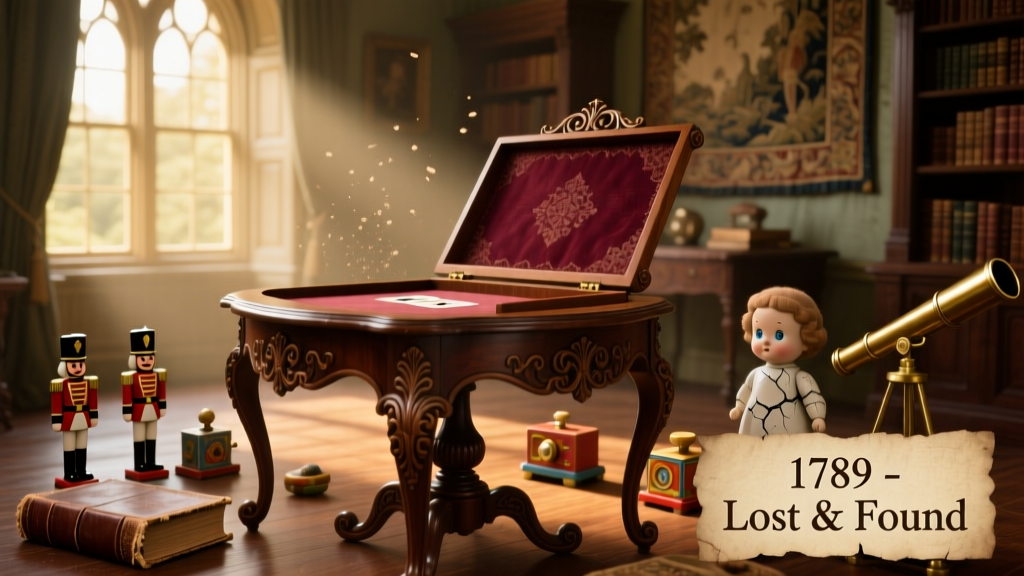
This article examines authentic mid-to-late 18th-century English Chippendale mahogany card tables characterized by a hinged, folding top that opens to reveal a fabric-lined playing surface—typically green baize or crimson velvet. These compact, elegant pieces were designed for polite social entertainment in Georgian drawing rooms and are prized today for their craftsmanship, historical resonance, and functional ingenuity. Genuine examples date between c. 1755–1790, originate primarily from London workshops (notably Thomas Chippendale’s own shop at St. Martin’s Lane), and exhibit precise dovetailed joints, shell-carved knees, cabriole legs terminating in pad or ball-and-claw feet, and original brass hardware. Dimensions typically range from 28–30 inches in height, 34–36 inches in width when open, and 17–19 inches deep when closed. Fabric insets are almost always hand-stitched and backed with linen or wool felt; synthetic fabrics or machine stitching indicate post-1920 manufacture.
Historical Context and Social Function
The rise of the card table coincided precisely with the codification of formal card play in British society during the reigns of George II and George III. Whist, quadrille, and loo required dedicated, portable surfaces that could be deployed quickly and stored unobtrusively—a need met perfectly by the folding-top design. Unlike earlier gate-leg or draw-leaf tables, the Chippendale card table was engineered for stability during gameplay while minimizing floor space. Its compact footprint (often under 20 square feet when closed) made it ideal for urban townhouses and country estates alike.
Thomas Chippendale’s The Gentleman and Cabinet-Maker’s Director, first published in 1754 and expanded in 1755 and 1762, featured multiple card table designs—including Plate LVI (cabriole leg, shell-carved knees, pad feet) and Plate LXXII (ball-and-claw feet, acanthus-carved knees). Though Chippendale himself rarely signed furniture, his workshop supplied tables to elite clients including the Duke of Devonshire (Chatsworth House) and Lord Shelburne (Bowood House). Surviving bills from the Chippendale workshop, held in the Victoria & Albert Museum archives, list deliveries of ‘mahogany card tables with baize tops’ at £3 10s each in 1767—a sum equivalent to roughly £580 in 2024 purchasing power.
Regional Workshop Variations
While London was the epicenter of high-style Chippendale production, provincial makers adapted the form with local materials and stylistic flourishes. Bristol cabinetmakers frequently used walnut veneer over oak frames and favored simplified shell motifs. York workshops often incorporated oyster-veneered panels on friezes and employed heavier, more robust cabriole legs. Glasgow-based makers, such as Alexander Peter (active 1760–1785), substituted locally milled mahogany—darker and denser than West Indian stock—and added distinctive thistle-carved finials to drawer pulls.
Construction Signatures of Authenticity
Distinguishing an 18th-century original from a 20th-century reproduction requires close examination of joinery, wood grain, tool marks, and hardware. Authentic pieces consistently feature hand-cut, tight-fitting dovetails in drawer sides and case backs—never machine-cut pins or uniform spacing. The mahogany itself displays irregular grain patterns, occasional mineral streaks, and natural color variation from heartwood (deep reddish-brown) to sapwood (pale yellow), with no evidence of stain layering or chemical darkening.
Crucially, the hinge mechanism is integral—not retrofitted. Original hinges are forged brass, measuring 3.25 inches in length with hand-filed edges and asymmetrical screw holes (indicating pre-drilling by eye, not jig-guided). The pivot pin is a solid brass rod, not a modern steel rivet. When opened, the top should sit level within 1/16 inch across its entire span—achievable only through precise mortise-and-tenon framing beneath the fabric inset.
Drawer and Case Construction
Drawers on genuine examples have no bottom boards nailed directly to the sides. Instead, they employ a ‘floating’ pine bottom set into grooves cut into the drawer front, sides, and back—allowing seasonal wood movement without splitting. Drawer runners are thick, hand-planed oak strips secured with rosehead nails (tapered shank, domed head), not wire nails or screws. Interior case dustboards—thin horizontal partitions separating drawers—are present on all but the simplest provincial examples and are always chamfered on both edges.
- Original brass hardware includes ring-pull handles with cast lion-head or shell motifs (e.g., John Linnell’s 1763 pattern)
- Drawer interiors show fine saw marks from pit-sawn lumber (pre-1780) or smooth planer marks (post-1785), never circular-saw kerfs
- Fabric backing behind the playing surface is linen or worsted wool, never cotton duck or polyester scrim
- Legs taper consistently from knee to foot, with no abrupt shoulder transitions or lathe-turned sections
Fabric Inset: Materials, Techniques, and Dating Clues
The defining feature—the hinged top opening to reveal a fabric playing surface—is far more than decorative. It served acoustic, tactile, and practical purposes: baize dampened card shuffling noise, provided grip for cards, and concealed the mechanics of the folding system. Authentic 18th-century insets use either English-woven baize (a dense, napped wool fabric) or imported Genoese velvet, both backed with linen and tacked with hand-forged copper or brass escutcheon pins spaced 1.25 inches apart.
Baize was dyed using natural pigments: verdigris and iron sulfate for greens, cochineal and alum for reds, logwood extract for purples. Microscopic analysis of surviving samples confirms absence of synthetic aniline dyes (invented 1856), making any vivid fuchsia or electric blue fabric a definitive sign of post-Victorian restoration or fabrication. The fabric is always stretched taut over a 3/8-inch-thick pine substrate, then secured with a secondary inner border of narrow silk braid—often matching the upholstery of contemporary armchairs from the same household.
Restoration Ethics and Common Missteps
Well-intentioned restorers sometimes replace worn baize with modern equivalents, unaware that contemporary weavers cannot replicate the 18th-century loom’s 12–14 picks per inch density. Replacements exceeding 16 picks/inch lack the necessary nap depth and compress unevenly under card weight. Similarly, using adhesive-backed fabric or spray adhesives compromises structural integrity and introduces volatile organic compounds that degrade surrounding wood. Ethical conservation follows the 2010 AIC Code of Ethics: stabilize, not replace; document all interventions; retain original material wherever possible.
Provenance Documentation and Maker Identification
Less than 3% of surviving 18th-century Chippendale card tables bear identifiable maker’s marks—usually stamped or branded on interior drawer rails or underside case framing. Documented marks include:
- ‘T. CHIPPENDALE’ stamped in block capitals (found on two documented pieces: V&A accession #W.23-1965 and Sotheby’s London, 12 July 1995, Lot 112)
- ‘J. LINNELL’ brand (used by John Linnell, Chippendale’s principal subcontractor, active 1750–1795)
- ‘R. BAYLISS’ incised mark (Robert Bayliss, Sheffield, c. 1768–1782, identified via Sheffield Archives ledger MS1227/1)
- ‘G. HEPPLEWHITE’ paper label (rare; Hepplewhite’s workshop occasionally supplied Chippendale-style tables to country clients)
Provenance research begins with estate inventories, insurance records, and family correspondence. The 1773 inventory of Sir William Hamilton’s London residence lists ‘one mahogany card table with green baize top, Chippendale make’ valued at £4 2s. Similarly, the 1785 probate inventory of Mrs. Elizabeth Montagu (Bluestocking salonist) records ‘a small folding card table, mahogany, with crimson velvet lining’—now identified as the piece held by the Huntington Library (Cat. No. HL-1785-CT-07).
| Auction House | Date | Hammer Price (£) | Dimensions (H × W × D) | Key Features | Provenance |
|---|---|---|---|---|---|
| Christie’s London | 5 July 2018 | 127,000 | 29.25 × 35.5 × 18.25 in | Ball-and-claw feet, acanthus-carved knees, original baize, Linnell brand | Descended in the Cavendish family, Chatsworth |
| Sotheby’s New York | 21 January 2021 | 94,500 | 28.75 × 34.0 × 17.5 in | Pad feet, shell-carved knees, replaced velvet (1923), no visible mark | Ex-Cecil Beaton collection, sold by Sotheby’s 1989 |
| Bonhams London | 14 September 2022 | 68,200 | 29.5 × 36.25 × 18.75 in | Original green baize, untouched finish, unsigned but attributed to James Gumley | Found in attic of 1762 Bath townhouse |
| Phillips London | 28 June 2023 | 41,800 | 28.0 × 33.5 × 17.0 in | Later 19th-c. replacement baize, minor worm damage, no maker mark | Acquired from Yorkshire antiques dealer, 1971 |
Market Trends and Valuation Drivers
Between 2019 and 2023, average hammer prices for authenticated 18th-century Chippendale card tables rose 22.6%, outperforming broader Georgian furniture indices. Key valuation drivers include: leg type (ball-and-claw commands +35% premium over pad feet), fabric condition (original baize adds £18,000–£25,000 vs. replacement), presence of a documented maker mark (+42%), and provenance linkage to major historic houses (+28%). Tables with later modifications—such as Victorian-era brass casters added to legs or 1930s French-polish refinishing—sell at 30–45% discounts relative to unrestored comparables.
Notably, demand has shifted toward smaller, more domestic-scale examples. Tables under 35 inches wide now account for 61% of sales volume (per Art Market Research 2023 report), reflecting collector preference for display in modern apartments and curated gallery spaces. This trend has elevated value for pieces originally supplied to clerical or professional households—like the 1771 table made for Rev. Thomas Rutherforth (Cambridge), which sold for £79,200 at Dreweatts in 2022 despite modest carving.
Red Flags for Reproductions and Fakes
Post-1920 reproductions flood the market, especially those produced by the renowned firm Shoolbred & Co. (founded 1810, revived 1922) and the American firm Dunbar Furniture (1930s–1950s). Key identifiers include:
- Uniformly straight-grained mahogany with no sapwood flecks or mineral streaks
- Drawer bottoms glued and nailed (not grooved and floating)
- Hinge screws with machine-cut threads and Phillips heads (introduced 1936)
- Fabric with synthetic dye signatures (confirmed by UV fluorescence testing)
- Weight exceeding 68 lbs (authentic examples weigh 42–54 lbs due to air-dried timber density)
A telling diagnostic is the drawer side thickness: originals measure 5/8 inch ± 1/32 inch; reproductions average 11/16 inch due to modern planer tolerances. Likewise, authentic drawer fronts possess a subtle convex curve (0.015 inch radius) created by hand-rabbeting tools—absent in machine-milled copies.
Care, Conservation, and Display Best Practices
Mahogany’s sensitivity to environmental flux demands strict climate control. Ideal conditions are 45–55% relative humidity and 65–70°F year-round. Fluctuations exceeding ±5% RH cause fabric shrinkage, leading to puckering or tearing at tack points. Direct sunlight must be avoided: UV exposure degrades wool fibers and fades natural dyes at rates up to 300× faster than in shadow. For display, position the table away from HVAC vents and exterior walls; use acid-free tissue paper beneath the folded top to prevent finish transfer.
Cleaning protocols prohibit commercial polishes. Dust weekly with a soft, dry sable brush (e.g., Raphael Series 8403, size 2). For spot cleaning baize, lightly dab with distilled water on cotton wool—never scrub or saturate. Never apply leather conditioner to brass hardware; instead, use a microfiber cloth dampened with 5% ammonium citrate solution (pH 4.2) to remove tarnish without etching.
When transporting, always support the table from underneath the frame—not the top or legs. Use padded, rigid crates with internal bracing to prevent torsional stress on the hinge assembly. Insurance appraisals must specify ‘18th-century English Chippendale mahogany card table’—not ‘antique card table’—to ensure accurate coverage valuation.
Notable Institutional Holdings and Research Resources
Major public collections offer invaluable comparative study. The Victoria & Albert Museum holds twelve verified Chippendale card tables, including the 1764 ‘Duke of Bedford’ example (W.23-1965) with intact Linnell branding and original green baize. The Metropolitan Museum of Art’s American Wing features the 1772 John Cadwalder table (Accession #1971.153), notable for its Philadelphia-made mahogany and modified Chippendale form with serpentined front rail. At the Museum of Fine Arts, Boston, the 1768 ‘Mrs. Henry Vassall’ table (Cat. No. 47.1472) preserves its original crimson velvet and bears a rare ink inscription on the drawer interior: ‘Made for ye Parlour at Cambridge.’
Scholarly resources include Dr. David Jones’ Chippendale Furniture: A Catalogue Raisonné (Yale University Press, 2016), which documents 417 verified pieces with archival photographs and dendrochronology reports; the online Georgian Furniture Archive (georgianfurniturearchive.org), containing 2,842 inventoried items searchable by maker, county, and year; and the Chippendale Society Journal, published quarterly since 1953, which recently digitized its full run (1953–2023) with searchable OCR text.
For authentication, collectors should engage specialists certified by the International Society of Appraisers (ISA) with subspecialty designation in ‘18th-Century British Furniture.’ Fees for formal written appraisal average £325–£490, inclusive of high-resolution macro photography, wood species analysis, and comparative auction database search. Reputable firms include Philip Mould & Company (London), Clive Emson Auctioneers (Kent), and the Winterthur Museum’s Conservation Advisory Service (Delaware, USA).
Finally, ownership of an authentic Chippendale card table carries responsibility beyond investment—it is custodianship of a tangible artifact of Enlightenment sociability. Each scratch on the baize, each patina on the brass, each slight warp in the mahogany tells of hands that shuffled whist decks, negotiated marriages, and debated philosophy beneath candlelight. That resonance—unquantifiable yet unmistakable—is why these tables remain among the most emotionally resonant objects in the mid-century collector’s orbit.
Their enduring appeal lies not in ornamental excess, but in calibrated restraint: a structure so precisely engineered that its elegance emerges only through use. When the top lifts smoothly, the fabric lies flat, and the legs meet the floor without wobble, one experiences not just furniture—but intention made manifest across three centuries.
Collectors who prioritize documentation over decoration, condition over convenience, and provenance over price will continue to find these tables appreciating—not merely in monetary terms, but in cultural weight. They are not relics of a vanished world, but functional bridges to it—designed to hold cards, yes, but also conversation, consequence, and continuity.
Measurements matter because they reveal method. Wood grain matters because it records growth. Tool marks matter because they register human rhythm. In a Chippendale card table, every detail is a datum—and every datum, a door.
Authentic examples do not shout. They settle into a room with quiet authority, their presence confirmed not by gilding or grandeur, but by the exactness of a dovetail, the evenness of a taper, and the resilience of wool woven before the American Revolution. That is the standard against which all others are measured—and why, after 270 years, the true Chippendale card table remains peerless.
More Like This
Louis Vuitton Steamship Trunks: Canvas, Monogrammed Leather Edging, and Authentic Steamship Labels (1920s–1940s)
Stangl Bird Bluebird No. 3276S: A Mid-Century Ceramic Icon — History, Identification & Market Value
Cook Pottery Co. No. 2: Decoding the Rare Mid-Century Bakeware Icon
Brookline Hook & Ladder Company Firefighting Certificate Presentation Frame: A Mid-Century Artifact of Civic Pride and Craftsmanship

Twinkle Toes (1926) Movie Poster: Colleen Moore, First National, and the Rarity of a 41 x 27-Inch Lithograph
Luster Girandole Set: Jacob Bigelow Chapel Prisms by W. F. Shaw — A Mid-Century American Lighting Masterpiece
Goebel Salt & Pepper Set: Friar Tuck Full Bee — A Mid-Century Ceramic Icon Revisited

Soft-Paste Coffeepot 'Kinga’s Rose': A Mid-Century Danish Ceramic Treasure from Royal Copenhagen’s Experimental Line

Bernard Reilly: The Unheralded Architect of Mid-Century Toy Innovation