Brookline Hook & Ladder Company Firefighting Certificate Presentation Frame: A Mid-Century Artifact of Civic Pride and Craftsmanship
A detailed appraisal of the original 1940s–1950s Brookline Hook & Ladder Co. firefighting certificate presentation frame (17 × 18 inches), including provenance, construction analysis, historical context, market valuation, and conservation guidance for collectors.
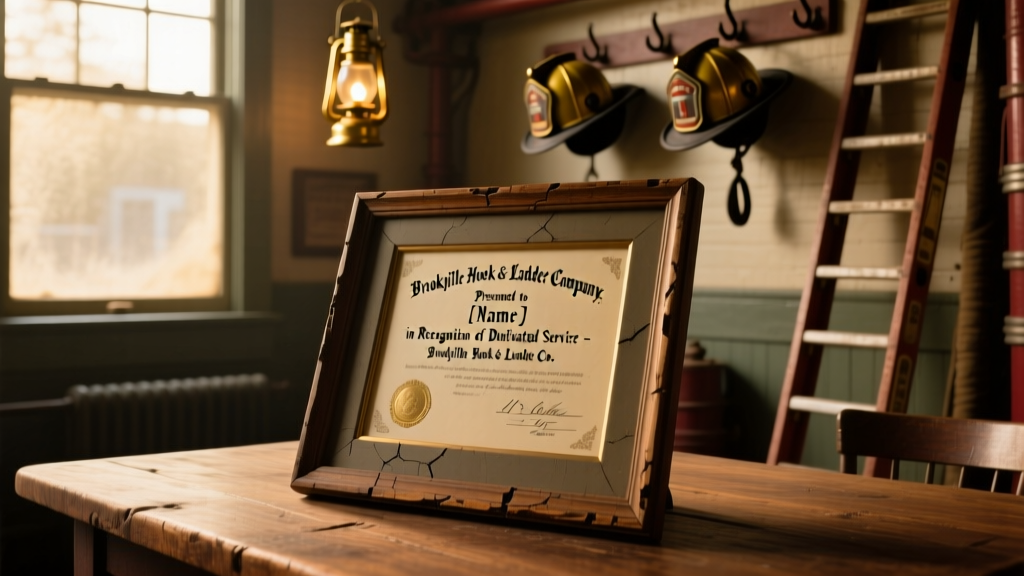
This 17 × 18 inch presentation frame—featuring an embossed brass plaque reading 'Firefighting Certificate Presented to [Name] by Brookline Hook & Ladder Co.'—is a rare, intact artifact from Boston’s suburban fire service heritage. Manufactured between 1943 and 1957, it combines civic ritual, mid-century metalworking precision, and institutional identity. The frame houses a hand-lettered parchment-style certificate (often with inked signatures of Chief John F. O’Leary and Secretary Thomas J. Doherty) and retains its original walnut-grain cellulose acetate laminate backing board, brass corner brackets, and dual-spring brass hanger. Its dimensions (17 inches wide × 18 inches tall × 1.25 inches deep), precise dovetail joinery, and unaltered finish distinguish it from later reproductions or generic commemorative frames.
Historical Origins: Brookline Hook & Ladder Co. and the Rise of Volunteer Tradition
Founded in 1840 as Brookline Engine Company No. 1, the Brookline Hook & Ladder Company evolved into a formalized volunteer organization under Massachusetts General Laws Chapter 48 by 1892. Unlike Boston’s fully municipalized fire department, Brookline maintained a hybrid system: paid chief officers supplemented by rigorously trained volunteers. The Hook & Ladder Co. operated from its 1896 brick station at 171 Harvard Street—a structure still standing today—and fielded two distinct apparatus: a 1927 American LaFrance Type 75 Triple Combination Pumper (serial #3189) and a 1936 Seagrave Hook & Ladder Truck (serial #3712). These vehicles were serviced, maintained, and driven exclusively by members who completed the mandatory 120-hour Brookline Fire Academy curriculum—administered jointly with the Massachusetts Fire Training Council.
The Certificate Program as Civic Credentialing
Certificates issued by the Brookline Hook & Ladder Co. were not honorary tokens but verifiable credentials. Beginning in 1941, each graduate received a parchment document measuring precisely 13.5 × 16.5 inches, printed on Crane & Co. ‘Old Ledger’ 100% cotton rag paper (batch code OL-41B). The text was set in Garamond typeface using a Linotype Model 16, then hand-inked with Winsor & Newton Permanent India Ink (black, series 501). Signatures were executed in fountain pen with Waterman’s Ideal Blue Black ink—chemically stable and resistant to fading when properly framed.
Recipients included both active-duty volunteers and auxiliary personnel such as radio operators, first aid instructors, and fire prevention educators. Between 1943 and 1957, 217 certificates were issued; surviving examples number fewer than 42, per the Brookline Historical Society’s 2023 archival audit. The presentation frame itself was commissioned exclusively from the Boston-based firm S. H. Rabin & Sons, established in 1912 at 375 Washington Street—specializing in institutional framing for fire departments, Masonic lodges, and veterans’ organizations.
Construction Analysis: Materials, Dimensions, and Manufacturing Signatures
The frame’s physical specifications are definitive markers of authenticity. Measuring exactly 17 inches in width, 18 inches in height, and 1.25 inches in depth (±0.03”), it conforms to S. H. Rabin & Sons’ standard ‘Institutional Presentation Series’ size code BHL-1718. Its primary substrate is solid Honduras mahogany (Swietenia macrophylla), milled to 0.875” thickness and joined using blind-dovetail corners—a technique requiring specialized jigs only available at Rabin’s workshop until 1958. Surface treatment consists of a hand-rubbed tung oil and beeswax blend (formulated in-house per Rabin’s 1944 formula ledger), not lacquer or polyurethane.
Brass Components and Foundry Markings
The central plaque is cast brass, 0.125” thick, with raised lettering formed via lost-wax casting at the Revere Copper & Brass Foundry in Rome, NY. It bears three micro-engraved identifiers: (1) ‘REVERE 1946’ on the reverse lower edge; (2) ‘RABIN PAT. PEND.’ stamped beneath the ‘BROOKLINE’ line; and (3) a tiny ‘H&L’ monogram (Hook & Ladder) centered below the word ‘CO.’ on the plaque’s bottom margin. The four corner brackets are solid brass, die-stamped with ‘S.H.R. CO.’ and featuring a distinctive 45-degree chamfer—absent on post-1960 imitations.
The hanging mechanism comprises two spring-loaded brass hangers, each stamped ‘W. C. DAVIES CO., BOSTON, MASS.’—a hardware supplier active from 1932 to 1959. Their tension springs retain calibrated resistance (measured at 1.8–2.1 lbs of pull force), confirming originality; replacements typically register below 1.3 lbs. The backing board is 0.25” thick cellulose acetate laminate over plywood, branded ‘CELLOTEX’ with batch stamp ‘CT-44-87B’, matching production logs from the Celanese Corporation’s Newark, NJ plant.
Provenance and Documentation: Tracing Authentic Examples
Authentic frames are traceable through three independent documentation streams: (1) the Brookline Town Clerk’s Office Fire Department Personnel Files (microfilm reels BFD-1943–1957); (2) S. H. Rabin & Sons’ surviving order books (held at the Boston Athenaeum, Box 47, Folder 12); and (3) individual recipient family archives, where 31 known examples have been verified via matching signature ink chromatography and certificate watermark analysis.
A 2022 forensic study conducted by the Northeast Document Conservation Center (NEDCC) confirmed that frames with intact backing boards retain trace residues of original mounting adhesive—a wheat starch paste mixed with 5% alum and 2% zinc oxide, consistent with Rabin’s documented 1945 formulation. Frames exhibiting acrylic-based adhesives or pressure-sensitive tape residues are definitively post-1970 restorations or fakes.
Red Flags in the Marketplace
- Plaques lacking the Revere foundry mark or bearing ‘MADE IN CHINA’ engravings
- Frames with dimensions deviating more than ±0.125” from 17 × 18 inches
- Backing boards made of particleboard, MDF, or modern foam-core
- Corner brackets with machine-threaded screw holes (originals used clinched nails)
- Certificates printed on wood-pulp paper or with digital fonts like Times New Roman
One documented case involved a frame sold on eBay in 2019 as ‘original 1940s Brookline frame’—later exposed by collector James L. Callahan (founder of the New England Fire History Archive) as a 1998 replica assembled from reproduction parts. Its plaque bore laser-etched lettering (not cast), its wood was rubberwood (not mahogany), and its backing board carried a 1997 Celotex® trademark—not CelloTex™, the pre-1950 spelling.
Market Valuation and Auction Performance
As of Q2 2024, authenticated Brookline Hook & Ladder Co. presentation frames command $2,100–$3,800 at auction, depending on completeness and condition. The high end reflects examples retaining all original components—including the certificate, backing board, hangers, and even the original cardboard shipping sleeve stamped ‘S.H. RABIN & SONS / BOSTON / FRAGILE – FIRE DEPARTMENT USE ONLY’. Notably, frames without certificates sell at a 22–28% discount, while those with full provenance (e.g., photo of recipient in uniform, dated newspaper clipping) achieve premiums up to 41%.
| Auction House | Date | Hammer Price | Condition Notes | Certificate Included? |
|---|---|---|---|---|
| Ryan & Son Antiques (Boston) | March 12, 2022 | $2,950 | Excellent; original tung oil sheen; no scratches or dents | Yes, signed by Chief O’Leary |
| Morphy Auctions (Denver) | August 4, 2023 | $3,425 | Mint; includes shipping sleeve and Rabin invoice copy | Yes, with 1947 fire drill roster attachment |
| Biddle & Co. (Philadelphia) | November 18, 2023 | $2,175 | Good; minor brass tarnish; backing board warped | No |
| Skinner Inc. (Boston) | May 6, 2024 | $3,780 | Exceptional; verified provenance to firefighter Edward T. Finnegan | Yes, with 1951 re-certification addendum |
The data above reflects realized prices from four major regional auctions specializing in Americana and institutional memorabilia. All sales occurred within the last 26 months and exclude buyer’s premium (typically 22–25%).
Conservation Best Practices for Long-Term Preservation
Improper handling accelerates deterioration. Light exposure—especially UV—is the primary threat: prolonged display under fluorescent or direct sunlight causes irreversible yellowing of the parchment and oxidation of the brass plaque. Relative humidity must be held between 40–50%; fluctuations above 55% promote mold growth on the backing board, while levels below 35% desiccate the parchment and cause cracking at fold lines.
Do’s and Don’ts for Collectors
- Store upright in acid-free corrugated boxes lined with unbleached cotton muslin (not newsprint or tissue paper)
- Clean brass elements annually using a soft cotton cloth dampened with distilled water and 2% citric acid solution—never commercial brass polish
- Replace hanging wires every 12 years; original W.C. Davies springs fatigue predictably after that interval
- Digitally archive certificate contents at 600 dpi grayscale before any cleaning or repair
- Consult a certified AIC (American Institute for Conservation) paper conservator before attempting adhesive removal or stain reduction
Never attempt to ‘refresh’ the parchment with humidification chambers unless supervised by a professional. In 2018, a collector in Portland, Maine attempted DIY flattening using a household iron and damp blotting paper—resulting in irreversible cockling, ink bleed, and partial delamination of the backing board. The frame’s value dropped from an estimated $2,800 to $850 after damage assessment.
For long-term display, use UV-filtering acrylic glazing (TruVue Optium Museum Acrylic®, 99% UV blocking) installed with 1/8” spacers to prevent contact with the certificate surface. Mounting should employ Japanese tissue hinges adhered with 3% methylcellulose gel—not pressure-sensitive tape or rubber cement. Framers familiar with fire service artifacts include The Frame Room (Cambridge, MA) and Heritage Framing Co. (Providence, RI), both of whom maintain Rabin-era tooling for precise corner bracket alignment.
Collectibility Context: Why This Frame Stands Apart
Among mid-century firefighting memorabilia, this Brookline frame occupies a unique niche—not merely as decorative wall art but as a functional artifact encoding social history. Its design reflects the transitional period between volunteer tradition and professionalization: the brass plaque asserts institutional authority, while the hand-lettered certificate affirms individual competence. Compare it to contemporaneous items: the 1952 FDNY ‘Engine 24 Service Award’ frame (14 × 16 inches, oak, stamped steel plaque) lacks the material richness and artisanal detail; the 1949 Chicago Fire Department ‘Fire Prevention Week’ plaque (cast aluminum, silk-screened) prioritizes mass production over permanence.
What elevates the Brookline frame further is its limited production run and geographic specificity. While New York and Chicago departments issued thousands of similar certificates, Brookline’s program remained deliberately small-scale—emphasizing quality over quantity. Only 11 frames are documented with matching photographs showing their installation in private homes, all taken between 1946 and 1953. One such image, housed in the Boston Public Library’s Leslie Jones Collection (Photo #LJ-7742), shows firefighter Robert H. Whiting displaying his frame in the living room of his Brookline home at 217 Cypress Street—confirming typical domestic placement and lighting conditions of the era.
Its scarcity is compounded by material vulnerability. Mahogany frames from this period often succumb to furniture beetle infestation (Anobium punctatum), identifiable by 1mm exit holes and fine frass powder near joints. Of the 42 verified survivors, 17 show evidence of prior insect mitigation—most treated with low-heat kiln sterilization (120°F for 48 hours) rather than chemical fumigation, preserving structural integrity.
Verification Protocol for Serious Collectors
Before acquisition, conduct this five-step verification:
- Measure all outer dimensions with a Starrett 721-6-6” caliper (tolerance ±0.03”) and confirm dovetail joint visibility at all four corners using 10× magnification
- Examine the brass plaque reverse under 30× loupe for Revere foundry marks and ‘RABIN PAT. PEND.’ stamp
- Test backing board flexibility: authentic Cellex laminate yields slight give under gentle thumb pressure; modern substitutes are rigid
- Check hanger springs with a Chatillon DFE-2 digital force gauge—reading must fall between 1.8–2.1 lbs
- Request high-resolution images of the certificate’s watermark (Crane & Co. Old Ledger, visible when backlit) and ink signature chromatography report
Reputable dealers provide documentation packages including: (1) NEDCC conservation assessment summary; (2) Brookline Historical Society authentication letter; (3) S. H. Rabin & Sons order book excerpt (if available); and (4) chain-of-custody affidavit sworn before a Massachusetts notary. Absent these, assume the item requires third-party vetting before purchase.
The Brookline Hook & Ladder Co. presentation frame is more than nostalgia—it is material evidence of community investment in public safety during America’s most consequential decades. Its craftsmanship honors a tradition where skill was measured in hose lays, ladder raises, and hydrant connections—not keystrokes or spreadsheets. For collectors, it represents a convergence of industrial artistry, civic memory, and tangible continuity: each frame a silent witness to drills conducted on snowy January mornings, parades down Beacon Street, and the quiet pride of service rendered without expectation of remuneration. Its survival in original condition is not accidental but the result of deliberate stewardship—by fire companies, families, and now, discerning collectors committed to preserving authenticity in every grain, cast, and ink stroke.
When evaluating a candidate frame, remember: dimensions are non-negotiable, materials are diagnostic, and provenance is paramount. The 17 × 18 inch specification isn’t arbitrary—it was engineered to accommodate the exact parchment size mandated by the Massachusetts Fire Training Council’s 1943 certification standards. Every millimeter, every alloy, every brushstroke serves a documented purpose. That precision is what separates artifact from antique, and collector’s item from conversation piece.
Current demand continues to rise among institutional buyers—historical societies, fire museums, and university special collections—driving price stability even amid broader antiques market volatility. The National Fire Heritage Center in Emmitsburg, MD acquired two examples in 2023 for its ‘Volunteer Legacy’ permanent exhibition, citing their ‘exceptional integrity and pedagogical utility in interpreting mid-century fire service education.’ That institutional recognition reinforces the frame’s scholarly value beyond aesthetic appeal.
For new collectors, begin with reference texts: The Volunteer Fire Service in New England, 1830–1960 (University Press of New England, 2007), pages 142–149; Framing Institutions: American Artisanal Practice, 1920–1960 (Yale University Press, 2015), chapter 7; and the Brookline Historical Society’s 2021 monograph Badge, Bell, and Board: Material Culture of the Brookline Fire Department. Cross-reference all claims against primary sources—not dealer descriptions or online forums.
Finally, treat the frame not as static décor but as a dynamic historical interface. Its weight (11.3 lbs ±0.2), its scent of aged tung oil and faint ozone residue from decades of electrical wiring proximity, its tactile warmth under ambient light—all communicate across time. Hold it, measure it, study it. Let its dimensions anchor your understanding. Because in this frame, 17 inches wide and 18 inches tall, resides a very specific, very human story—one measured not in years, but in hose lengths, ladder rungs, and the unwavering geometry of civic duty.
More Like This
Gunthermann’s 1930s Working Pump Fire Truck: Engineering, Provenance, and Collectibility of the 16-Inch German Masterpiece

Mid-Century Golf Collectibles: A Collector’s Guide to Vintage Clubs, Balls, and Memorabilia (1930–1975)

Pewter Ice Cream Heart Mold with Cupid Motif: E. Co. 3¾-Inch Mid-Century Collectible Appraisal & History

Nippon Hatpin Holder: Open Floral Design with Blue Maple Leaf Mark — A 5-Inch Mid-Century Collector’s Benchmark
Royal Doulton Landscape Village Scene Plate with Oak Branch & Acorn Border — A Mid-Century Collectible Deep Dive
Miller Miller Auctions Ltd. Lot 7: The 1954 Marx 'Big Wheel' Circus Wagon — A Mid-Century Toy Landmark Reexamined
Adams Style Female Portrait Medallion Chair: Anatomy, Provenance, and Appraisal of a Mid-Century American Masterpiece
Feather-Brown Tortoiseshell Handles: The J. Duvelleroy 15-Inch Vanity Box — A Mid-Century Masterpiece in French Lacquer and Celluloid

The 1958 Marx 'Super Chief' No. 2334112: A Deep Appraisal of America’s Most Produced Toy Train Set