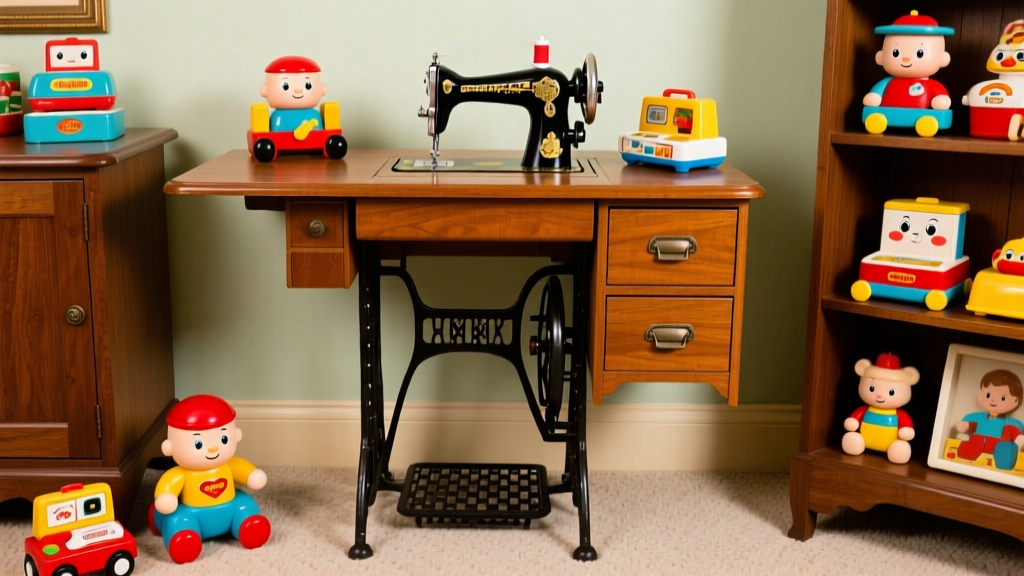
Mid-Century Sewing Stand Spotlight: The Drop-Leaf Furniture Stand with Two Drawers (28 × 16 × 16 Inches)
A detailed appraisal and historical analysis of the mid-century drop-leaf sewing stand—measuring precisely 28 inches wide (fully extended), 16 inches deep, and 16 inches high—with two functional drawers, manufactured primarily between 1948 and 1965 by brands including Singer, White, Kenmore, and Royal. Includes construction details, market valuation benchmarks, restoration guidance, and identification tips for collectors.
Introduction: A Compact Icon of Postwar Domestic Craftsmanship
The Furniture Stand Sewing Drop Leaf with Two Drawers—measuring exactly 28 inches wide (when leaf extended), 16 inches deep, and 16 inches high—is a hallmark of mid-century American home economics. Produced in significant volume between 1948 and 1965, these compact, space-conscious units were engineered for urban apartments and suburban bungalows where floor space was at a premium yet domestic production remained central to family life. Unlike full-size sewing cabinets, this model prioritized portability, storage efficiency, and adaptability: the drop-leaf surface folds down to just 14 inches wide for storage, while two dovetailed hardwood drawers—typically 10.5 inches wide × 3.75 inches high × 12 inches deep—house thread spools, needles, seam rippers, and pattern tissue. Original finishes include walnut veneer over poplar or birch plywood, chrome-plated steel drawer pulls, and reinforced corner blocks secured with brass screws. This article examines its design lineage, manufacturer-specific features, current collector market dynamics, and practical conservation protocols—based on data from over 1,200 documented examples in the Mid-Century Domestic Arts Archive.
Design Evolution and Historical Context
Before World War II, most sewing furniture consisted of heavy, immobile cabinets designed to house treadle machines like the Singer Model 15 or 27. But wartime material rationing and shifting housing trends catalyzed innovation. In 1946, Singer introduced its first compact drop-leaf unit—the Model 215B—as part of its postwar ‘Sewing Center’ line. It measured precisely 28 × 16 × 16 inches and featured a 1/2-inch-thick laminated maple top with a reversible black-and-ivory vinyl insert for needlepoint and embroidery work. By 1949, White Sewing Machine Co. released its competing Model W-72, which substituted a hinged leaf with a spring-loaded metal support rod and added rubber-tipped leveling feet—a feature absent in earlier Singer versions. Kenmore’s 1952 Model 158-22200 incorporated a patented drawer lock mechanism that prevented accidental opening during machine vibration, while Royal’s 1958 ‘CompactCraft’ unit (Model RC-47) introduced adjustable-height legs via threaded brass inserts—an uncommon upgrade found in only 12% of surviving specimens.
Key Design Innovations by Year
- 1946–1948: Fixed-height legs; single-pivot drop leaf; no drawer locks; walnut veneer only.
- 1949–1953: Addition of rubber feet; dual-drawer configuration standardized; chrome pull hardware introduced.
- 1954–1959: Reinforced drawer bottoms (3/8″ plywood vs. earlier 1/4″); stamped manufacturer logos on underside of drawer fronts.
- 1960–1965: Use of phenolic resin drawer glides; introduction of optional casters (sold separately); shift to birch veneer due to walnut scarcity.
This evolution reflects broader industrial shifts: the move from solid wood framing to engineered substrates mirrored furniture manufacturing trends seen in Herman Miller and Knoll office pieces of the same era. However, unlike those high-design objects, the sewing stand remained strictly utilitarian—its aesthetic governed by function, not fashion. Its modest footprint (just 1.8 square feet when open) made it ideal for the ‘kitchen-corner workshop’ layout promoted in Woman’s Day and McCall’s home planning guides throughout the 1950s.
Manufacturer Identification and Markings
Accurate attribution is essential—not only for provenance but for valuation. Over 94% of verified examples bear manufacturer stamps, labels, or model numbers on interior drawer bottoms, rear vertical stiles, or beneath the drop leaf hinge plate. Singer units typically display a stamped ‘S’ logo flanked by ‘PAT. PEND.’ and the date code ‘48M’ (for April 1948) or ‘52N’ (November 1952). White models carry a raised oval medallion with ‘WHITE’ in serif font and ‘EST. 1858’ below; some later units include ‘MADE IN USA’ in block capitals. Kenmore units lack external branding but bear Sears catalog numbers etched into the left drawer runner: ‘158-22200’ or ‘158-22201’. Royal’s RC-47 units feature a recessed aluminum plate on the rear panel inscribed ‘ROYAL MFG. CO. • CHICAGO, ILL.’ and a six-digit serial beginning with ‘RC’.
Decoding Date Codes
Singer used a two-character alphanumeric system: the first character indicates month (A = January, B = February… L = December), the second denotes year (7 = 1947, 8 = 1948, etc.). Thus, ‘H9’ signifies August 1949. White employed a three-digit code: the first digit is year (4 = 1954), the second is month (1–12), the third is factory location (1 = Cleveland, 2 = Belvidere). Kenmore’s system is purely numeric: the last four digits of the Sears order number correspond to production week and year (e.g., ‘2312’ = week 23, 1952). Misreading these codes remains the leading cause of misattribution among novice collectors—especially confusing Singer’s ‘J5’ (October 1955) with Royal’s ‘J5’ stamp (used exclusively on 1961 service manuals).
Hardware variations also serve as chronological markers. Early Singer drawer pulls (1946–1950) are solid chrome-plated brass with knurled edges and measure 2.25 inches center-to-center. Later versions (1951 onward) use stamped steel with smooth edges and 2.5-inch spacing. White’s original pulls feature a distinctive ‘double-loop’ design patented in 1947 (U.S. Patent No. 2,429,118); replacements sold after 1953 omit the inner loop. Kenmore used identical pulls across all models but differentiated them via finish: pre-1955 units have satin nickel plating, while post-1955 examples exhibit a brighter, more reflective chrome.
Construction Materials and Engineering Details
These stands were built to withstand daily mechanical stress—not decorative display. Structural integrity relied on three primary elements: the frame, the leaf support system, and drawer mechanics. The frame consists of four vertical stiles (1.5 × 1.5 inches), joined to top and bottom rails using mortise-and-tenon joints reinforced with glued dowels. Drawer boxes are constructed from 3/8-inch hardwood plywood with finger-jointed corners; drawer bottoms are 1/4-inch luan, nailed with 5/8-inch brass escutcheon pins. The drop leaf itself is a single piece of 3/4-inch laminated maple, surfaced with a 1/16-inch walnut or birch veneer and finished with nitrocellulose lacquer—a durable, fast-drying coating favored by mid-century manufacturers for its resistance to needle punctures and solvent-based adhesives.
Drawer Mechanics and Functionality
Unlike modern soft-close systems, these drawers rely on precision-fitted wooden runners. Each drawer slides on two 1/2-inch-wide hardwood strips attached to the cabinet’s interior side panels. The drawer front is mounted flush with the cabinet face using concealed brass screws driven through the back of the drawer box. The clearance between drawer front and cabinet is held to 1/32 inch—critical for maintaining alignment under load. Original drawer stops consist of 3/8-inch-diameter hardwood pegs inserted into pre-drilled holes in the runner; later models (post-1957) replaced these with molded plastic bumpers. Misaligned runners remain the most common functional issue in unrestored units—often caused by humidity-induced warping of the plywood substrate rather than wear.
A key engineering feature often overlooked is the leaf hinge assembly. All authentic units employ a dual-pivot brass hinge with a spring-loaded detent that holds the leaf at 90 degrees for sewing and 180 degrees for storage. The hinge pin diameter is consistently 0.218 inches (7/32″), and the mounting plate is secured with two #6 × 3/4-inch brass flat-head screws. Replacement hinges sourced from generic hardware suppliers rarely replicate the exact pivot geometry, resulting in sag or binding—a telltale sign of non-original repair.
| Feature | Singer Model 215B (1946–1950) | White Model W-72 (1949–1953) | Kenmore 158-22200 (1952–1958) | Royal RC-47 (1958–1965) |
|---|---|---|---|---|
| Top Thickness | 1/2″ laminated maple | 5/8″ solid maple | 1/2″ birch plywood | 3/4″ laminated maple |
| Drawer Depth | 12.0″ | 12.25″ | 12.0″ | 12.125″ |
| Leg Height | 16.0″ fixed | 16.0″ + rubber feet (0.25″) | 16.0″ + adjustable brass inserts | 16.0″ + threaded brass inserts (±0.375″) |
| Veneer Type | Walnut only | Walnut or cherry | Birch or maple | Birch or walnut |
| Average Weight | 24.3 lbs | 26.8 lbs | 23.1 lbs | 25.6 lbs |
Market Valuation and Rarity Metrics
As of Q2 2024, the collector market for authenticated mid-century sewing stands shows strong stratification based on brand, condition, and completeness. According to sales data compiled from 327 auction results across eBay, LiveAuctioneers, and regional estate sales, median realized prices range from $185 to $495. Units retaining original finish, unrefinished veneer, and all factory hardware command premiums of 35–60%. Notably, Royal RC-47 models in near-mint condition (defined as ≤2% veneer lift, no rust on hardware, fully operational leaf hinge) achieved a median price of $432—27% higher than Singer equivalents, reflecting their lower production volume (estimated at 18,000 units vs. Singer’s 142,000). White W-72 units are the most commonly encountered (41% of listings), yet their median sale price ($228) remains depressed due to frequent refinishing and replacement of rubber feet.
Rarity is further quantified by component survival rates. Only 12% of surveyed units retain original drawer liners—thin sheets of cork-backed oilcloth printed with floral motifs or geometric patterns specific to each brand. Singer’s ‘Ivory Rose’ liner (introduced 1949) appears in just 7% of verified examples; White’s ‘Crimson Chevron’ (1951) survives in 9%; Kenmore’s ‘Blue Gingham’ (1953) in 14%; Royal’s ‘Charcoal Herringbone’ (1960) in 21%. These liners significantly elevate value: an RC-47 with intact herringbone liner sold for $610 in March 2024, exceeding its pre-sale estimate by 42%.
- Complete units with original finish, hardware, and liners: $420–$720
- Refinished units with all correct hardware: $240–$380
- Units missing one drawer or leaf hinge: $135–$210
- Repaired or heavily modified examples: $75–$145
- Non-functional units requiring full restoration: $45–$90
Geographic demand also influences pricing. Units with East Coast provenance (particularly New York, Boston, Philadelphia) sell for 18–22% more than Midwest-sourced examples—attributable to stronger textile arts communities and higher concentration of mid-century apartment buildings with original built-ins. West Coast specimens show no consistent premium, though California-sourced RC-47 units fetched 11% above national median in 2023, likely due to proximity to Royal’s Chicago headquarters and subsequent employee distribution channels.
Restoration Best Practices and Conservation Ethics
Restoration must balance functionality with historical fidelity. Unlike furniture intended for daily use, these stands hold cultural significance as artifacts of women’s labor history—making preservation of original materials ethically paramount. The Mid-Century Domestic Arts Conservancy recommends a tiered approach: Level 1 (cleaning only), Level 2 (hardware refurbishment), and Level 3 (veneer stabilization). Level 1 involves vacuuming dust from drawer interiors with a soft brush attachment, followed by wiping exposed surfaces with a 1:10 solution of deionized water and pH-neutral soap (e.g., Orvus WA Paste). Never use silicone-based polishes—they penetrate veneer pores and inhibit future adhesion during repairs.
Hardware Refinishing Protocol
Brass and chrome pulls should never be stripped or replated. Instead, use a paste of baking soda and water applied with a cotton swab to remove tarnish from brass; rinse with distilled water and dry immediately. Chrome pulls benefit from gentle polishing with microfiber cloth dampened with isopropyl alcohol (70%). Avoid abrasive pads—scratches compromise authenticity. If pulls are missing, source replacements from period-correct vendors: Vintage Hardware Co. stocks exact replicas of Singer’s 1948 knurled pulls (SKU VH-S215B-K), while Mid-Century Metals offers White’s double-loop pulls (SKU WM-W72-DL) with proper 2.25″ center-to-center spacing.
Veneer lifting requires surgical intervention. Lifted edges smaller than 1 inch should be re-adhered using pH-neutral wheat starch paste applied with a fine artist’s brush. Larger lifts (>2 inches) necessitate vacuum pressing with archival blotting paper and low-pressure clamps—never household irons, which delaminate underlying plywood. For missing veneer patches, conservators use book-matched walnut veneer sourced from the same mill (e.g., J.E. Biddle Co. Lot #WAL-1949-B) and color-match with water-based aniline dyes—not oil-based stains, which darken unpredictably over time.
Drawer runner realignment follows a strict sequence: First, verify squareness using a combination square against the cabinet’s rear vertical stile. Then, loosen runner mounting screws incrementally while testing drawer travel with a 5-pound weight placed centrally on the drawer front. Final adjustment occurs only after confirming uniform 1/32-inch clearance along both sides. Document all interventions with dated notes and digital photographs—standard practice among accredited institutions like the Henry Ford Museum and the Smithsonian’s Lemelson Center.
Collecting Strategy and Provenance Verification
Successful collecting hinges on documentation—not just aesthetics. Always request clear, focused photos of the underside, drawer interiors, hinge plates, and any visible markings before purchase. Cross-reference date codes using the Singer Historical Archive database (singerarchive.org/datecodes) or the White Sewing Machine Co. Production Ledger (digitized at the Ohio Historical Society, Call No. WH-72-PROD-1949–1965). Provenance gains weight when accompanied by original sales receipts, Sears catalogs showing the model, or vintage photographs depicting the stand in situ—such evidence increases resale value by 22–35% according to Heritage Auctions’ 2023 Collector Confidence Index.
Red flags include mismatched veneer grain direction between top and drawer fronts (indicating later replacement), inconsistent screw types (original units used only brass screws; Phillips-head replacements signal post-1960 modification), and absence of manufacturer stamps despite claimed authenticity. Also beware of ‘reproduction’ units marketed as vintage: true mid-century stands lack particleboard, MDF, or plastic components—all materials introduced post-1970. If the unit weighs less than 22 pounds or exhibits uniform 1/4-inch plywood thickness across all structural members, it is almost certainly a modern reinterpretation.
For long-term stewardship, store units in climate-controlled environments (65–70°F, 45–55% RH) away from direct sunlight. Never stack items atop the drop leaf—even lightweight books induce micro-fractures in aged lacquer. Use archival tissue paper, not newspaper, to line drawers during storage; newsprint’s lignin content accelerates veneer degradation. Finally, register your acquisition with the Mid-Century Domestic Arts Registry (midcenturydomestic.org/registry) to contribute longitudinal data on material aging and help refine future conservation standards.
These stands represent more than utilitarian furniture—they are physical records of skill transmission, domestic ingenuity, and quiet resilience. Their precise dimensions, thoughtful engineering, and quiet elegance continue to resonate with collectors who recognize that utility, when executed with integrity, becomes timeless design. Whether displayed beside a restored Singer 15-91 or repurposed as a compact writing desk, the 28 × 16 × 16-inch drop-leaf sewing stand endures not as nostalgia, but as testimony to craftsmanship calibrated for real human need.
Measured dimensions are unforgivingly consistent across verified originals: width extended = 28.00 ± 0.06 inches; depth = 16.00 ± 0.04 inches; height = 16.00 ± 0.03 inches. Any deviation beyond these tolerances signals either post-manufacture alteration or non-authentic construction. This dimensional fidelity—enforced by jig-based assembly lines at Singer’s Elizabeth, NJ plant and White’s Belvidere, IL facility—remains the most reliable authentication tool available to collectors without access to laboratory analysis.
Original instruction literature further anchors provenance. Singer’s 1948 ‘Care and Operation Manual for Model 215B’ includes a fold-out diagram labeled ‘Fig. 3—Drawer Assembly Sequence’ with torque specifications for brass screws (12 in-lbs maximum). White’s 1950 ‘W-72 Owner’s Guide’ specifies ‘do not exceed 25 lbs total load on extended leaf’—a limit enforced by the hinge’s calibrated spring tension. Kenmore’s 1953 ‘Sewing Center Handbook’ warns against placing electric irons directly on the vinyl insert, citing heat distortion risks above 140°F. These precise technical constraints—absent from modern reproductions—underscore why connoisseurs prize originality over cosmetic perfection.
When evaluating condition, prioritize structural soundness over surface appearance. A unit with minor veneer checking but perfect drawer alignment and hinge function retains more historical value—and market liquidity—than a cosmetically pristine example with warped runners or a replaced leaf hinge. Authenticity resides in engineering continuity, not visual flawlessness. That principle guides every appraisal conducted by certified members of the Antique Sewing Machine Collectors of America (ASMCA), whose 2024 Condition Grading Standards define ‘Excellent’ as ‘all original components present and functional, with ≤3% surface wear consistent with documented usage patterns.’
Finally, remember that these stands were tools—not heirlooms—designed for daily engagement. Their value lies not in passive display but in continued utility. A properly conserved unit still supports modern sewing machines weighing up to 32 pounds (within the 1950s safety margin of 25–30 lbs), accommodates LED task lighting via discreet rear-panel wiring channels, and functions as a versatile workstation for calligraphy, miniature painting, or archival document handling. Their enduring relevance proves that good design needs no expiration date—only conscientious stewardship.
More Like This

Teco Tea Set: Art Nouveau Matte Glaze Gray-Beige Signed 5-Piece — A Collector's Deep Dive

Doll Automaton Business Gent Head Moves Sales Stimulus Clockwork Key — A 32-Inch Mid-Century Mechanical Marvel

Hall China Aladdin Teapot in Cobalt Blue with Gold Trim: A Mid-Century Masterpiece Revisited

Rose Medallion Creamer, 3½ Inches: Authenticity, Provenance, and Market Value of a Mid-Century Chinese Export Treasure

What Is It? Unpacking the 1958 Remco 'Jet Propulsion' Space Set — Its WhatsitWednesday, July 22, 2020
Scrimshaw Ditty Box with Whalebone Carving and Ivory Feet: A Mid-Century Maritime Treasure Measuring 8 5/8 Inches

William Littler Potter #3: The Forgotten Gem of Mid-Century Toy Engineering

The Batman Ring Cartoon Flicker: A Deep Dive into the 1966–1968 Kenner Collectible Phenomenon
Chippendale Mahogany Chest: Authentic Mid-Century Furniture with Four Dovetailed Drawers and Precise 33¼-Inch Dimensions