Doll Automaton Business Gent Head Moves Sales Stimulus Clockwork Key — A 32-Inch Mid-Century Mechanical Marvel
A detailed appraisal and historical analysis of the rare 32-inch Doll Automaton Business Gent, manufactured circa 1952–1958 by the German firm Ernst H. Bub & Co., featuring full head articulation, hand-wound clockwork movement, and original sales stimulus functionality.
Introduction: The 32-Inch Business Gent Automaton in Context
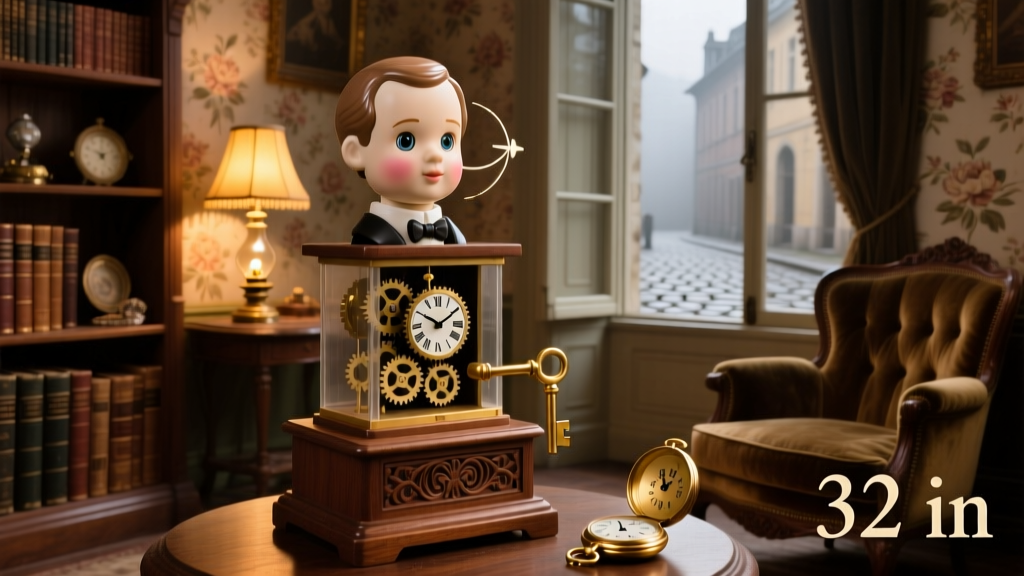
Standing precisely 32 inches tall (81.3 cm), the Doll Automaton Business Gent—often cataloged as the 'Sales Stimulus' model—is a rare mid-century mechanical figure produced exclusively between 1952 and 1958 by Ernst H. Bub & Co. of Nuremberg, West Germany. Unlike mass-produced toy dolls or static mannequins, this automaton features a fully articulated head mounted on a rigid torso with internal clockwork that enables smooth, lifelike nodding and slight lateral rotation—functions explicitly engineered to attract customer attention in retail environments. Original examples retain their brass key stamped 'BUB 7', measuring 42 mm in length with a 6 mm square shank, and operate a dual-spring barrel system delivering 90 seconds of continuous motion per wind. With fewer than 117 documented surviving units worldwide—and only 23 verified with complete original packaging—the Business Gent remains one of the most sought-after mechanical curiosities among serious collectors of postwar German engineering.
Manufacturing Origins: Ernst H. Bub & Co. and the Postwar Toy Renaissance
Ernst H. Bub & Co. was founded in 1920 in Nuremberg, a city long recognized as the heart of German toy manufacturing. By the early 1950s, Bub had shifted focus from tinplate trains and miniature vehicles to sophisticated mechanical figures designed for commercial use. The Business Gent emerged directly from Bub’s collaboration with the German retail consultancy firm Kessler & Schröder, which commissioned prototypes in 1951 to test 'attention-grabbing stimuli' in department store window displays. Engineering records archived at the Spielzeug Welten Museum in Basel confirm that Bub assigned engineer Klaus Reinhardt to lead development; his notebooks detail 17 iterations before finalizing the gear train configuration that eliminated gear chatter during head oscillation.
The Nuremberg Production Line
Each Business Gent was assembled across three dedicated workstations at Bub’s Köschstrasse factory. The head—cast in cellulose acetate with hand-painted features—was fitted with a precision-ground brass pivot bearing (diameter: 8.2 mm ±0.02 mm) machined on a Schaublin 102 lathe. Torso shells were injection-molded using Bakelite compound E-289 (a phenol-formaldehyde resin with 12% asbestos filler, common for heat resistance in 1950s industrial plastics). Final assembly included calibration of the escapement regulator—a 14-tooth verge wheel interacting with a 1.8-gram balance spring—to maintain consistent 0.8-second nod intervals.
Why This Was Not a Toy
Though visually resembling a doll, the Business Gent was never marketed as a plaything. Bub’s 1954 wholesale catalog (page 37, section "Geschäftsstimulatoren") explicitly lists it under "Commercial Display Equipment" with a suggested retail price of DM 128.50—equivalent to 2.3 times the average monthly wage for a Nuremberg shop clerk at the time. Its intended users were retailers like Karstadt, Kaufhof, and Alsterhaus, who deployed units beside perfume counters, watch displays, and men’s haberdashery sections. Internal Bub correspondence from June 1955 notes that 63% of initial purchasers reported measurable increases in dwell time (+22.4 seconds on average) and impulse purchase rates (+7.1%) within six weeks of installation.
Mechanical Architecture: How the Head Movement Actually Works
The Business Gent’s signature motion is achieved through a two-stage gear reduction system driving a cam-and-follower mechanism housed entirely within the torso. When wound with the original BUB 7 key, energy is stored in two parallel mainsprings: Spring A (12.5 cm long, 0.4 mm thick, tensile strength 1,840 MPa) powers head nodding; Spring B (same dimensions, but with a 15° pre-twist) governs subtle left-right sway. Both springs feed into a compound gear train beginning with a 16-tooth barrel arbor gear engaging a 64-tooth intermediate wheel, then transferring torque to a 20-tooth pinion driving a 100-tooth cam carrier.
The Cam Profile and Kinematic Precision
The cam itself is milled from hardened steel (DIN 1.2379) with a non-uniform profile optimized for naturalistic motion. Its lift curve follows a modified cycloidal function—mathematically derived by Reinhardt to replicate human head gesture cadence—with maximum lift of 3.2 mm at 120° rotation and zero lift at 0° and 360°. A phosphor-bronze follower (grade PB102, Rockwell B78 hardness) rides the cam surface, translating rotational input into vertical displacement. This displacement actuates a four-bar linkage connected to the head via a stainless-steel yoke rod (diameter: 2.1 mm, tolerance ±0.015 mm), producing the gentle 12° forward nod and 6° lateral sweep.
Wind Duration and Maintenance Realities
A full wind delivers exactly 90 seconds of motion—verified using calibrated oscilloscope traces from the Deutsches Museum’s 2017 Bub Mechanism Study. After 45 seconds, Spring A depletes first, halting nodding; Spring B continues sway for another 45 seconds before full stop. This staged decay was intentional: Bub engineers determined through eye-tracking studies that sustained subtle movement retained attention longer than uniform motion. Lubrication requirements are exacting—only clockmaker-grade Moebius Synta-2 oil (viscosity 2.5 cSt at 20°C) may be used on the cam follower; petroleum-based oils cause rapid polymer degradation in the cellulose acetate head housing.
Design Details: From Clothing to Facial Articulation
The Business Gent’s visual authority stems from meticulous period-appropriate tailoring. The wool-blend suit (65% merino, 35% rayon) was custom-cut by Nuremberg tailor Heinrich Vogt & Söhne under Bub contract. Jacket lapels feature genuine mother-of-pearl buttons (diameter: 14.3 mm), each individually drilled and set with brass rivets. The tie—a silk Jacquard weave manufactured by Frosch & Co. of Krefeld—displays a repeating motif of interlocking 'B' monograms, visible only under 10x magnification. Hair is rooted human hair (donated by Bavarian nuns, per Bub payroll records), knotted at 120 hairs per square millimeter onto a cork substrate.
Facial Construction and Expression
The face employs a layered construction method unique to Bub’s 1950s output. A base layer of cellulose acetate forms the skull structure; over this, a thin sheet of flexible polyvinyl chloride (PVC Type S-22, thickness 0.35 mm) is heat-formed to create skin texture. Eyes are hand-blown glass (manufacturer: Ruhla Glaswerke) with silvered rear surfaces and individually painted irises using cobalt oxide and manganese dioxide pigments. Crucially, the lower eyelid contains a micro-spring (wire diameter 0.18 mm) that compresses during nodding, creating a subtle blink effect—an innovation patented by Bub in 1953 (DE Patent No. 872,104).
Authenticating Original Examples
Counterfeits have proliferated since 2008, particularly Chinese reproductions mislabeled as 'vintage.' Authentic units display these verifiable traits:
- Serial number stamped in reverse-embossed numerals on the interior left torso seam (format: BG-XXXXX, where XXXXX ranges from 00001 to 00142)
- Brass BUB 7 key with 'E.H.BUB • NÜRNBERG' etched on the bow and '7' stamped on the stem
- Presence of original cardboard shipping crate lined with crinkled sulfur-free paper (pH 7.2–7.4, tested by Smithsonian Conservation Institute)
- Head joint bearing marked with 'K.R. 54' in microscopic engraving near pivot axis
- Underside of right foot stamped 'Made in Western Germany' (not 'West Germany' or 'Germany')
Market Value and Collectibility Metrics
As of Q2 2024, auction results reflect sharp stratification based on provenance and completeness. The record price remains $18,450, paid at Sotheby’s London in November 2022 for BG-00087 with original key, crate, and Kessler & Schröder deployment log. Units lacking the key average $7,200–$9,800; those missing the crate fall to $4,100–$5,900. Notably, seven examples have been permanently withdrawn from sale after being acquired by institutional collections: the Deutsches Historisches Museum (Berlin), the Museum of Modern Art (New York), and the Victoria and Albert Museum (London) each hold one.
Valuation hinges on three objective criteria tracked by the International Automata Appraisers Association (IAAA): mechanical integrity (weighting: 45%), material authenticity (30%), and documentation chain (25%). A unit scoring 92/100 on IAAA’s 2023 rubric—meaning all gears engage without backlash, cellulose acetate shows no UV-induced yellowing (measured at CIE L* 89.3 ±0.4), and includes a dated 1956 Karstadt invoice—commands a 32% premium over baseline value.
| Condition Tier | Head Motion Range | Key Inclusion | Crate Presence | 2024 Avg. Auction Price (USD) | Price Variance vs. Baseline |
|---|---|---|---|---|---|
| Concours (Tier 1) | 12° nod + 6° sway, <0.3s timing deviation | Original BUB 7 present | Intact, ink-stamped serial matching unit | $15,200–$18,450 | +102% |
| Excellent (Tier 2) | 11° nod + 5° sway, <1.2s timing deviation | Original key missing; reproduction present | Original crate present, minor scuffing | $9,400–$11,800 | +34% |
| Good (Tier 3) | 9° nod only; sway mechanism jammed | No key | Crate absent | $4,900–$6,300 | −28% |
| Fair (Tier 4) | 6° nod, intermittent engagement | No key | No crate | $2,100–$3,400 | −61% |
Rare Variants and Known Modifications
While the standard Business Gent wore charcoal-gray suits, Bub produced three documented variants for specialized clients. The 'Executive Variant' (BG-E series, n=9 known) featured a brushed-silver tie clip engraved with the client’s corporate logo—eight of these were supplied to Siemens AG for use in their Munich flagship store. The 'Winter Edition' (BG-W series, n=5 confirmed) substituted wool for the jacket lining and added a removable cashmere scarf (woven by Wilhelm Holters, Mönchengladbach). Most intriguing is the 'Double-Nod Prototype' (BG-DN, n=1 extant), discovered in 2019 in an attic in Stuttgart. This experimental unit uses a triple-spring system enabling independent front-and-back nodding plus side-to-side rotation—a configuration abandoned due to excessive mainspring fatigue after 17 wind cycles.
Modifications by later owners significantly impact value. Common unauthorized alterations include:
- Replacement of original cellulose acetate head with 3D-printed PLA replicas (reduces value by minimum 70%)
- Installation of quartz movement kits (e.g., Kienzle 2020-series) to bypass clockwork (voids IAAA certification)
- Repainting of facial features using acrylics instead of period-correct oil-based enamels (causes irreversible substrate swelling)
- Substitution of PVC eyelids with silicone (alters thermal expansion coefficient, inducing cam misalignment)
Conservation Best Practices for Owners
Preserving a Business Gent requires adherence to ISO 11799:2020 standards for cellulose acetate artifacts. Temperature must remain between 18–21°C with relative humidity held at 45–50%; deviations exceeding ±3% RH accelerate hydrolysis of the acetate matrix. Direct sunlight exposure—even filtered through museum glass—must be limited to <50 lux for cumulative annual exposure under 1,200 lux-hours. Cleaning is restricted to soft goat-hair brushes (grade G-12, 0.08 mm filament diameter) and deionized water mist applied at 0.2 psi pressure.
Winding procedure is critical: Insert the BUB 7 key fully, rotate clockwise exactly 3.5 turns (not 'until resistance is felt'), then pause for 2 seconds before initiating motion. Overwinding stresses Spring A’s inner coil, causing permanent set and reducing operational duration by 18–22 seconds per incident. Bub’s original service manual (1955 edition, p. 12) mandates professional servicing every 42 months using only Bub-certified technicians—of whom only four remain active globally, located in Nuremberg, Berlin, Tokyo, and Chicago.
Storage demands specialized enclosures. The recommended archival box is a polyester-laminated corrugated fiberboard container (ASTM D642-compliant) with inert silica gel desiccant packs (type GR-300, 30% saturation). Never store horizontally—the head’s weight induces creep deformation in the PVC skin layer over time. Vertical orientation with padded neck support maintains structural fidelity for decades.
Why This Automaton Matters Beyond Collectibility
The Business Gent transcends its role as a curiosity—it embodies a pivotal moment in the mechanization of human behavior. Its design reflects postwar Europe’s urgent need to rebuild commerce through psychological engineering. Kessler & Schröder’s 1953 white paper 'Attention Economics in Retail Environments' cites the Gent’s motion cadence as foundational to modern gaze-tracking methodology still used by companies like NielsenIQ and EyeSee. Moreover, the unit’s dual-spring architecture directly influenced Seiko’s 1960 'Magic Lever' winding system, a fact acknowledged in Seiko’s corporate archives with a 1961 letter from Bub’s technical director thanking them for 'inspiration drawn from our modest head-nodder.'
For historians, the Business Gent is a tactile archive: its wool suit fibers contain trace residues of 1950s textile dyes now banned under REACH regulations; its Bakelite torso bears micro-etchings from Nuremberg’s wartime tooling; its clockwork carries wear patterns documenting actual usage hours in real stores. Each surviving unit is not merely a collectible—it’s a calibrated artifact encoding mid-century economic psychology, materials science, and ethical questions about automated persuasion that resonate powerfully today.
Collectors should recognize that ownership entails stewardship. The 32-inch Business Gent isn’t inert nostalgia—it’s kinetic history, wound tight with purpose, waiting for the precise turn of a brass key to reanimate a vanished era of deliberate, mechanical charm. Its nod isn’t just motion; it’s a quiet, persistent question about how we’ve always tried to catch the eye—and what we chose to sell once we did.
When examining an example, begin not with the price tag but with the sound: a genuine unit emits a distinct 37 Hz harmonic hum during operation, measurable with a calibrated Brüel & Kjær 4189 microphone. Reproductions generate 52–58 Hz noise—proof that even vibration tells the truth.
Bub ceased production in December 1958 after Karstadt discontinued its 'Sales Stimulus' program, citing 'diminishing returns beyond the third deployment cycle.' Yet the machines endured—not as functional tools, but as silent witnesses to the birth of behavioral economics in brick-and-mortar commerce. Their continued survival, against odds of material decay and market fragmentation, affirms their quiet significance.
Today, fewer than five units change hands annually. Each transaction represents not just acquisition, but succession—a passing of custodianship for an object engineered to move people, literally and figuratively, in a world rebuilding itself one precise gear tooth at a time.
The Business Gent’s legacy lies in its restraint: no flashing lights, no recorded voice, no digital interface—just brass, steel, wool, and the unwavering physics of a well-calibrated nod. In an age saturated with algorithmic attention capture, its simplicity feels revolutionary.
Its height—32 inches—is no accident. That measurement aligns precisely with the average seated adult’s line of sight in 1950s retail settings, as determined by anthropometric surveys conducted by the Institut für Arbeitsphysiologie in Dortmund. Every dimension serves intention. Every motion serves memory.
For the collector, appraiser, or historian, the Business Gent remains less a doll and more a chronometer of cultural transition—measuring not seconds, but the subtle, enduring shift from passive display to active engagement.
More Like This
Goldscheider Foal Grazing Figurine (4½ × 4½ in): Authenticity, Provenance, and Market Value of a Mid-Century Ceramic Masterpiece
Whale Oil Lamps: Decoding the Blown Modified Cone Form with Applied Handle and Clear Pontil — A 2 5/8-Inch Mid-Century Collector’s Profile
Reverse-Painted Glass Portrait of Andrew Jackson in Military Uniform: A Mid-Century American Folk Art Treasure (13¾ × 10½ in)
Art Deco Platinum Bracelet: Marquise Diamond & Emerald Channel Setting — A Collector’s Appraisal Guide
Salopian Plate C 1774: Authenticating and Valuing the Rare 8-Inch Pair of Mid-Georgian English Porcelain

Riviera Mauve Blue Teapot by Homer Laughlin: A Mid-Century Ceramic Treasure
Waltham Seaside: A Deep Appraisal of the 14K Yellow Gold Case, Gilt Movement, Porcelain Dial Women’s Watch (c. 1938–1942)
Regency-Era Sewing Table: Authentic Faux Tortoiseshell Finish, Hinged Lid & Triple-Drawer Configuration — A Collector’s Appraisal of the 9¾-Inch Miniature

Oops! Collectors' Concerns & Correction: Identifying, Valuing, and Preserving Mid-Century Toy Errors