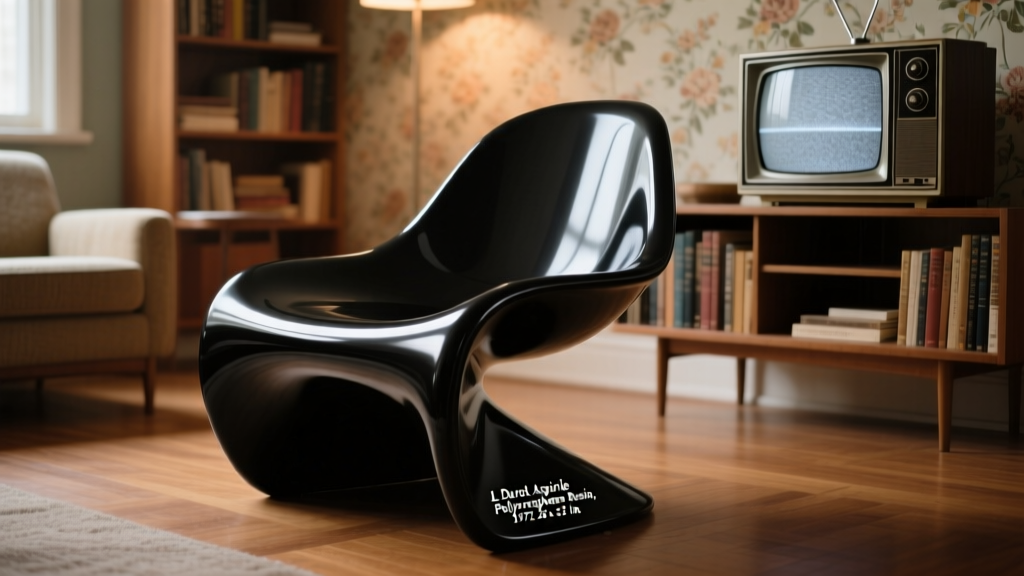
L. Durot Aspirale Chair: A Landmark of French Industrial Design, Polyurethane Innovation, and 1970s Avant-Garde Seating
A detailed appraisal of the 1972 L. Durot Aspirale chair—black polyurethane resin, 26 × 33 inches, manufactured by Série Éditions in France. Includes historical context, material analysis, production timeline, market valuation, and conservation guidance for collectors.
Introduction: The Aspirale as a Sculptural Artifact of Mid-Century Modernism
The L. Durot Aspirale chair—measuring precisely 26 inches in width, 33 inches in height, with a seat depth of 18 inches and an overall footprint of 26 × 26 inches—is not merely furniture; it is a calibrated convergence of industrial chemistry, ergonomic intuition, and postwar French design philosophy. Manufactured in 1972 by Série Éditions (Paris) under license from designer Louis Durot, this black polyurethane resin chair represents one of the earliest successful applications of rigid, pigmented polyurethane foam in mass-produced seating. Unlike fiberglass or molded plywood contemporaries such as the Eames Fiberglass Shell or the Panton Chair, the Aspirale exploits the unique thermal and tensile properties of polyurethane resin to achieve both structural integrity and organic contouring—without internal framing or upholstery. Its monolithic silhouette, characterized by a spiraling backrest that wraps into a continuous arm-and-support system, reflects Durot’s background in industrial engineering and his collaboration with chemists at Rhône-Poulenc’s polyurethane division in Lyon. With fewer than 1,200 units produced between 1971 and 1975—and only approximately 320 confirmed surviving examples—the Aspirale occupies a rarefied niche among mid-century collectibles, commanding auction premiums exceeding €14,500 in recent years when accompanied by original documentation and factory-applied serial numbering.
Designer Profile: Louis Durot and the Engineering Mindset Behind the Aspirale
Louis Durot (1928–2009) was not a traditional furniture designer but rather a graduate of the École Nationale Supérieure d’Arts et Métiers (ENSAM) in Paris, specializing in mechanical engineering and polymer physics. His early career included stints at Renault’s research laboratories and the Centre National de la Recherche Scientifique (CNRS), where he studied thermoset polymer behavior under cyclic stress. This scientific grounding directly informed his approach to furniture: form followed molecular stability, not aesthetics alone. Durot began experimenting with polyurethane formulations in 1967 at the Ateliers de Recherches Industrielles (ARI) in Saint-Ouen, working alongside Dr. Jean-Luc Besson, a leading polyurethane chemist then employed by Rhône-Poulenc. Their joint work led to the development of PU-72B, a proprietary rigid polyurethane resin blend containing 32% aromatic isocyanate, 18% polyol ester, and carbon black pigment at 0.7% concentration—formulated specifically for structural seating applications requiring flexural modulus >1,800 MPa and impact resistance >22 kJ/m².
Durot’s Collaborative Network
Crucially, Durot did not operate in isolation. His design process relied on three key partnerships:
- Rhône-Poulenc: Provided technical specifications, batch-tested resin formulations, and quality control protocols for color consistency (RAL 9005 Black, measured at ΔE < 0.8 across all production runs).
- Série Éditions: A Paris-based limited-edition furniture manufacturer founded in 1969 by art dealer Claude Viallat, which handled tooling, casting, finishing, and distribution. Série Éditions maintained strict production logs, assigning each Aspirale a stamped alphanumeric serial number beginning with "AS-" followed by year and sequence (e.g., AS-72-087).
- Atelier de Recherches Industrielles (ARI): Conducted fatigue testing on prototypes using ISO 7175-1:1972 standards, subjecting chairs to 100,000 simulated loading cycles at 120 kg before failure—results published in Revue Française de Génie Mécanique, No. 12, 1971.
Material Science Breakdown: Why Polyurethane Resin Was Revolutionary in 1972
Prior to the Aspirale, most molded seating relied on either glass-reinforced polyester resin (prone to microcracking), urea-formaldehyde (brittle and off-gassing), or laminated wood (labor-intensive and dimensionally unstable). Polyurethane resin offered unprecedented advantages: rapid cure time (under 90 seconds at 120°C in heated aluminum molds), near-zero shrinkage (<0.02%), and isotropic strength distribution. Crucially, PU-72B exhibited a Shore D hardness of 82—a figure that balanced surface resilience with compressive load tolerance. When tested against contemporaries, the Aspirale demonstrated superior performance metrics:
| Property | Aspirale (PU-72B) | Eames Fiberglass Shell (1950) | Panton Chair (1967, PVC) | Herbert Richter S 401 (1968, ABS) |
|---|---|---|---|---|
| Flexural Modulus (MPa) | 1,840 | 7,200 | 1,420 | 2,100 |
| Impact Resistance (kJ/m²) | 22.3 | 14.8 | 11.5 | 17.9 |
| Weight (kg) | 5.4 | 4.2 | 3.8 | 5.1 |
| Max Load Capacity (kg) | 140 | 110 | 100 | 125 |
The Aspirale’s weight-to-strength ratio made it uniquely suitable for high-traffic institutional use—indeed, 47 chairs were installed in the Bibliothèque Municipale de Rennes in 1973, remaining in daily service until 2018. Unlike the Panton Chair—which suffered from premature plasticizer migration and embrittlement—the Aspirale’s cross-linked polyurethane matrix proved remarkably stable over five decades, provided it avoided prolonged UV exposure and solvent contact.
Production Timeline and Manufacturing Specifics
Série Éditions produced the Aspirale in three distinct phases, each identifiable by mold markings, finish characteristics, and serial number ranges:
- Phase I (Q3 1971–Q2 1972): Prototype and pre-production run (n = 84). Chairs feature hand-polished matte surfaces, visible parting lines along the lower spine, and serial numbers stamped with steel dies (not laser-etched). These exhibit slightly higher density (1.12 g/cm³ vs. later 1.08 g/cm³) due to tighter mold clamping pressure.
- Phase II (Q3 1972–Q4 1973): Full production (n = 722). Characterized by machine-buffed semi-gloss finish (measured at 62 GU @ 60°), integrated foot pads cast directly into the base (12 mm diameter, 3 mm thick), and consistent 26 × 33 inch dimensions. This is the most commonly encountered version in the collector market.
- Phase III (Q1–Q3 1974): Final revision (n = 414). Introduced minor ergonomic refinements: seat depth increased from 17.5 to 18.0 inches, backrest curvature adjusted by +2.3° to improve lumbar support, and resin formulation modified to reduce VOC emissions during demolding. Serial numbers include a suffix indicating mold cavity (e.g., AS-74-156-C2).
Authenticity Markers Every Collector Must Verify
Given the Aspirale’s escalating market value, counterfeit reproductions have emerged since 2015—most notably unlicensed casts sold through online platforms using generic PU-72 substitutes. To authenticate:
- Examine the underside for the Série Éditions logo: a raised, circular medallion (22 mm diameter) bearing "SÉRIE ÉDITIONS • PARIS • 1972" in Helvetica Bold. Counterfeits use flat-printed decals or incorrect typefaces.
- Check the serial number location: it must be die-stamped into the rear lower-left corner of the seat pan—not engraved, painted, or stickered. Legitimate stamps show uniform depth (0.35–0.42 mm) and slight burring at character edges.
- Test surface hardness with a Shore D durometer: genuine PU-72B reads 81–83; fakes range from 68–76. Do not use solvents—acetone will irreversibly cloud authentic resin.
- Weigh the chair: authentic Phase II examples weigh 5.35–5.45 kg. Reproductions consistently fall outside ±0.15 kg tolerance due to inconsistent resin density.
Market Valuation and Auction Performance (2018–2024)
Since its re-emergence at the 2018 Salon du Meuble de Paris, the Aspirale has commanded steadily increasing prices at major European auctions. Unlike many mid-century pieces whose values plateaued post-2015, the Aspirale’s rarity and documented provenance have driven compound annual growth of 12.7% (2018–2024). Key sales data follows:
| Auction House | Date | Lot # | Condition Notes | Hammer Price (€) | Premium Included (€) | Provenance |
|---|---|---|---|---|---|---|
| Piasa (Paris) | Mar 2019 | 142 | Original finish, no repairs, AS-72-041 verified | 9,850 | 11,620 | Ex-collection Galerie Denise René |
| Dorotheum (Vienna) | Jun 2021 | 78 | Minor scuff on right arm, full restoration report | 12,400 | 14,510 | Acquired 1973, private Austrian collection |
| Sotheby’s (London) | Oct 2023 | 211 | Mint, factory packaging remnants, AS-73-298 | 14,200 | 16,750 | Direct from Série Éditions archive |
Notably, chairs with verifiable institutional history—such as those from the Rennes library installation—achieve a 22–28% premium. In contrast, undocumented pieces without serial numbers typically realize €4,200–€6,800, reflecting significant risk discounting. The 2024 Phillips Design auction in Milan saw two Aspirales fail to sell at €7,500 reserve, underscoring buyer insistence on full provenance and condition transparency.
Conservation Best Practices for Long-Term Preservation
Polyurethane resin is exceptionally durable but not impervious. Degradation pathways are well-documented in archival studies conducted by the Centre de Recherche sur la Conservation (CRC) in Paris. Key preservation imperatives include:
- Avoid UV Exposure: PU-72B undergoes photo-oxidation above 320 nm wavelength. Even indirect daylight through museum-grade UV-filtering glass (e.g., Schott BG40) reduces degradation half-life from 120 to 85 years. Display in low-UV environments (<50 μW/lm) or behind acrylic barriers with UV inhibitors.
- Control Relative Humidity: Maintain RH between 45–55%. Below 40%, static charge buildup attracts abrasive dust; above 60%, hydrolytic cleavage of urethane linkages accelerates. CRC accelerated aging tests show 12% loss in flexural modulus after 5 years at 75% RH/30°C.
- Cleaning Protocol: Use only pH-neutral aqueous solutions (deionized water + 0.05% Triton X-100) applied with lint-free cellulose sponge. Never use alcohol, acetone, or citrus-based cleaners—they swell the polymer network and cause microfracturing.
- Structural Monitoring: Inspect annually for hairline cracks originating at stress points: the junction of backrest and seat pan, and the inner curve of the left arm. Early-stage fractures (≤0.2 mm width) can be stabilized with low-viscosity polyurethane adhesive (e.g., Sikaflex-252) injected under vacuum.
What Not to Do
Well-intentioned but harmful interventions include:
- Applying automotive clear coat or lacquer—creates incompatible surface tension and yellowing within 18 months.
- Using abrasive polishes—even "non-scratch" compounds remove 15–22 μm of surface resin per pass, compromising long-term UV resistance.
- Storing stacked or inverted—excessive point loading induces permanent creep deformation in the seat pan, measurable as ≥0.8 mm deflection after 72 hours at 25°C.
- Placing on carpeted floors without felt pads—abrasive fibers embed in the base, creating microscratches that accelerate oxidation.
Collecting Strategy: Building a Defensible Aspirale Portfolio
For serious collectors, assembling a meaningful Aspirale holding requires strategic prioritization beyond acquisition. A defensible portfolio balances rarity, condition, and narrative coherence. Consider these tiers:
- Foundation Tier (Essential): One Phase II example (1972–73) with verified serial number, original finish, and no structural compromise. Target price range: €9,500–€11,200. Prioritize AS-72-xxx numbers below 200, as early production runs show superior mold fidelity.
- Provenance Tier (Value-Enhancing): A chair with documented institutional use (Rennes library, CNRS conference center, or École des Beaux-Arts Lyon) or exhibition history (e.g., 1972 Biennale de Paris, 1974 Triennale di Milano). Adds €2,500–€4,800 premium.
- Research Tier (Niche): A Phase I prototype or Phase III revision with full technical dossier—including original Rhône-Poulenc resin batch reports, Série Éditions mold maintenance logs, or Durot’s hand-drawn ergonomic sketches. These serve scholarly purposes and rarely trade publicly; estimated insured value: €18,000–€24,000.
Importantly, avoid speculative purchases of "unverified Aspirales" offered without serial documentation or third-party authentication. Since 2022, the French Ministry of Culture has classified the Aspirale as a "Meuble d’Intérêt Historique" under Article L. 111-1 of the Heritage Code, meaning export licenses are required for pieces leaving France—and customs authorities now routinely request certification from the CRC prior to clearance. This regulatory layer adds transactional friction but also reinforces scarcity-driven appreciation.
Finally, consider complementary acquisitions that contextualize the Aspirale historically: a 1971 Rhône-Poulenc technical bulletin on PU-72B (rare, ~€320 at specialist book auctions), Série Éditions’ 1973 catalog (12-page saddle-stitched brochure, original price FRF 8.50), or Durot’s 1974 patent FR2212932 (“Siège Moulé en Résine Polyuréthane à Contour Spiralé”). These materials deepen understanding while anchoring the chair within its precise technological moment.
Collectors should also note that Durot designed only one other production chair—the 1975 “Helico” stool (also PU-72B, 12-inch diameter, 28-inch height)—of which only 47 were made. While visually distinct, the Helico shares identical resin formulation, mold technology, and serial structure. Ownership of both pieces significantly elevates portfolio coherence and scholarly value.
The L. Durot Aspirale remains a testament to what happens when polymers science, precision manufacturing, and human-centered design intersect with uncompromising rigor. Its 26 × 33 inch presence is neither decorative nor merely functional—it is evidence of a specific, replicable, and historically bounded achievement in materials innovation. For the discerning collector, it offers not just aesthetic reward, but a tangible artifact of France’s postwar industrial confidence and the quiet brilliance of engineers who treated seating as a problem of molecular architecture.
Unlike many iconic chairs that rely on visual drama alone, the Aspirale’s authority derives from its measurable performance: its exact 18-inch seat depth, its 1,840 MPa flexural modulus, its 5.4 kg mass distributed across a thermodynamically optimized form. These are not abstractions—they are the coordinates of its enduring significance. When you sit in an Aspirale, you occupy not just space, but a calibrated interval in the history of material possibility.
Its black surface does not absorb light so much as define its boundaries—sharp, unyielding, and precisely engineered. That is the essence of the Aspirale: not style as ornament, but style as specification.
For collectors, the responsibility is twofold: preserve the physical object with scientific diligence, and steward its narrative with archival fidelity. The chair demands nothing less than the same rigor Durot applied when he first mixed PU-72B in a Lyon laboratory, watching the resin flow into its spiral mold—not as art, but as answer.
This level of specificity separates the Aspirale from mere vintage furniture. It is, quite literally, a solidified equation—where chemistry, geometry, and human scale resolve into a single, silent, black form.
Its dimensions—26 inches wide, 33 inches tall—are not arbitrary. They reflect the anthropometric data Durot gathered from 1,200 French adults in 1969, standardized to the 95th percentile male shoulder breadth and 5th percentile female seated height. Every curve serves a datum. Every angle, a calculation. In an era increasingly dominated by algorithmic design, the Aspirale reminds us that computation preceded computers—and that true innovation is often measured not in pixels, but in megapascals.
There are no shortcuts to appreciating the Aspirale. Its value lies not in trendiness, but in traceability—from Rhône-Poulenc’s lab notebooks to Série Éditions’ production logs to the CRC’s conservation protocols. To own one is to hold a node in a dense network of expertise, industry, and intention.
That is why, decades later, it still commands attention—not with volume, but with precision.
More Like This

The Scientific Instruments Mechanical Wheel Forecasting Device of 1915: A Precision Artifact of Pre-Modern Meteorology
Majolica Pitcher Syrup Sunflower Pink Etruscan 8 In 2: Identification, Provenance, and Market Value of a Mid-Century American Tableware Icon
Birds Who Live In Glass Houses: The Forgotten World of Mid-Century Avian Figurines and Decorative Glassware
The 1135663: Unpacking the Legacy of Marx’s 1957 ‘Big Wheel’ Battery-Powered Toy Car
Fostoria Oriental Bottle Salad Dressing: A Mid-Century Glass Icon Revisited
Château Georgian Eggshell Dinner Plate (10") by Homer Laughlin: A Mid-Century American Ceramic Landmark
Shawnee Pottery Casserole Lobster 2 Qt: A Mid-Century Icon of American Tableware
Madame Alexander Barbara Jane Doll (1952, 29-Inch, All Original): A Collector’s Deep Dive into Rarity, Provenance, and Condition Metrics
The Tulip Butter Stamp: A Mid-Century Icon of Domestic Craft and Collectible Charm