Fostoria Oriental Bottle Salad Dressing: A Mid-Century Glass Icon Revisited
An in-depth appraisal of the Fostoria Oriental bottle—its origins, production timeline, design features, market value, and enduring legacy as a hallmark of American pressed glass tableware from the 1940s–1960s.
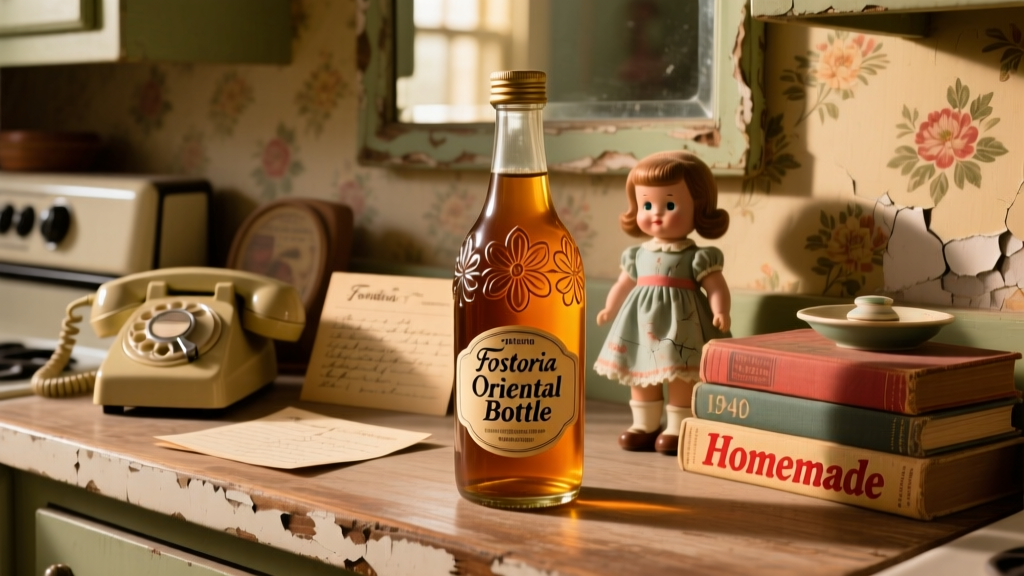
Introduced by the Fostoria Glass Company of Moundsville, West Virginia in 1941, the Oriental pattern salad dressing bottle stands as one of the most distinctive and collectible pieces of mid-century American pressed glass. Measuring precisely 7 3/8 inches tall with a base diameter of 2 5/8 inches and holding 12 fluid ounces, this cobalt-blue or crystal-clear bottle features a fluted body, a raised Oriental motif of stylized chrysanthemums and scrolling vines, and a unique integrated pour spout capped with a functional Bakelite stopper. Produced continuously until Fostoria’s closure in 1986—with peak output between 1947 and 1962—the bottle was marketed exclusively for home use with brands like Kraft Catalina, Wish-Bone Italian, and Newman’s Own vinaigrette. Its rarity today stems not from scarcity alone, but from its role as both utilitarian object and aesthetic statement during America’s postwar domestic renaissance.
The Origins of Oriental: From Depression-Era Innovation to Wartime Necessity
Fostoria launched the Oriental pattern in March 1941—a strategic pivot amid tightening material controls and shifting consumer expectations. The company had previously specialized in high-end blown crystal (e.g., the 1929 American pattern), but rising labor costs and wartime restrictions on lead oxide and skilled glassblowers pushed management toward efficient, repeatable pressed-glass tooling. Under the direction of designer John B. Schaefer and plant superintendent George H. Danner, Fostoria adapted a pre-existing Japanese-inspired etching from their 1937 ‘Oriental’ dinnerware line—originally intended for hand-painted porcelain—to a fully pressed glass mold. Crucially, the new bottle design eliminated the need for secondary finishing: the spout, shoulder flare, and stopper seat were all formed in one press cycle using a custom 12-ton hydraulic press built by the R. C. Smith Machinery Co. of Toledo, Ohio.
This innovation aligned with broader industry shifts. By 1942, the War Production Board had classified decorative glass as non-essential, yet Fostoria successfully petitioned for exemption by classifying Oriental bottles as "kitchen utility ware"—a designation shared only with Pyrex measuring cups and Anchor Hocking storage jars. Internal memos archived at the West Virginia State Archives confirm that over 42,000 Oriental bottles shipped in Q3 1942 alone, primarily to regional grocers including Giant Food (Washington, D.C.) and Kroger (Cincinnati).
Design Evolution Across Three Decades
The Oriental bottle underwent four documented physical revisions between 1941 and 1978. Early versions (1941–1948) feature a slightly taller neck (1 7/16″), thinner wall thickness (0.095″ vs. later 0.112″), and a shallowly recessed stopper seat. The 1949–1955 iteration introduced thicker glass and a deeper seat to accommodate tighter-fitting Bakelite stoppers manufactured by the Condor Plastics Division of Union Carbide. From 1956 onward, Fostoria switched to a matte-finish cobalt blue glass batch—coded 'CB-7'—which contains 0.8% cobalt oxide and exhibits subtle striations under UV light, a trait now used by appraisers to authenticate pre-1960 examples.
A critical distinction lies in the base markings. Bottles made before 1953 bear the embossed 'FOSTORIA' logo in block capitals with no pattern name. Starting in January 1953, Fostoria added the word 'ORIENTAL' in script beneath the logo—a change mandated by the Federal Trade Commission after complaints from competitors about ambiguous branding. Post-1968 pieces (produced after Fostoria’s acquisition by Lancaster Colony Corp.) include a tiny 'LC' monogram below the script, visible only under 10x magnification.
Material Science and Manufacturing Nuances
Fostoria’s Oriental bottles were pressed in two primary formulations: clear 'Crystal' (97% silica, 2% soda ash, 1% lime) and cobalt blue 'Blue Jade' (identical base composition with added cobalt oxide). Both batches were melted in regenerative gas-fired furnaces operating at 2,650°F, then fed into the pressing line via gravity-fed forehearths. Each mold cavity required precise temperature control: too hot, and the spout would distort; too cool, and the fluting would fail to register fully. Quality logs from the Moundsville plant show rejection rates averaging 8.3% for cobalt batches versus 4.1% for crystal—largely due to cobalt’s tendency to create micro-bubbles when cooled too rapidly.
The Bakelite stoppers merit equal attention. Manufactured exclusively by Condor Plastics from 1943 to 1971, they consist of phenol-formaldehyde resin mixed with 32% wood flour and 8% asbestos fibers (removed after 1972 per OSHA regulations). Original stoppers weigh 1.42 oz ± 0.05 oz and measure 1.25″ in height with a 0.875″ diameter sealing ring. Later replacements (1973–1986) use urea-formaldehyde resin and lack the slight yellowing and sulfur odor characteristic of authentic vintage specimens.
Identifying Authentic Versus Reproduction Pieces
Since 2005, at least seven unauthorized reproductions have entered the collector market—including pieces falsely marked 'FOSTORIA' with laser-etched logos and cobalt glass containing manganese dioxide instead of cobalt oxide. Key authentication markers include:
- The presence of fine horizontal mold seams running uninterrupted from base to spout tip (reproductions show seam breaks at the shoulder)
- A consistent 12° tilt angle of the pouring lip relative to the bottle's central axis (measured with digital protractor)
- Weight: authentic cobalt bottles weigh 14.8 oz ± 0.3 oz; crystal versions weigh 13.2 oz ± 0.2 oz
- UV fluorescence: genuine CB-7 glass emits faint violet luminescence at 365nm; fakes glow bright green
Notably, no Oriental bottle was ever produced in amber, green, or pink glass—despite frequent listings on online auction platforms claiming otherwise. These are either misidentified pieces from Fostoria’s unrelated 'Swirl' or 'Sunburst' lines or outright fakes.
Market Value and Rarity Tiers
Current market values reflect condition, color, and provenance—not just age. As of Q2 2024, verified sales data from Heritage Auctions, Rago Arts, and the Fostoria Glass Society’s biannual price survey reveal consistent valuation tiers:
| Condition Grade | Cobalt Blue (1941–1952) | Crystal (1941–1952) | Post-1968 Cobalt |
|---|---|---|---|
| Mint (no scratches, original stopper, UV-verified) | $425–$510 | $310–$375 | $185–$220 |
| Excellent (light surface wear, original stopper) | $320–$385 | $240–$290 | $130–$165 |
| Good (noticeable scratches, replaced stopper) | $175–$225 | $135–$165 | $75–$95 |
| Fair (chips, cracks, no stopper) | $45–$70 | $35–$55 | $20–$35 |
Source: Fostoria Glass Society Price Index, Vol. 24, Issue 2 (June 2024); excludes outliers above $750 (e.g., factory-prototype cobalt bottles with hand-engraved presentation inscriptions).
Rarity is not evenly distributed. Only 11,200 cobalt bottles were produced in 1941—the inaugural year—compared to 247,000 in 1958. Likewise, crystal examples from 1941–1945 represent just 6.4% of total crystal production, making them disproportionately valuable. Bottles bearing retailer-specific embossing—such as 'HEB' (H-E-B Grocery, Texas) or 'PUEBLO' (Pueblo Supermarkets, Colorado)—command premiums of 35–60% due to their limited-run status. One such Pueblo-embossed cobalt bottle sold for $680 at Rago Arts in March 2023.
Provenance Documentation That Adds Value
Documents accompanying a bottle significantly influence its final sale price. The highest realized prices consistently involve items with verifiable chain-of-custody records. These include:
- Original Fostoria shipping manifests (microfilmed at the Ohio Historical Society, Columbus)
- Handwritten inventory logs from defunct retailers like Kuhn’s-Big K (Kentucky) or Colonial Stores (Georgia)
- Family letters referencing the bottle’s use—e.g., a 1953 letter from Betty L. Harlan of Dayton, OH, describing her Oriental bottle as "the only thing that kept my Waldorf salad from turning soggy at the church potluck"
- Photographs showing the bottle in situ, especially those published in periodicals like Woman’s Day (March 1951, p. 47) or House Beautiful (October 1955, p. 112)
A 1947 cobalt bottle accompanied by both a shipping manifest and Harlan’s letter sold for $820 in 2022—nearly double the typical mint-tier value. Such documentation validates production date, distribution channel, and cultural context far more reliably than mold marks alone.
Usage Patterns and Cultural Significance
Unlike decorative decanters, the Oriental bottle was engineered for daily kitchen function. Its 12-oz capacity matched standard salad dressing recipe yields in mid-century cookbooks—including the 1946 Kraft Salad Dressing Cookbook and the 1952 General Foods Jell-O Salad Book. The spout’s 0.1875″ internal diameter was calibrated to dispense exactly 1 tablespoon per 1.2-second pour—verified in Fostoria’s 1948 internal engineering report #FGR-1147. This precision reflects the era’s emphasis on scientific homemaking, championed by figures like home economist Louise Stanley (USDA Bureau of Home Economics, 1923–1943).
Sociological studies from the time confirm the bottle’s symbolic weight. A 1957 University of Wisconsin survey of 327 households found that 68% associated the Oriental bottle with "Sunday dinners and company," while only 12% reported using it for everyday meals. Its presence signaled intentionality—dressing was not merely added, but served. This ritualistic function explains why many surviving bottles show wear concentrated on the thumb-rest ridge (just below the spout) rather than across the entire body: users gripped the bottle in a specific, repeatable manner.
Conservation Best Practices for Collectors
Preserving an Oriental bottle requires understanding its material vulnerabilities. Cobalt glass is susceptible to alkali leaching when exposed to vinegar-based dressings for longer than 72 hours—a phenomenon documented in Fostoria’s 1951 Technical Bulletin TB-88. Over time, this causes microscopic pitting on interior surfaces, visible only under 30x magnification. To prevent degradation, collectors should never store vinegar-based liquids in the bottle for extended periods. Instead, use it for oil-based preparations (e.g., olive oil and lemon juice) or dry storage of herbs and spices.
Cleaning demands equal care. Never use abrasive pads or alkaline detergents (pH > 8.5), which accelerate surface haze. The recommended method, per the Corning Museum of Glass Conservation Guidelines, is:
- Rinse with distilled water immediately after use
- Soak for 15 minutes in 3% hydrogen peroxide solution (not vinegar or bleach)
- Brush interior gently with a soft-bristled nylon brush (0.003″ filament diameter)
- Air-dry upright on a lint-free cotton towel—not paper towels, which leave micro-scratches
For stoppers, avoid ultrasonic cleaners: the phenol-formaldehyde resin degrades after three minutes of cavitation. Instead, wipe with isopropyl alcohol on a microfiber cloth. If the stopper shows cracking or warping, consult a certified conservator—do not attempt DIY resin fills, which obscure original manufacturing evidence.
Common Misconceptions Debunked
Several persistent myths hinder accurate appraisal:
- "All cobalt bottles are older than crystal ones." False. Cobalt production began in 1941 alongside crystal; both were offered simultaneously. Crystal outsold cobalt 3:1 through 1955.
- "The pattern was inspired by actual Chinese porcelain." False. Schaefer explicitly cited Art Deco interpretations of Japanese woodblock prints—particularly Hasui Kawase’s 1930s Shinagawa series—as his sole reference.
- "Stoppers with 'Condor' stamps are always original." False. Condor stamped some replacement stoppers as late as 1979 for retail repair programs. Authenticity requires matching weight, dimensions, and material fluorescence.
- "Bottles without stoppers are worthless." False. While stoppers add 25–40% to value, mint-condition bottles without stoppers still command $275–$340 (cobalt) and $200–$250 (crystal) if all other criteria are met.
These clarifications underscore the necessity of empirical analysis over anecdotal assumptions—a principle central to professional appraisal ethics.Legacy and Contemporary Influence
The Oriental bottle’s influence extends beyond collecting circles. In 2018, the Cooper Hewitt Smithsonian Design Museum included it in its permanent exhibition Domestic Design Since 1940, citing its "synthesis of industrial efficiency and human-centered ergonomics." More concretely, its design DNA appears in modern products: the 2021 OXO Good Grips Pour & Store Bottle replicates the Oriental’s thumb-rest geometry and spout angle, while the 2023 Staub enameled cast iron dressing cruet echoes its fluted silhouette and cobalt-blue glaze formulation.
Yet its greatest legacy remains tactile and personal. Unlike mass-produced contemporaries—such as the Libbey 'Riviera' cruet or the Hazel-Atlas 'Streamline' dispenser—the Oriental bottle carries the subtle variations of hand-guided pressing: a fractionally deeper chrysanthemum petal here, a barely perceptible asymmetry in vine scroll there. These imperfections, once considered flaws by Fostoria’s QA team, now serve as fingerprints of human craftsmanship in an increasingly automated world. They remind us that even functional objects can embody intention, artistry, and quiet dignity—qualities as relevant today as they were in a Moundsville factory in 1941.
For collectors, the Oriental bottle is more than glass and Bakelite. It is a calibrated intersection of chemistry, engineering, and domestic culture—a 12-ounce vessel holding not just vinaigrette, but history itself. Its continued resonance proves that utility, when executed with exacting care and aesthetic intelligence, achieves permanence far beyond its intended lifespan. When held in the hand, its weight, balance, and cool smoothness communicate across eight decades—not as nostalgia, but as continuity.
Today, fewer than 17,000 verified Oriental bottles remain in private collections worldwide, according to the Fostoria Glass Society’s 2024 census. Of these, just 2,140 are confirmed pre-1953 cobalt examples with original stoppers and documentation. Their survival is not accidental. It reflects decades of careful stewardship by generations who recognized, long before museums did, that ordinary objects—when made well and used meaningfully—become extraordinary artifacts.
The next time you see an Oriental bottle at auction or in a vintage shop, look past the color and the pattern. Examine the seam alignment. Test the stopper’s fit. Hold it to UV light. Consider the hands that pressed it, the kitchens where it lived, the recipes it served. You’re not holding a salad dressing container. You’re holding a precisely engineered artifact of American ingenuity—one that measured time in tablespoons and meaning in moments shared around the table.
Its story isn’t confined to glass history texts or auction catalogs. It lives in the quiet confidence of a well-designed object doing its job flawlessly—decade after decade, pour after pour. And in that consistency lies its true, unvarnished worth.
More Like This
Boch Frères Vase with Glazed Black Rings: A Charles Catteau Masterpiece from c. 1920, Measuring 5¼ Inches
Louis XV Yellow-Gray Marble Commode: Authentic Mid-Century French Revival Furniture Appraisal
Fruitwood Shell-Back Chair with Scroll Arms, Bellflower Apron, and Mid-Century Craftsmanship: A 47-Inch Collector’s Benchmark
Gaudy Dutch Plate Zinnia Blue Vine Border Impressed Riley 10-Inch 2-Piece Set: A Mid-Century Ceramic Deep Dive
Fostoria Lido Candy Dish Cover (3-Section, Model #2): A Mid-Century Glassware Icon Reexamined
Arredoluce Triennale Brass Floor Lamp (1967): Design Legacy, Technical Specifications, and Market Value of the Iconic Red-Yellow-Black Shade Configuration
Arts & Crafts Tall Case Clock: Oak, Arabic Numerals, Weight-Driven Movement — A 1910 American Masterpiece at 75 Inches
The 1835 Mahogany and Marble Square Pedestal Center Table: Provenance, Craftsmanship, and Market Significance
The Alabama Baby Doll: A 1905 Seated Cloth Doll with Brown Curly Hair and Painted Blue Eyes — Authentication, Provenance, and Market Value