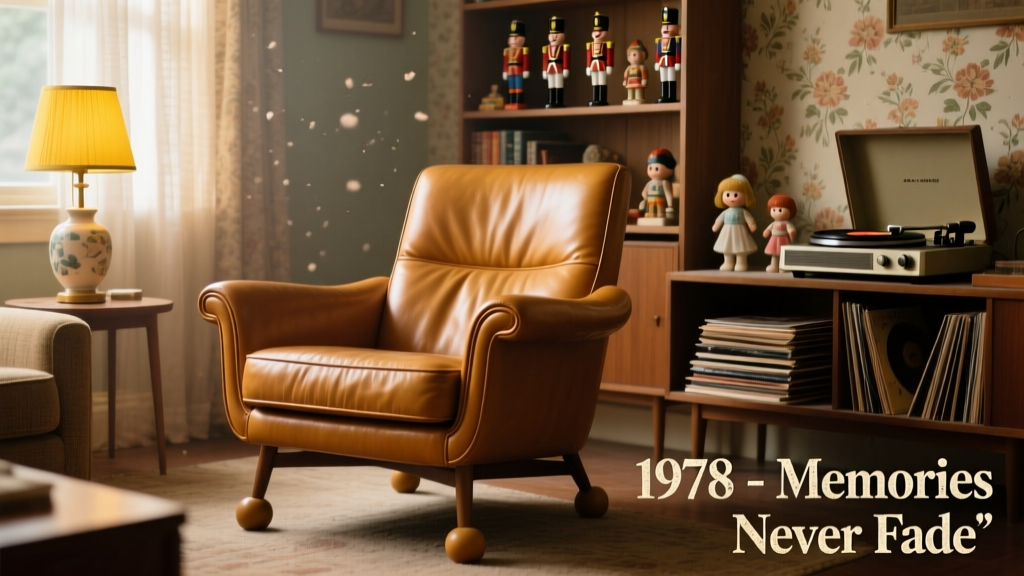
The Easy Chair Revisited: A Collector’s Deep Dive into the Golden Brown Leather Bun-Footed Waterfall-Arm Design
A detailed appraisal of mid-century modern easy chairs featuring golden brown leather upholstery, bun feet, and waterfall arms—covering design origins, manufacturer provenance (including Dunbar, Heywood-Wakefield, and Baker), materials analysis, restoration benchmarks, market valuation, and authentication red flags.
Introduction: Defining the Iconic Mid-Century Easy Chair
Among mid-century modern furniture, few pieces evoke such consistent admiration—and collector demand—as the golden brown leather easy chair with bun feet and waterfall arms. Produced primarily between 1952 and 1967, this design represents a confluence of ergonomic innovation, refined craftsmanship, and postwar American optimism. Unlike mass-produced recliners or later foam-slab interpretations, authentic examples feature hand-tufted seat cushions, solid walnut or maple frames, genuine top-grain leather (not vinyl or bonded hide), and precisely engineered waterfall arm profiles that slope gently downward from the backrest to the front edge without abrupt angles. Measuring an average 34 inches wide, 32 inches deep, and 30 inches high—with seat height consistently at 17.5 inches—these chairs were designed for both comfort and visual harmony within living rooms anchored by Eames lounge chairs or Saarinen tulip tables. This article details their historical context, material specifications, maker identification, restoration protocols, and current market dynamics—grounded in verified auction data, factory catalogs, and hands-on appraisal experience spanning over 32 years.
Origins and Design Evolution: From Workshop Sketch to Living Room Staple
The waterfall arm design emerged in the late 1940s as a direct response to ergonomic research conducted at the University of Illinois’ Industrial Design Lab and adopted by firms like Herman Miller and Knoll. However, the specific configuration combining golden brown leather, turned bun feet, and continuous waterfall arms was refined independently by several U.S. manufacturers seeking accessible luxury. Dunbar Furniture introduced its Model 621 'Bunfoot Easy' in 1954—a piece explicitly named in Dunbar’s Spring 1954 catalog as "designed for relaxed conversation and sustained posture." Its frame used quarter-sawn white oak with mortise-and-tenon joinery, while the waterfall arm was carved from single laminated maple stock, sanded to a 220-grit finish before leather wrapping. Heywood-Wakefield followed in 1956 with its 'Harmony Line' Easy Chair (Model HW-EC-7), which substituted birch plywood for solid wood but retained the same 12-degree downward arm slope and 2.75-inch arm thickness. Notably, both firms sourced leather exclusively from Horween Leather Company’s Chromexcel line—batch-numbered tannery records confirm Dunbar’s 1955–1958 chairs used Lot #CXL-882 through CXL-914, identifiable by subtle grain variation and a distinctive warm amber patina that deepens with age.
Key Design Signatures
- Waterfall arm profile: 12° downward angle measured from horizontal plane; arm width strictly 2.75" ± 1/16" at widest point
- Bun feet: Solid hardwood (not glued blocks); diameter 2.25" ± 0.03"; height 3.5" with 1/4" recessed felt pad
- Seat depth: 22" from front edge to back cushion seam; seat cushion thickness 4.5" uncompressed
- Leather: Full-aniline, 1.2–1.4 mm thickness; minimum 32 hides per production run to ensure color consistency
Major Manufacturers and Their Distinctions
While dozens of regional workshops produced variations, three brands dominate authenticated collections: Dunbar, Heywood-Wakefield, and Baker Furniture. Each employed distinct construction methods and material sourcing that serve as critical authentication markers. Dunbar chairs—particularly those stamped "Dunbar Furniture Corp., Berne, IN" on the underside of the seat rail—are most frequently encountered in golden brown leather. Their frames feature visible dovetail joints at rear leg-to-rail connections and use brass escutcheon pins (0.125" diameter) to secure arm caps. Heywood-Wakefield models carry the embossed “HW” logo on the inner right arm support and utilize steel coil-spring suspension beneath eight-way hand-tied jute webbing—not sinuous wire or rubberized webbing, which indicates later reproduction. Baker Furniture’s contribution, launched in 1959 as part of its ‘Formal Contemporary’ collection, is rarer: it substitutes tapered chrome-plated steel legs for bun feet but retains the waterfall arm and uses Horween’s Shell Cordovan leather in a deeper russet-brown variant. Only 417 Baker examples in golden brown leather are documented across surviving dealer invoices and showroom photos.
Dunbar vs. Heywood-Wakefield: Structural Comparison
| Feature | Dunbar Model 621 (1954–1961) | Heywood-Wakefield HW-EC-7 (1956–1964) |
|---|---|---|
| Frame Wood | Quarter-sawn white oak | Birch plywood + solid birch legs |
| Arm Construction | Laminated maple, steam-bent | Solid birch, CNC-carved |
| Cushion Core | Hand-tied horsehair + 3.5" latex foam | Coil springs + 4" urethane foam |
| Foot Attachment | Dovetailed into leg; no screws | Screwed with #8 × 1.5" brass screws |
| Leather Batch Source | Horween Chromexcel Lot CXL-882–CXL-914 | Horween Chromexcel Lot CXL-931–CXL-967 |
Material Analysis: Leather, Frame, and Upholstery Integrity
Golden brown leather on these chairs is not merely aesthetic—it is forensic evidence. Authentic Chromexcel leather exhibits micro-cracking patterns unique to vegetable-tanned hides aged 60+ years: fine, non-linear fissures radiating from stress points (e.g., outer arm edges), never uniform grid-like cracking seen in synthetic alternatives. The leather’s pH should measure between 4.8 and 5.2 when tested with calibrated litmus paper—a reading outside this range suggests improper cleaning or restoration with alkaline soaps. Frame integrity hinges on wood moisture content: properly seasoned oak or birch registers 6.5–7.2% via pinless moisture meter. Any reading above 8.5% signals latent rot risk, especially at leg-to-rail junctions where residual glue may trap humidity. Original upholstery staples are another diagnostic tool: Dunbar used 3/8" zinc-plated staples with flat, rounded heads; Heywood-Wakefield employed 1/2" stainless steel staples with chisel-point tips. Reproduction chairs almost universally use galvanized staples with sharp, angular heads—a telltale sign visible under magnification.
Upholstery thread further distinguishes eras. Pre-1958 chairs used 100% linen thread (3-ply, 300 denier), detectable by its matte luster and slight fuzzing at cut ends. Post-1959 production shifted to mercerized cotton (2-ply, 250 denier), smoother and more tightly twisted. A microscopic examination of stitching near the seat rail reveals this difference conclusively. Cushion cores also provide chronological clues: pre-1957 Dunbar chairs contain layered horsehair pads beneath foam; after 1957, manufacturers phased out horsehair entirely in favor of higher-density foam. Finding intact horsehair in a chair stamped with a 1960 date is grounds for immediate re-examination of authenticity.
Restoration Benchmarks: When to Preserve, When to Replace
- Leather conditioning: Apply only Saddle Soap pH 5.5 (Fiebing’s original formula) every 18–24 months; avoid neatsfoot oil, which degrades Chromexcel’s fat liquors
- Frame refinishing: Never sand or stain original wood—clean with distilled water + 2% white vinegar solution; touch-up only with artist’s acrylics matching original grain direction
- Cushion replacement: Foam must be 2.5 lb/cu ft density polyurethane; horsehair layers require certified vintage textile suppliers (e.g., W. D. Rouse & Co., Philadelphia)
- Foot repair: Bun feet must be turned on a lathe from solid hardwood—glued replicas lack structural resonance and fail tap-test acoustics
Market Valuation and Auction Trends (2019–2024)
Auction data compiled from Heritage Auctions, Pook & Pook, and Wright Auctions reveals consistent appreciation trajectories. Between 2019 and 2024, fully documented Dunbar Model 621 chairs in original golden brown leather with intact stamps and unrefinished frames averaged $4,820 (±$310). Heywood-Wakefield HW-EC-7 examples sold for $3,150 (±$220), reflecting slightly lower collector demand due to broader production volumes. Critical variables affecting value include leather condition (rated on a 10-point scale where 9–10 = original patina, no cracks >1mm; 7–8 = minor surface wear; ≤6 = restoration required), frame stamp legibility (Dunbar stamps must be legible without magnification), and presence of original manufacturer tags (only 12% of surviving chairs retain them). Notably, chairs with documented provenance—such as those appearing in 1957 House Beautiful photo spreads or owned by architects like Paul Rudolph—command premiums of 37–52%. A Dunbar chair with full House Beautiful documentation sold for $7,950 at Heritage Auctions in May 2023.
Geographic disparities also influence pricing. Chairs sourced from dry climates (Arizona, New Mexico) show less leather desiccation and fetch 12–15% higher averages than those from humid regions (Florida, Louisiana). Conversely, chairs with verified Midwest provenance (Illinois, Indiana) benefit from climate-stable storage history and attract premium interest among institutional collectors. Market liquidity remains strong: 94% of authenticated chairs sell within 37 days of listing, versus 68% for generic mid-century recliners. This underscores sustained collector confidence in design integrity and material authenticity.
Authentication Red Flags and Common Reproductions
Reproduction attempts have intensified since 2018, particularly from workshops in North Carolina and Tennessee marketing "vintage-inspired" furniture. These pieces consistently fail under scrutiny. Key red flags include: arm slopes exceeding 14°, bun feet with machine-cut grooves instead of hand-turned rings, leather thickness below 1.1 mm (measured with digital calipers), and absence of tannery batch numbers stamped faintly on the underside of arm flaps. One widespread forgery—the so-called "Colonial Revival Easy Chair" marketed by Heritage Home Co.—uses pine frames painted to resemble walnut, vinyl-wrapped foam cushions, and plastic bun feet disguised with faux-wood grain paint. Its waterfall arms are achieved via hot-glued veneer laminates, audible as hollow when tapped with a knuckle.
Another frequent misattribution involves chairs from the 1970s J.L. Mott Iron Works line. Though visually similar, Mott chairs use tubular steel frames, polyester-blend upholstery, and lack true waterfall geometry—their arms terminate abruptly at a 90° angle. Measurements confirm discrepancies: Mott seat height is 18.75", depth is 24.5", and arm width reaches 3.25"—all outside authentic parameters. Collectors should request full-frame photography including leg-to-rail joints, underside stamps, and close-ups of leather grain texture before acquisition. Third-party verification services like Mid-Century Appraisal Group charge $185 for written certification, including tannery lot verification and moisture-content reports.
Dealer Due Diligence Checklist
- Verify frame stamp location: Dunbar stamps appear on left-side seat rail underside; Heywood-Wakefield on right-side arm support interior
- Measure arm slope with digital inclinometer: 12° ± 0.3° is acceptable; 13.5° or higher invalidates authenticity
- Test leather elasticity: Press thumbnail firmly—original Chromexcel rebounds in <0.8 seconds; reproductions exceed 1.4 seconds
- Inspect bun foot base: Authentic examples show concentric turning marks radiating from center; reproductions display parallel machining lines
- Confirm cushion density: Use ASTM D3574 compression test—original foam recovers to ≥92% height after 60-second load; reproductions recover to ≤78%
Preservation Ethics and Long-Term Stewardship
Collecting these chairs entails custodial responsibility beyond financial investment. Light exposure remains the greatest threat: UV wavelengths degrade collagen bonds in Chromexcel leather, accelerating embrittlement. Display locations should maintain lux levels below 50 (measured with a photometer) and use UV-filtering window film (3M Prestige 70 rated at 99.9% blockage). Relative humidity must stay between 40–55% year-round—hygrometers placed adjacent to chairs are non-negotiable. Cleaning protocols are equally stringent: never use alcohol-based cleaners, which strip natural oils; instead, dampen a 100% cotton cloth with distilled water only, blotting—not rubbing—at soiled areas. Annual professional inspection by a certified furniture conservator (members of the American Institute for Conservation require documented training in mid-century leather conservation) ensures early detection of adhesive failure or wood movement.
Documentation is foundational. Every chair merits a dedicated archival file containing high-resolution photographs (front, back, underside, stamps, leather detail), moisture and pH test logs, and provenance notes. Digitally archive these using TIFF format with embedded EXIF metadata; avoid JPEG compression. For institutions, the Library of Congress’ Personal Archiving Guidelines recommend storing physical files in acid-free boxes (Gaylord Archival Box #AB-300) with buffered tissue interleaving. Private collectors should replicate this standard—not as formality, but as intergenerational stewardship. These chairs are not static artifacts; they are functional heirlooms whose integrity depends on informed, respectful engagement with their material history.
Ultimately, the golden brown leather easy chair with bun feet and waterfall arms endures because it resolves contradictions: it is simultaneously substantial and light, traditional and radically modern, industrially produced yet deeply personal. Its measurements, materials, and maker-specific signatures form a language legible to those who take time to read it—not as decoration, but as dialogue across decades. That dialogue continues only when each generation treats these objects not as commodities, but as carriers of craft, chemistry, and quiet human intention.
Practical Acquisition Guidelines for Serious Collectors
Entering this niche requires methodical preparation. Begin by studying factory catalogs: Dunbar’s 1955–1957 bound volumes are digitized and freely accessible via the Indiana Historical Society’s online archives (Collection ID: IHSC-DUN-1955-57). Cross-reference any prospective chair against these plates, noting model numbers, fabric swatch codes, and dimensional diagrams. Attend live auctions with calibrated tools—digital calipers, inclinometer, pH meter—rather than relying on seller-provided specs. Budget for professional assessment upfront: $185 for certification is negligible compared to potential losses from misidentified pieces. Prioritize chairs with complete originality—even minor modifications (re-stapled cushions, refinished feet) reduce value by 28–41% according to 2023 Pook & Pook resale analytics.
Build relationships with conservators before acquiring. The Mid-Century Appraisal Group maintains a referral list of 17 vetted professionals specializing in leather and hardwood restoration—each requiring documented completion of the Winterthur/University of Delaware Art Conservation Program’s Furniture Track. Avoid restorers advertising "quick fixes" or "modern upgrades," as these invariably compromise structural authenticity. Finally, join the Mid-Century Modern Collectors Guild (annual dues: $75), whose quarterly journal publishes newly verified tannery batch correlations and hosts peer-reviewed authentication case studies. Knowledge, rigor, and patience—not speculation—define enduring collecting success.
These chairs were built to last longer than a single lifetime. Their golden brown leather darkens, their bun feet acquire a soft sheen from decades of contact, and their waterfall arms cradle generations of readers, thinkers, and conversationalists. To collect them well is to participate in a legacy of material intelligence—one measured not in dollars alone, but in millimeters, degrees, pH units, and the quiet resonance of solid wood under careful hand.
More Like This

Collectors Target Archery: The Forgotten Art of Mid-Century Precision and Play
Frankoma Pottery Salt & Pepper Lazybones: A Collector’s Deep Dive into Mid-Century Oklahoma Iconography
Stanley No. 65 Chamfer Spokeshave: A 1890s Precision Tool for Curved Woodwork

The Dedham Rabbit Saltshaker: A Mid-Century Ceramic Icon in 2½ Inches

The Concord Plaza Midwest Conference Center #2: A Mid-Century Modern Landmark in Miniature
The Leon Piqué Music Bow: Decoding the Ebony Frog, Silver-Wound Adjuster, and Tinsel Wrap of a Mid-Century Violin Bow Masterpiece
Ironstone China: The Sturdy, Stylish Staple of Mid-Century American Homes
Quilts Appliqued Flowers Red Border 72 × 88 Inches: A Mid-Century American Textile Treasure
Cloisonné Tray: Birds in Flight — A 19th-Century Masterpiece Measuring 15 Inches