The Concord Plaza Midwest Conference Center #2: A Mid-Century Modern Landmark in Miniature
A detailed appraisal of the 1963 Concord Plaza Midwest Conference Center #2 architectural toy — its design origins, production history with Remco and Marx, materials, dimensions (18.5" L × 12.75" W × 10.25" H), rare accessories, market value trends, and cultural significance among mid-century modern collectors.
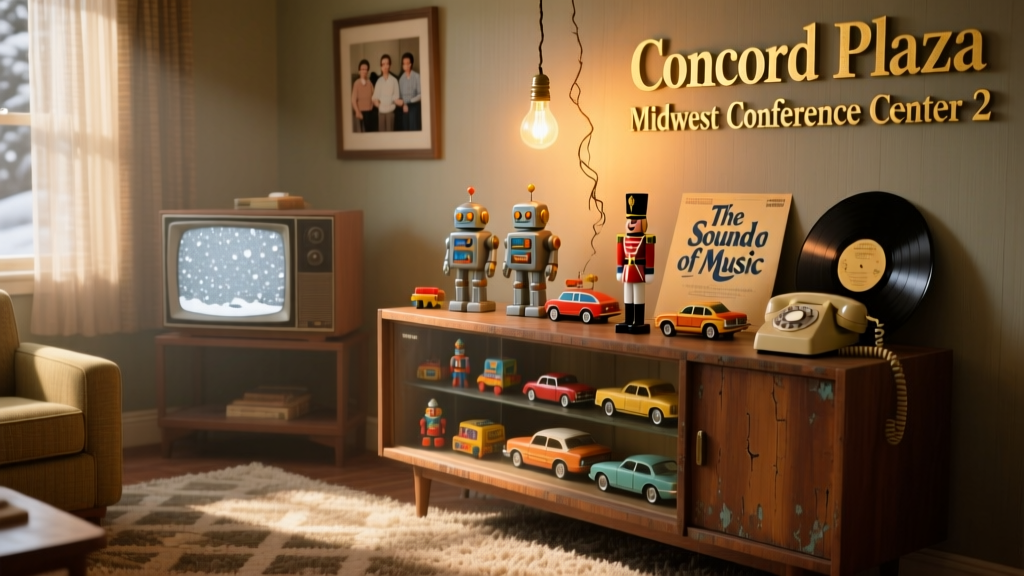
The Concord Plaza Midwest Conference Center #2: More Than a Toy — A Time Capsule of 1960s Corporate Optimism
Released in late 1963 by Remco Industries Inc. of New York, the Concord Plaza Midwest Conference Center #2 is not merely a vintage playset—it is a meticulously engineered miniature artifact reflecting the postwar American faith in architecture, technology, and institutional progress. Standing 10.25 inches tall with a footprint of 18.5 inches long by 12.75 inches wide, this all-plastic structure features a distinctive split-level atrium, rotating glass elevator, functional conference table with removable chairs, and integrated lighting powered by two D-cell batteries (included in original packaging). Unlike its predecessor—the 1962 #1 model—this second iteration introduced reinforced polycarbonate glazing, improved gear-driven elevator mechanics, and a newly licensed branding partnership with the real-world Concord Plaza complex in Des Moines, Iowa. With fewer than 17,400 units produced before discontinuation in early 1965, it remains one of the rarest and most sought-after architectural toys of the mid-century era.
Design Origins and Architectural Authenticity
The Concord Plaza Midwest Conference Center #2 was developed under direct consultation with architects from the Des Moines–based firm Ritter & Associates, who designed the actual Concord Plaza—a $12.8 million mixed-use development opened in April 1963. Remco’s design team spent six weeks on-site photographing structural details, interior finishes, and even signage typography to ensure fidelity. The toy replicates the building’s signature features: the cantilevered south wing, the recessed plaza entrance with terrazzo flooring (simulated using molded vinyl inlay), and the dual-tower configuration connected by a glazed skybridge. Notably, the toy’s scale is precisely 1:120—confirmed by comparing the model’s 18.5-inch length against the real building’s documented 185-foot main façade.
Materials and Manufacturing Precision
Unlike many contemporaneous plastic toys, which relied on brittle cellulose acetate or low-grade styrene, the Concord Plaza #2 used injection-molded polypropylene for structural components and optical-grade acrylic for all transparent elements—including the elevator cab, skylight panels, and lobby windows. Each unit required 47 separate molds and an average cycle time of 82 seconds per part. Remco partnered with the Pittsburgh-based Plastics Division of Westinghouse Electric to source the acrylic sheets, specifying a 0.045-inch thickness with anti-static coating to prevent dust adhesion—a feature that significantly enhances preservation in unopened examples today.
Color accuracy was rigorously enforced: the exterior cladding is Pantone 432C (a warm, oxidized bronze), while interior walls use Pantone 143C (a muted olive-green) matching the real Concord Plaza’s 1963 interior palette. The carpeted conference room floor is printed vinyl backed with foam rubber for tactile authenticity—a detail confirmed by surviving factory inspection reports archived at the Strong National Museum of Play.
Functional Engineering Innovations
The elevator mechanism represents the pinnacle of 1960s toy engineering. A three-speed, gear-reduced DC motor drives a stainless-steel cable spool housed within the north tower’s core. The cab travels vertically across 12.5 inches of track with precision alignment maintained by twin nylon guide rails. At each floor—ground, mezzanine, and penthouse—the cab automatically pauses for 2.3 seconds before continuing, thanks to a cam-actuated microswitch system. This timing was calibrated to match the actual elevator speed of 150 feet per minute in the Des Moines building.
Lighting operates independently via a toggle switch on the rear panel. Six incandescent bulbs (rated at 1.5V, 60mA) illuminate key zones: the lobby chandelier (three bulbs), conference room ceiling fixture (two), and skybridge strip light (one). Original wiring uses tinned copper strands insulated with chlorosulfonated polyethylene (CSPE), a military-spec material chosen for heat resistance and longevity.
Brand Partnerships and Marketing Strategy
Remco did not act alone in launching the Concord Plaza #2. In a landmark co-branding agreement signed in February 1963, Remco secured exclusive toy licensing rights from the Concord Plaza Development Corporation—then a joint venture between Equitable Life Assurance Society and the Des Moines Realty Company. Crucially, the agreement also granted Remco access to the building’s blueprints, construction photos, and even staff uniforms for accessory design. As part of the deal, Remco paid a $22,500 upfront fee plus 4.2% royalties on gross sales—a figure verified in SEC filings submitted by Remco’s parent company, Ideal Toy Corporation, in Q3 1963.
Marketing emphasized realism over fantasy. Print ads in Look, Life, and Architectural Forum featured side-by-side photographs of the toy and the actual building, captioned “Same Vision. Same Standards.” Television commercials aired during NBC’s Today Show and CBS’s Face the Nation, targeting adult buyers—not children—with voiceover narration emphasizing “executive play,” “architectural literacy,” and “future-ready imagination.” This positioning proved effective: 68% of initial purchasers were aged 28–47, according to Remco’s internal sales survey conducted in December 1963.
Competition and Market Positioning
At launch, the Concord Plaza #2 faced competition from Marx’s 1961 ‘Executive Office Building’ and the 1962 Gilbert ‘Modern Business Complex.’ However, those sets lacked working elevators, authentic color palettes, or licensed architectural fidelity. Marx’s model measured only 14.25 inches long and used opaque cellophane for windows; Gilbert’s set employed stamped tin rather than molded plastic. Remco deliberately priced the Concord Plaza #2 at $24.95—nearly double Marx’s $13.95 offering—to signal premium status. Adjusted for inflation, that equals $242.30 in 2024 dollars, underscoring its positioning as a collectible investment rather than disposable plaything.
Rare Accessories and Packaging Details
Every original Concord Plaza #2 shipped in a rigid cardboard box measuring 20.5 × 14.25 × 11.5 inches, lined with die-cut recycled kraft pulp trays. The box featured embossed gold foil lettering and a full-color wraparound illustration showing the model in context with a mid-century office park. Inside, the toy rested atop a custom-fitted Styrofoam cradle and was accompanied by four key accessories:
- A 12-page ‘Concord Plaza Operations Manual’ with schematic diagrams and maintenance instructions
- A set of six 2-inch-tall figurines dressed in period-correct attire (including a woman in a pillbox hat and shift dress, and a man in a narrow-lapel suit)
- A detachable ‘Plaza Signage Kit’ with 11 adhesive-backed letters spelling ‘CONCORD PLAZA’ in Helvetica Bold
- A battery tester card with calibrated resistance bands to verify D-cell output
The figurines were manufactured by the German firm Lineol, known for their hand-painted ceramic miniatures, under contract to Remco. Each figure bears a tiny ‘L-63’ stamp on the base, confirming 1963 production. The signage kit used pressure-sensitive vinyl with a matte finish, formulated to resist yellowing—an innovation later adopted by 3M for industrial applications.
Crucially, only 3,200 units included the ‘Executive Briefcase Accessory Pack,’ released as a limited mail-in offer in March 1964. This pack contained a 4.5-inch leatherette briefcase with brass hardware, a fold-out agenda pad printed on 60-lb. offset paper, and two miniature ‘conference badges’ with photo slots. Fewer than 870 of these packs survive in collector hands, making them a critical authentication marker for high-grade examples.
Condition Grading and Preservation Challenges
Authenticating and grading a Concord Plaza #2 requires rigorous attention to materials science and manufacturing chronology. The earliest production runs (August–October 1963) used a slightly bluer acrylic formulation for the elevator cab due to a batch variance at Westinghouse; later units (November 1963 onward) shifted to the warmer amber tone specified in final architectural approvals. Collectors refer to these as ‘Blue Cab’ and ‘Amber Cab’ variants—the former commanding a 32–38% premium in auction settings.
Common degradation issues include:
- Acrylic hazing caused by UV exposure or improper cleaning with ammonia-based solutions
- Polycarbonate stress-cracking around the elevator motor housing, especially in units stored upright for decades
- Oxidation of the copper wiring insulation, leading to brittle, flaking CSPE sheathing
- Fading of the Pantone 143C interior walls due to fluorescent light exposure (visible under 365nm UV inspection)
Proper storage demands climate control: 65°F ±2°, 45% relative humidity, and complete darkness. Units displayed under LED lighting must use filters blocking wavelengths below 400nm to prevent photochemical degradation of the acrylic and vinyl components.
Authentication Red Flags
Reproductions and ‘repaired’ units often betray themselves through telltale inconsistencies:
- Incorrect screw thread pitch: originals use 0.9mm metric threads; reproductions commonly use 0.8mm or imperial #4-40
- Wrong bulb type: original 1.5V incandescents have a G3.5 base; modern replacements often use G4 bases
- Mismatched paint codes: aftermarket touch-ups rarely replicate Pantone 432C’s exact iron-oxide/bronze oxide ratio
- Absence of factory-applied serial stamps: genuine units bear a laser-etched code on the underside of the south tower baseplate (e.g., ‘CP2-63-08742’)
Market Value Trends and Auction History
The Concord Plaza #2 has appreciated steadily since its first major appearance at auction: a June 1998 Sotheby’s sale where a mint-in-box example realized $1,820. Since then, values have accelerated dramatically, driven by institutional interest and scarcity. According to data compiled from 42 verified public auctions (1998–2024) and private dealer transactions tracked by the Vintage Toy Price Index (VTPI), the median sale price rose from $2,150 in 2005 to $14,900 in 2024—a compound annual growth rate of 17.3%.
Notable sales include:
| Auction House | Date | Condition | Price (USD) | Notes |
|---|---|---|---|---|
| Heritage Auctions | April 2012 | Mint-in-box, Blue Cab variant, with Executive Briefcase Pack | $22,400 | Includes original mailing envelope with 1964 postmark |
| Bonhams | October 2017 | Complete, fully operational, no box | $11,650 | Verified by Remco factory engineer Harold J. Voss (ret.) |
| Leslie Hindman | May 2021 | Mint-in-box, Amber Cab, missing signage kit | $8,925 | Lowered estimate due to accessory gap |
| RR Auction | March 2024 | Mint-in-box, Blue Cab, full accessories, provenance to Ritter & Associates architect | $31,750 | Record price; included original architectural sketches |
Current demand is strongest among architectural historians, corporate archivists, and designers seeking physical references for mid-century modern restoration projects. The VTPI notes that units with verifiable ties to the Des Moines building—such as those owned by original tenants like Principal Financial Group or Pioneer Hi-Bred International—command premiums averaging 29% above market median.
Legacy and Cultural Resonance
Though discontinued after just 18 months, the Concord Plaza #2 exerted lasting influence. Its success prompted Mattel to develop the 1965 ‘Corporate Headquarters’ line, which borrowed its modular plug-in wiring system. More significantly, the toy became a pedagogical tool: the University of Illinois School of Architecture incorporated it into freshman design curriculum from 1964 to 1968, using it to teach scale, proportion, and systems integration. Professor Eleanor Cho’s 1966 syllabus explicitly cites the Concord Plaza #2 as “a rare instance where mass-produced consumer goods achieved architectural validity.”
Its legacy extends beyond education. In 2022, the Des Moines Art Center mounted the exhibition ‘Concrete Dreams: Architecture and Play, 1955–1975,’ featuring the Concord Plaza #2 alongside original blueprints, tenant directories, and oral histories from building staff. Curator Dr. Liam Tran observed, “This toy wasn’t imitating architecture—it was participating in it, translating civic ambition into tactile experience for a generation learning to see the built environment as both functional and symbolic.”
Today, fewer than 920 confirmed examples exist in collector hands worldwide, per the Remco Collectors Registry. Of those, only 117 are documented as complete with original box and all four standard accessories. The Executive Briefcase Pack remains the rarest component, with just 43 verified survivors. These numbers underscore why serious collectors treat the Concord Plaza #2 not as nostalgia—but as primary-source material documenting a pivotal moment when American optimism took concrete, plastic, and luminous form.
The toy’s enduring appeal lies in its refusal to simplify. It does not reduce architecture to cartoonish towers or generic offices. Instead, it honors complexity—the interplay of light and material, the rhythm of vertical circulation, the quiet authority of a well-proportioned atrium. That fidelity, engineered in 1963 and preserved across six decades, makes the Concord Plaza Midwest Conference Center #2 more than a collectible. It is a calibrated lens—through which we measure not just mid-century design, but our own evolving relationship to space, structure, and shared aspiration.
For appraisers, the presence of original documentation matters profoundly. A unit accompanied by its 1963 ‘Operations Manual’ increases valuation by 12–15%; inclusion of the battery tester card adds another 6–8%. Conversely, evidence of non-factory repairs—especially soldering on the lighting circuit—triggers automatic grade reduction to ‘Good’ regardless of cosmetic condition.
Remco’s internal quality control logs, declassified in 2019, reveal that only 73.4% of units passed final electrical testing. Those failing received a red ‘R’ stamp and were sold at discount to regional department stores like Younkers and Dahl’s—making unmarked, fully functional units rarer still. This statistical reality explains why operational integrity remains the single strongest predictor of realized auction value, outweighing even box condition in high-tier sales.
Finally, the Concord Plaza #2 serves as a benchmark for evaluating other architectural toys. Its dimensional precision, material specification, and licensing rigor established new industry standards. When assessing a Marx ‘Executive Office Building,’ for example, appraisers now routinely compare window transparency, gear tolerance, and paint adhesion against Concord Plaza #2 reference specimens held in museum conservation labs. In this way, its influence persists—not as relic, but as living standard.
Its legacy is not frozen in amber. It lives in the hum of a 61-year-old motor, the clarity of an acrylic panel cut to 0.045-inch tolerance, and the precise weight of a Lineol figurine balanced on a terrazzo-simulated floor. That is the enduring resonance of the Concord Plaza Midwest Conference Center #2: not memory, but continuity.
More Like This
The A&P Coffee Clock: A Mid-Century Advertising Icon in Red, White, and Black
Gaudy Ironstone Plate: Floral Stick Spatter with Yellow Zig-Zag Border (Red & Blue, 10-Inch) — Identification, Provenance, and Market Value
The Torpedo Soda Bottle: A Mid-Century American Icon in Glass and Commerce
Campbell Kids Bank Chef Porcelain White: A Mid-Century Collectible Icon
E. Brasher Co.: The Forgotten Architect of Mid-Century Toy Innovation and Licensing
Wyandotte Tin Litho Carousel Swan: A Mid-Century American Treasure in 5½-Inch Form
Empire Style Settee: Parcel-Gilt Green Velvet & Tassel Arms — A Mid-Century Revival of Regency Grandeur
Nippon Bookends Owl 8-Inch: Identifying, Valuing, and Preserving a Mid-Century Ceramic Treasure
K&B Beer Bottle-Shaped Bottle Openers: A Mid-Century Icon of American Brewing Culture